Sandisk Corporation(SNDK)

Search documents
海力士+闪迪,存储芯片巨头力推 HBF 标准化
3 6 Ke· 2026-02-27 02:56
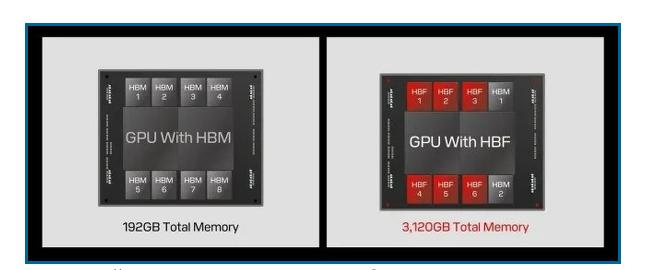
Core Viewpoint - The emergence of High Bandwidth Flash (HBF) technology is accelerating commercialization, aiming to fill the storage gap in AI inference, while existing technologies like HBM continue to evolve [1][2]. Group 1: HBF Technology Overview - HBF is not a new concept but is derived from the transition in the AI industry from training to large-scale inference, addressing the storage bottleneck in current architectures [2]. - HBF aims to provide a solution that combines high bandwidth, large capacity, and cost-effectiveness, bridging the gap between HBM's limited capacity and SSD's slower read/write speeds [2][3]. - HBF utilizes a restructured architecture and packaging optimization, incorporating 3D stacking technology from HBM and replacing storage media with NAND flash, achieving high-speed data transfer while retaining NAND's advantages [3]. Group 2: HBF and HBM Collaboration - HBF is designed to complement HBM rather than replace it, with HBM handling latency-sensitive tasks and HBF focusing on large-capacity sequential reads [4]. - The "H3 hybrid architecture" by SK Hynix demonstrates the synergy between HBM and HBF, showing significant performance improvements in various scenarios [4]. Group 3: Industry Response and Future Outlook - Major storage companies, including SK Hynix and SanDisk, are actively investing in HBF, with SanDisk being the pioneer in its commercialization [6]. - The establishment of a dedicated working group under the Open Compute Project (OCP) will facilitate the standardization of HBF technology, paving the way for its widespread adoption [6]. - HBF products are expected to be showcased by late 2026, with market demand projected to grow rapidly by 2030, driven by the expansion of AI inference applications [6]. Group 4: Challenges Ahead - Despite its promising outlook, HBF still faces inherent limitations related to NAND flash's slower write speeds, which could impact user experience in dynamic caching scenarios [7]. - Industry collaboration is necessary to address compatibility with existing GPU architectures, packaging complexity, and thermal management issues [7].

Is Sandisk Stock Still a Buy After its 1,750% Surge?
Yahoo Finance· 2026-02-26 21:50
Core Insights - The semiconductor industry is experiencing a renaissance driven by surging demand for artificial intelligence (AI) chips, with companies like Nvidia, Broadcom, and Taiwan Semiconductor Manufacturing seeing significant stock price increases, joining the trillion-dollar club [1] - AI hyperscalers such as Microsoft, Alphabet, Amazon, Meta Platforms, and OpenAI are increasing their infrastructure investments, leading to a rising demand for high-bandwidth memory (HBM) solutions beyond just GPUs [2] Group 1: Company Performance - Sandisk, spun off from Western Digital, has seen its shares increase by 1,750% since the spin-off, raising questions about whether it remains a viable investment opportunity [3] - The stock price surge of Sandisk is attributed to the company's ability to leverage its memory solutions from consumer electronics to meet enterprise workload demands [7] Group 2: Market Dynamics - The AI revolution is characterized by breakthroughs in generative AI, with large language models (LLMs) becoming integral to enterprise workflows, indicating a broader application of AI beyond productivity enhancements [4][5] - As AI workloads scale rapidly, hyperscalers are now focusing on complementing their GPU clusters with HBM chips, indicating a shift in AI budget allocations [6]
存储“超级牛市”仍未结束?闪迪被香橼做空后重回前高、韩国存储双雄股价创历史新高
Jing Ji Guan Cha Wang· 2026-02-26 10:50
Core Viewpoint - Citron Research has initiated a short position on SanDisk, arguing that the current supply tightness in the storage chip industry is temporary and that once major manufacturers restore yields and release capacity, the supply-demand dynamics could reverse dramatically [1][2]. Group 1: Citron Research's Short Report - The report claims that SanDisk's current valuation is significantly overestimated and that the market fundamentally misjudges its growth potential [1]. - Citron compares SanDisk to "NVIDIA-like" growth stocks, emphasizing that its products are essentially highly commoditized rather than possessing a long-term competitive moat [1]. - The report highlights the cyclical nature of the storage industry, stating that NAND flash memory, SanDisk's main product, is a commodity whose price and profitability are primarily driven by supply-demand cycles rather than structural innovation [1][2]. Group 2: Historical Context and Market Dynamics - Citron cites historical examples where high margins, currently around 50%, are typical characteristics of market peaks rather than sustainable states, with past instances showing price drops of approximately 50% and 70% following periods of high demand [2]. - The report emphasizes that unlike NVIDIA's GPU ecosystem, NAND flash products are highly interchangeable, with competition primarily based on cost and scale rather than technological barriers [2]. - Citron notes that SanDisk's former parent company, Western Digital, recently sold a significant portion of its SanDisk shares at a price about 25% lower than the current market price, indicating an internal judgment of a market peak [2]. Group 3: Market Reaction and Stock Performance - Following the release of Citron's report, SanDisk's stock price fell from $666.49 to a low of $612.92, reflecting an 8% drop, before closing at $638.52, down 4.20% [3]. - The trading volume surged to over 30.4 million shares, indicating a rapid shift in market sentiment [3]. - However, just two trading days later, SanDisk's stock price rebounded to around $665, nearly returning to pre-report levels [3]. Group 4: Broader Industry Trends - Concurrently, South Korean storage giants Samsung and SK Hynix reached historical highs in their stock prices, with Samsung's market capitalization surpassing $1 trillion [4]. - Citigroup has raised its 2026 price forecasts for DRAM and NAND, indicating a "runaway increase" in the market, with demand driven by AI infrastructure investments outpacing supply [4]. - For Chinese investors, the China-Korea semiconductor ETF has emerged as a key investment vehicle, reflecting strong performance with a closing increase of 9.64% [4].
美股异动丨闪迪盘前涨超5%,携手SK海力士启动下一代存储器“HBF”全球标准化进程
Ge Long Hui· 2026-02-26 09:22
Core Viewpoint - SanDisk (SNDK.US) shares rose over 5% to $665 following the announcement of a global standardization strategy for the next-generation storage solution HBF, aimed at meeting the demands of AI inference scenarios [1] Group 1: Company Developments - SK Hynix and SanDisk jointly held the "HBF Specification Standardization Alliance Launch Meeting" on the 25th, marking a significant step in the development of HBF technology [1] - HBF is positioned as a new storage tier that bridges the gap between high bandwidth memory (HBM) and solid-state drives, addressing the dual needs for capacity scalability and energy efficiency in AI applications [1] Group 2: Market Outlook - The industry anticipates that the integrated memory solutions featuring HBF as a key component will see a significant market demand expansion around 2030 [1]
SK海力士联手闪迪,启动HBF标准化,容量碾压HBM 10倍!
Hua Er Jie Jian Wen· 2026-02-26 07:41
Core Insights - SK Hynix and SanDisk are collaborating to advance the global standardization of High Bandwidth Flash (HBF), positioned as a key solution to bridge the gap between HBM and SSD in the AI inference era [1] - The establishment of a dedicated working group under the Open Compute Project (OCP) framework marks a significant step in the competitive landscape of next-generation storage architecture [1][3] Group 1: HBF Technology Overview - HBF is designed to fill the storage hierarchy gap between ultra-fast HBM and high-capacity SSD, addressing the structural contradictions in existing storage architectures for AI services [2] - HBF offers approximately 10 times the storage capacity of HBM while maintaining high bandwidth, making it suitable for AI inference workloads [2] - The technology is expected to enhance the scalability of AI systems and potentially lower total cost of ownership (TCO) [2] Group 2: Industry Collaboration and Standardization - The collaboration between SK Hynix and SanDisk is based on their expertise in HBM and NAND design, packaging, and mass production [3] - The OCP serves as a widely recognized platform for advancing HBF standardization, transitioning from bilateral agreements to broader industry collaboration [3] - The goal is to launch HBF products by 2027, with the potential for HBF to become an industry standard that supports the growth of the AI ecosystem [3] Group 3: Market Outlook - Demand for HBF solutions is expected to accelerate around 2030, with long-term market potential projected to surpass that of HBM by approximately 2038 [4][5] - The commercialization cycle for HBF is anticipated to be shorter than that of HBM, driven by the growing AI workload and the shift from training to inference phases [4] - Companies that can provide both HBM and HBF solutions are likely to gain strategic advantages in the emerging market expected to see significant demand growth [5]
Sandisk Corporation (SNDK) Presents at Bernstein Insights: What's next in tech? - 4th Annual Tech, Media, Telecom Forum Transcript
Seeking Alpha· 2026-02-26 03:07
Group 1 - The article does not provide any relevant content regarding company or industry insights [1]

Better Artificial Intelligence (AI) Stock: Micron Technology vs. Sandisk
The Motley Fool· 2026-02-26 00:33
Core Insights - Both Micron Technology and Sandisk are experiencing significant stock gains due to booming memory demand from AI applications, particularly in data centers, with Micron up 46% and Sandisk up 169% in 2026 [1][2] Micron Technology - Micron specializes in dynamic random-access memory (DRAM) and NAND flash memory chips, with 80% of its revenue derived from DRAM sales [5][8] - The demand for high-bandwidth memory (HBM) is increasing due to AI workloads, leading to a projected 58% revenue increase in the HBM industry to nearly $55 billion in 2026 [9] - Analysts estimate a 51% revenue increase for the DRAM industry this year, driven by a 33% rise in average selling prices, benefiting Micron significantly [10] - Consensus estimates predict a 309% increase in Micron's earnings to $33.92 per share in the current fiscal year, with strong growth expected to continue through 2028 due to ongoing memory shortages [12] Sandisk - Sandisk focuses on NAND flash storage products, including solid-state drives (SSDs), and is also benefiting from AI-driven demand, particularly for SSDs in data centers [13][14] - The AI-fueled storage market is projected to grow from $34 billion in 2024 to nearly $283 billion by 2033, indicating sustainable momentum for Sandisk [15] - Sandisk's earnings are expected to grow more than 13 times in the current fiscal year, with significant price increases for its 3D NAND flash memory anticipated [17] - Sandisk's stock performance has outpaced Micron's, reflecting its strong earnings growth potential [18] Comparative Analysis - Both companies are leveraging similar growth drivers in the memory market, with strong revenue and earnings growth expected [19] - Valuations for both companies are attractive, making either a viable choice for investors looking to capitalize on AI data center investments [21]

Sandisk (NasdaqGS:SNDK) FY Conference Transcript
2026-02-26 00:32
Summary of Sandisk Conference Call Company Overview - **Company**: Sandisk - **Key Executives**: David Goeckeler (CEO), Luis Visoso (CFO) - **Industry**: NAND Flash Memory Core Industry Insights - **NAND Market Dynamics**: The NAND market is undergoing fundamental structural changes, with data centers projected to become the largest market segment by 2026, shifting from a predominantly device market to a data center-focused market [31][35] - **Demand Growth**: Demand forecasts for data centers have increased significantly, with expectations of mid to high 60% growth by 2026, compared to previous forecasts of mid-20s to mid-40s [33][35] - **Pricing Environment**: Current pricing in NAND flash is volatile, with increases of 50% to 60% per quarter, prompting discussions on long-term agreements (LTAs) for supply assurance [28][30] Strategic Business Practices - **Long-Term Agreements (LTAs)**: The transition of LTAs from price negotiation tools to critical supply assurance mechanisms is emphasized, with a focus on aligning supply and demand more effectively [29][51] - **Investment Strategy**: Sandisk is committed to investing billions in the business and hundreds of millions in R&D to support growth, aiming for a sustainable and attractive financial model over time [56][95] - **Customer Collaboration**: The company is working closely with data center customers to understand their long-term demand forecasts, which helps in planning and investment decisions [45][61] Product Development and Technology - **Enterprise SSD Growth**: Sandisk has seen a 64% sequential growth in its data center business, with expectations for continued growth driven by a strong product portfolio [119][121] - **Stargate Product**: The introduction of the Stargate QLC ESSD, which is currently in qualification, is expected to unlock new market opportunities, although it is not anticipated to replace hard disk drives [122][138] - **High Bandwidth Flash (HBF)**: Progress on HBF technology is noted, with collaboration with SK Hynix to develop specifications and system integration, aimed at meeting the needs of AI applications [174][186] Competitive Landscape - **Chinese Competitors**: The competitive threat from Chinese companies like YMTC is acknowledged, with Sandisk factoring this into its market supply and demand equations [170][171] - **Market Positioning**: Sandisk maintains confidence in its market position and growth potential, emphasizing the importance of understanding long-term demand and aligning business practices accordingly [240][241] Future Outlook - **Consumer Franchise**: The consumer segment is highlighted as a strong area for growth, with plans to invest in brand development and technology [236][238] - **Sustainable Business Model**: The focus is on creating a sustainable business model that maximizes value over time, rather than maximizing short-term profits [56][240] - **AI Integration**: The integration of NAND technology into AI architectures is seen as a significant growth opportunity, with expectations that AI will drive demand for NAND storage solutions [159][213] Additional Considerations - **Market Volatility**: The need to dampen volatility in the NAND market is emphasized, with a goal to create a more predictable supply-demand balance [53][249] - **Long-Term Vision**: Sandisk aims to change the way the industry operates, focusing on long-term relationships and agreements that benefit all parties involved [251][252]
非沪籍购房政策再放宽,AMD获Meta五年芯片订单 | 财经日日评
吴晓波频道· 2026-02-26 00:29
Fiscal Revenue Growth Targets - The fiscal revenue growth targets for 31 provinces in 2026 are set between 0.5% and 10%, with an average growth target of 2.7%, remaining stable compared to 2025 [2][3] - Provinces like Guangdong, Jiangsu, and Zhejiang have set growth targets between 2% and 4%, while regions like Xinjiang and Tibet aim for 4.5% to 10% [2] - The eastern provinces face pressure due to high revenue bases and ongoing industrial adjustments, while western provinces benefit from rising prices in energy and mining sectors [3] Shanghai Real Estate Policy Changes - Shanghai has relaxed housing purchase restrictions for non-local residents, reducing the required social security or tax payment period from 3 years to 1 year [4] - The maximum public housing loan amount for first-time buyers has increased from 1.6 million to 2.4 million yuan, with potential increases for families with multiple children [4] - These measures aim to stabilize the housing market and provide more options for new residents and young people [4][5] Chinese Film Industry Performance - The 2026 Spring Festival box office reached 5.752 billion yuan, with a significant year-on-year decline of 39.5%, marking the lowest performance in eight years [6] - The average ticket price dropped by 5.9% to 47.8 yuan, with a notable decrease in attendance, particularly in lower-tier cities [6] - The film quality and content diversity are cited as reasons for the poor performance, with audiences losing interest in cinema [6][7] AMD and Meta Partnership - Meta has expanded its partnership with AMD, committing to purchase chips worth potentially over $60 billion over five years, starting in the second half of 2026 [8] - AMD will grant Meta stock warrants, allowing it to purchase up to 160 million shares at a nominal price, potentially making Meta a significant shareholder [8] - This partnership reflects a trend among tech giants to diversify their supplier base amid increasing AI infrastructure demands [8][9] AI Stock Analysis Tools - A trend of DIY AI stock analysis tools, such as OpenClaw, is gaining popularity among tech-savvy investors, allowing for automated market analysis and reporting [14] - Traditional brokerage firms have also launched various AI investment advisory tools, emphasizing compliance and data authority [14] - While AI can enhance efficiency in data processing, reliance solely on AI for stock trading is cautioned against due to the unpredictable nature of market movements [15] Market Performance Overview - The stock market experienced a strong opening with significant gains across major indices, driven by a surge in various sectors including real estate and semiconductors [16] - The market is shifting focus from growth stories to price increases as a driver of performance, indicating a structural change in investor sentiment [17]

Samsung Releases New Flagship Phones With Focus on Easy-to-Use AI
WSJ· 2026-02-25 18:05
Core Viewpoint - The Galaxy S26 phones, the flagship lineup of the company, are set to launch in the U.S. and other markets on March 11 [1] Group 1 - The Galaxy S26 phones represent the company's latest flagship offerings [1]