Tuniu(TOUR)

Search documents
SIRIUSXM AND KIDZ BOP COLLABORATE FOR "DADDY DANCE OFF" DURING THE KIDZ BOP LIVE CERTIFIED BOP TOUR
Prnewswire· 2025-06-05 11:00
Group 1: KIDZ BOP Tour Overview - KIDZ BOP is launching the KIDZ BOP LIVE Certified BOP Tour in 2025, featuring performances of popular songs like "espresso," "HOT TO GO!," and "Dance Monkey" [3] - The tour will include a "Daddy Dance Off" segment where dads from the audience compete in a dance battle, hosted by SiriusXM personalities [2][3] - The tour will kick off on Father's Day weekend and will visit 42 cities throughout the summer [1] Group 2: Collaborations and Sponsorships - SiriusXM personalities, including Andy Cohen and others, will host the "Daddy Dance Off" and create custom content for the tour [2] - Spin Master’s Unicorn Academy™ will sponsor the KIDZ BOP LIVE tour and provide prizes for the "Daddy Dance Off" winners [3] Group 3: KIDZ BOP Brand and Reach - KIDZ BOP is recognized as the 1 music brand for kids, having generated 14 billion streams since its inception in 2001 [5] - The brand connects with its audience through various channels, including a dedicated SiriusXM channel and live tours across the US, UK, and Canada [5] - KIDZ BOP records music in five different languages, enhancing its global reach [5] Group 4: SiriusXM Overview - SiriusXM is a leading audio entertainment company in North America, reaching approximately 160 million listeners monthly [6] - The company offers a diverse range of content, including music, talk, news, and sports, through its various platforms [6]



途牛《2025端午出游消费盘点》:短途休闲游主导 县域旅游市场持续升温
Zheng Quan Shi Bao Wang· 2025-06-02 10:41
Group 1 - The core viewpoint of the report indicates a surge in last-minute travel bookings during the Dragon Boat Festival, with a notable rise in the "book today, travel tomorrow" model [1] - The overlap of the Dragon Boat Festival with Children's Day has invigorated the tourism market, leading to increased participation in various cultural activities such as dragon boat races and traditional crafts [1] - Popular domestic travel destinations during the festival include Shanghai, Beijing, Guangzhou, Sanya, Nanjing, Chengdu, Hangzhou, Chongqing, Suzhou, and Xi'an, reflecting a diverse and fragmented booking trend among travelers [1] Group 2 - The tourism market in third- and fourth-tier cities and county-level areas is experiencing significant growth, with destinations like Urumqi, Yan'an, and Nanjing showing notable increases in visitor numbers [2] - Families with young children have emerged as a primary consumer group during the festival, favoring destinations with theme parks and cultural venues [2] - Self-driving and high-speed rail travel have become the preferred modes of transportation for travelers, with cities like Shanghai, Guangzhou, and Beijing leading in self-drive bookings [2] Group 3 - Group travel products, particularly "destination tours," have gained popularity, with packages such as "5-day tour in Beijing" and "3-day tour in Nanjing" being highly sought after [3]
Tuniu to Report First Quarter 2025 Financial Results on June 12, 2025
Prnewswire· 2025-05-27 06:00
Core Viewpoint - Tuniu Corporation, a leading online leisure travel company in China, is set to release its unaudited financial results for Q1 2025 on June 12, 2025, before market opening [1]. Group 1: Financial Results Announcement - Tuniu plans to announce its unaudited financial results for the first quarter ended March 31, 2025, before the market opens on June 12, 2025 [1]. - An earnings conference call will be held at 8:00 am U.S. Eastern Time on June 12, 2025 [1]. Group 2: Conference Call Details - Listeners can access the earnings conference call through various dial-in numbers provided for the U.S., Hong Kong, Mainland China, and international callers [2]. - A telephone replay of the conference call will be available one hour after the call ends, lasting until June 19, 2025 [2]. - A live and archived webcast of the conference call will be accessible on Tuniu's investor relations website [2]. Group 3: Company Overview - Tuniu Corporation is recognized as a leading online leisure travel company in China, offering a wide range of integrated travel services, including packaged tours and travel-related services [3]. - The company provides one-stop leisure travel solutions through its online platform and offline service network, which includes a dedicated customer service team and extensive retail store networks [3].

金十图示:2025年05月22日(周四)热门中概股行情一览(美股盘中)
news flash· 2025-05-22 16:41
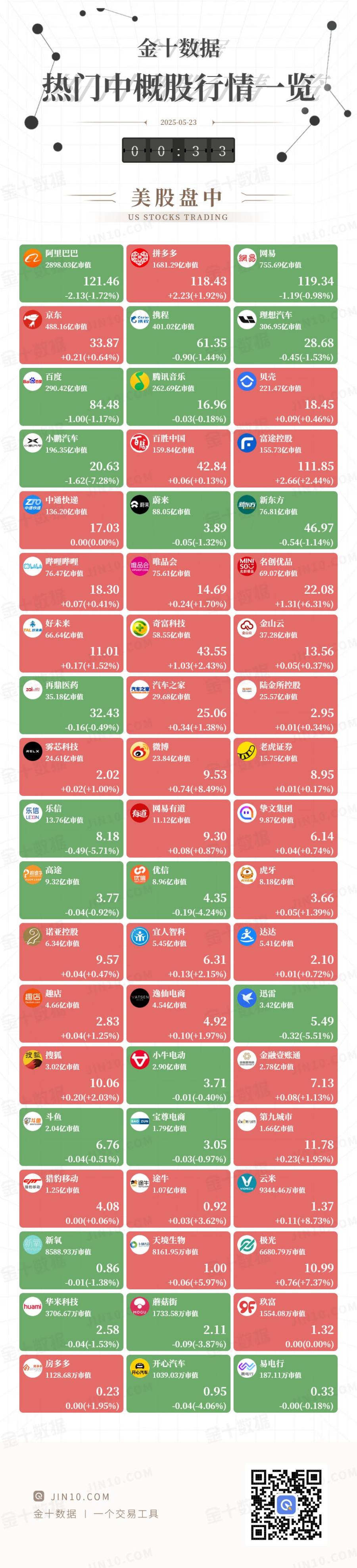
Market Capitalization Summary - The market capitalizations of various companies are listed, with notable figures including 136.20 billion for a leading company and 88.05 billion for another significant player [2] - Companies like MINISO and VIPSHOP have market caps of 76.81 billion and 75.61 billion respectively, indicating strong positions in the market [2] - TAL Education and other firms show varying market caps, with TAL at 66.64 billion and others like Zai Auto and Huya at 35.18 billion and 29.68 billion respectively [2] Stock Performance Overview - Stock price changes are noted, with MINISO showing a slight increase of +0.07 (+0.41%) and VIPSHOP increasing by +0.24 (+1.70%) [2] - TAL Education's stock rose by +1.03 (+2.43%), while other companies like Dada and Yatsen experienced minor fluctuations [2] - Companies such as Lexin and Huya saw declines, with Lexin down by -0.49 (-5.71%) and Huya down by -0.19 (-4.24%) [2] Company Specific Insights - MINISO and VIPSHOP are highlighted as strong competitors in the retail sector, with significant market caps and positive stock performance [2] - TAL Education continues to show resilience with a notable market cap and stock price increase, reflecting investor confidence [2] - Companies like Dada and Yatsen are also mentioned, indicating a diverse range of players in the market with varying performance metrics [2]






端午假期出游趋势预测报告出炉 非遗游入境游热度不减
Zheng Quan Shi Bao Wang· 2025-05-21 10:46
Core Insights - The travel market is experiencing steady growth during the Dragon Boat Festival in 2025, with local and surrounding travel dominating at a 50% share [1] - The popularity of short-distance overseas travel to destinations like Japan, South Korea, and Thailand is notable, alongside a continued interest in inbound tourism [1][4] Domestic Travel Trends - Local and surrounding travel is the primary focus for the 2025 Dragon Boat Festival, with a significant increase in bookings for trips within a "3-hour high-speed rail circle" [1][2] - Bookings for surrounding travel have increased by 23% year-on-year, indicating a stable growth trend in the domestic market [1] - The search interest in traditional cultural experiences during the festival has surged by 50% compared to last year, highlighting a strong interest in local customs [2] Event-Driven Travel - The presence of various themed music festivals and concerts during the Dragon Boat Festival has led to a noticeable increase in cross-city travel [2] - Major events such as concerts by popular artists have sold out, contributing to a spike in hotel bookings in cities hosting these events [2] Family and Pet Travel - The proportion of family travel has significantly increased, with family-oriented bookings accounting for 35% of total orders on travel platforms [3] - There is a growing trend of pet-friendly travel, with a 20% increase in the popularity of pet-friendly hotels compared to last year [3] Inbound and Outbound Travel - Inbound tourism remains strong, with hotel search interest for inbound travel increasing by over 100% during the Dragon Boat Festival [3] - Popular outbound destinations include Japan and South Korea, with unique locations like Egypt and Russia seeing significant hotel booking increases [4]

端午聚焦周边民俗体验,假期后出境游强势上扬
Cai Jing Wang· 2025-05-21 10:42
Group 1 - The tourism market for the Dragon Boat Festival in 2025 is characterized by a deep integration of traditional cultural experiences and modern consumer demands, with local and surrounding travel dominating, an increase in long-distance travel popularity, and cross-border experiences and cultural consumption emerging as new highlights [1][2] - Data from Tuniu and Tongcheng Travel indicate that local and surrounding travel will be the most popular choices for the 3-day holiday, with a peak in bookings expected before the holiday [1][2] - The main travel areas within a 2-hour high-speed rail radius include the Yangtze River Delta, Beijing-Tianjin-Hebei, Pearl River Delta, and Sichuan-Chongqing regions, with popular routes such as Beijing-Qinhuangdao and Chengdu-Leshan [1] Group 2 - The cultural attributes of the Dragon Boat Festival, recognized as the first Chinese traditional festival included in the UNESCO Intangible Cultural Heritage list, are driving tourism consumption, particularly in the Beijing-Tianjin-Hebei, Pearl River Delta, and Sichuan-Chongqing regions [2] - There has been a significant increase in search volume for keywords related to the festival, with terms like "Dragon Boat" and "Zongzi" seeing a 220% increase compared to the previous month [2] - The top ten popular destinations for folk tourism during the festival include Chengdu, Hangzhou, Foshan, Suzhou, Tongren, Nanning, Huaihua, Dongguan, Miluo, and Suqian, featuring various dragon boat races and intangible cultural heritage activities [2] Group 3 - Following the Dragon Boat Festival, there is an anticipated increase in international travel as parents reward their children for completing the national college entrance examination, with international flight prices rising nearly 20% on June 7 [3] - The average price of international tickets is expected to peak at around 3000 yuan by June 17, reflecting strong demand for outbound travel during the upcoming summer season [3] - Observations indicate that there is a window of opportunity for cost-effective international travel before the holiday rush, with ticket prices for routes like Kunming to Paris and Fuzhou to New York remaining below 3000 yuan and 4000 yuan, respectively [3]
途牛:端午假期“传统文化+亲子互动”复合型旅游消费需求旺
news flash· 2025-05-20 12:17
Core Insights - Tuniu predicts a rise in demand for local and nearby travel during the Dragon Boat Festival, with 47% of bookings for short trips [1] - Long-distance travel remains popular, accounting for 31% of total bookings [1] - Self-driving and high-speed rail travel are the preferred choices for nearby trips, making up over 80% of the travel volume [1] Group 1: Travel Trends - The demand for family-oriented travel is expected to surge due to the overlap of the Dragon Boat Festival and Children's Day [1] - Popular destinations for self-driving trips include major cities such as Shanghai, Guangzhou, Beijing, and Nanjing, among others [1] - The "cross-regional travel" demand is particularly strong in the Yangtze River Delta, Pearl River Delta, and Beijing-Tianjin-Hebei regions [1]
金十图示:2025年05月16日(周五)热门中概股行情一览(美股盘中)
news flash· 2025-05-16 16:52
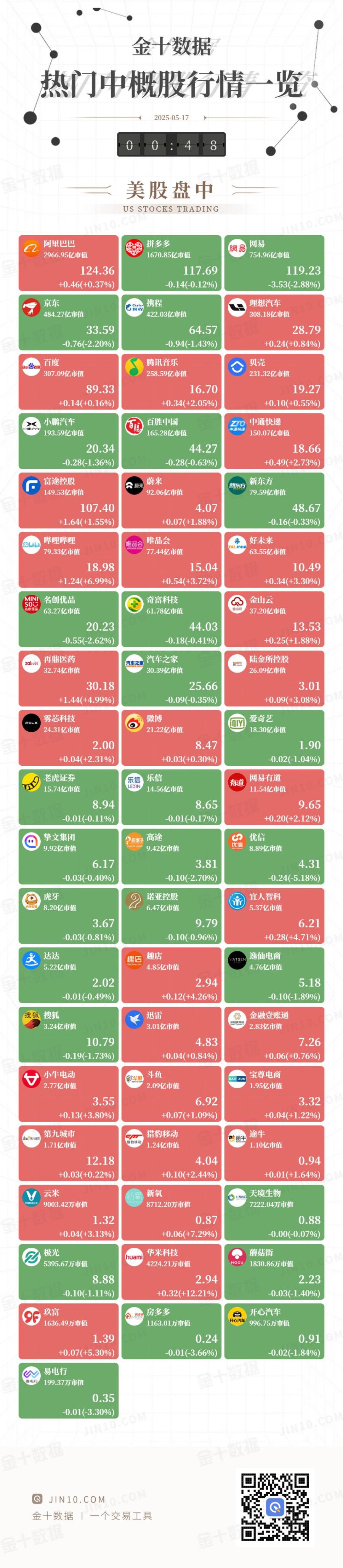
Market Capitalization Overview - The market capitalization of TAL Education Group is 14.95 billion, while Vipshop Holdings has a market cap of 9.21 billion [2] - Other companies such as Miniso and Qifu Technology have market caps of 7.77 billion and 6.33 billion respectively [2] - The market cap of various companies shows a range from 5.22 million to 149.53 billion, indicating a diverse market landscape [2] Stock Performance - TAL Education Group's stock increased by 1.64 (+1.55%), while Vipshop's stock rose by 0.07 (+1.88%) [2] - Miniso's stock saw a significant increase of 1.24 (+6.99%), indicating strong market performance [2] - Companies like Huya and Yiren Digital experienced slight declines in their stock prices, with decreases of -0.03 (-0.81%) and -0.10 (-0.96%) respectively [2] Comparative Analysis - The comparison of market caps shows that TAL Education Group leads with 14.95 billion, followed by Vipshop and Miniso [2] - The performance of stocks varies significantly, with some companies like Miniso showing robust growth compared to others that faced declines [2] - The data indicates a competitive environment among these companies, with varying degrees of market success and stock performance [2]


在线旅游平台纷纷推出AI助手
Ren Min Ri Bao Hai Wai Ban· 2025-05-14 01:31
Group 1 - Multiple online travel platforms are launching AI assistants to enhance travel planning and improve user experience, addressing the time-consuming nature of travel research [1][2] - Fliggy's AI product "Ask One" operates as a 24/7 online travel customization team, offering various services such as itinerary assistance, route customization, and local recommendations [1] - Mafengwo's "AI Roadbook" provides deep personalization by actively asking users questions to better understand their needs, creating tailored travel plans that include itineraries, accommodations, and practical tips [2] Group 2 - Tuniu's "AI Assistant Little Cow" analyzes user needs from vague information, providing clear recommendations and intelligent evaluations of selected products and itineraries [2] - Tongcheng Travel has upgraded its "Chengxin AI" to enhance user experience by facilitating a seamless transition from AI recommendations to decision execution and booking [2] - Trip.com has introduced TripGenie, an AI assistant that supports multiple languages to assist overseas users with travel inquiries, reflecting the growing demand for customized travel options [3]
GABBY'S DOLLHOUSE LIVE! PRESENTED BY WALMART KICKS OFF 80+ SHOW NORTH AMERICAN TOUR IN LONG BEACH, CA
Prnewswire· 2025-05-13 19:27
Core Insights - The North American premiere of "Gabby's Dollhouse Live!" will launch on September 19, 2025, in Long Beach, CA, and will tour over 75 cities [1][3][4] - The live production is based on the popular DreamWorks Animation series "Gabby's Dollhouse," which has been a top 10 series in 63 countries on Netflix [4][10] - The show features an original story with unique puppets, dynamic staging, and songs designed to engage audiences [5][10] Company Collaborations - DreamWorks Animation is partnering with TEG Life Like Touring and Terrapin Station Entertainment to bring the live show to North America [4][10] - Walmart is the presenting sponsor for "Gabby's Dollhouse Live!" [5][14] - TEG Life Like Touring has a history of producing successful shows for popular entertainment brands, enhancing the live entertainment landscape [15][16] Tour Details - The tour will include major venues such as the Grand Ole Opry in Nashville, TN, and the Chicago Theatre in Chicago, IL [1][4] - The initial tour dates span from September 19, 2025, to December 20, 2025, covering various cities across the United States [6][7][8] - The production aims to capture the magic of the "Gabby's Dollhouse" franchise and engage families through live entertainment [4][10]