
Vipshop(VIPS)

Search documents
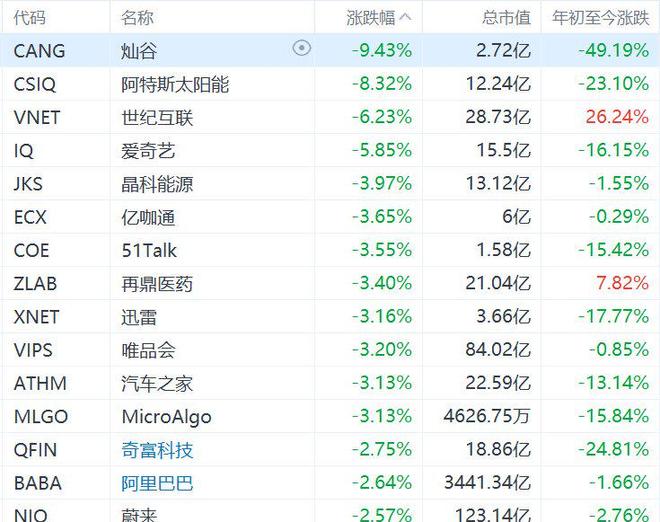
纳斯达克中国金龙指数跌1.4%
Ge Long Hui A P P· 2026-02-27 15:39
Group 1 - The Nasdaq China Golden Dragon Index fell by 1.4%, indicating a general decline in Chinese concept stocks [1] - Notable declines among individual stocks include Cango down over 9%, Canadian Solar down over 8%, and Century Internet down over 6% [1] - Other companies such as iQIYI, JinkoSolar, Yika Technology, Xunlei, and Vipshop also experienced declines of over 3% [1] Group 2 - Cango (CANG) reported a decline of 9.43% with a total market capitalization of $272 million and a year-to-date drop of 49.19% [2] - Canadian Solar (CSIQ) decreased by 8.32%, with a market cap of $1.224 billion and a year-to-date decline of 23.10% [2] - Century Internet (VNET) fell by 6.23%, holding a market cap of $2.873 billion and a year-to-date increase of 26.24% [2] - iQIYI (IQ) saw a drop of 5.85%, with a market cap of $1.55 billion and a year-to-date decline of 16.15% [2] - JinkoSolar (JKS) decreased by 3.97%, with a market cap of $1.312 billion and a year-to-date decline of 1.55% [2] - Yika Technology (ECX) fell by 3.65%, with a market cap of $600 million and a year-to-date decline of 0.29% [2] - Other companies like 51Talk, Zai Lab, Xunlei, and Vipshop also reported declines ranging from 2.75% to 3.55% [2]




唯品会(VIPS):暖冬影响下收入承压,26年预计保持高股东回报
CMS· 2026-02-27 08:59
Investment Rating - The report maintains a "Strong Buy" rating for Vipshop (VIPS.N) [4][5] Core Insights - Vipshop's Q4 2025 revenue was 32.5 billion yuan, a year-on-year decrease of 2.3%, with GMV at 66.6 billion yuan, up 0.6% year-on-year, impacted by a warm winter [2][5] - For Q1 2026, the company expects revenue between 26.3 billion to 27 billion yuan, indicating a year-on-year growth of 0% to 5%, aligning with market expectations [2][5] - The company plans to return 75% of its 2025 Non-GAAP net profit to shareholders, continuing its commitment to high shareholder returns [2][5] Financial Performance Summary - Revenue for 2024 is projected at 108.42 billion yuan, with a year-on-year decline of 3.9% in 2025, followed by a slight recovery in 2026 with an expected growth of 3.1% [3][8] - Non-GAAP net profit is forecasted to be 9.034 billion yuan in 2024, decreasing to 8.798 billion yuan in 2025, but expected to rise to 9.387 billion yuan in 2026 [3][8] - The company aims for a target price of $21.22 based on an 8x PE multiple of the 2026 Non-GAAP net profit [4][5] Shareholder Returns - In Q4 2025, Vipshop repurchased shares worth $305.4 million, with a remaining buyback plan of $316 million [2][5] - The cash dividend for 2025 is set at $3.1 per ordinary share, with a payment date expected on April 24, 2026 [2][5] User Engagement and Growth - Active users in Q4 2025 were 45.3 million, a slight decrease of 0.9% year-on-year, but the company anticipates a recovery in Q1 2026 [2][5] - The number of active SVIP members grew by 11% year-on-year, contributing approximately 52% to online sales [2][5]

唯品会(VIPS):2025Q4财报点评:受大盘影响收入利润疲软,2026年股东回报势头持续
Guoxin Securities· 2026-02-27 08:01
Investment Rating - The report maintains an "Outperform" rating for the company [4][3] Core Views - The company's revenue for Q4 2025 was 32.4 billion yuan, a year-over-year decrease of 2.3%, with product revenue at 29.9 billion yuan, down 3.1%. The growth in the wearable category was flat, primarily due to a warm winter affecting apparel sales, while other income grew by 8% to 2.5 billion yuan, driven by the Shanshan outlet stores [6][2] - The company's GMV for the quarter increased by 0.6% year-over-year to 66.6 billion yuan, with active buyers totaling 45.3 million, a decrease of 1% year-over-year. The SuperVIP membership increased by 11% to 9.8 million, accounting for 52% of online transaction value [6][2] - The company is leveraging AI technology for operational improvements, including automated creative generation and advertising, AI virtual fitting, and AI customer service [6][2] Financial Summary - Non-GAAP net profit for the quarter was 2.9 billion yuan, a decrease of 4% year-over-year, with a net profit margin decline of 0.2 percentage points. Adjusted operating profit decreased by 5% year-over-year, with an adjusted operating profit margin of 10% [2][6] - The company returned a total of $944 million to shareholders in 2025, with a shareholder return rate of 11%. This included a share buyback of $305 million in Q4 2025 and a total buyback of $684 million for the year, alongside cash dividends of $0.62 per ADS, totaling nearly $300 million [7][2] - Revenue projections for 2026 and 2027 have been adjusted to 108.7 billion yuan and 111.5 billion yuan, respectively, with a slight downward adjustment of 1.5% and 1.2%. The adjusted net profit estimates for the same years are 9 billion yuan and 9.3 billion yuan [3][12]
唯品会发布2025年业绩:净营收1059亿元,SVIP活跃用户数保持两位数增长
36氪未来消费· 2026-02-27 06:56
Group 1 - The core revenue for Vipshop in 2025 is projected to be 105.9 billion RMB, with a net profit of 8.7 billion RMB, and SVIP users reaching 9.8 million [2] - In Q4 2025, Vipshop achieved a net revenue of 32.5 billion RMB and a Non-GAAP net profit of 2.9 billion RMB [2] - The company returned approximately 940 million USD to shareholders through stock buybacks and dividends, with a new annual dividend plan approved [4] Group 2 - Vipshop's chairman and CEO, Shen Ya, emphasized the company's strategic execution, business agility, and technological innovation to strengthen brand partnerships and respond to changing consumer demands [4] - The platform's core high-value brand performance showed stable growth, with overall performance from Super Brand Days and Super Category Days increasing by 17% year-on-year [4] - Vipshop introduced several international brands in 2025, enhancing its supply advantages and attracting high-value users with exclusive products [4] Group 3 - The platform saw positive growth in active users, with SVIP active users increasing to 9.8 million, contributing 52% to online sales [6] - New member benefits for SVIP users include exclusive products and broader lifestyle privileges, enhancing the perceived value of membership [6] - AI applications in search recommendations, intelligent customer service, and virtual fitting rooms have significantly improved user engagement and operational efficiency [6]
唯品会(VIPS):25Q4业绩点评:利润好于预期,股东回报稳健
GF SECURITIES· 2026-02-27 04:53
Investment Rating - The report maintains a "Buy" rating for the company, with a current price of $18.12 and a fair value of $25.90 [3]. Core Insights - The company's Q4 2025 performance exceeded expectations, with a net profit of 28.58 billion RMB, surpassing forecasts by 4.6%. The net profit margin was 8.8%, slightly down from 9.0% year-on-year [6][8]. - The company anticipates a revenue growth of 0-5% in Q1 2026, driven by improved consumer shopping enthusiasm post-Spring Festival [6]. - The report highlights a stable profit margin and a commitment to shareholder returns, with approximately $9.4 billion in total returns through stock buybacks and dividends in 2025 [6][8]. Financial Forecasts - Revenue projections for 2026-2028 are as follows: - 2026: 108.67 billion RMB - 2027: 111.22 billion RMB - 2028: 113.82 billion RMB - Adjusted net profit forecasts for the same period are: - 2026: 9.06 billion RMB - 2027: 9.20 billion RMB - 2028: 9.51 billion RMB [6][8][10]. - The report expects the adjusted net profit margin to remain above 8% in 2026, with a gross margin of 23% [7][8]. Valuation Metrics - The report assigns a price-to-earnings (P/E) ratio of 10x based on the adjusted net profit for 2026, leading to a fair value estimate of $25.90 per ADS [8]. - The company’s earnings per share (EPS) estimates are: - 2026: 13.27 RMB - 2027: 13.45 RMB - 2028: 13.93 RMB [10][13].
异动盘点0227 | 亚博科技控股节后累计涨幅已接近140%,老铺黄金涨超4%;Eos Energy暴跌39.44%,IonQ Inc大涨21.7%
贝塔投资智库· 2026-02-27 04:00
Group 1 - China Qinfa (00866) experienced a significant drop in performance, forecasting a net loss of up to RMB 98 million for the year, a stark contrast to a net profit of approximately RMB 556 million in 2024, primarily due to the divestment of its Shanxi coal business [1] - WuXi AppTec (02268) saw its stock rise over 8% after announcing a positive earnings forecast for 2025, with revenue projections slightly adjusted to RMB 5.88 billion, RMB 8.28 billion, and RMB 11.11 billion for 2025-2027, reflecting a strong CAGR of 38% to 46% driven by growth in CMC orders [1] - Lao Pu Gold (06181) increased by over 4.2% as it announced a price hike for gold jewelry, leading to long queues at stores ahead of the price increase [1] Group 2 - Yancoal Australia (03668) reported a projected net profit of AUD 440 million for 2025, a decline of 64% year-on-year, with earnings per share at AUD 0.33, aligning with market expectations [2] - JS Global Life (01691) issued a profit warning, anticipating a net loss of up to USD 22.5 million for 2025, compared to a net profit of USD 8.8 million in the previous year [2] - Chow Tai Fook (00659) saw a decline of over 4% post-earnings announcement, despite reporting a 15% year-on-year increase in shareholder profit to HKD 1.3343 billion [2] Group 3 - Federal Pharmaceutical (03933) stock rose over 3% following the completion of Phase II clinical trials for its innovative drug UBT251 in overweight/obese patients in China [3] - Guofu Quantum (00290) surged over 7%, with a cumulative increase of over 40% in the past seven trading days, following its inclusion in the Hang Seng Composite Index [4] - Xiansheng Pharmaceutical (02096) projected revenue of approximately RMB 7.7 billion to RMB 7.8 billion for the fiscal year ending December 31, 2025, marking a year-on-year increase of about 16% to 17.6% [4] Group 4 - The Nasdaq Golden Dragon China Index fell over 2%, with major Chinese concept stocks declining, including Beike (BEKE.US) down 5.62% and Alibaba (BABA.US) down 2.78% [5] - Nvidia (NVDA.US) reported better-than-expected earnings but saw its stock drop over 5% due to market concerns about potential bubbles despite a 73% increase in fourth-quarter revenue [5] - Zoom Video Communications (ZM.US) fell 11.58% after missing earnings expectations for the fourth quarter, reporting adjusted earnings of USD 1.44 per share, below the expected USD 1.49 [6]


Q4盈利超预期抵消营收压力 唯品会(VIPS.US)股价小幅走高
Zhi Tong Cai Jing· 2026-02-26 15:15
Core Viewpoint - Vipshop's stock price increased by 1.38% in intraday trading, reflecting a generally positive market reaction to its latest earnings report, which showed mixed results for Q4 2025 [1] Financial Performance - The company reported a non-GAAP earnings per American depositary share of $0.81, exceeding market expectations by $0.03 [1] - Q4 revenue was approximately $4.6 billion, remaining flat year-over-year but falling short of market expectations by about $220 million [1] Key Operational Metrics - Total merchandise volume in Q4 grew by 0.6% year-over-year to RMB 66.6 billion [1] - Active user count was 45.3 million, slightly down from 45.7 million in the same period last year [1] - Order volume decreased to 206 million from 217.5 million year-over-year [1] Guidance and Market Outlook - The company provided a relatively stable performance outlook, expecting Q1 2026 net revenue to be between RMB 26.3 billion and RMB 27.6 billion, indicating a year-over-year growth of approximately 0% to 5% [1] - Market analysts believe that despite short-term revenue growth pressures, the company's stable profitability and moderate forward guidance provide some support for its stock price [1]
美股异动 | Q4盈利超预期抵消营收压力 唯品会(VIPS.US)股价小幅走高
智通财经网· 2026-02-26 15:09
Core Viewpoint - Vipshop's stock price increased by 1.38% in intraday trading, reflecting a generally positive market reaction to its latest earnings report, which showed mixed results for Q4 2025 [1] Financial Performance - The company reported a non-GAAP earnings per American depositary share of $0.81, exceeding market expectations by $0.03 [1] - Q4 revenue was approximately $4.6 billion, remaining flat year-over-year but falling short of market expectations by about $220 million [1] Key Operational Metrics - The total merchandise volume for Q4 grew by 0.6% year-over-year to RMB 66.6 billion [1] - Active user count decreased slightly to 45.3 million from 45.7 million in the same period last year [1] - The number of orders fell to 206 million, down from 217.5 million year-over-year [1] Future Guidance - The company provided a relatively stable performance outlook, expecting Q1 2026 net revenue to be between RMB 26.3 billion and RMB 27.6 billion, indicating a year-over-year growth of approximately 0% to 5% [1] - Market analysts believe that despite short-term revenue growth pressures, the company's stable profitability and moderate forward guidance provide some support for its stock price [1]
Vipshop(VIPS) - 2025 Q4 - Earnings Call Transcript
2026-02-26 13:02
Financial Data and Key Metrics Changes - Total net revenues for Q4 2025 were RMB 32.5 billion, a decrease from RMB 33.2 billion in the prior year period, representing a year-over-year decline of 2.1% [13] - Gross profit for Q4 2025 was RMB 7.4 billion, down from RMB 7.6 billion in the prior year, with a gross margin of 22.9%, slightly lower than 23.0% in the previous year [13] - For the full year 2025, total net revenues were RMB 105.9 billion, compared to RMB 108.4 billion in the prior year, indicating a decline of 2.3% [17] - Net income attributable to Vipshop shareholders increased by 5.8% year-over-year to RMB 2.6 billion in Q4 2025, with a net margin of 8.0%, up from 7.4% in the prior year [16] Business Line Data and Key Metrics Changes - The Made for Vipshop line saw sales growth of over 40%, accounting for 5% of online apparel sales in 2025 [6] - Active Super VIP (SVIP) members grew by 11% to 9.8 million, contributing 52% of online spending [7] - Non-GAAP income from operations for Q4 2025 was RMB 3.2 billion, compared to RMB 3.4 billion in the prior year [16] Market Data and Key Metrics Changes - The company experienced a deceleration in December sales due to weak winter apparel demand and delayed holiday shopping, attributed to a later Spring Festival [4] - Consumer activity showed signs of recovery in Q1 2026, driven by New Year shopping, with expectations of 0% to 5% revenue growth [25] Company Strategy and Development Direction - The company implemented a strategic reorganization of merchandising and customer engagement teams to enhance agility and competitiveness [5] - Focus on building a stronger portfolio of branded products and enhancing customer relevance through data-driven insights [6] - Plans to expand offline presence through Shan Shan outlets, which have proven to be a stable revenue stream [33] Management's Comments on Operating Environment and Future Outlook - Management expressed confidence in delivering sustainable profitability growth in 2026 and beyond, despite a dynamic macro environment [10] - The company aims to stabilize margins and maintain a focus on high-quality growth [26] - Management noted that the business model relies on effective merchandising and supply chain reliability to remain competitive against e-commerce trends [32] Other Important Information - The company returned a total of $944 million to shareholders through dividends and share repurchases in 2025, with plans to maintain this momentum in 2026 [12] - Cash and cash equivalents as of December 31, 2025, were RMB 24.1 billion, with short-term investments of RMB 5.8 billion [17] Q&A Session Summary Question: Impact of late Spring Festival on business performance and recovery - Management acknowledged that Q4 sales were impacted by warm weather and a late Spring Festival, but noted a recovery in consumer activity in Q1 2026 [25] Question: Margin outlook for 2026 - Management expects margins to stabilize and aims to outperform in terms of margins for 2026 and beyond [26] Question: User growth expectations for 2026 and demand for apparel vs. non-apparel - Management indicated that customer growth is a priority and expects to see faster customer growth than sales growth in 2026 [30] - Consumers remain cautious but continue to shop across categories, with a focus on providing value [31] Question: Resilience of the business model against e-commerce trends and offline expansion - Management believes the off-price model will remain resilient and plans to expand the offline business through Shan Shan outlets [33]
Vipshop(VIPS) - 2025 Q4 - Earnings Call Transcript
2026-02-26 13:02
Financial Data and Key Metrics Changes - Total net revenues for Q4 2025 were RMB 32.5 billion, a decrease from RMB 33.2 billion in the prior year period, representing a year-over-year decline of 2.1% [13] - Gross profit for Q4 2025 was RMB 7.4 billion, down from RMB 7.6 billion in the prior year, with a gross margin of 22.9%, slightly lower than 23.0% in the previous year [13] - For the full year 2025, total net revenues were RMB 105.9 billion, compared to RMB 108.4 billion in the prior year, indicating a decline of 2.3% [17] - Net income attributable to Vipshop shareholders increased by 5.8% year-over-year to RMB 2.6 billion in Q4 2025, with a net margin of 8.0%, up from 7.4% in the prior year [16] Business Line Data and Key Metrics Changes - The Made for Vipshop line saw sales growth of over 40%, accounting for 5% of online apparel sales in 2025 [6] - Active Super VIP (SVIP) members grew by 11% to 9.8 million, contributing 52% of online spending [7] - Non-GAAP income from operations for Q4 2025 was RMB 3.2 billion, compared to RMB 3.4 billion in the prior year [16] Market Data and Key Metrics Changes - The company experienced a deceleration in December sales due to weak winter apparel demand and delayed holiday shopping caused by a later Spring Festival [4] - Consumer activity showed signs of recovery in early 2026, driven by New Year shopping, with expectations of 0% to 5% revenue growth for Q1 2026 [25] Company Strategy and Development Direction - The company implemented a strategic reorganization of merchandising and customer engagement teams to enhance agility and long-term competitiveness [5] - Focus on building a stronger portfolio of branded products and enhancing customer relevance through data-driven insights [6] - Plans to expand offline presence through Shan Shan Outlets, which have proven to be a stable revenue stream [33] Management Comments on Operating Environment and Future Outlook - Management expressed confidence in delivering sustainable profitability growth in 2026 and beyond, despite a dynamic macro environment [10] - The company aims to stabilize margins while focusing on high-quality growth and sustainable profitability [26] - Management acknowledged the need to adapt to AI trends while maintaining a strong merchandising and supply chain reliability [32] Other Important Information - The company returned a total of $944 million to shareholders through dividends and share repurchase in 2025, with plans to maintain this momentum in 2026 [12] - Cash and cash equivalents as of December 31, 2025, were RMB 24.1 billion, with short-term investments of RMB 5.8 billion [17] Q&A Session Summary Question: Impact of late Spring Festival on business performance and recovery - Management noted that Q4 sales were impacted by warm weather and a late Spring Festival, but consumer activity has picked up in early 2026, supporting guidance for revenue growth [25] Question: Margin outlook for 2026 - Management expects margins to stabilize and aims to outperform in terms of margins for 2026 and beyond, focusing on sustainable, profitable growth [26] Question: User growth expectations for 2026 and demand for apparel vs. non-apparel - Management aims to regrow customer numbers in 2026, with expectations that customer growth will outpace sales growth [30] - Consumers remain cautious but continue to shop across categories, with a focus on providing value [31] Question: Resilience of the business model against e-commerce trends and offline expansion - Management believes the off-price model will remain resilient and is expanding the offline business through Shan Shan Outlets, which are performing well [33]