Walmart(WMT)

Search documents
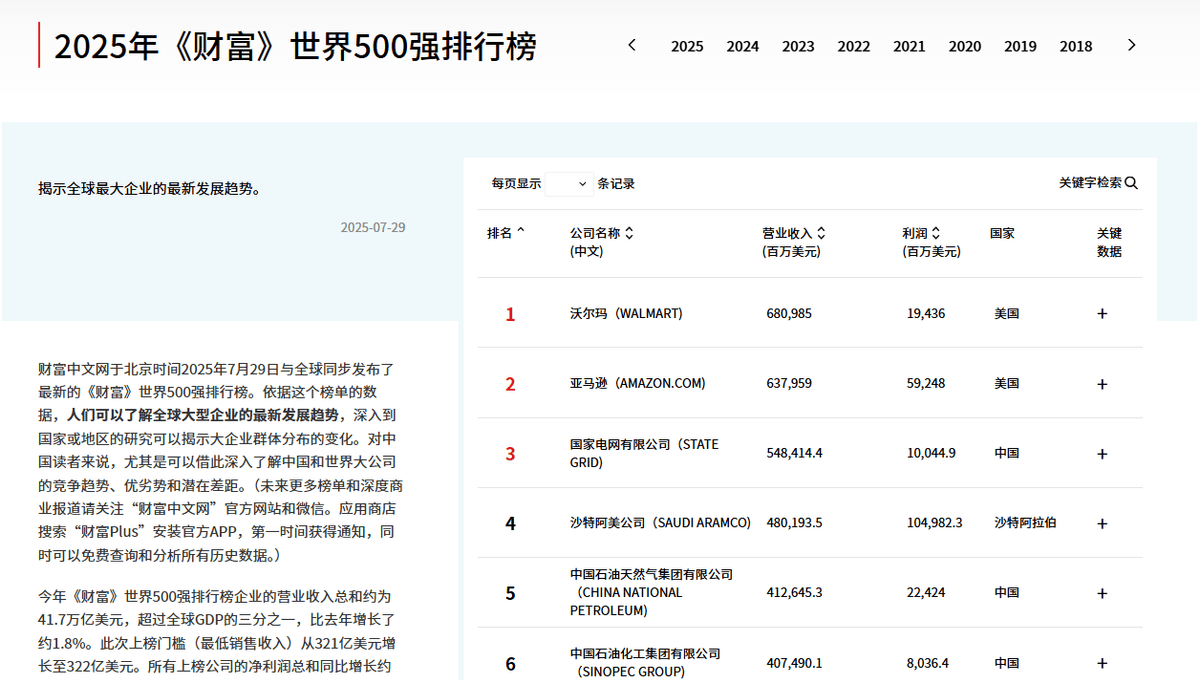
2025年最新世界500强公布,美国独占138家,日本跌至38家,中国呢
Sou Hu Cai Jing· 2025-08-23 05:37
Group 1 - The latest Fortune Global 500 list reveals the economic strength of various countries, with a total revenue of approximately $41.7 trillion, accounting for over one-third of global GDP, and a year-on-year growth of about 1.8% [2][11] - Walmart leads the list with revenues of $680.985 billion and profits of $19.436 billion, followed by Amazon with $637.959 billion in revenue and $59.248 billion in profit [2] - The threshold for inclusion in the list increased from $32.1 billion to $32.2 billion in sales revenue [2] Group 2 - American companies dominate the list, accounting for 44% of the total, with an average sales figure of $121.7 billion and net profits of $31 billion, reflecting a year-on-year increase of 19% and 31% respectively [8][11] - In contrast, Chinese companies, totaling 130, generated $10.7 trillion in revenue but had an average net profit of only $4.2 billion, less than half of their American counterparts [11][18] - Japanese companies have seen a significant decline, dropping from 149 to 38 on the list, with an average net profit of only $3.13 billion, highlighting a stagnation in their business models [20][22] Group 3 - High-tech companies are showing strong performance, with 34 global high-tech firms averaging $96.7 billion in revenue and $18.1 billion in net profit, marking increases of 9.6% and 24% year-on-year [5][11] - Notable examples include Nvidia, which boasts a 55% net profit margin, and other tech giants like Microsoft and Google, which have established significant revenue streams through advanced technologies [8][10] - The rise of companies like BYD and Chery illustrates China's shift from scale to efficiency, with BYD surpassing Tesla and Chery achieving significant export growth [13][14][15] Group 4 - Pinduoduo's revenue reached $54.736 billion with a profit of $15.626 billion, showcasing a remarkable efficiency in its operations, particularly in agricultural product sales [17] - The contrasting business models of the U.S., China, and Japan highlight different paths to economic success, with the U.S. focusing on technology, China on efficiency, and Japan struggling with outdated practices [24]





Is Walmart Stock Clearly the Better Investment Than Target's After Q2 Results?
ZACKS· 2025-08-23 00:41
Core Insights - Walmart outperformed Target in Q2 results, showcasing stronger growth driven by e-commerce and grocery sales [1][3][4] - Target is facing challenges with declining sales and leadership changes, impacting its growth trajectory [2][10] Walmart Performance - Walmart reported Q2 earnings of $0.68 per share, slightly below expectations of $0.73, but up from $0.67 in the same quarter last year [3] - Q2 sales reached $177.4 billion, a nearly 5% increase year-over-year, surpassing estimates of $175.51 billion [3][4] - Global e-commerce sales surged by 25% in Q2, and advertising revenue increased by 46% [4] - Walmart raised its full-year revenue growth guidance to 3.75%-4.75% and adjusted EPS guidance to $2.52-$2.62 for fiscal 2026 [8] Target Performance - Target's Q2 sales were $25.11 billion, down from $25.45 billion a year ago, but above estimates of $24.91 billion [5] - Q2 EPS of $2.05 fell short of expectations of $2.09 and decreased by 20% from $2.57 in the prior period [5][6] - Target experienced a 4% increase in digital sales but a 2% decline in comparable sales, with store traffic down over 1% [6] - Target maintained its full-year outlook, expecting a low-single-digit decline in sales and adjusted EPS between $7.00-9.00 [9] Leadership Changes - Target's CEO Brian Cornell will step down in February after 11 years, transitioning to executive chair, with COO Michael Fiddelke set to replace him [10] Valuation and Dividend - Target's stock is trading at 12X forward earnings, a discount compared to its decade-long median of 15X, while Walmart and Amazon trade at over 30X [11][12] - Target offers a higher annual dividend yield of 4.7% compared to Walmart's 0.96%, with both companies classified as Dividend Kings [13] Investment Considerations - Walmart's operational performance is currently stronger, appealing to growth-focused investors, while Target may attract income and value investors despite its challenges [17]


Walmart And Target Earnings
Seeking Alpha· 2025-08-22 18:26
Group 1 - Walmart and Target announced their earnings this week, providing insights into their financial performance [4] - The simultaneous review of both companies' earnings offers an interesting comparative analysis [4] Group 2 - The analysis of Walmart's earnings reveals key metrics that may indicate its market position [4] - Target's earnings report also presents significant data that could impact its competitive standing [4]

Wall Street Roundup: Markets Celebrate Powell's Jackson Hole Comments
Seeking Alpha· 2025-08-22 18:05
Federal Reserve and Economic Outlook - Jerome Powell's comments at Jackson Hole indicate a shift towards an easing stance, surprising many investors who anticipated a more cautious approach [5][6][9] - The labor market's actual job growth was revealed to be significantly weaker than previously thought, with only 35,000 jobs added per month instead of the expected 150,000 [5][6] - Markets are now pricing in a full easing cycle, with speculation about multiple rate cuts in 2025 and beyond [10][11] Retail Sector Performance - Walmart reported a revenue beat driven by a 25% increase in e-commerce sales but missed on earnings due to tariff-related costs, leading to a 4% decline in stock price [12][13] - Home Depot also missed earnings expectations and indicated plans to raise prices due to tariffs, despite a slight increase in stock price following its earnings report [14][15] - The retail sector is facing margin pressures from increased tariffs, prompting strategic price adjustments [13][15] Technology Sector Insights - NVIDIA is set to report earnings next week, with ongoing debates about its valuation versus long-term growth prospects in the AI sector [16][18] - The stock has experienced significant appreciation over the past few years, raising concerns about its ability to maintain growth rates [16][18] - Other AI-related stocks, such as Palantir, Oracle, and AMD, have seen recent declines, indicating potential skepticism about the sustainability of their growth [23][24][25] Upcoming Earnings and Market Reactions - A number of high-profile retailers are expected to report earnings next week, including Dollar General and Abercrombie and Fitch, which will provide further insights into the retail landscape [26] - The bond market is anticipated to react strongly to Powell's upcoming speech, which may influence interest rates and investor sentiment [22]



No Change In Walmart's Strong Momentum, Analysts Confirm
Benzinga· 2025-08-22 17:45
Core Viewpoint - Walmart Inc. reported second-quarter results that included a miss on adjusted earnings per share but an increase in annual guidance, indicating a mixed performance with strong sales growth [1][2]. Financial Performance - Adjusted earnings per share for the second quarter were 68 cents, below the analyst consensus estimate of 74 cents [1]. - Quarterly sales reached $177.40 billion, reflecting a year-over-year increase of 4.8%, surpassing the expected $176.16 billion [2]. - Total revenues on a constant currency basis increased by 5.6% [2]. Guidance and Analyst Reactions - Walmart raised its fiscal year 2026 adjusted earnings per share guidance to a range of $2.52–$2.62, up from the previous $2.50–$2.60, compared to the analyst estimate of $2.62 [2]. - Analyst Joseph Feldman raised the price forecast from $115 to $118, citing strong e-commerce growth of 26% and solid food sales [3]. - Analyst Christopher Horvers maintained an Overweight rating but lowered the price forecast from $130 to $127, emphasizing that Walmart's outlook remains stable despite competition [5]. Growth Drivers - Walmart's expansion into higher-margin areas such as digital ads and merchant services is expected to drive faster income growth [4]. - Analyst Robert F. Ohmes noted that Walmart's gross margin is benefiting from higher-margin businesses, which have made U.S. e-commerce profitable [7]. - Analyst Steven Shemesh highlighted strong sales momentum in grocery, predicting further market share gains due to widening price gaps [10]. Future Projections - Analysts expect continued growth in earnings per share, with estimates for fiscal year 2027 raised from $2.90 to $2.94 [9]. - Walmart's sales growth projections for 2025 and 2026 have been adjusted to 4.6% and 5.0%, respectively [10][11]. - Analyst Kate McShane raised the price forecast from $101 to $114, indicating confidence in Walmart's value strategy and market share gains [12].
Walmart: Currently More Expensive Than Amazon
Seeking Alpha· 2025-08-22 16:54
Group 1 - Walmart Inc. has established itself as a leading player in the American grocery sector with a vast network of hypermarkets and grocery stores across the U.S. [1] - The company has a strong foundation in finance and business, focusing on analyzing undervalued and disliked companies or industries with strong fundamentals and good cash flows [1] - There is a particular interest in sectors such as Oil & Gas and consumer goods, especially those that are undervalued for unjustified reasons, which could offer substantial returns [1] Group 2 - The analysis emphasizes long-term value investing while also exploring potential deal arbitrage opportunities in various sectors [1] - The company tends to avoid investments in high-tech or certain consumer goods sectors, preferring more traditional products [1] - There is skepticism towards investing in cryptocurrencies, indicating a preference for more established investment avenues [1]

关税风暴席卷美国零售商,美经济支柱消费岌岌可危
2 1 Shi Ji Jing Ji Bao Dao· 2025-08-22 14:16
Core Viewpoint - The retail sector, particularly Walmart, is facing significant challenges due to the impact of tariffs, leading to increased costs and pressure on profit margins [1][2][3] Group 1: Walmart's Financial Performance - Walmart reported Q2 revenue of $177.4 billion, exceeding analyst expectations of $176.16 billion, but adjusted earnings per share were $0.68, below the expected $0.74, marking the first miss in three years [1] - Despite the profit miss, Walmart raised its full-year sales and profit guidance, expecting sales growth of 3.75% to 4.75%, up from a previous forecast of 3% to 4% [1] Group 2: Impact of Tariffs - The company has begun raising prices on certain imported goods to offset tariff costs, which has drawn criticism from President Trump [2] - Walmart's CFO indicated that while some costs have been absorbed, others have had to be passed on to consumers, with overall tariff-related costs continuing to rise [2] - A broader trend is emerging, with nearly one-third of U.S. businesses planning to raise prices in the next six months due to increased input and import costs [2] Group 3: Employment Market and Economic Outlook - The U.S. job market is showing signs of weakness, with initial jobless claims rising by 11,000 to 235,000, the largest increase since late May [3] - High unemployment rates may not fully reflect the underlying economic conditions, as labor demand is weakening and job vacancies are decreasing [3][4] - Economic forecasts suggest that the U.S. economy will continue to slow down, impacting consumer spending and overall economic health [3][4]
X @Bloomberg
Bloomberg· 2025-08-22 13:55
Walmart's upgraded forecast shows it's possible to tempt shoppers to open their wallets right now — it’s just not easy, says @andreafelsted (via @opinion) https://t.co/4yZudYtGq8 ...
After Earnings Miss, Walmart Is Still a Top Consumer Staples Play
MarketBeat· 2025-08-22 13:22
Core Viewpoint - Walmart remains a dominant player in the consumer staples sector despite recent competition from Amazon and a slight earnings miss, with strong growth in key metrics indicating a positive outlook for the company [2][3][12]. Financial Performance - In fiscal 2026 Q2, Walmart reported revenues of approximately $177 billion, reflecting a growth rate of 4.8%, with a constant currency growth rate of 5.6% [3][6]. - The company missed adjusted earnings per share (EPS) expectations, reporting 68 cents, which was 6 cents lower than anticipated, leading to a 4.5% drop in shares post-earnings release [4][5]. - Walmart has increased its full fiscal year adjusted EPS guidance to $2.57, up from $2.55, and expects constant currency net sales growth between 3.75% and 4.75% for the full year [6][7]. Growth Drivers - U.S. comparable sales growth was reported at 4.6%, an increase from 4.2% a year ago, while U.S. eCommerce sales surged by 26%, up from 22% in the previous quarter [8]. - The global advertising business grew by 46%, and membership fees from Walmart+ service increased by 15%, highlighting the importance of these higher-margin revenue sources [8][9]. Competitive Landscape - Amazon is intensifying competition, having achieved over $100 billion in U.S. grocery sales in the prior year, excluding Whole Foods and Amazon Fresh, and has introduced same-day delivery for perishables [10][11]. - Despite Amazon's efforts, Walmart continues to gain market share, although the effectiveness of Amazon's new offerings will need to be monitored closely [11][13]. Market Outlook - Walmart's forward price-to-earnings (P/E) ratio is around 37x, driven by the strong growth of its emerging higher-margin revenue streams [12]. - Analysts maintain a positive outlook on Walmart, with a 12-month stock price forecast of $109.89, indicating a potential upside of 12.24% from the current price [2].
Tariffs aren't dealing a huge blow to big retailers and consumers — yet. Here are key earnings takeaways
CNBC· 2025-08-22 13:14
Core Insights - Retailers are facing rising tariff costs but have managed to avoid significant price hikes for consumers so far [2][3][5] - Consumer spending remains steady, with some retailers reporting healthy sales of discretionary items [8][11][12] - Companies are employing various strategies to mitigate the impact of tariffs, including diversifying sourcing and adjusting pricing carefully [16][20][28] Group 1: Retail Performance - Walmart and Tapestry have raised their sales outlooks for the year, indicating strong consumer demand for discretionary items [8][12] - Sales of fashion items at Walmart accelerated, with specific high-demand products selling out quickly [9][29] - Lower-income shoppers are more sensitive to price changes, affecting their purchasing behavior [11][12] Group 2: Tariff Impact and Mitigation - Retailers have absorbed some tariff costs while passing others onto consumers, but the overall impact has been less severe than anticipated [5][21][30] - Companies like Home Depot and Lowe's are focusing on home professionals to stabilize traffic amid uncertain consumer spending [25][26] - Walmart has benefited from diversified revenue streams, including a 46% growth in global advertising [26][28] Group 3: Strategic Adjustments - Retailers are importing goods from a wider range of countries and stocking up on high-frequency purchases to mitigate tariff impacts [16][20] - Some brands, like Birkenstock and Coach, have successfully increased prices without losing customer demand [29][30] - Companies are adjusting inventory strategies, with Crocs reducing orders and swapping out older inventory for fresher styles [32]