
ExxonMobil(XOM)

Search documents
Softer Oil & Gas Prices in Q2: Will XOM's Bottom Line Be Affected?
ZACKS· 2025-07-08 15:16
Core Insights - Exxon Mobil Corporation (XOM) anticipates a decline in earnings for Q2 2025 due to lower oil and natural gas prices, which is a significant concern given the company's reliance on exploration and production activities [1][3] Price Trends - The average spot prices for West Texas Intermediate (WTI) crude were $63.54, $62.17, and $68.17 per barrel for April, May, and June respectively, indicating a decline from Q1 prices which averaged $75.74, $71.53, and $68.24 per barrel [2] - Natural gas prices have also shown a similar downward trend, impacting the overall pricing environment for the energy sector [2] Earnings Impact - XOM forecasts that lower oil prices will reduce its upstream earnings by $800 million to $1.2 billion, while changes in gas prices could decrease upstream profit by $300 million to $700 million, leading to an expected earnings per share (EPS) of $1.47 for Q2, a decline of nearly 31% year over year [3][7] - The Zacks Consensus Estimate for EOG Resources, Inc. (EOG) is $2.13 per share for Q2, reflecting a 33% year-over-year decline, while ConocoPhillips (COP) is estimated at $1.44 per share, indicating a 27.3% decline [5] Stock Performance and Valuation - XOM shares have increased by 3.7% over the past year, contrasting with a slight decline of 0.6% in the broader industry [6] - XOM's current trailing 12-month enterprise value to EBITDA (EV/EBITDA) ratio stands at 6.89X, which is above the industry average of 4.16X [8] Earnings Estimates Revision - The Zacks Consensus Estimate for XOM's earnings for 2025 has been revised upward in the past week, with current estimates for Q2 at $1.47, next quarter at $1.48, and the current year at $6.33 [10][11]



Exxon Mobil expects $1.5B hit to Q2 earnings from lower oil and gas prices
Proactiveinvestors NA· 2025-07-08 14:59
Group 1 - Proactive provides fast, accessible, informative, and actionable business and finance news content to a global investment audience [2] - The news team covers medium and small-cap markets, as well as blue-chip companies, commodities, and broader investment stories [3] - Proactive focuses on sectors such as biotech and pharma, mining and natural resources, battery metals, oil and gas, crypto, and emerging digital and EV technologies [3] Group 2 - Proactive is committed to adopting technology to enhance workflows and content production [4] - The company utilizes automation and software tools, including generative AI, while ensuring all content is edited and authored by humans [5]

7月8日电,伯恩斯坦将雪佛龙目标价从168美元下调至149美元;将埃克森美孚石油目标价从140美元下调至129美元。
news flash· 2025-07-08 09:22
智通财经7月8日电,伯恩斯坦将雪佛龙目标价从168美元下调至149美元;将埃克森美孚石油目标价从 140美元下调至129美元。 ...

Exxon Mobil warns lower oil, gas prices could cut profit by over $1B
New York Post· 2025-07-07 22:46
Core Insights - Exxon Mobil indicated that lower oil and gas prices could reduce its second-quarter earnings by approximately $1.5 billion compared to the previous quarter [1] - The earnings report from Exxon Mobil is significant for understanding the overall performance of the oil sector as companies prepare to release their quarterly results [1] Oil Prices - Benchmark Brent crude prices averaged $66.71 per barrel during the April to June quarter, reflecting an 11% decline from the previous quarter due to increased crude supply from OPEC+ [2][4] - US natural gas prices also saw a decrease, falling by 9% from the first quarter [2] Earnings Expectations - Exxon Mobil is scheduled to release its second-quarter earnings on August 1, with Wall Street anticipating adjusted earnings of $1.53 per share [4] - In the first quarter, the company reported upstream earnings of $6.8 billion, contributing to a total profit of $7.71 billion [5]

ExxonMobil: Limited Risk and Lots of Reward With This Oil Play
MarketBeat· 2025-07-07 20:15
Core Viewpoint - Exxon Mobil is positioned to maintain strong cash flow and capital returns despite challenges in the oil market, with a focus on new project launches and potential growth opportunities from upcoming arbitration decisions [1][2][3]. Financial Performance - The company has a current stock price of $111.13, with a 52-week range between $97.80 and $126.34, and a dividend yield of 3.56% [1]. - Analysts forecast a 14% decline in revenue for Q2, but the company is expected to outperform estimates due to resilient economic data [6]. - The 12-month stock price forecast is set at $125.40, indicating a potential upside of 13.20% [7]. Growth Opportunities - Exxon Mobil aims to launch at least ten new projects in key locations such as the Permian, Guyana, and Indonesia, projected to contribute $3 billion to the bottom line this year [2]. - The upcoming arbitration decision regarding the Hess/Chevron merger could provide Exxon with a right of first refusal, allowing for further expansion in its Guyana portfolio [3][4]. Analyst Sentiment - Analysts show a high level of confidence in Exxon Mobil, with a consensus rating of Moderate Buy and a steady price target reflecting a 10% upside [5]. - Institutional ownership exceeds 60% and is increasing, providing a supportive backdrop for the stock [11]. Capital Return Strategy - The company has affirmed its commitment to capital returns, including dividends and buybacks, which are expected to continue into 2025 [8][9]. - The buybacks are significant, equating to roughly 1% of the market cap, and are expected to positively influence shareholder value [9][10]. Market Position - The stock has shown consistent support around the $110 level, with long-term moving averages likely to push prices higher over time [12].

Final Decision Reached on Chevron's Disputed Hess Acquisition
ZACKS· 2025-07-07 13:06
Core Insights - Chevron Corporation is poised for a significant opportunity depending on the arbitration ruling regarding its $53 billion acquisition of Hess Corporation, which is crucial for accessing the Stabroek oilfield in Guyana [1][5]. Group 1: Acquisition Details - The arbitration is being overseen by the International Chamber of Commerce, which is currently reviewing the decision before sharing it with the involved parties [2]. - Chevron's interest in acquiring Hess is primarily driven by Hess's 30% stake in the Stabroek block, a key offshore oilfield operated by Exxon and involving CNOOC [3]. - The Stabroek block is vital for Chevron's strategy to address declining reserves, as indicated by a reserve replacement ratio of -4% in 2024, highlighting the urgency of this acquisition [3][7]. Group 2: Dispute Context - Exxon and CNOOC assert that their joint venture agreements provide them a right of first refusal on Hess's stake, while Chevron and Hess argue that this clause does not apply to their merger [4]. - The outcome of the arbitration will determine if Chevron can proceed with the acquisition or if Exxon and CNOOC can block the deal and potentially acquire the stake themselves [5]. Group 3: Strategic Implications - A favorable ruling for Chevron would enhance its position in a promising oil region, while an unfavorable outcome could jeopardize one of the largest oil deals in recent history [5].


欧佩克+突掀增产巨浪 全球油市锁定过剩格局
Zhi Tong Cai Jing· 2025-07-06 23:40
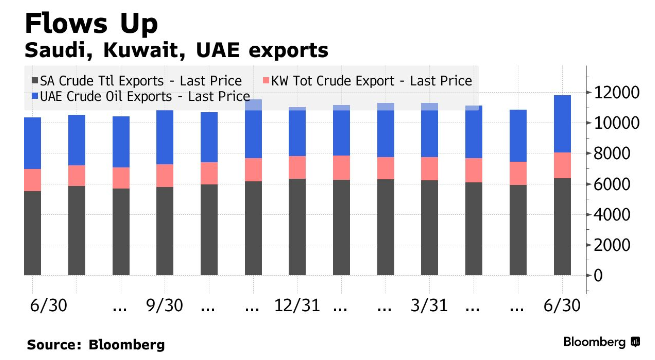
Core Viewpoint - The recent decision by OPEC+ to accelerate oil production is expected to exacerbate global oil supply surplus in the second half of the year, responding to U.S. President Trump's call to lower fuel prices while putting price pressure on oil-producing countries [1][2]. Group 1: Supply Dynamics - OPEC+ has decided to restore 548,000 barrels per day of production starting in August, significantly higher than the previous increase of 411,000 barrels per day from May to July [7]. - The International Energy Agency has predicted a global oil surplus of 1.5% over consumption in the fourth quarter, raising skepticism about OPEC's ability to meet demand with the new production levels [3]. - Despite the increase in production, actual supply impacts may be less than expected due to pressure on overproducing countries to adhere to quotas [7]. Group 2: Market Reactions - Oil prices in London have dropped by 11% over the past two weeks, indicating that traders do not see an urgent need for increased production despite geopolitical tensions [6]. - The U.S. key oil storage hub in Cushing has seen a continuous decline in crude oil inventories, which has not yet shown signs of oversupply [2]. - Analysts suggest that unless there is a visible increase in inventories, the path for oil prices to decline further is not clear [7]. Group 3: Economic Implications - The price drop could severely impact the U.S. oil industry, with shale oil executives expecting a significant reduction in drilling activity by 2025 due to weak oil prices [8]. - Saudi Arabia's economic transformation plan requires oil prices to remain above $90 per barrel, and ongoing fiscal pressures may lead to further supply cuts if the situation persists [8]. - OPEC+ officials have indicated that the production increase plan can be paused or reversed based on market conditions, highlighting the flexibility in their strategy [7].
Exxon Mobil: Guyana Production About To Grow Roughly 50%
Seeking Alpha· 2025-07-04 08:57
Group 1 - Exxon Mobil Corporation (NYSE: XOM) is set to report significant earnings factors for the upcoming quarter, with a notable increase in production from Guyana [2] - The oil and gas industry is characterized as a boom-bust, cyclical sector, requiring patience and experience for successful investment [2] Group 2 - The analysis of oil and gas companies focuses on identifying undervalued entities, examining their balance sheets, competitive positions, and development prospects [1]

ExxonMobil's Golden Pass JV Seeks U.S. Nod to Re-Export LNG
ZACKS· 2025-07-03 14:01
Group 1: Joint Venture and Regulatory Approval - Exxon Mobil Corporation's joint venture with QatarEnergy, Golden Pass LNG, has requested U.S. regulatory approval to re-export liquefied natural gas (LNG) starting October 1, 2025, marking a critical step toward launching commercial operations at the long-delayed export facility in Sabine Pass, TX [1][9] - The request involves re-exporting a cargo of LNG that the company plans to first import to cool down the liquefaction trains, which is a standard and essential final phase before full-scale LNG production begins [2] Group 2: Project Status and Challenges - Golden Pass is constructing an LNG export terminal with a planned capacity of 18 million metric tons per annum, but the project has faced significant delays and cost overruns, with lead contractor Zachry Holdings filing for bankruptcy in March 2024 due to project cost overruns of at least $2.4 billion [3] - Following Zachry Holdings' exit, McDermott International has taken over as the new lead contractor for Train 1 and is in talks to assume construction responsibilities for the remaining two trains [4] Group 3: Market Position and Future Prospects - Once operational, Golden Pass will become the ninth U.S.-based LNG export terminal, further bolstering the United States' position as the world's leading LNG exporter, with first LNG shipments expected later this year, assuming regulatory approvals and construction timelines remain on track [5][9]

丙烯:供应格局概览
Guo Tou Qi Huo· 2025-07-03 13:52
Group 1: Global Propylene Supply Pattern - The global propylene production is concentrated in Northeast Asia, North America, and Western Europe. Northeast Asia is the largest production region, with a 48.1% share of the world's total capacity in 2024, and China accounts for 39.4%. North America and Northeast Asia together account for 65.6% of the global capacity. Western Europe has a 9% share, and has been a net importer since 2021. The Middle East and Southeast Asia also have propylene production, with shares of 7.4% and 6.5% respectively [1]. - The global propylene production capacity had a compound growth rate of 5.9% from 2020 - 2024. Over 14 million tons/year of new capacity is planned from 2025 - 2027, and the capacity is expected to reach 196 million tons by 2030, with major increments in Northeast Asia, North America, and Southeast Asia [1]. Group 2: Global Major Propylene Producers Head - enterprises - Sinopec has a propylene capacity of about 13 million tons/year, accounting for 7.6% of the global total, ranking first globally. It uses mainly naphtha cracking (60%) and is accelerating the layout of PDH. Over 2 million tons/year of new PDH capacity was added in 2024. More than 50% of its propylene is consumed domestically, and it exports through Southeast Asia [4]. - PetroChina has a total propylene capacity of about 6.76 million tons/year as of 2024, accounting for 4.0% of the global total, ranking second. About 85% of its capacity comes from naphtha cracking. Its future competitiveness depends on high - end product R & D, PDH technology penetration, and low - carbon transformation [4]. - LyondellBasell has a capacity of about 5 million tons/year, ranking third globally. It has production bases in North America, Rotterdam in Europe, and Singapore in Asia. It is the world's largest polypropylene producer, and its propylene is mainly used for high - end derivatives with 15% - 20% higher added value [5]. - Saudi Aramco has a capacity of about 4.8 million tons/year, ranking fourth. It has a core device in the Jubail Petrochemical Park. It exports products, accounting for 12% of the global propylene exports, and plans to expand the Zhejiang Petrochemical project with Rongsheng Petrochemical in 2026, adding 1 million tons/year of propylene capacity [5]. Regional leaders - INEOS has a capacity of about 3.8 million tons/year, being the largest propylene producer in Europe. It uses mainly steam cracking (70%) and supplies the European automotive and packaging industries, and also radiates the North American market [6]. - BASF has a capacity of about 3 million tons/year, ranking fifth globally. It投产 the first bio - based propylene plant in Europe in 2024, aiming for a 15% bio - based raw material share by 2030 [6]. - ExxonMobil has a capacity of about 2.8 million tons/year, ranking sixth globally, with production bases in the US, Singapore, and China [6]. Emerging Asian forces - Zhongjing Petrochemical has a capacity of 2.8 million tons/year, being the world's largest single - plant propylene producer. It uses all PDH processes and targets over 30% market share in the domestic PP powder market and exports to Vietnam and Indonesia [8]. - Wanhua Chemical has a capacity of about 1.8 million tons/year, ranking among the top ten globally. Its propylene is mainly used for high - end products such as POE and MDI [8]. Group 3: China's Propylene Capacity Development Structural over - supply and slowing growth - China's propylene capacity had a compound growth rate of 14.34% from 2020 - 2024, adding 29.12 million tons. From 2025 - 2030, the planned new capacity is 22.15 million tons/year, with a compound growth rate of 5.29%, showing a significant slowdown [9]. Increasing industry concentration - In 2024, there were 189 propylene producers in China, with 13 enterprises having an annual capacity of over 1 million tons, accounting for 6.88%. The CR10 enterprise capacity accounted for 22.77%. In the next 5 years, the industry will continue to develop in a diversified, integrated, and large - scale manner [11]. Process route competition and regional development - China has diverse propylene production processes, including naphtha cracking, propane dehydrogenation (PDH), methanol - to - olefins, and catalytic cracking. PDH has developed rapidly and impacted the market share of naphtha cracking. PDH capacity is mainly distributed in coastal areas [13]. - From 2020 - 2024, East China's propylene capacity increased by 8.56 million tons, with an average annual compound growth rate of 14%. Shandong's capacity increased by 7.81 million tons, with an average annual compound growth rate of 21% [15]. Declining import dependence and commodification rate - China's propylene import dependence has declined from 14.1% in 2014 to 3.3% in 2024 and is expected to further decrease. The commodification rate is also expected to decline to 13.3% in 2025, with the commodity volume expected to drop to 7.9 million tons [17].


