Bunge

Search documents
X @Bloomberg
Bloomberg· 2025-11-20 21:10
Billionaire German Larrea’s conglomerate Grupo Mexico is planning to bid for an Argentine freight railway being privatized by Javier Milei, and it could see competition from major crop traders including Bunge and Louis Dreyfus https://t.co/aGIznmmWDN ...
中方反制生效已满一周,关键在于这拳打开了
Guan Cha Zhe Wang· 2025-10-22 09:37
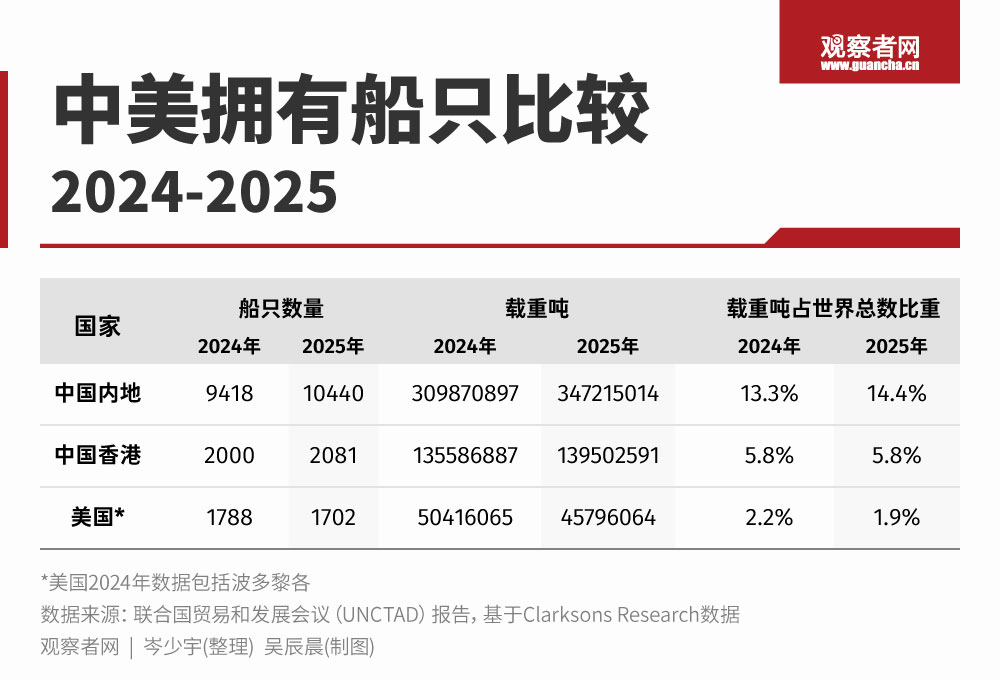
Core Points - The article discusses China's response to the U.S. imposition of special port fees on Chinese vessels, which is seen as a countermeasure to U.S. actions against China's maritime and logistics industries [1][2][34] - The implementation of the special port fee by China is viewed as a strategic move to maintain parity in the ongoing trade tensions between the two countries [2][34] Group 1: Impact on Shipping Industry - The U.S. will impose port service fees on Chinese-owned or operated vessels starting October 14, 2025, affecting a significant number of ships [1][3] - As of January 1, 2025, China is projected to have 10,440 vessels, an increase from 9,418 in 2024, while the U.S. will see a decrease from 1,788 to 1,702 vessels [4][6] - China's share of the global deadweight tonnage is expected to rise from 13.3% in 2024 to 14.4% in 2025, indicating a strengthening position in the global shipping market [6][8] Group 2: Financial Comparisons - The total value of Chinese vessels is projected to reach $255.236 billion in 2025, a 25.11% increase from 2024, while the U.S. total will be $116.447 billion, reflecting a 16.61% growth [13][17] - The value of bulk carriers in China is expected to be $68.454 billion in 2025, compared to $4.054 billion for the U.S., highlighting a significant disparity [17] - The value of container ships in China is projected to be $63.533 billion, while the U.S. will have $4.938 billion, further emphasizing China's dominance in this sector [17] Group 3: Regulatory Responses - The article notes that many U.S. companies have their own fleets, with significant numbers reported by major agricultural firms like Cargill and Bunge [19][22] - The complexity of ownership structures complicates the assessment of which vessels will be affected by the new fees, as many U.S. companies have foreign ownership or operations [25][29] - The article highlights that the U.S. has provided exemptions for certain vessels, which may influence the operational decisions of shipping companies [38] Group 4: Strategic Implications - China's countermeasures are seen as a way to disrupt U.S. efforts to weaken its shipping and shipbuilding industries, forcing global shipping companies to reconsider their strategies [34][39] - The article suggests that the ongoing situation may lead to a reevaluation of the relationships between shipping companies and their operational strategies in light of the geopolitical landscape [39]

Bunge shares soar 11% after Trump considers China cooking oil embargo
CNBC· 2025-10-15 16:57
Core Insights - Bunge Global's stock surged over 11% following the Trump administration's threat to halt U.S. purchases of Chinese cooking oil, reflecting market sensitivity to geopolitical trade tensions [1] - The company is a leading player in soybean processing and cooking oil production, with year-to-date stock gains of approximately 18% [1] Group 1: Trade Relations and Impact - President Trump indicated the U.S. is contemplating terminating business with China regarding cooking oil as a response to China's refusal to purchase U.S. soybeans, which has not occurred since May [2] - China, previously the largest buyer of American soybeans, has shifted its purchases to Argentina and Brazil due to high tariffs imposed by the Trump administration [2] - The U.S. accounted for 43% of China's used cooking oil exports last year, highlighting the significance of this trade relationship [3] Group 2: Company Performance and Forecast - Bunge provided a full-year earnings forecast of $7.30 to $7.60 per share, excluding items, which is slightly above analysts' expectations of $7.39 per share, indicating stronger performance than anticipated [5] - The forecast reflects the company's recent merger with grain and oilseeds processor Viterra, suggesting potential growth and consolidation in the industry [5] Group 3: Broader Trade Tensions - Recent escalations in trade tensions include Trump's threat of an additional 100% tariff on Chinese imports following China's new export controls on rare earth minerals [4] - China has also imposed sanctions on five U.S. subsidiaries from South Korea's Hanwha Group, further complicating the trade landscape [4]


International Flavors & Fragrances(IFF) - 2025 Q2 - Earnings Call Transcript
2025-08-06 14:00
Financial Data and Key Metrics Changes - The company achieved second quarter sales of over $2.75 billion, reflecting a 3% year-over-year increase, with adjusted operating EBITDA of $552 million, a solid 6% increase [12][17] - The net debt to EBITDA ratio improved to 2.5 times, marking the first time below 3.0 times since 2018 [6][8] - Free cash flow for Q2 totaled $94 million, a sequential increase of over $140 million from the previous quarter [17] Business Line Data and Key Metrics Changes - Pharma Solutions reported sales of $103 million, a 21% year-over-year increase, but this segment will no longer be reported following its divestiture [13] - Taste segment sales reached $631 million, a 6% increase, with profitability growth driven by volume and favorable net pricing [14] - Health and Biosciences grew 4% in the quarter, with adjusted operating EBITDA of $151 million, a 3% increase [15] - Scents achieved sales growth of 1% year-over-year, with adjusted operating EBITDA impacted by unfavorable net pricing [16] Market Data and Key Metrics Changes - Growth in the Taste segment was strongest in Latin America and the Europe, Africa, and Middle East region [14] - The company noted challenges in North America and China, particularly in the Health and Biosciences segment, which is expected to see negative growth in Q3 [40][56] Company Strategy and Development Direction - The company is focusing on divesting non-core businesses to enhance margins and streamline operations, with a goal of achieving mid-teens EBITDA margins in the food ingredients business [8][9] - A new $500 million share repurchase authorization was announced, reflecting confidence in the company's future and a balanced capital allocation strategy [9][19] - The company is committed to increasing free cash flow generation and prioritizing investments in high-return areas [18][21] Management's Comments on Operating Environment and Future Outlook - Management expressed confidence in navigating a challenging operating environment and reiterated full-year 2025 guidance, expecting sales growth at the lower end of 1% to 4% [10][22] - The company anticipates a moderation in growth, particularly in Q3, due to strong prior year comparisons [23][40] - Management highlighted the importance of innovation and R&D investments to drive future growth, particularly in 2026 and beyond [11][56] Other Important Information - The company completed the divestiture of its Pharma Solutions and Nitrocellulose businesses, which has strengthened its financial position [6][8] - The divestiture of soy crush concentrates and lecithin business to Bunge was also announced, allowing the company to focus on differentiated innovation [8][27] Q&A Session Summary Question: Strategic rationale behind the divestiture to Bunge - The divested soy products were commoditized with low single-digit EBITDA margins, allowing the company to focus on higher-margin isolated soy protein business [27][28] Question: Timeline for evaluating strategic alternatives for Food Ingredients - The company expects to provide updates on strategic options by the fourth quarter earnings call early next year, with strong interest from private equity and strategic buyers [30][34] Question: Monthly cadence of Q2 performance and volume assumptions for the second half - All businesses delivered growth in Q2, but management is cautious about the second half due to strong year-over-year comparisons [36][40] Question: Outlook for the Scent segment in Q3 and Q4 - Fine Fragrance is expected to continue strong performance, while Fragrance Ingredients will face pressure from commodity elements [42][46] Question: Changes in board composition and its impact - The company has strengthened its leadership and board to drive innovation and market leadership in scent, taste, and health [50][52] Question: Performance of Health and Biosciences segment - Food biosciences and home care are performing well, but health is expected to see a slowdown in the second half [55][56] Question: Market response to potential regulatory changes - Customers are seeking cleaner labels and reformulation opportunities, which aligns with the company's capabilities [65][66] Question: Differences in performance between global and local customers - Global companies are focusing on innovation, while local players are emerging with strong growth in developing markets [94][95]

X @Bloomberg
Bloomberg· 2025-08-05 19:35
Bunge has sold another cargo of Argentine soybean meal to China as the country looks to diversify feed supplies due to a trade war with the US, sources say https://t.co/4A0KyabEZy ...
X @Bloomberg
Bloomberg· 2025-07-30 10:38
Bunge’s second-quarter profits fell to the lowest in seven years as lingering uncertainty over tariffs and US biofuel policy continued to pressure crop traders and processors https://t.co/Ujg4NRkvN7 ...
X @Bloomberg
Bloomberg· 2025-07-02 19:47
Bunge completed its takeover of Glencore-backed Viterra https://t.co/6fDMMvuoYC ...
X @Bloomberg
Bloomberg· 2025-07-02 16:08
Glencore plans to buy back up to $1 billion of its shares following the completion of the sale of its agricultural business to Bunge https://t.co/E5viAz3ekq ...
Archer-Daniels-Midland: Undervalued Agricultural Giant Poised For Recovery
Seeking Alpha· 2025-05-27 09:43
Company Overview - Archer-Daniels-Midland Company (NYSE: ADM) is involved in the production of oilseeds, corn, wheat, cocoa, and other agricultural commodities [1] - ADM is one of the four major companies dominating the global grain market, alongside Cargill, Louis Dreyfus, and Bunge [1] Investment Analysis Approach - The company specializes in analyzing US bonds and commodities, with a focus on medium to long-term investment horizons while also considering short-term price movements [1] - The typical research process includes identifying undervalued or overvalued assets, reviewing fundamentals, and assessing technical and economic signals if the fundamentals yield meaningful results [1] - The analysis is primarily value-driven and contrarian, focusing on mispriced assets [1]


宠物食品行业的戴维斯双击
雪球· 2025-05-15 08:57
Core Viewpoint - The article discusses the "Davis Double Play" phenomenon observed in the leading A-share pet food companies, Zhongchong Co., Ltd. and Guobao Pet, where both profit growth and valuation (P/E ratio) have increased simultaneously since 2024 [1][14]. Group 1: Profit Growth and Valuation - Profit growth for both companies began to accelerate in Q2 2023, with significant growth observed by Q2 2024, leading to a valuation rebound [2]. - Zhongchong Co., Ltd. has a TTM P/E ratio of approximately 45.7, with a market cap of about 178.34 billion [8][11]. - Guobao Pet has a TTM P/E ratio of 63.92, significantly higher than the industry average of 41.41, reflecting a market premium for its high growth performance [10]. Group 2: EPS and P/E Relationship - Zhongchong Co., Ltd. experienced a price increase of approximately 237% over 10 months, while Guobao Pet saw a 160% increase over 9 months, illustrating the appeal of the "Davis Double Play" [11][12]. Group 3: Conditions for Davis Double Play - Not all industries with significant profit increases can achieve simultaneous valuation re-evaluation; key factors include market perceptions of profit sustainability, growth visibility, capital requirements, and industry risks [15]. - The "Davis Double Play" mechanism occurs when both EPS and P/E rise, leading to accelerated stock price increases [16]. Group 4: Industry Comparisons - Industries characterized by cyclical or commodity-driven profits often face valuation declines despite profit increases, as seen in sectors like steel and agriculture [20][22]. - In contrast, growth-oriented industries like pet food benefit from sustained consumer demand and brand penetration, leading to higher valuations [23]. Group 5: Summary Insights - Significant profit increases do not guarantee valuation increases; the market's assessment of profit sustainability and visibility is crucial [30]. - High capital expenditure industries tend to have lower valuations even with profit increases, while low capital requirement sectors can achieve higher valuations [24][25]. - Investor sentiment and thematic investment trends can significantly influence valuation re-evaluations, with sectors like pet food currently attracting sustained interest [27].