
Uranium Energy

Search documents
美股核电股表现强劲
Xin Lang Cai Jing· 2025-11-20 15:05
来源:视频滚动新闻 英伟达财报击退"泡沫论",核电/铀矿概念股普遍上涨,星座能源(CEG.O)涨3.4%、Oklo(OKLO.N) 涨4.1%、Energy Fuels(UUUU.A)涨1.4%、Uranium Energy(UEC.A)涨2.2%,Nano Nuclear Energy(NNE.O)涨4.9%。 ...
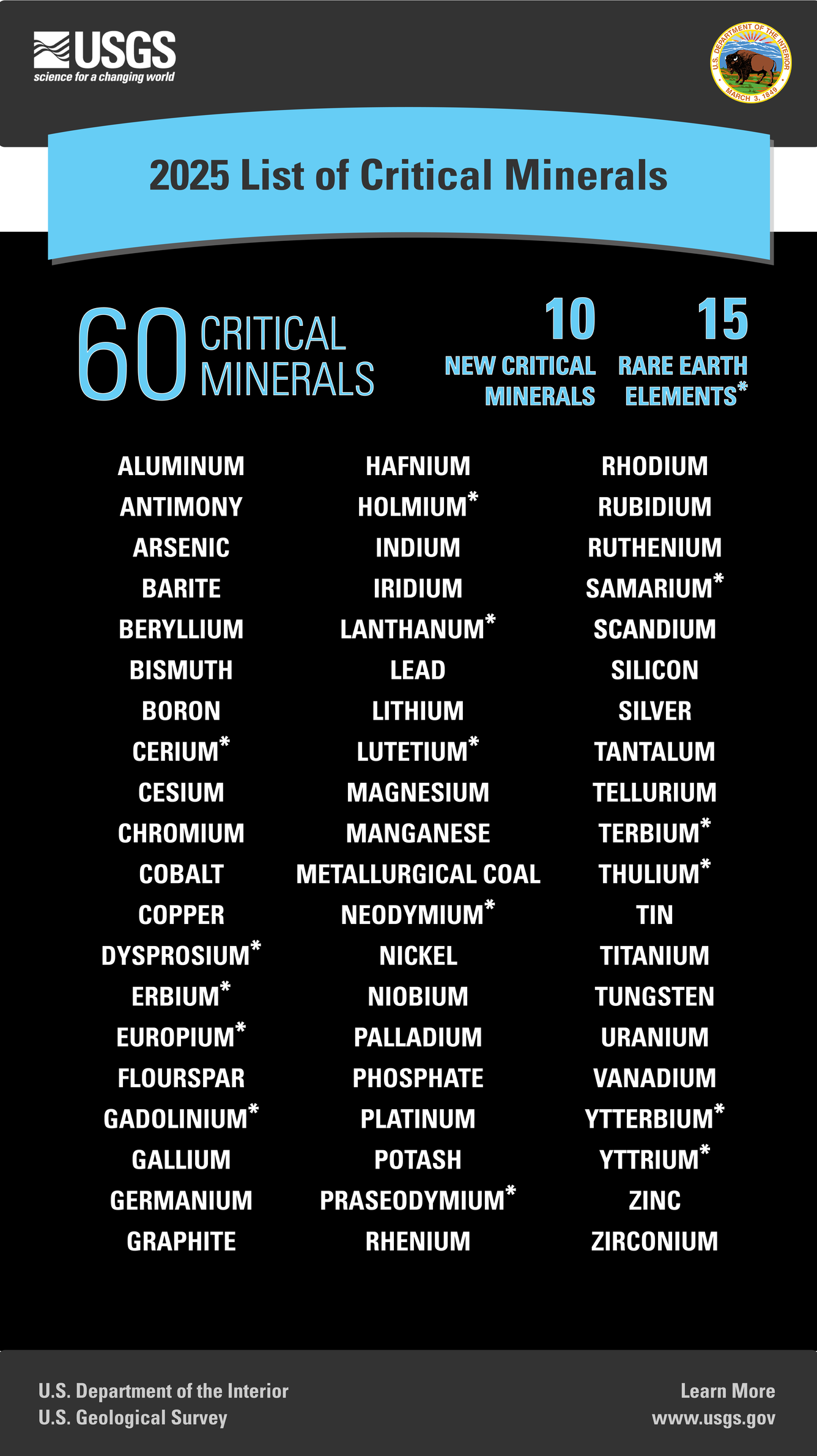
美国正式公布新版关键矿产清单:首次纳入铜,银铀钾肥也入列
Hua Er Jie Jian Wen· 2025-11-07 00:00
Core Points - The U.S. government has made its largest adjustment to the critical minerals list since its inception, directly impacting the Section 232 investigation announced by the Trump administration in April, which may lead to tariffs and trade restrictions on related products [1] - The updated list now includes copper, uranium, silver, metallurgical coal, potash, rhenium, silicon, and lead, marking a significant change from the 2022 version [1] - This adjustment aims to reduce U.S. reliance on imports and expand domestic production, as stated by U.S. Secretary of the Interior Doug Burgum [1] Group 1 - The inclusion of copper and potash addresses supply chain risks, with copper being crucial for electrification, defense, and clean energy [4][5] - The U.S. imports nearly half of its copper consumption, primarily from Chile, Peru, and Canada, while most global copper refining capacity is concentrated in China [5] - Potash, used mainly for fertilizer production, is largely imported from Canada, with 80% of U.S. usage coming from there [5] Group 2 - The addition of silver has raised concerns among precious metal traders and manufacturers reliant on the material, as the U.S. heavily depends on imports to meet domestic silver demand [6] - Silver's inclusion is a response to potential supply disruptions from Mexico, with the U.S. Geological Survey (USGS) categorizing minerals by risk levels for the first time [6] - The new assessment method considers economic consequences of supply shocks and highlights vulnerabilities from reliance on single domestic producers [6] Group 3 - Metallurgical coal and uranium were added to the final list despite not being included in the draft published in August, indicating a comprehensive evaluation process [7] - Metallurgical coal is essential for steel production, while uranium serves as fuel for nuclear power plants [7] - The USGS removed arsenic and tellurium from the critical minerals list due to decreased supply disruption risks and increased domestic production [7]

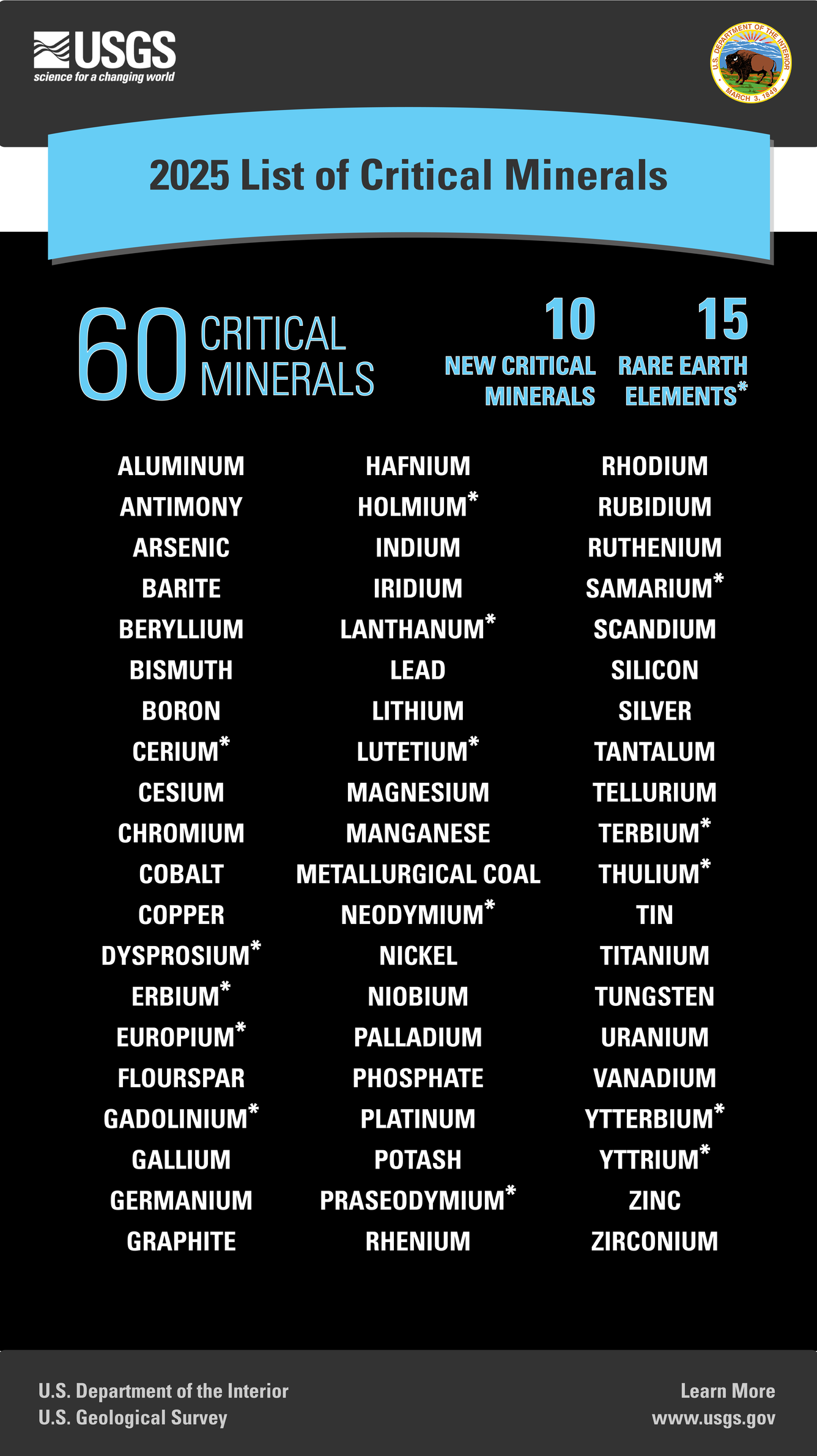
美国正式公布新版关键矿产清单,首次纳入铜,银铀钾肥也入列
Hua Er Jie Jian Wen· 2025-11-06 16:19
Core Viewpoint - The U.S. government has made its largest adjustment to the critical minerals list since its inception, directly impacting the Section 232 investigation announced by the Trump administration, which may lead to tariffs and trade restrictions on related products [1]. Group 1: Key Minerals Added - Copper has been added to the critical minerals list for the first time, marking a significant change since the list was first published in 2018 [1]. - The updated list also includes uranium, silver, metallurgical coal, potash, rhenium, silicon, and lead, replacing the 2022 version [1]. - The inclusion of these minerals aims to reduce U.S. dependence on imports and expand domestic production [1]. Group 2: Market Reactions - Following the announcement of the new critical minerals list, copper ETFs rose approximately 2%, while Southern Copper Corporation increased by 1.6%. In contrast, Freeport and McEwen saw declines of 1.2% and 1.9%, respectively [4]. - The decision on the critical minerals list will influence mining investments, recycling of mining waste, tax incentives for mineral processing, and mining permit approval processes [4]. Group 3: Strategic Importance of Copper and Potash - Copper is recognized for its strategic importance due to its applications in transportation, defense, and power network construction, especially as demand for electricity rises with the growth of data centers and artificial intelligence [5]. - The U.S. imports nearly half of its copper consumption, primarily from Chile, Peru, and Canada, with most global refining capacity concentrated in China [5]. - Potash, primarily used in fertilizer production, has been included due to potential trade barriers from major supplying countries, with about 80% of U.S. potash imports coming from Canada [5]. Group 4: Concerns Over Silver - The addition of silver to the critical minerals list has raised concerns among precious metal traders and manufacturers reliant on the material, as the U.S. heavily depends on imports to meet domestic silver demand [6]. - Silver is widely used in electronics, solar panels, and medical devices, and any tariffs on silver could significantly impact the metal market [6]. Group 5: New Assessment Methods - A new assessment method has been introduced to evaluate the economic consequences of supply shocks and highlight vulnerabilities associated with reliance on single domestic producers [7]. - The updated list includes metallurgical coal and uranium, which were not part of the draft published in August, indicating a comprehensive evaluation process [7]. - Arsenic and tellurium have been removed from the critical minerals list due to changes in domestic production and supply risk assessments [7].
Denison Mines (DNN) Surges 10.4% as US Govt Places $80-Billion Bet on Nuclear
Yahoo Finance· 2025-10-29 14:06
Group 1 - Denison Mines Corp. experienced a significant increase of 10.43% on Tuesday, closing at $3.07 per share, driven by investor interest in uranium stocks following a US government announcement of an $80 billion investment in the energy sector [1][3] - The positive sentiment for the nuclear industry was bolstered by the US government's collaboration with Cameco Corp., Brookfield Asset Management, and Westinghouse Electric Company to enhance nuclear power deployment through new reactor development [2][3] - The US government's nuclear development initiative is expected to increase demand for uranium products, benefiting uranium producers like Denison Mines, which saw a rally alongside other companies such as NexGen Energy, Uranium Energy, and Energy Fuels [3]

NexGen (NXE) Climbs 12% as Govt Bares $80-Billion Support for Nuclear Devt
Yahoo Finance· 2025-10-29 14:05
Group 1 - NexGen Energy Ltd. (NYSE:NXE) experienced a 12% increase in share prices, closing at $9.52, driven by positive investor sentiment following the US government's $80 billion investment in the energy sector [1][3] - The rally in NexGen Energy's stock was part of a broader trend among uranium stocks, including Denison Mines, Uranium Energy, and Energy Fuels, due to a billion-dollar partnership involving Cameco Corp., Brookfield Asset Management, and Westinghouse Electric Company aimed at enhancing nuclear power deployment in the US [2][3] - The optimism surrounding the partnership is expected to increase demand for uranium products as more nuclear reactors are deployed, benefiting NexGen Energy and other uranium stocks [3] Group 2 - NexGen Energy successfully raised up to A$1 billion through a global offering of new shares, with proceeds designated for the development of the Rook I Project, which is the largest development-stage uranium project in Canada [4]

全线大涨!美国突传大消息!
天天基金网· 2025-10-29 01:13
Core Viewpoint - The article discusses significant developments in the nuclear power sector in the United States, driven by the increasing electricity demand from artificial intelligence (AI) and the strategic partnerships formed between the government and private companies to enhance nuclear energy production [3][5][10]. Group 1: Government Actions and Agreements - The U.S. government has signed an $80 billion agreement with Westinghouse Electric Company to build nuclear reactors to meet the growing electricity demand from AI [5][10]. - This partnership involves Brookfield Asset Management and Canadian uranium producer Cameco Corp, which recently acquired Westinghouse for approximately $7.9 billion [5][6]. - The plan aims to solidify the U.S. position as a nuclear power leader and increase the global export of Westinghouse nuclear technology [7][8]. Group 2: Job Creation and Economic Impact - Each AP1000 nuclear power plant with two units is expected to create or maintain 45,000 manufacturing and engineering jobs across 43 states, with over 100,000 construction jobs nationwide [6][8]. - The initiative is part of a broader strategy to revitalize the nuclear energy sector, which includes regulatory reforms and increased investment in nuclear technology [8]. Group 3: Corporate Involvement and Projects - Major tech companies like Google and Microsoft are entering agreements to restart closed nuclear power plants to meet their energy needs for AI data centers [10][11]. - Google has signed a 25-year power purchase agreement with NextEra to restart the Duane Arnold Energy Center in Iowa, with a projected cost exceeding $1.6 billion and expected to begin operations in 2029 [10][11]. - Microsoft has also reached a similar agreement to restart the Three Mile Island nuclear plant in Pennsylvania, highlighting a trend of tech companies opting to revive existing facilities rather than building new ones [11]. Group 4: Safety Concerns and Criticism - Critics caution that efforts to restart decommissioned nuclear plants must adhere to strict regulatory standards, emphasizing the need for careful consideration of safety, especially for aging reactors [12]. - Concerns have been raised regarding the Duane Arnold plant, which suffered significant damage during a storm and shares design similarities with the Fukushima reactor that experienced a meltdown in 2011 [12].

深夜全线大涨,美国突传大消息
Zheng Quan Shi Bao· 2025-10-28 23:58
Core Viewpoint - The U.S. government has signed an $80 billion agreement with Westinghouse to build nuclear reactors to meet the growing electricity demand driven by artificial intelligence, leading to a surge in nuclear power stocks [1][3][4]. Group 1: U.S. Nuclear Power Developments - The U.S. government has partnered with Westinghouse, Cameco Corp, and Brookfield Asset Management to accelerate nuclear power deployment, with plans to construct reactors worth at least $80 billion [3][4]. - Each AP1000 nuclear power plant, equipped with two units, is expected to create or maintain 45,000 manufacturing and engineering jobs across 43 states, with over 100,000 construction jobs nationwide [3][4]. - The initiative aims to solidify the U.S. position as a nuclear power leader and enhance the global export of Westinghouse nuclear technology [4]. Group 2: Technology Companies' Involvement - Google has reached an agreement with NextEra to restart the Duane Arnold Energy Center in Iowa, which has been closed for five years, to address the electricity demand from AI [7][8]. - The Duane Arnold plant, with a capacity of 615 megawatts, is expected to have a restart cost exceeding $1.6 billion and is planned to begin supplying power in 2029 [7][8]. - Microsoft has also partnered with Constellation Energy to restart the Three Mile Island nuclear plant in Pennsylvania, indicating a trend among tech companies to collaborate with nuclear firms to revive old reactors rather than waiting for new technologies [7][8]. Group 3: Regulatory and Safety Considerations - The Trump administration is expected to assist Westinghouse in obtaining land and permits for reactor construction, potentially providing loan guarantees [4][5]. - Concerns have been raised regarding the safety of restarting older reactors, particularly the Duane Arnold plant, which suffered significant damage from a storm in 2020 [9]. - Analysts suggest that reviving idle nuclear plants is more cost-effective and quicker than building new facilities from scratch, although critics emphasize the need for strict regulatory compliance [8][9].
总计5500亿美元!日本对美投资计划清单曝光,最大项目近1000亿美元,美股这一板块应声大涨
Mei Ri Jing Ji Xin Wen· 2025-10-28 16:40
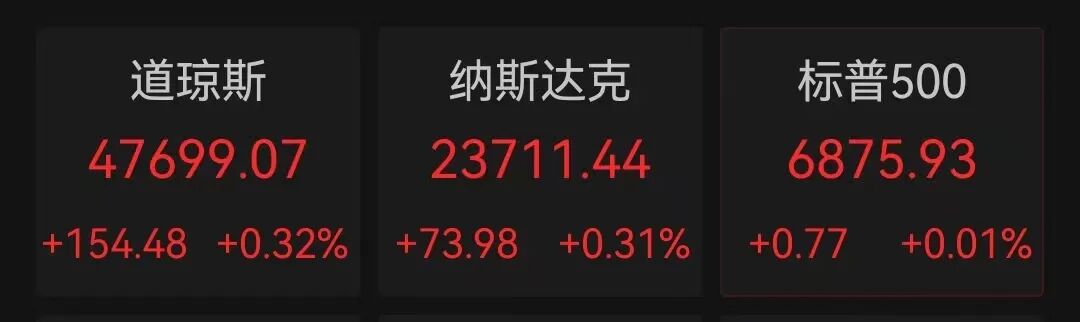
Group 1: US-Japan Investment Cooperation - The Japanese government has unveiled a potential project list under a $550 billion investment mechanism with the US, detailing specific funding proposals related to the US-Japan trade agreement [3][4] - The project list includes investments from companies like SoftBank, Westinghouse Electric, and Toshiba in sectors such as energy, artificial intelligence, and critical minerals, with individual project sizes ranging from $350 million to $100 billion [3][4] - Energy projects dominate the list, with Westinghouse planning to invest nearly $100 billion in AP1000 nuclear reactors and small modular reactors, while SoftBank is interested in a $25 billion power infrastructure project [4] Group 2: Market Reactions and Stock Performance - US stock indices reached new historical highs, with the Dow Jones up 0.32%, Nasdaq up 0.31%, and S&P 500 up 0.01% as of the report [1] - The uranium sector saw significant gains, with uranium stocks rising by 11.5%, including Cameco up over 20% and Uranium Energy up over 11% [6] - The nuclear power sector also experienced a rise of 3.87%, with NuScale Power increasing by nearly 12% [6] Group 3: Apple and Microsoft Market Performance - Microsoft’s market capitalization briefly surpassed $4 trillion, with shares trading at approximately $541.68 [9][12] - Apple’s market capitalization also briefly exceeded $4 trillion, although it later fell back to around $3.99 trillion, with the stock price showing a slight increase of 0.02% [12][13] - Reports indicate strong early sales for Apple's iPhone 17 series, outperforming the iPhone 16 series by 14% in the first ten days post-launch in China and the US [14]
I continue to like uranium, says 'Fast Money' trader Tim Seymour
CNBC Television· 2025-10-24 22:21
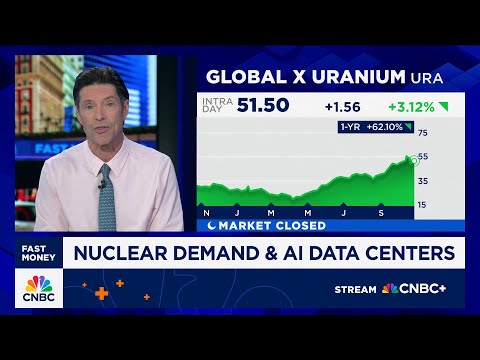
Market Trends & Investment Opportunities - Brookfield Asset Management is in talks to acquire two reactors from South Carolina, indicating growing interest and potential valuation increases in the uranium sector [1] - Limited assets and a handful of key players characterize the uranium market, with names like Centric Oaklo uranium Energy experiencing significant gains [2][1] - Government commitment to nuclear power infrastructure supports the demand for uranium [1][6] - Reactivation of abandoned reactors by Brookfield signifies strong demand for uranium [4] Company & Financial Performance - Mentions of specific companies like Centric Oaklo uranium Energy seeing "outsized gains" suggest potential investment opportunities, but also highlight volatility [1][5] - Kamo is noted as being very expensive and volatile, but trending higher [2] - URA ETF is presented as an option for broader exposure to the uranium market [2] Risks & Speculation - Uranium stocks are currently in a "very speculative" phase, with potential for rapid price drops, as exemplified by Oakland's 40% drop in 48 hours [5] - Transition from speculative to non-speculative hinges on the successful construction and operation of multiple reactors [6] - The timeline for achieving operational reactors remains uncertain [7] Demand Drivers - The need for uranium is expected to increase significantly in the future [3] - The demand for power, particularly to support AI, is a key driver for nuclear energy and uranium [6]
美股核电概念股强势拉升
Ge Long Hui A P P· 2025-10-15 13:53
Core Viewpoint - NuScale Power, Centrus Energy, OKLO, and Uranium Energy have experienced significant stock price increases, with NuScale Power and Centrus Energy rising over 8%, OKLO nearly 8%, and Uranium Energy over 6% [1] Company Summaries - NuScale Power's stock has surged by more than 8%, indicating strong market interest and potential growth in the nuclear energy sector [1] - Centrus Energy also saw its shares increase by over 8%, reflecting positive investor sentiment towards companies involved in uranium enrichment and nuclear fuel supply [1] - OKLO's stock price rose nearly 8%, suggesting a favorable outlook for small modular reactor technology and its applications in the energy market [1] - Uranium Energy's shares increased by over 6%, highlighting ongoing demand for uranium as a critical component in nuclear energy production [1]