
沪农商行

Search documents
沪农商行:构建差异化竞争优势
Zheng Quan Ri Bao Wang· 2026-01-30 12:14
Core Viewpoint - The company aims to transform its technology finance approach from a "pioneer" to a "leader" by cultivating early-stage small and hard technology enterprises, specializing in industry finance, and empowering the sci-tech ecosystem through a differentiated competitive advantage [1] Group 1: Unique Competitive Advantages - The company is establishing a unique advantage and competitive barrier focused on discovering and nurturing early-stage small and hard technology enterprises [1] - It emphasizes the "donation+" model and is proactively laying out future industries such as brain-computer interfaces, establishing deep connections with sci-tech teams from the initial stage of technology transformation [1] Group 2: Professional Leadership and Risk Control - The company plans to leverage its industry research institute to explore an online, intelligent, and data-driven precise marketing and smart risk control system [1] - It aims to implement a "one bank, one policy" intelligent and professional full-process risk control system, focusing on key industries in Shanghai to identify and select high-quality enterprises [1] Group 3: Innovative Empowerment Platform - The company is launching the "Xindongneng+" online empowerment platform, which will be the first open empowerment ecosystem in the banking industry focused on technology enterprises [1] - This platform will connect government departments, industrial parks, investment institutions, and professional service organizations, providing a one-stop professional module for legal consulting, tax consulting, equity financing, policy services, merger facilitation, and IPO advisory [1] - The goal is to create an efficient empowerment ecosystem that supports the establishment of long-term sustainable customer relationships and value growth foundations, injecting new digital momentum into the high-quality development of technology finance [1]
卫星扎堆「上天」,银行风控卷出「新高度」
Xin Lang Cai Jing· 2026-01-30 10:41
Core Insights - The commercial space industry is experiencing a surge in interest and investment, driven by increased policy support and the active participation of various sectors, including traditional banking [1][25][27]. Group 1: Policy and Industry Trends - Beijing has issued measures to promote the development and utilization of commercial satellite remote sensing data from 2026 to 2030, encouraging the construction of differentiated commercial satellite constellations with clear commercial value and application prospects [2][26]. - The banking sector, traditionally seen as unrelated to space, is now actively engaging in commercial space initiatives, with banks like China Merchants Bank and Shanghai Pudong Development Bank launching their own satellites [3][28]. Group 2: Satellite Launches and Applications - On January 16, 2024, China Merchants Bank's "Zhaoyin Jinkui" and Shanghai Pudong Development Bank's "Pudong Smart" satellites were successfully launched, both part of China's first global low-orbit satellite IoT constellation, "Tianqi Constellation" [4][29]. - The "Zhaoyin Jinkui" satellite is designed for high-precision monitoring of construction progress for first-hand mortgage properties, while the "Pudong Smart" satellite aims to enhance intelligent risk control and provide critical financial services during extreme scenarios like natural disasters [6][31]. Group 3: Evolution of Banking Risk Control - The trend of banks launching satellites signifies a shift from traditional ground-based data reliance to a "heaven and earth collaboration" model, enhancing risk control capabilities in response to complex and changing realities [12][45]. - Satellites provide high-resolution optical, radar, and multispectral sensors, offering banks a stable and objective "God's eye view" to address the core pain point of information asymmetry in traditional risk control [13][36]. Group 4: Innovations in Risk Management - The "Zhaoyin Jinkui" satellite can increase monitoring accuracy to over 95%, significantly improving traditional post-loan inspection efficiency [38]. - The integration of satellite technology with AI and deep learning, as seen in the "Dashanque" system by WeBank, allows for precise analysis of agricultural data, aiding in the determination of reasonable credit limits for farmers [38][40]. Group 5: Future Implications for Banking and Space - The banking sector's involvement in commercial space may lead to deeper due diligence and value discovery, as banks seek to understand and engage with the complexities of the commercial space industry [21][43]. - The future of financial competition may hinge on the ability to create intelligent collaborative networks between "starry skies" and "real ground," positioning banks to leverage new opportunities in the evolving commercial space landscape [24][46].






上海农商银行“捐赠+”模式首期项目落地
Xin Lang Cai Jing· 2026-01-30 04:12
(来源:经济日报) 上海农商银行"捐赠 +"是促进早期科技成果转化的创新模式,与上海理工大学的合作聚焦医工交叉领域 产业化发展与医疗器械概念验证工程化中心建设两大重点方向。在实施捐赠的同时,上海农商银行还联 动政府部门、投资机构、产业园区等多方生态圈资源,为早期科研项目提供从资金支持、技术验证到市 场对接的全链条服务,全力破解科技成果转化"最初一公里" ,着力打造科创客户全周期服务体系,建 设科技金融"线上+线下"生态圈,深化行业金融专业支撑,坚持"向早、向小、向硬",持续探索科技金 融服务的"无人区"。 转自:经济日报 未来,上海农商银行将聚焦"捐赠 +"项目全生命周期需求深化合作,提供覆盖公司成立前后的金融服务 与孵化赋能,配套人才服务等增值支持,同时激活专家库资源,推动更多科研成果落地转化,共同为上 海科创产业高质量发展注入动力。(经济日报记者 李治国) 1月28日,上海农商银行创新推出的、旨在推动早期科研转化的"捐赠+"模式首期10个项目落地。 据了解,2025年6月,上海农商银行与上海理工大学签署早期科技成果转化"捐赠+"合作方案,共建成果 转化赋能生态圈。合作以来,双方聚焦医学前沿与临床需求,从1 ...
上海农商银行发布贯彻落实相关领域贷款财政贴息政策公告
Jin Tou Wang· 2026-01-30 03:34
Core Viewpoint - Shanghai Rural Commercial Bank is implementing financial subsidy policies for personal consumption loans, small and micro enterprises, and service industry loans to stimulate consumption and support the real economy in accordance with government directives [1][2][3] Personal Consumption Loan Subsidy - Individuals can enjoy financial subsidies on personal consumption loans or credit card bill installments if the usage meets the specified requirements, with details to be announced later [1] Small and Micro Enterprises Loan Subsidy - Small and micro private enterprises in key industry chains can receive financial subsidies for newly issued fixed asset loans from January 1, 2026, to December 31, 2026, if they meet the specified requirements [2] Service Industry Loan Subsidy - The bank supports 11 major consumption sectors, including catering, health, and tourism, by providing financial subsidies for loans aimed at improving consumption infrastructure or enhancing service supply capabilities during the same period [3] Compliance and Process - Shanghai Rural Commercial Bank will comply with policy requirements, streamline processes, and ensure no service fees are charged for these subsidy services, with further details to be communicated through official channels [3]
政策呵护流动性充裕,银行板块估值修复受关注!
Sou Hu Cai Jing· 2026-01-30 02:52
Group 1 - The core viewpoint of the articles highlights the positive performance of the banking sector, with the China Banking Index (399986) rising by 0.24% and key banks like Qingdao Bank and CITIC Bank showing significant gains [1] - The People's Bank of China conducted a 7-day reverse repurchase operation of 477.5 billion yuan at a rate of 1.4%, resulting in a net liquidity injection of 352.5 billion yuan for the day [1] - The central bank's actions in January have led to a net liquidity injection exceeding 1 trillion yuan, indicating a proactive approach to maintain a stable monetary environment [1] Group 2 - The banking sector is expected to benefit from supportive fiscal and monetary policies, which are likely to bolster performance and improve valuations [1] - The Huaxia Bank ETF (515020) is noted for having the lowest comprehensive fee rate among ETFs tracking the China Banking Index [2]
农商行板块1月29日涨2.37%,渝农商行领涨,主力资金净流入6754.01万元
Zheng Xing Xing Ye Ri Bao· 2026-01-29 09:03
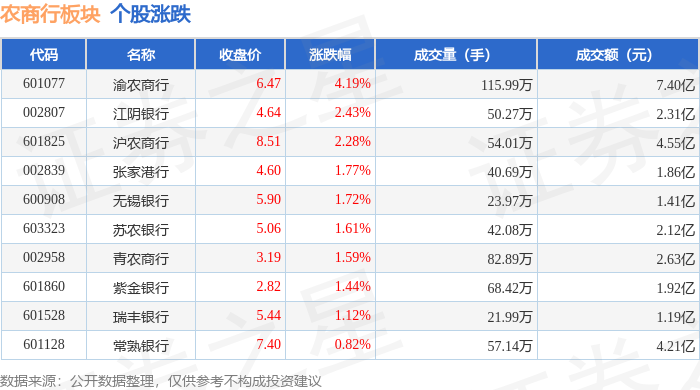
Group 1 - The agricultural commercial bank sector increased by 2.37% on January 29, with Chongqing Rural Commercial Bank leading the gains [1] - The Shanghai Composite Index closed at 4157.98, up 0.16%, while the Shenzhen Component Index closed at 14300.08, down 0.3% [1] - Major stocks in the agricultural commercial bank sector showed varying performance, with Chongqing Rural Commercial Bank closing at 6.47, up 4.19% [1] Group 2 - The net inflow of main funds in the agricultural commercial bank sector was 67.54 million yuan, while retail funds saw a net inflow of 44.49 million yuan [1] - The table of fund flows indicates that the main funds had a negative net flow in several banks, including Shanghai Rural Commercial Bank and Jiangyin Bank [2] - Retail investors showed a positive net flow in several banks, including Jiangyin Bank and Su Nong Bank, despite some negative flows in other banks [2]




生态赋能,价值创造,沪农商行“捐赠+”模式首期项目落地
Jin Rong Jie· 2026-01-28 12:01
近年来,上海农商银行坚持"谋科创就是谋未来"理念,着力深耕金融资源最稀缺、服务难度最大的"0-1 阶段"成果转化项目及初创期科技企业服务,布局从"孵化"到"成熟"的接力培育体系。 未来,上海农商银行将聚焦"捐赠 +"项目全生命周期需求深化合作,提供覆盖公司成立前后的金融服务 与孵化赋能,配套人才服务等增值支持,同时激活专家库资源,推动更多科研成果落地转化,共同为上 海科创产业高质量发展注入动力。 银行频道更多独家策划、专家专栏,免费查阅>> 责任编辑:小讯 1月28日,上海农商银行创新推出的、旨在推动早期科研转化的"捐赠+"模式首期10个项目落地,上海农 商银行副行长张跃红、上海理工大学副校长张众参加项目阶段性总结活动。 2025年6月,上海农商银行与上海理工大学签署早期科技成果转化"捐赠+"合作方案,共建成果转化赋能 生态圈。合作以来,双方聚焦医学前沿与临床需求,从103个候选项目中遴选出10个优秀项目,涵盖医 学影像与智能诊断、AI辅助诊疗、康复与神经工程、生物医药、高端医疗设备五大方向,突出体现 了"医工交叉、智能驱动、国产替代"的转化导向。针对这10个项目,上海农商银行将依托"捐赠+"合作 方案提供早 ...
反洗钱宣传月|全民反洗钱 护航新生活(一)
天天基金网· 2026-01-28 11:58
全民反洗钱 护航新生活 认真贯彻落实反洗钱法 切实推进洗钱风险防控 2024年11日8日、 笠十四届全国人 大常委会第十二次会议表决通过了最新 修订的《中华人民共和国反洗钱法》, 自2025年1月1日起施行。 新《反洗钱法》是中央金融工作会议 之后修订出台的第一部金融领域法律,其 颁布实施标志着中国反洗钱事业发展进入 了一个新的历史阶段,具有里程碑意义。 让我们一同深入了解新《反洗钱法》。 = : # # # " 1 IX 110 1500 HFFV 反洗钱是指为了预防通过各种方式掩 饰、隐瞒犯罪所得及其收益的来源、性质 的洗钱活动,依照本法规定采取相关措施 的行为。 黑社会性质的 组织犯罪 毒品犯罪 恐怖活动犯罪 走私犯罪 破坏金融管理 贪污贿赂犯罪 金融诈骗犯罪 其他犯罪 第二条 第三条 贯彻落实党和国家路线方针政策、 决策部署,坚持总体国家安全观,完善监 督管理体制机制,健全风险防控体系。 第四条 反洗钱工作应当依法进行,确保反洗 钱措施与洗钱风险相适应,保障正常金融 服务和资金流转顺利进行,维护单位和个 人的合法权益。 音量机构 SEEFLY F 内部控制制度 第二十七条 会融机构应当建立健全反洗钱内 ...

农商行板块1月28日涨0.59%,常熟银行领涨,主力资金净流入9116.38万元
Zheng Xing Xing Ye Ri Bao· 2026-01-28 09:04
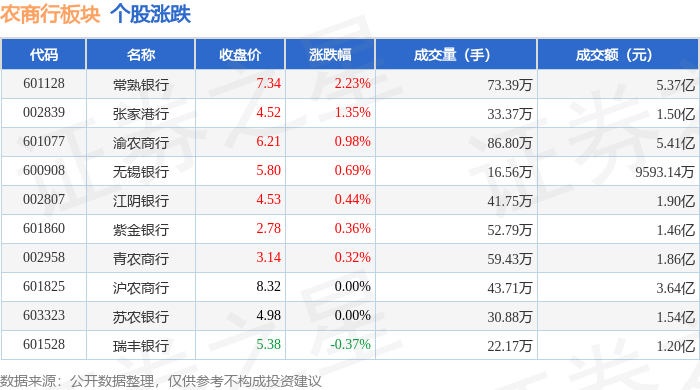
Core Insights - The agricultural commercial bank sector experienced a rise of 0.59% on January 28, with Changshu Bank leading the gains [1] - The Shanghai Composite Index closed at 4151.24, up by 0.27%, while the Shenzhen Component Index closed at 14342.9, up by 0.09% [1] Agricultural Commercial Bank Sector Performance - Changshu Bank (601128) closed at 7.34, with an increase of 2.23% and a trading volume of 733,900 shares, amounting to a transaction value of 537 million [1] - Zhangjiagang Bank (002839) closed at 4.52, up by 1.35%, with a trading volume of 333,700 shares and a transaction value of 150 million [1] - Yunnan Agricultural Commercial Bank (601077) closed at 6.21, increasing by 0.98%, with a trading volume of 868,000 shares and a transaction value of 541 million [1] - Other banks such as Wuxi Bank (600908), Jiangyin Bank (002807), and Zijin Bank (601860) also showed modest gains [1] Capital Flow Analysis - The agricultural commercial bank sector saw a net inflow of 91.16 million from institutional investors, while retail investors experienced a net outflow of 205 million [1] - Notable net inflows from individual stocks include Hu Agricultural Commercial Bank (601825) with 52.25 million from institutional investors and Zhangjiagang Bank (002839) with 13.01 million [2] - Conversely, Yunnan Agricultural Commercial Bank (601077) and Hu Agricultural Commercial Bank (601825) faced significant net outflows from retail investors, amounting to 88.16 million and 98.40 million respectively [2]


一文纵览全国分省份财政社融特征
GF SECURITIES· 2026-01-28 07:49
Investment Rating - The industry investment rating is "Buy" [2] Core Insights - The average narrow deficit ratio for all provinces in 2024 is 16.4%, and the average broad deficit ratio is 20.0%, both at relatively low levels since 2010. The average debt ratio stands at 357.0%, which has been on the rise since 2016 [5] Summary by Sections Regional Finance - The average tax revenue ratio across provinces is 67.2% in 2024, showing a year-on-year decline of 2.7%. The overall trend indicates a decrease in tax revenue reliance [20][26] - The average fiscal self-sufficiency rate for all provinces is 43.9% in 2024, reflecting a continuous decline since 2013 [17][19] - The government fund budget, which accounts for 20% of fiscal revenue, has seen a revenue decline of 14.2% year-on-year in 2024, primarily due to the downturn in the real estate market [27][28] Regional Social Financing - The new social financing has shown significant differentiation, with a notable concentration in economically developed eastern regions. Approximately 60% of the new social financing increment from 2020 to 2024 has been directed towards eastern regions, although this percentage has been gradually declining [5] - In 2024, the marginal contribution of government financing has increased, while corporate financing has decreased. The contribution of government departments to new loans is 69.1%, while corporate and household contributions are 34.7% and 24.8%, respectively [5][19]


