
石药集团

Search documents
阿斯利康发布2026年业绩指引,预计核心每股收益两位数增长
Xin Lang Cai Jing· 2026-02-15 23:25
Core Viewpoint - AstraZeneca expects a double-digit percentage growth in core earnings per share by 2026, with total revenue projected to grow in the mid-to-high single digits at constant exchange rates [1] Group 1: Clinical Trials and Product Development - The company plans to announce results from up to 20 advanced clinical trials by 2026, focusing on oncology, respiratory diseases, and rare diseases [1] - Key trials include AVANZAR and TROPION-Lung07 [1] - The oral GLP-1 drug elecoglipron has entered late-stage clinical trials, and the company has partnered with CSPC Pharmaceutical Group to accelerate its entry into the weight loss drug market [1] Group 2: Financial Outlook and Shareholder Returns - AstraZeneca has increased its annual dividend by approximately 3% to $3.30 [1] - The company reaffirms its long-term goal of achieving $80 billion in revenue by 2030 [1]

中国创新药对外授权年交易额突破千亿美元,4年增长近10倍
YOUNG财经 漾财经· 2026-02-14 09:10
Core Insights - The annual transaction value of China's innovative drug licensing has surpassed $100 billion, marking a nearly tenfold increase over four years, with a total of $137.7 billion in licensing deals signed in 2025 [2] - Major global pharmaceutical companies, including Novartis, AstraZeneca, and GSK, have signed significant agreements with Chinese firms, indicating a strong interest in China's next-generation innovative drug development pipelines [3] - The average transaction size for licensing deals involving Chinese biopharmaceutical companies has significantly increased this year, with an average deal size of $1.3 billion, a 76% increase from 2025 and six times the average size in 2021 [4] Group 1 - In 2025, there were 186 licensing transactions involving Chinese companies, reflecting a growing trend in the biopharmaceutical sector [2] - The average upfront payment for licensing deals this year is $77.7 million, double that of 2025 and three times the average in 2021 [4] - Notable recent agreements include a strategic partnership between Innovent Biologics and Eli Lilly worth $8.85 billion, and a potential $18.5 billion collaboration between AstraZeneca and CSPC Pharmaceutical Group [4] Group 2 - Macquarie Capital predicts that oncology drugs will continue to attract global pharmaceutical companies, highlighting China's strong capabilities in chemical drug development [5] - Multinational companies are increasingly viewing China as a critical part of their global R&D infrastructure, especially as they face patent cliffs and seek to reduce costs [5] - Vision Lifesciences reports that China leads the world in specific molecular types, with Chinese companies accounting for nearly 90% of global licensing transactions for antibody-drug conjugates (ADCs) [5]

中国创新药对外授权年交易额突破千亿美元,4年增长近10倍
第一财经· 2026-02-14 08:43
根据数据提供商Pharmcube的最新数据,2025年,中国企业签署了1377亿美元总规模的对外许可 交易,较2021年增长了近10倍,交易数量达到186项。 2026.02. 14 本文字数:1085,阅读时长大约2分钟 作者 | 第一财经 钱童心 中国生物制药公司参与的新药对外许可授权交易在2025年再次创下历史新高,并突破了千亿美元大 关。 麦格理资本亚洲医疗保健研究部门预测,今年被视为肿瘤治疗基石的一类药物将继续吸引全球制药商 的关注。麦格理资本分析师指出,尽管中国在生物学领域的实力相较于美国仍有差距,但在化学领域 实力雄厚,跨国公司可以从中国企业获得有前景的分子授权,其成本低于大型企业内部研发成本。 麦格理资本在最近的一份报告中表示:"许多跨国公司正将中国视为其全球研发基础设施的重要组成 部分。尤其是在一些公司面临专利悬崖之际,为了削减成本,这一点显得尤为重要。" 行业咨询公司Vision Lifesciences在去年12月发布的2026年生物技术许可展望报告中也指出,中国 在特殊分子类型方面处于世界领先地位。以热门的肿瘤疗法抗体偶联药物(ADC)为例,中国企业 占据了全球此类药物对外许可交易的近 ...
中国创新药对外授权年交易额突破千亿美元 4年增长近10倍
Di Yi Cai Jing· 2026-02-14 06:44
Group 1 - In 2025, Chinese biopharmaceutical companies achieved a record high in outbound licensing deals, surpassing $137.7 billion, nearly a tenfold increase from 2021, with 186 transactions [1] - Major global pharmaceutical companies, including Novartis, AstraZeneca, and GSK, signed significant agreements with Chinese firms last year [1] - Tom Barsha from Bank of America Securities predicts that the total value of these licensing deals could double again in the next 18 to 24 months, as global companies focus on finding next-generation innovative drug pipelines in China [1] Group 2 - AstraZeneca announced a collaboration with China’s CSPC Pharmaceutical Group, potentially worth up to $18.5 billion, to develop a next-generation GLP-1 class weight loss therapy [2] - The average deal size for outbound licensing by Chinese pharmaceutical companies has reached $1.3 billion this year, a 76% increase from 2025 and six times the average level of 2021 [2] - Macquarie Capital analysts noted that many multinational companies view China as a crucial part of their global R&D infrastructure, especially as they face patent cliffs and seek to reduce costs [2]
中国创新药对外授权年交易额突破千亿美元,4年增长近10倍
Di Yi Cai Jing· 2026-02-14 06:37
Core Insights - Many multinational companies are increasingly viewing China as a crucial part of their global R&D infrastructure, especially as they face patent cliffs and seek to cut costs [1][4] - The value of licensing agreements for new drugs from Chinese biopharmaceutical companies is expected to reach a historic high of over $100 billion by 2025, with a total of $137.7 billion in licensing deals signed in 2025, nearly a tenfold increase from 2021 [1][4] Group 1 - Global pharmaceutical giants, including Novartis, AstraZeneca, and GSK, signed multiple significant agreements with Chinese companies last year [3] - Tom Barsha, head of Asia-Pacific M&A at Bank of America Securities, predicts that the total value of these licensing deals could double again in the next 18 to 24 months, as global companies focus on finding next-generation innovative drug pipelines in China [3] - There have been nearly 40 licensing transactions involving Chinese biopharmaceutical companies this year, with average deal sizes significantly higher than last year [3] Group 2 - The average deal size for licensing agreements from Chinese pharmaceutical companies this year has reached $1.3 billion, a 76% increase from 2025 levels and approximately six times the average from 2021 [4] - The average upfront payment this year is $77.7 million, doubling from $38.8 million in 2025 and tripling from the average in 2021 [4] - Macquarie Capital's Asia healthcare research department predicts that a class of drugs considered foundational for cancer treatment will continue to attract global pharmaceutical interest [4] Group 3 - Many multinational companies are recognizing China's strength in chemical fields, allowing them to obtain promising molecular licenses at lower costs compared to internal R&D [4] - Vision Lifesciences' report highlights that China is a world leader in specific molecular types, with Chinese companies accounting for nearly 90% of global licensing deals for antibody-drug conjugates (ADCs) [4]

阿斯利康2025年财报发布,营收增长8%,肿瘤业务表现强劲
Jing Ji Guan Cha Wang· 2026-02-13 19:42
经济观察网阿斯利康于2026年2月10日发布2025年全年财报,总营收达587.39亿美元,同比增长8%;其 中肿瘤板块收入256.19亿美元,同比增长14%,占总营收44%。公司2025年第四季度营收155.03亿美 元,符合市场预期,核心营业利润41.00亿美元,主因研发投入加码。2026年业绩指引预计收入中高个 位数增长,核心盈利双位数增长,研发投入占比维持约24%。 财报分析 阿斯利康于2026年2月10日发布2025年全年财报,总营收达587.39亿美元,同比增长8%;其中肿瘤板块 收入256.19亿美元,同比增长14%,占总营收44%。公司2025年第四季度营收155.03亿美元,符合市场 预期,核心营业利润41.00亿美元,主因研发投入加码。2026年业绩指引预计收入中高个位数增长,核 心盈利双位数增长,研发投入占比维持约24%。 近期事件 战略合作:2026年2月10日,阿斯利康与中国石药集团达成潜在价值185亿美元的合作,获得长效肽技术 平台,布局GLP-1减肥药物市场。 研发进展:在2026年摩根大通医疗健康大会上,公司披露37个后期适应症拓展项目,重点包括靶向 CLDN18.2的ADC药 ...
阿斯利康,豪赌中国
Ge Long Hui· 2026-02-13 17:24
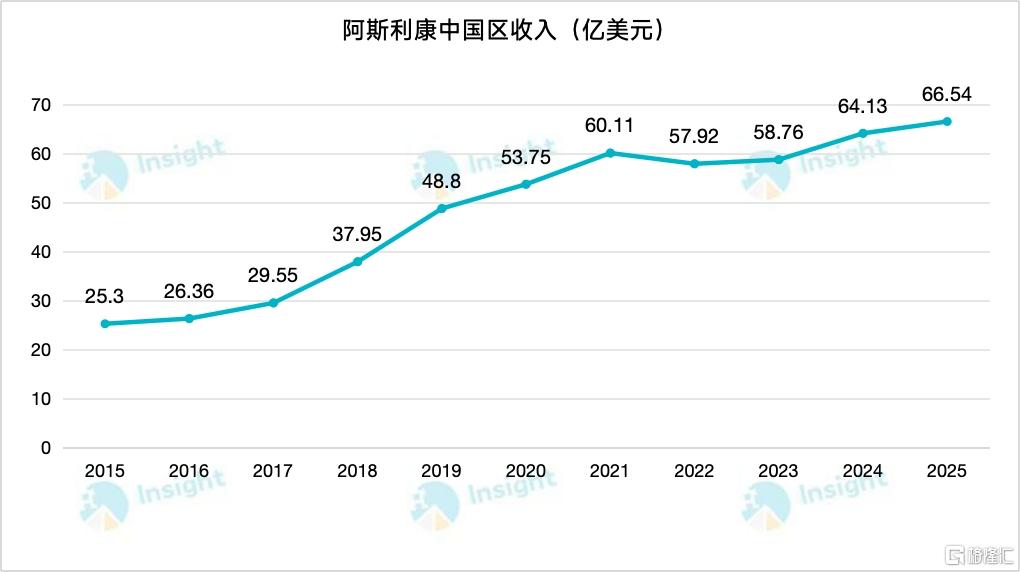
Core Insights - AstraZeneca achieved a record revenue of $6.664 billion in China for 2025, marking a significant milestone in its 30-year history in the market [1] - The company plans to invest $15 billion in China by 2030 and has established a $18.5 billion collaboration with CSPC Pharmaceutical Group [1] Revenue Performance - AstraZeneca is the second-largest market for the company, with 2024 revenues reaching $54.073 billion, and China contributing $6.413 billion, a year-on-year increase of 11% [1] - In 2025, total revenue reached $58.739 billion, with China contributing $6.654 billion, accounting for 11% of total revenue, maintaining the top position among multinational pharmaceutical companies in China [1][3] Product Portfolio - Since entering the Chinese market in 1993, AstraZeneca has introduced over 40 innovative drugs, including key products in oncology and chronic disease management [3] - The inhaled budesonide suspension is the highest-selling drug in China, although its sales have declined due to policy price adjustments [3] - Osimertinib is expected to become a new flagship product in China, potentially replacing budesonide due to the large market for non-small cell lung cancer patients [3][4] Strategic Focus - AstraZeneca is focusing on a comprehensive "innovation offensive" in China, particularly in oncology, cardiovascular, renal, and metabolic disease areas [6] - The company has a robust pipeline in oncology, with several promising drugs set to launch in China, including novel AKT inhibitors and TROP2 ADCs for breast cancer treatment [6] - The pipeline also includes treatments for chronic diseases and rare diseases, addressing the diverse needs of the Chinese market [7][8] Investment Plans - AstraZeneca's $15 billion investment will focus on expanding drug manufacturing and R&D capabilities, particularly in cell therapy and radiolabeled drug conjugates [12][13] - The company has made 23 collaborations in China since 2021, totaling over $40 billion, with a significant focus on oncology and chronic disease treatments [9][12] Market Positioning - AstraZeneca aims to leverage China's scientific and manufacturing strengths to provide cutting-edge treatment solutions, positioning itself as a leader in cell therapy capabilities [13] - The company has established global strategic R&D centers in Beijing and Shanghai and operates multiple production bases across China [13][14] Conclusion - AstraZeneca's deep integration into the Chinese market signifies a shift from merely selling products to becoming a core participant in China's healthcare ecosystem, evolving into a global innovation center rooted in China [15]
Analysis-China biotech licensing boom to hit record in 2026 as pipeline swells
Yahoo Finance· 2026-02-13 09:32
By Kane Wu and Andrew Silver HONG KONG/SHANGHAI, Feb 13 (Reuters) - Global drugmakers are stepping up their search for China‑developed experimental medicines as they cut costs ahead of patent expirations, with industry analysts predicting licensing deals will surge to a fresh record this year. The value of such deals signed by companies in the greater China region - which includes Hong Kong, Macau and Taiwan - rose nearly tenfold last year from 2021 to an unprecedented $137.7 billion, according to data ...
深度|316种国家集采药品接续采购开标,覆盖26个治疗领域
Di Yi Cai Jing· 2026-02-13 08:55
Core Viewpoint - The recent round of national drug procurement has resulted in 4,163 products from 1,020 companies being shortlisted, covering 316 commonly used drugs across 26 therapeutic areas, with only 21 original drugs winning bids, representing less than 10% of the total [1][2]. Group 1: Procurement Details - The procurement aims to reduce drug prices and patient burdens while reallocating saved healthcare funds to innovative drugs that provide significant clinical value [2]. - The procurement process was led by the medical insurance bureaus of Jiangsu, Henan, and Guangdong provinces, with a high selection rate of 93% among participating companies [2]. - The results of this procurement are expected to be implemented by the end of March 2026, with a procurement cycle lasting until the end of 2028 [2]. Group 2: Original Drug Participation - The original drugs selected include various formulations such as Fosinopril and Acarbose, with companies like Bristol-Myers Squibb and Sanofi involved [3]. - Several original drugs that had previously won bids in earlier rounds, such as Gefitinib and Clopidogrel, did not participate in this round, allowing generic competitors to dominate [4][3]. - The absence of original drugs in the procurement reflects a trend where original drugs face significant competition from generics post-patent expiration, leading to a decline in sales and profits [6]. Group 3: Market Dynamics - The "patent cliff" phenomenon has led to original drugs experiencing substantial sales and profit declines once their patents expire, which was previously mitigated by high prices and market share [6]. - Some original drug companies have reduced or dissolved their sales teams for products affected by procurement policies, yet many still find market opportunities outside public hospital settings [7]. - Cross-national pharmaceutical companies are increasingly focusing on innovative drug development while divesting mature product lines to local firms [8][9]. Group 4: Future Outlook - The Chinese government is implementing policies to support the development of innovative drugs, which is expected to expand the overall pharmaceutical market [10].


港股通创新药ETF工银(159217)跌0.30%,成交额2.32亿元
Xin Lang Cai Jing· 2026-02-13 07:14
Core Viewpoint - The Hong Kong Stock Connect Innovative Drug ETF (工银, 159217) has shown a slight decline of 0.30% in its closing price, with a trading volume of 2.32 billion yuan on February 13, 2025. The fund has experienced growth in both its share count and total assets since the beginning of the year [1]. Fund Overview - The Hong Kong Stock Connect Innovative Drug ETF (工银, 159217) was established on March 26, 2025, with an annual management fee of 0.40% and a custody fee of 0.07%. Its performance benchmark is the adjusted return of the National Index for Hong Kong Stock Connect Innovative Drugs [1]. - As of February 12, 2025, the fund's latest share count is 3.935 billion shares, with a total asset size of 5.214 billion yuan. Compared to December 31, 2025, the fund's shares have increased by 4.57% and its total assets by 9.73% [1]. Liquidity - Over the last 20 trading days, the cumulative trading amount for the Hong Kong Stock Connect Innovative Drug ETF (工银, 159217) reached 7.823 billion yuan, with an average daily trading amount of 391 million yuan [1]. Fund Management - The current fund managers are Liu Weilin and Jiao Wendong. Liu has managed the fund since March 26, 2025, achieving a return of 31.76%, while Jiao has been managing it since April 10, 2025, with a return of 50.17% [2]. Top Holdings - The fund's top holdings include: - CSPC Pharmaceutical Group (石药集团) - 10.65% of the portfolio, valued at 506 million yuan - BeiGene (百济神州) - 10.10%, valued at 480 million yuan - CanSino Biologics (康方生物) - 9.91%, valued at 471 million yuan - China National Pharmaceutical Group (中国生物制药) - 9.85%, valued at 468 million yuan - Innovent Biologics (信达生物) - 9.72%, valued at 462 million yuan - 3SBio (三生制药) - 7.08%, valued at 337 million yuan - Hansoh Pharmaceutical (翰森制药) - 7.07%, valued at 336 million yuan - Kelun Pharmaceutical (科伦博泰生物-B) - 3.54%, valued at 168 million yuan - Kangzhe Pharmaceutical (康哲药业) - 2.60%, valued at 124 million yuan [3].