
春秋航空

Search documents
春秋航空: 春秋航空募集资金管理制度
Zheng Quan Zhi Xing· 2025-08-29 17:02
春秋航空股份有限公司 募集资金管理制度 具对账单,以及存在未配合保荐机构或者独立财务顾 问查询与调查专户资料情形的,公司可以终止协议并 注销该募集资金专户。 (二)协议在有效期届满前提前终止的,公司自协议终止之日起 及时公告。 第一章 总则 第二章 募集资金的存放 第六条 公司应当审慎选择商业银行并开设募集资金专项账户(以下简称 "募集资金专户"),募集资金应当存放于董事会决定的募集资 金专户集中管理,募集资金专户不得存放非募集资金或用作其它 用途。 公司存在两次以上融资的,应当分别设置募集资金专户。实际募 集资金净额超过计划募集资金金额的部分(以下简称"超募资 金")也应当存放于募集资金专户管理。 第一条 为了规范春秋航空股份有限公司(以下简称"公司")募集资金 的管理和运用,保护投资者的权益,依照《中华人民共和国公司 法》《中华人民共和国证券法》《上市公司证券发行注册管理办 法》《上海证券交易所股票上市规则》《上市公司募集资金监管 规则》《上海证券交易所上市公司自律监管指引第 1 号——规范 运作》和《春秋航空股份有限公司章程》(以下简称"《章程》") 及其他有关规定,结合公司实际情况,特制定本制度。 第 ...

春秋航空: 春秋航空公司债券信息披露管理制度
Zheng Quan Zhi Xing· 2025-08-29 17:02
Core Points - The document outlines the information disclosure management system for Spring Airlines Co., Ltd., aiming to standardize the disclosure of bond-related information and protect investors' rights [1][2] - The company is obligated to disclose information in a timely, fair, and accurate manner, ensuring that the disclosed information reflects its debt repayment capability and aids investors in making informed decisions [1][4] Group 1: General Principles - The system is established in accordance with relevant laws and regulations, including the Company Law and Securities Law of the People's Republic of China [1] - Information disclosure refers to the public announcement of required information by the company and its subsidiaries regarding various types of bonds [1][2] - The company and its key personnel must act in good faith and provide accurate information to fulfill disclosure obligations [1][2] Group 2: Responsibilities and Management - The Chairman of the Board is the primary responsible person for information disclosure, with all board members bearing individual and joint responsibility for the accuracy and completeness of the disclosed content [2][3] - The Board Office manages the information disclosure affairs, coordinating the disclosure work and maintaining investor relations [3][4] - Senior management must report significant operational or financial events to the Board in a timely manner [3][4] Group 3: Disclosure Content and Procedures - Information disclosure is categorized into pre-listing and ongoing disclosure, including bond prospectuses, issuance results, and credit rating reports [4][5] - Regular reports must be disclosed within four months after the end of each fiscal year, including audited financial statements and necessary information [4][5] - Significant events affecting the company's debt repayment ability or investor rights must be disclosed promptly, detailing the cause, current status, and potential impact [5][6] Group 4: Special Circumstances - In the event of bankruptcy, the disclosure obligations transfer to the bankruptcy administrator, who must continuously disclose relevant progress and information affecting investor decisions [7][8] - The company must disclose any major changes in circumstances that could impact its debt repayment ability or investor rights [6][7] - Any special requirements for specific types of corporate bonds must be adhered to as per the regulations [9]
春秋航空: 春秋航空公司债券募集资金管理与使用制度
Zheng Quan Zhi Xing· 2025-08-29 17:02
Core Viewpoint - The document outlines the management and usage system for funds raised through bond issuance by Spring Airlines Co., Ltd, aiming to enhance the efficiency of fund utilization and protect investors' rights [2][3]. Group 1: General Principles - The system is established in accordance with relevant laws and regulations, including the Company Law and Securities Law of the People's Republic of China [2][3]. - The company is responsible for the management and usage of raised funds, ensuring compliance with the established regulations [3][4]. Group 2: Fund Storage - Funds raised must be stored in a special account approved by the board of directors, and cannot be used for non-designated purposes [4][6]. - A tripartite supervision agreement must be signed with the management institution and the commercial bank before the funds can be utilized [4][5]. Group 3: Fund Usage - The company must adhere to the approved usage plan for the raised funds and report any significant deviations to the underwriting institution [8][9]. - Prohibited actions include lending the funds to others, using them to cover losses, or violating legal and regulatory requirements [9][10]. Group 4: Changes in Fund Allocation - Any changes in the use of funds must be approved by a resolution from the bondholders' meeting for public offerings, and must follow the procedures outlined in the bond prospectus for private placements [12][13]. Group 5: Management and Supervision of Fund Usage - The company is required to disclose the actual usage of raised funds accurately and completely in periodic reports [14][15]. - Issues in fund management will be subject to accountability according to relevant laws and regulations [15]. Group 6: Miscellaneous - The system will be interpreted and revised by the company's board of directors, and will take effect upon approval by the board [17][19].
春秋航空: 春秋航空2022年员工持股计划管理办法(修订稿)
Zheng Quan Zhi Xing· 2025-08-29 17:02
Core Viewpoint - The article outlines the management measures for the employee stock ownership plan of Spring Airlines, emphasizing compliance with laws and regulations, voluntary participation, and risk-bearing principles for employees [2][3][4]. Group 1: Basic Principles of the Employee Stock Ownership Plan - The plan adheres to the principle of legal compliance, ensuring that all procedures are followed according to relevant laws and regulations [3][4]. - Participation in the plan is voluntary, with no forced allocation to employees [3][4]. - Participants bear their own risks, with equal rights to other investors [3][4]. Group 2: Implementation Procedures - The plan requires approval from the shareholders' meeting, with a majority vote needed for implementation [4][5]. - Monthly announcements will be made regarding the progress of the plan, including details on stock transfers [4][5]. Group 3: Participants and Funding Sources - Eligible participants include senior management and employees of the company and its subsidiaries [5][6]. - Funding for the plan comes from employees' legal salaries, self-raised funds, and other legally permitted sources [5][6]. Group 4: Duration and Lock-up Period - The plan's duration starts from the date of the last stock transfer and can be extended under certain conditions [6][7]. - The lock-up period is structured based on performance ratings from 2023 to 2026, with specific unlock schedules tied to performance evaluations [6][7][8]. Group 5: Management and Governance - The plan will be managed internally, with a management committee elected by the participants [9][10]. - The management committee is responsible for daily operations, including stock sales and distribution of benefits [9][10]. Group 6: Rights and Obligations of Participants - Participants have rights to the plan's assets proportional to their holdings and must comply with relevant regulations [16][17]. - Participants are obligated to pay subscription funds and bear investment risks [16][17]. Group 7: Changes and Termination of the Plan - Any changes to the plan require a two-thirds majority approval from the participants and must be submitted for board and shareholder approval [17][18]. - The plan can be terminated early under specific conditions, including company decisions or participant disqualifications [17][18].
春秋航空: 春秋航空2023年员工持股计划管理办法(修订稿)
Zheng Quan Zhi Xing· 2025-08-29 17:02
春秋航空股份有限公司 第一章 总则 第一条 为规范春秋航空股份有限公司(以下简称"春秋航空"或"公司") 员工持股计划(以下简称"员工持股计划")的实施,根据《中华人民共和国公 司法》 (以下简称" 《公司法》")、 《中华人民共和国证券法》 (以下简称" 《证券法》")、 《关于上市公司实施员工持股计划试点的指导意见》(以下简称"《指导意见》") 等相关法律、行政法规、规章、规范性文件和《公司章程》之规定,特制定本管 理办法。 第二章 员工持股计划的制定 第二条 员工持股计划所遵循的基本原则 (一)依法合规原则 公司实施员工持股计划,严格按照法律、行政法规的规定履行程序,真实、 准确、完整、及时地实施信息披露。任何人不得利用员工持股计划进行内幕交易、 操纵证券市场等证券欺诈行为。 (二)自愿参与原则 公司实施员工持股计划遵循公司自主决定,员工自愿参加,公司不以摊派、 强行分配等方式强制员工参加员工持股计划。 (三)风险自担原则 员工持股计划参与人盈亏自负,风险自担,与其他投资者权益平等。 第三条 员工持股计划履行的程序 见。 是否有利于公司的持续发展,是否存在损害公司及全体股东的利益,是否存在摊 派、强行分 ...
上半年三大航仍未扭亏,东航国航亏损收窄
Bei Jing Ri Bao Ke Hu Duan· 2025-08-29 13:09
Group 1 - China Eastern Airlines reported a revenue of 66.822 billion yuan for the first half of 2025, a year-on-year increase of 4.09%, with a net loss of 1.431 billion yuan, significantly reducing losses by 1.337 billion yuan compared to the previous year [1] - The total transportation turnover for China Eastern Airlines reached 135.06 billion ton-kilometers, with a passenger volume of 73.1696 million, representing year-on-year growth of 11.89% and 8.03% respectively [1] - China International Airlines also reported a reduced net loss of 1.806 billion yuan for the first half of 2025, with a revenue of 80.757 billion yuan, an increase of 12.37% year-on-year [1] Group 2 - China Southern Airlines reported a revenue of 86.291 billion yuan for the first half of 2025, a year-on-year increase of 1.77%, but a net loss of 1.533 billion yuan, which is a 24.84% decline compared to the previous year [4] - The overall passenger transport volume in China's civil aviation sector reached approximately 370 million, reflecting a year-on-year growth of 5.9%, indicating a "high passenger volume but low profitability" situation [4] - Spring Airlines is projected to be the most profitable airline in mainland China, reporting a revenue of 10.304 billion yuan for the first half of 2025, with a year-on-year growth of 4.35% and a net profit of 1.169 billion yuan, down 14.11% year-on-year [4]





春秋航空(601021) - 春秋航空关于获得向专业投资者公开发行公司债券注册批复的公告
2025-08-29 10:03
证券代码:601021 证券简称:春秋航空 公告编号:2025-049 春秋航空股份有限公司 二、本次发行公司债券应严格按照报送上海证券交易所的募集说明书进行。 三、本批复自同意注册之日起 24 个月内有效,公司在注册有效期内可以分期 发行公司债券。 四、自中国证监会同意注册之日起至本次公司债券发行结束前,公司如发生重 大事项,应及时报告并按有关规定处理。 公司将按照有关法律法规和上述批复文件的要求及公司股东会的授权,择机办 理本次公司债券发行的相关事宜,并及时履行信息披露义务。 特此公告。 春秋航空股份有限公司董事会 2025 年 8 月 30 日 关于获得向专业投资者公开发行公司债券注册批复的公告 本公司董事会及全体董事保证本公告内容不存在任何虚假记载、误导性陈述 或者重大遗漏,并对其内容的真实性、准确性和完整性承担法律责任。 近日,春秋航空股份有限公司(以下简称"公司")收到中国证券监督管理委 员会(以下简称"中国证监会")出具的《关于同意春秋航空股份有限公司向专业 投资者公开发行公司债券注册的批复》(证监许可[2025]1788 号),该批复就公司 公开发行公司债券注册事项批复如下: 一、同意公司向专 ...
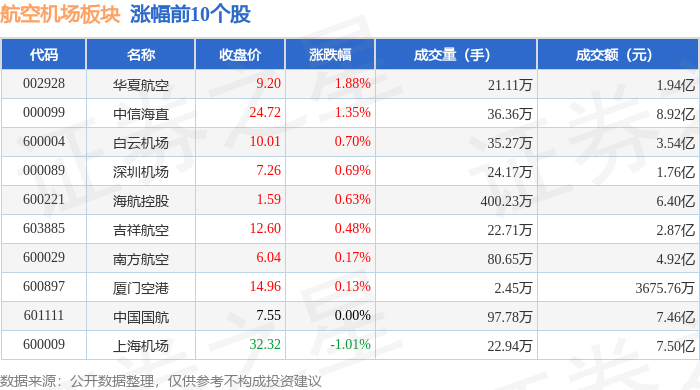
航空机场板块8月29日跌0.26%,中国东航领跌,主力资金净流出3.24亿元
Zheng Xing Xing Ye Ri Bao· 2025-08-29 08:41
Market Overview - On August 29, the aviation and airport sector declined by 0.26%, with China Eastern Airlines leading the drop [1] - The Shanghai Composite Index closed at 3857.93, up 0.37%, while the Shenzhen Component Index closed at 12696.15, up 0.99% [1] Stock Performance - Notable stock performances included: - Huaxia Airlines (002928) closed at 9.20, up 1.88% with a trading volume of 211,100 shares and a turnover of 194 million yuan [1] - China Eastern Airlines (600115) closed at 4.07, down 1.93% with a trading volume of 1,442,400 shares [2] - Shanghai Airport (600009) closed at 32.32, down 1.01% with a trading volume of 229,400 shares [2] Capital Flow - The aviation and airport sector experienced a net outflow of 324 million yuan from institutional investors, while retail investors saw a net inflow of 310 million yuan [2] - The sector's capital flow indicated that retail investors were more active compared to institutional investors [2] Individual Stock Capital Flow - Individual stock capital flows showed: - Huaxia Airlines had a net inflow of 5.9973 million yuan from institutional investors, while retail investors had a net outflow of 6.8206 million yuan [3] - China Eastern Airlines saw a net outflow of 28.2219 million yuan from institutional investors [3] - South Airlines (600029) had a net outflow of 31.0209 million yuan from institutional investors [3]
春秋航空(601021):税前小幅改善 分红及回购增强信心
Xin Lang Cai Jing· 2025-08-29 08:29
Core Viewpoint - The company reported a mixed performance for 1H25, with revenue growth but a decline in net profit, indicating challenges in the current market environment [1][3]. Financial Performance - 1H25 revenue reached 10.304 billion yuan, a year-on-year increase of 4.3%, while net profit attributable to shareholders was 1.169 billion yuan, down 14.1% [1]. - In Q2 25, revenue was 4.987 billion yuan, up 6.0%, but net profit fell to 0.491 billion yuan, a decrease of 10.7% [1][2]. - The overall ASK (Available Seat Kilometers) increased by 9.5% in 1H25, while the passenger load factor decreased by 0.8 percentage points to 90.5% [2][3]. Cost and Profitability - The average price of aviation kerosene decreased by 17% year-on-year in Q2 25, leading to a reduction in fuel cost pressure [2]. - Operating costs rose by 6.9% to 4.425 billion yuan, with unit ASK costs declining by 4.7% [2]. - Gross profit margin fell by 0.8 percentage points to 11.3%, with gross profit slightly down by 0.8% to 0.562 billion yuan [2]. Other Income and Tax Impact - Other income increased by 32.3% to 0.354 billion yuan in Q2 25, contributing to a tax pre-profit of 0.650 billion yuan, up 5.6% year-on-year [2]. - The effective tax rate rose significantly from 10.6% in Q2 24 to 24.4% in Q2 25, impacting net profit [2][3]. Dividend and Buyback Plans - The company announced a 36% interim dividend and a share buyback plan of 300-500 million yuan, which may enhance market confidence [3]. Profit Forecast and Valuation - The company revised down its net profit forecasts for 2025-2027 by 13%, 12%, and 10% to 2.374 billion, 3.016 billion, and 3.443 billion yuan respectively [4]. - The target price for 2025 is set at 67.80 yuan, based on a price-to-book ratio of 3.5x, reflecting the company's growth potential in the low-cost aviation sector [4].
春秋航空(601021):税前小幅改善,分红及回购增强信心
HTSC· 2025-08-29 07:14
Investment Rating - The investment rating for the company is "Buy" with a target price of RMB 67.80 [6][7]. Core Views - The company reported a slight improvement in pre-tax profits, with a revenue of RMB 10.304 billion for 1H25, a year-on-year increase of 4.3%, but a net profit attributable to shareholders of RMB 1.169 billion, a decrease of 14.1% [1][4]. - The low-cost airline sector in China still has penetration potential, and the company is expected to maintain growth due to its efficient low-cost operating model [1][5]. Summary by Sections Financial Performance - In 1H25, the company achieved a revenue of RMB 10.304 billion, up 4.3% year-on-year, while the net profit attributable to shareholders was RMB 1.169 billion, down 14.1% [1][4]. - For 2Q25, the revenue was RMB 4.987 billion, an increase of 6.0%, but the net profit decreased by 10.7% to RMB 4.91 billion due to the absence of tax shield benefits [1][3][4]. Capacity and Revenue - The company accelerated capacity deployment in 2Q25, with overall ASK (Available Seat Kilometers) and RPK (Revenue Passenger Kilometers) increasing by 12.1% and 10.9% respectively [2]. - The overall passenger load factor slightly decreased by 1.0 percentage points to 90.4%, with international routes experiencing a more significant decline [2]. Cost and Profitability - The average price of aviation kerosene decreased by 17% year-on-year, leading to a reduction in fuel cost pressure [3]. - Despite a 6.9% increase in operating costs to RMB 4.425 billion, the gross profit margin fell by 0.8 percentage points to 11.3% [3]. Dividend and Buyback - The company announced a mid-term dividend of 36% and a buyback plan of RMB 300-500 million, which may enhance market confidence [4]. Earnings Forecast and Valuation - The forecast for net profit attributable to shareholders for 2025-2027 has been revised down by 13%, 12%, and 10% to RMB 2.374 billion, RMB 3.016 billion, and RMB 3.443 billion respectively [5]. - The target price remains unchanged at a PB (Price to Book) ratio of 3.5x, with a projected BPS (Book Value per Share) of RMB 19.38 [5].