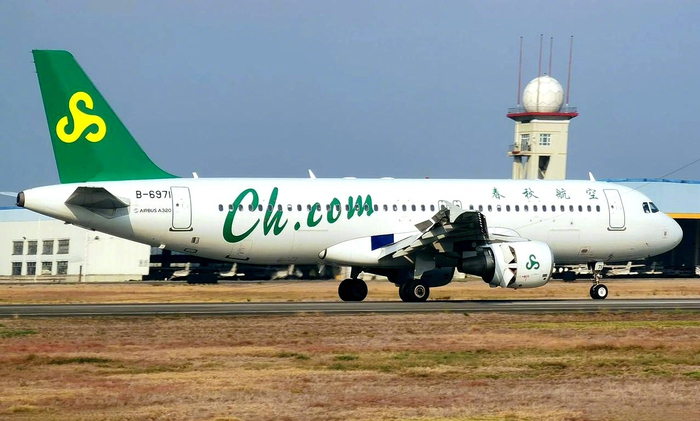
低成本航空

Search documents
2025年欧洲十大机场:新老王者之争!
Xin Lang Cai Jing· 2026-02-24 04:55
Core Insights - The European aviation industry is experiencing stable growth despite geopolitical challenges, with passenger throughput expected to reach 2.6 billion in 2025, a 4.4% increase year-on-year and a 5.6% increase compared to 2019, adding 100 million passengers from 2024 [2] Group 1: Passenger Throughput Rankings - The top ten busiest airports in Europe for 2025 have been identified, with London Heathrow (LHR) leading at 84.48 million passengers, followed closely by Istanbul Airport (IST) at 84.44 million [3][6] - Traditional strongholds such as Paris Charles de Gaulle (CDG), Amsterdam Schiphol (AMS), Madrid Barajas (MAD), and Frankfurt (FRA) remain in the top six, showcasing their resilience [7][8][9][10][11] - Istanbul emerges as the only city with two airports in the top ten, with Sabiha Gokcen Airport (SAW) ranking ninth at 48.42 million passengers, highlighting the city's dual-airport strategy [12][13] Group 2: Market Trends - Competition among hub airports is intensifying, with traditional leaders facing challenges from emerging hubs like Istanbul and Madrid, indicating a significant shift in the European aviation landscape [18] - The growth of low-cost airlines is driving passenger increases, as evidenced by the performance of Sabiha Gokcen Airport and airports in tourist cities like Barcelona and Rome [19] - The multi-airport system in cities like Istanbul is becoming a successful model for managing passenger flow and enhancing overall airport capacity, providing a template for other major cities [20]


8亿债券被超额认购3倍,春秋航空靠什么成为“安全资产”?
中国基金报· 2025-11-22 03:30
Core Viewpoint - Spring Airlines successfully issued a record low-interest bond, indicating strong market confidence in the company as a "safe asset" amidst a favorable policy environment [6][7]. Group 1: Bond Issuance - The bond "25 Spring K1" was issued for 800 million yuan with a three-year term and a coupon rate of 1.98%, achieving an oversubscription of 3.03 times, marking the lowest interest rate for a similar duration in the private airline sector [6][7]. - The issuance was driven by three main considerations: preparing for future capital expenditures, responding to investor calls for increased leverage, and testing market acceptance of the company's bonds [6]. - The successful issuance reflects not only the company's strong fundamentals but also the supportive regulatory environment, including the introduction of the Private Economy Promotion Law [6][7]. Group 2: Business Strategy and Innovation - Spring Airlines has positioned itself as a low-cost carrier since its establishment in 2004, focusing on cost control and operational efficiency, which has allowed it to become the first airline to return to profitability post-pandemic [9][12]. - The company is committed to continuous cost optimization and technological innovation, with significant investments in R&D, including AI applications for operational efficiency and safety risk management [9][10][11]. - Future domestic strategies include increasing capacity at core bases, expanding routes to second- and third-tier markets, and exploring niche tourism destinations [12]. Group 3: International Market Focus - International operations, particularly in Northeast Asia, have become a significant growth area for Spring Airlines, with revenue from this region exceeding pre-pandemic levels [12]. - The company plans to expand its presence in underdeveloped Southeast Asian markets such as Vietnam, Malaysia, and Indonesia, despite facing short-term disruptions in travel demand [12][14]. - Spring Airlines maintains a long-term strategic approach to route development, emphasizing stability and gradual adjustments rather than reactive changes to market fluctuations [12][14]. Group 4: Corporate Culture and Competitive Advantage - Spring Airlines is known for its frugal corporate culture, which emphasizes cost-saving measures while offering competitive salaries that are 20% to 30% above industry averages [16][17]. - The company's values include thrift, hard work, foresight, and gratitude, which are seen as foundational to its sustainable development [16]. - The competitive advantages of Spring Airlines have been validated over its 20-year history, with a focus on consistent execution of its business model and corporate culture [17].

8亿债券被超额认购3倍,春秋航空靠什么成为“安全资产”?
Zhong Guo Ji Jin Bao· 2025-11-22 03:28
Core Viewpoint - Spring Airlines successfully issued a record low-interest bond, reflecting strong market demand and investor confidence in the company as a "safe asset" [3][4]. Group 1: Bond Issuance Details - The bond, named "25 Spring Airlines K1," was issued for 800 million yuan with a three-year term and a coupon rate of 1.98%, achieving an oversubscription of 3.03 times, marking the lowest interest rate for a similar duration in the private airline sector [3][4]. - This bond issuance is the first in nine years for Spring Airlines, and the results exceeded expectations, indicating a strong market acceptance of the company's bonds [3][4]. Group 2: Strategic Considerations for Issuance - The company aimed to prepare for future capital expenditures, such as purchasing aircraft and engines, respond to investor calls for increased leverage, and test market acceptance of corporate bonds [3][4]. - The supportive regulatory environment, including the introduction of the Private Economy Promotion Law and backing from the CSRC and exchanges, has significantly improved the market's acceptance of private enterprise bond issuances [4]. Group 3: Focus on Technological Innovation - Spring Airlines has been optimizing costs through technological innovation, with significant investments in R&D, including two research centers and nearly 600 IT professionals [5][6]. - The company has implemented AI applications to enhance operational efficiency, such as a local deployment of the DeepSeek-R1 model for safety risk classification and an automated financial auditing system [6][7]. Group 4: Business Strategy and Market Expansion - The company plans to enhance its domestic operations by increasing capacity at core bases, expanding routes to second- and third-tier markets, and exploring niche tourism destinations [8]. - Internationally, Spring Airlines is focusing on expanding its presence in Northeast Asia and underdeveloped Southeast Asian markets, with a strategic commitment to long-term growth despite short-term disruptions [8][9]. Group 5: Corporate Culture and Competitive Advantage - Spring Airlines is known for its frugal corporate culture, emphasizing cost-saving measures while maintaining competitive salaries that are 20% to 30% above industry averages [10][12][13]. - The company believes that its competitive advantages, built over 20 years, are validated by market experience, and while its business model is replicable, the true challenge lies in the consistent execution of its corporate culture and strategy [15].


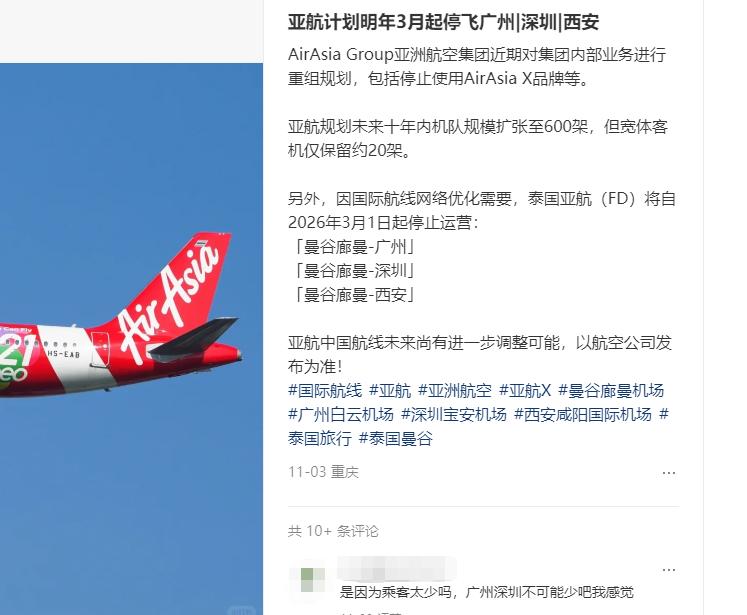
又有外航,“下架”中国航线
3 6 Ke· 2025-11-20 09:28
Core Viewpoint - AirAsia's decision to suspend three routes between China and Thailand is a strategic response to market demand changes, competitive pressures, and a broader restructuring of the company [1][5]. Group 1: Strategic Restructuring - AirAsia's route adjustments are part of a larger restructuring effort, which includes the integration of subsidiaries under the AirAsia Group and the retirement of long-haul brand AirAsia X [6]. - The company is shifting its fleet strategy by retiring A330 wide-body aircraft and focusing solely on the Airbus A320 series, particularly the A321XLR, to enhance its low-cost carrier model [9]. - The previous "super app" strategy has been shelved, with a clear focus on core aviation operations [9]. Group 2: Market Demand and Financial Performance - The demand for flights on the China-Thailand routes has declined significantly, with a recovery rate of only 53.8% for flights from China to Thailand during the summer travel season [12]. - Data from OAG indicates that the number of seats available on routes from mainland China to Thailand has dropped from 7.4 million in summer 2019 to 4.1 million in summer 2025, a 44% decrease [13]. - AirAsia's Q2 financial report shows a 9% year-on-year decline in sales and service revenue, totaling 23.045 billion Thai Baht, with an average load factor of 84% [16]. Group 3: Competitive Landscape - The low-cost airline market in Southeast Asia is experiencing intense competition, with two-thirds of international flights operated by low-cost carriers, compared to one-third globally [17]. - Competitors like Thai Airways and Spring Airlines are expanding their services to capture market share, further squeezing AirAsia's operational space [18]. - The airline industry is facing a paradox of increasing passenger volumes but declining profitability, prompting AirAsia to optimize its route network as a strategic response to competitive pressures [19].
春秋航空(601021):2025年三季报点评:客座率高位、票价承压,业绩有望稳增
Xinda Securities· 2025-10-31 13:15
Investment Rating - The report maintains a "Buy" rating for Spring Airlines (601021) [1][6] Core Views - The company reported a revenue of 16.8 billion yuan for the first three quarters of 2025, a year-on-year increase of 5.0%, while the net profit attributable to shareholders was 2.336 billion yuan, a decrease of 10.3% year-on-year [1][2] - The report highlights that despite a decline in profitability due to falling ticket prices, the company has shown resilience in its operations and cost management [2][5] - The airline's capacity has steadily increased, with a high passenger load factor, indicating strong demand recovery [3][5] Revenue and Profitability - For Q3 2025, the company achieved revenues of 6.47 billion yuan, with a year-on-year growth of 6.0%, while the gross margin and net profit margin showed slight declines [2][3] - The unit revenue per RPK (Revenue Passenger Kilometer) decreased by 7.0% year-on-year, reflecting significant pressure on ticket prices [4] Capacity and Load Factor - The total ASK (Available Seat Kilometer) for Q3 2025 increased by 14.1% year-on-year, with domestic and international routes showing growth [3] - The overall passenger load factor for Q3 was 92.5%, slightly down from the previous year but still above pre-pandemic levels [3] Cost Management - The unit cost per ASK decreased by 4.7% year-on-year, benefiting from lower fuel prices and improved fleet utilization [4] - The report suggests that the company is effectively managing its fixed costs, which has contributed to a reduction in overall costs [4] Future Outlook - The report anticipates a recovery in travel demand in Q4, which could lead to improved ticket prices and profitability for the airline [5] - The company is expected to achieve net profits of 2.409 billion yuan, 3.054 billion yuan, and 3.542 billion yuan for 2025, 2026, and 2027 respectively, with corresponding year-on-year growth rates of 6.0%, 26.8%, and 16.0% [6][7]
春秋航空(601021)2025年三季报点评:客座率高位、票价承压 业绩有望稳增
Xin Lang Cai Jing· 2025-10-31 12:29
Core Viewpoint - Spring Airlines reported a revenue of 16.8 billion yuan for the first three quarters of 2025, reflecting a year-on-year increase of 5.0%, while the net profit attributable to shareholders decreased by 10.3% to 2.336 billion yuan [1][2]. Group 1: Financial Performance - For Q3 2025, the company achieved a revenue of 6.47 billion yuan, with a year-on-year growth of 6.0%, while the net profit attributable to shareholders was 1.167 billion yuan, down 6.2% year-on-year [2]. - The overall revenue for the first three quarters was 16.77 billion yuan, with Q1, Q2, and Q3 revenues of 5.32 billion, 4.99 billion, and 6.47 billion yuan respectively, showing year-on-year growth rates of 2.9%, 6.0%, and 6.0% [2]. Group 2: Capacity and Load Factor - In Q3 2025, the total Available Seat Kilometers (ASK) increased by 14.1% year-on-year, with domestic, international, and regional ASK growth rates of 11.4%, 27.5%, and -26.7% respectively [3]. - The total Revenue Passenger Kilometers (RPK) also rose by 14.0% year-on-year, with domestic, international, and regional RPK growth rates of 11.6%, 26.3%, and -25.8% respectively [3]. - The overall passenger load factor for Q3 was 92.5%, with domestic, international, and regional load factors of 93.5%, 89.2%, and 91.8% respectively, showing slight year-on-year changes [3]. Group 3: Pricing and Cost Structure - The unit revenue per RPK for Q3 was 0.412 yuan, down 7.0% year-on-year, while the unit revenue per ASK was 0.381 yuan, also down 7.1% year-on-year, indicating significant price declines in the industry [4]. - The unit cost per ASK for Q3 was 0.290 yuan, reflecting a year-on-year decrease of 4.7% and a quarter-on-quarter decrease of 3.2%, benefiting from lower fuel prices and improved fleet utilization [4]. Group 4: Future Outlook - The demand for travel is expected to improve in Q4, with favorable oil and exchange rate factors potentially leading to significant performance improvements for airlines [5]. - The industry is anticipated to experience a contraction in supply, which may enhance pricing power and revenue for airlines, including Spring Airlines, which is expected to benefit from resilient pricing [5]. - Profit forecasts for the company from 2025 to 2027 are projected at 2.409 billion, 3.054 billion, and 3.542 billion yuan, with corresponding year-on-year growth rates of 6.0%, 26.8%, and 16.0% [5].
春秋航空(601021):低成本龙头有望受益景气改善
HTSC· 2025-10-31 10:51
Investment Rating - The investment rating for the company is maintained as "Buy" with a target price of RMB 75.50 [1][10]. Core Views - The company is expected to benefit from an improving industry environment, with a focus on its position as a leading low-cost airline in China. The report highlights the potential for revenue growth driven by increased demand for low-cost travel and improved pricing dynamics in the industry [6][9]. Financial Performance - For the first nine months of 2025, the company reported revenue of RMB 16.773 billion, a year-on-year increase of 5.0%. However, the net profit attributable to the parent company was RMB 2.336 billion, a decrease of 64.69% year-on-year [6]. - In Q3 2025, the company achieved revenue of RMB 6.469 billion, reflecting a 6.0% year-on-year increase, while the net profit was RMB 1.167 billion, down 6.2% year-on-year [7][8]. Operational Metrics - The company experienced a 14.1% increase in capacity and a 14.0% increase in demand in Q3, with a slight decline in passenger load factor to 92.5%. Domestic capacity growth was notably strong at 11.4% [7]. - The average aircraft utilization in the first half of 2025 was 9.7 hours, below the 11.2 hours recorded in the first half of 2019, indicating room for operational efficiency improvements [9]. Revenue and Profitability Forecast - Revenue projections for the upcoming years are as follows: RMB 20 billion in 2024, RMB 21.059 billion in 2025, RMB 23.774 billion in 2026, and RMB 26.888 billion in 2027, with growth rates of 11.50%, 5.30%, 12.89%, and 13.10% respectively [5]. - The net profit attributable to the parent company is forecasted to be RMB 2.273 billion in 2025, with an expected EPS of RMB 2.30 [10]. Valuation Metrics - The report provides valuation metrics including a PE ratio of 22.96 for 2024, decreasing to 14.58 by 2027, and a PB ratio of 3.00 for 2024, decreasing to 2.21 by 2027 [5][10]. - The target price is based on a projected PB of 3.5x for 2026, with a BPS of RMB 21.56 [10].
春秋航空招40岁“空嫂”,“最抠门”航司怎么突然温情了?
Zhong Guo Zheng Quan Bao· 2025-10-30 04:48
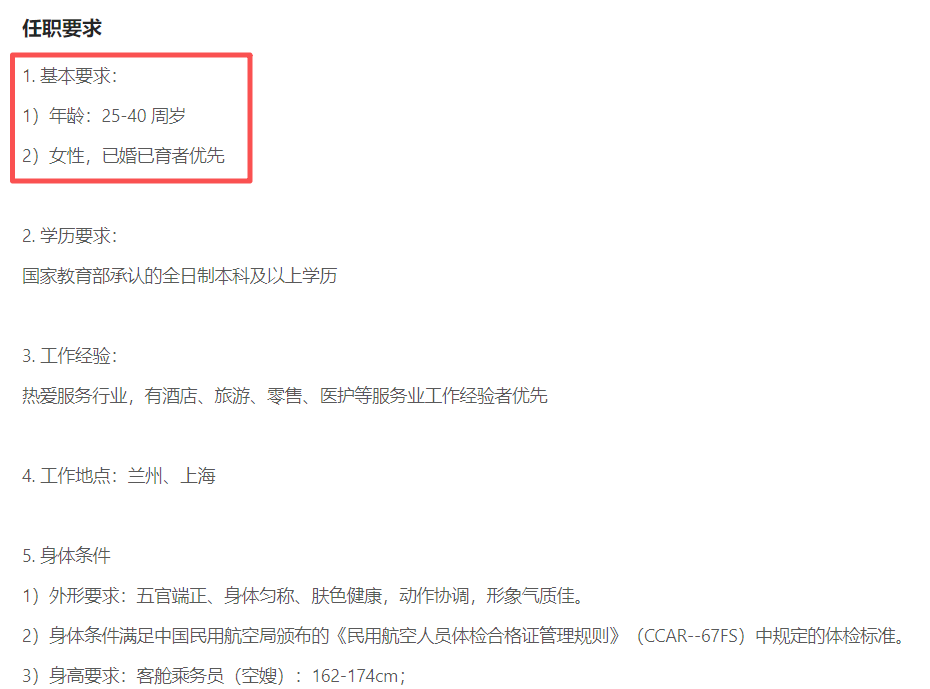
Core Viewpoint - Spring Airlines has launched a special recruitment for "air sisters" (experienced female flight attendants), targeting married women up to 40 years old, marking a shift from the industry's typical focus on youth and beauty [1][4][10]. Group 1: Recruitment Strategy - The recruitment aims to leverage the natural advantages of experienced women, such as strong interpersonal skills and the ability to handle children and passenger emotions effectively [9][10]. - This move is seen as a progressive step in breaking the industry's "youth filter," providing more job opportunities for mature women [10][12]. - The recruitment is strategically focused on key hubs like Lanzhou and Shanghai, aligning with the company's expansion plans for new routes [18][20]. Group 2: Cost Efficiency and Service Quality - Spring Airlines maintains its cost-saving philosophy, viewing the recruitment as a way to optimize training investments and reduce turnover costs associated with younger flight attendants [18][21]. - The experienced "air sisters" are expected to enhance service quality, leading to fewer complaints and lower operational risks, ultimately saving costs for the airline [18][24]. - The company has demonstrated strong financial performance, with a revenue of 10.304 billion and a net profit of 1.169 billion in the first half of 2025, outperforming competitors [24][25]. Group 3: Market Positioning - Spring Airlines is positioned as a low-cost carrier that successfully combines cost efficiency with high service quality, challenging the notion that service upgrades require significant spending [28][29]. - The airline's approach has resonated with consumers, as evidenced by a 22.87% year-on-year increase in passenger turnover in September, indicating a strong market presence [28]. - The company's strategy reflects a broader trend in the low-cost airline market, which is still underdeveloped in China compared to the U.S., suggesting significant growth potential [28].
放宽至40岁,春秋航空开招“空嫂”,最新回应:选拔核心标准是能力,非年龄或婚育状况!专家:年龄成熟度带来稳定性,打法难以复制
Mei Ri Jing Ji Xin Wen· 2025-10-29 05:00
Core Viewpoint - Spring Airlines has initiated a specialized recruitment program for "air sisters" targeting married women, aiming to break traditional age barriers in flight attendant hiring and enhance its brand image as a low-cost airline [1][5]. Recruitment Strategy - The recruitment plan allows for candidates aged up to 40, with a minimum education requirement of a full-time bachelor's degree, and no prior work experience necessary. The company plans to hire between 30 to 60 individuals, with training starting in early 2026 [1][4]. - This initiative is a response to the growing demand for talent due to the expansion of western flight routes, leveraging the life experience of "air sisters" to improve customer service and team cohesion [2][8]. Brand Logic - The recruitment aligns with Spring Airlines' low-cost brand positioning, aiming to reduce non-core costs while enhancing its employer brand as practical and inclusive [5][7]. - The strategy is expected to increase brand value by embedding local, mature employees into the community, enhancing customer relations through familiarity and warmth [7][8]. Performance Metrics - Spring Airlines has shown strong financial performance, reporting a net profit of 22.57 billion in 2023 and 22.73 billion in 2024, with a continued profit of 11.69 billion in the first half of 2025 [8]. - The airline's operational metrics include a total transport turnover of 24.1 billion ton-kilometers and a passenger turnover of 265.3 billion person-kilometers, reflecting year-on-year increases of 8.9% and 8.5%, respectively [8]. Competitive Advantage - The "air sisters" program is expected to reduce employee turnover rates, as older employees tend to have lower attrition, thus enhancing service reliability and reducing training costs [8][9]. - Other airlines may find it challenging to replicate this model due to structural differences in their operations and brand positioning [9].

春秋航空否认明年赴港上市计划称暂无相关安排
3 6 Ke· 2025-10-05 03:30
Core Viewpoint - Spring Airlines is considering a potential listing in Hong Kong, with discussions ongoing regarding the scale and timing of the issuance, although the company has stated that there are currently no formal plans for this [1][2]. Group 1: Company Overview - Spring Airlines, established in 2004, is one of China's first private airlines, focusing on low-cost aviation services, including domestic and international passenger and cargo transport [1]. - The company was listed on the Shanghai Stock Exchange in 2015 and has been expanding its international routes since 2010 [1]. Group 2: Financial Performance - In the first half of the year, Spring Airlines reported a profit of 1.169 billion yuan, making it the most profitable among four private airlines, although this represents a 14.11% year-on-year decline [1][2]. - The company's revenue for the same period was 10.304 billion yuan, reflecting a year-on-year growth of 4.35% [1]. Group 3: Profitability Analysis - The decline in net profit is attributed to the previous year's use of deferred tax assets, which significantly reduced tax expenses, leading to a decrease in net profit despite an increase in total profit [2]. - The airline industry is facing challenges such as decreased passenger revenue per kilometer and intense competition, contributing to a "high traffic but low profit" scenario [2]. Group 4: Market Dynamics - Spring Airlines noted that while the international route capacity has largely recovered to 2019 levels, the Thai market has experienced a decline in demand and pricing, prompting the airline to adjust its capacity to more favorable markets like Singapore and Vietnam [2]. - The company plans to continue monitoring domestic and international market conditions and leverage its differentiated positioning and enhanced data analysis capabilities for refined revenue management [3].