成都银行

Search documents
金融行业双周报(2025、6、27-2025、7、10)-20250711
Dongguan Securities· 2025-07-11 09:26
Investment Rating - The report maintains an "Overweight" rating for the insurance sector and highlights a positive outlook for the banking and securities sectors due to strong performance indicators and favorable market conditions [3][5][45]. Core Insights - The banking sector shows resilience with a return on equity (ROE) above 10%, despite marginal declines in overall performance due to macroeconomic factors. The report suggests that the banking sector will benefit from policy support aimed at expanding domestic demand, which is expected to lead to a moderate recovery in credit issuance [6][45]. - The securities sector is experiencing a surge, with several firms reporting significant profit growth for the first half of the year, driven by increased market activity and new account openings. The approval of virtual asset trading licenses for certain firms is also expected to catalyze further investment in this sector [4][47]. - The insurance sector is undergoing a transformation from a scale-oriented to a value-oriented strategy, which is anticipated to enhance the competitive advantage of leading firms and stabilize the market [5][49]. Summary by Sections Market Review - As of July 10, 2025, the banking, securities, and insurance indices have shown respective changes of +2.16%, +1.15%, and -1.24%, with the Shanghai and Shenzhen 300 index at +1.62%. Notably, Minsheng Bank and Zhongyin Securities have performed exceptionally well, with increases of +13.50% and +10.03% respectively [6][14]. Valuation Situation - The banking sector's price-to-book (PB) ratio stands at 0.78, with state-owned banks at 0.81 and joint-stock banks at 0.72. Individual banks like China Merchants Bank and Hangzhou Bank have higher valuations at 1.14 and 1.10 respectively [23][24]. - The securities sector's PB ratio is at 1.47, indicating potential for valuation recovery [25]. Recent Market Indicators - Key interest rates as of July 10, 2025, include a 1-year medium-term lending facility (MLF) rate of 2.0% and loan market quotation rates (LPR) of 3.0% for 1-year and 3.50% for 5-year loans. The liquidity in the market appears to be easing [31][35]. Investment Recommendations - For the banking sector, recommended stocks include Chengdu Bank, Ningbo Bank, and China Merchants Bank, focusing on those with strong regional performance and robust retail banking capabilities [46]. - In the securities sector, firms like Zheshang Securities and CITIC Securities are highlighted for their strong fundamentals and potential for growth [48]. - The insurance sector suggests focusing on companies like China Pacific Insurance and Ping An Insurance, which are expected to benefit from ongoing reforms and market conditions [50].
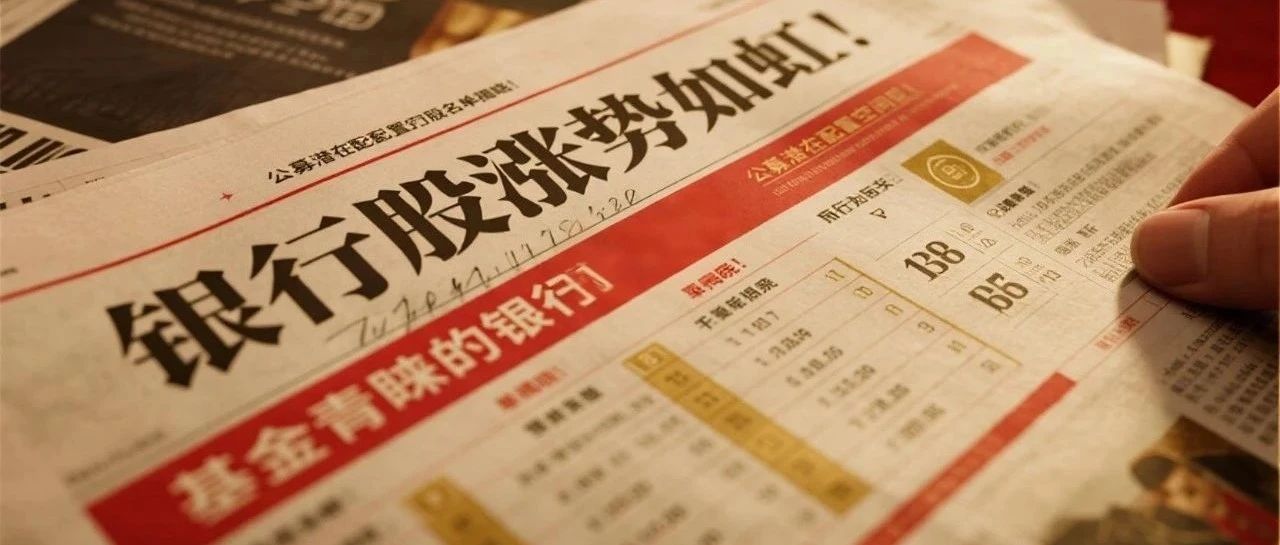
银行股涨势如虹!公募潜在配置空间巨大?基金青睐的银行股名单揭晓!
私募排排网· 2025-07-11 09:01
Core Viewpoint - The banking sector in A-shares has experienced significant growth, with major banks reaching historical highs and outperforming key market indices, driven by improvements in asset quality and stable earnings [2][3][4]. Group 1: Reasons for the Surge in Bank Stocks - The recent strong performance of A-share bank stocks is attributed to both fundamental and liquidity factors [2]. - Fundamental factors include improved asset quality and stable profitability, with core earnings showing signs of recovery [2]. - Liquidity factors highlight significant increases in insurance fund investments in bank stocks, driven by a search for stable returns amid low bond yields [3]. - Public funds have also increased their allocation to bank stocks, with a rise in the proportion of active funds holding bank shares from 3.72% to 4% [4]. Group 2: Performance Metrics of Bank Stocks - The average return of the top 20 performing bank stocks in A-shares has reached 28.54%, with eight stocks gaining over 30% year-to-date [7]. - The average price-to-book (PB) ratio of these top-performing bank stocks is 0.70, indicating they are generally undervalued [8]. - Notable stocks include Qingdao Bank, which has seen a year-to-date increase of 38.02% and a dividend yield of 3.08% [7][8]. Group 3: Fund Holdings in Bank Stocks - Several bank stocks have garnered significant interest from public funds, with four banks having fund ownership ratios exceeding 6% [9]. - Chengdu Bank leads with a fund holding ratio of 8.94%, followed by China Merchants Bank and Industrial Bank, which also have substantial fund backing [10]. Group 4: Earnings Performance of Bank Stocks - Among A-share listed banks, several have reported impressive earnings growth, with Hangzhou Bank achieving a net profit growth of 17.30% year-on-year [11]. - The analysis indicates that banks with double-digit profit growth include Changshu Bank, which also saw revenue growth exceeding 10% [11][12].

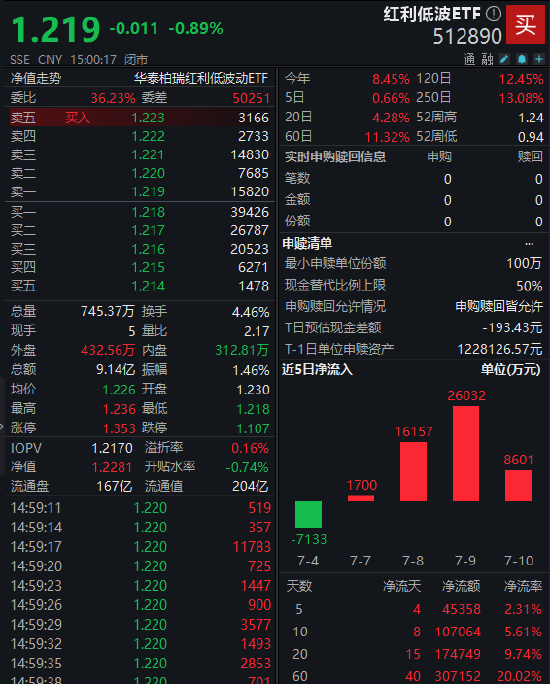
红利低波ETF(512890)本周整体涨0.66%,成交额25.4亿
Xin Lang Ji Jin· 2025-07-11 08:40
Core Viewpoint - The Reducing Volatility Dividend ETF (512890) has seen significant inflows and growth in fund size, driven by the performance of major banks and a favorable investment environment for dividend assets [1][3]. Fund Performance - On July 11, the Reducing Volatility Dividend ETF (512890) closed down 0.89% with a trading volume of 914 million yuan, while the overall weekly performance was up 0.66% with a total trading volume of 2.54 billion yuan [1]. - The fund has attracted over 520 million yuan in net inflows over four consecutive trading days, reaching a record high in fund size of 20.535 billion yuan as of July 10 [1][3]. Market Context - The banking sector continues to rise, with the stock prices of the four major banks breaking previous highs and setting historical records [1]. - Current dividend assets are considered valuable in a declining interest rate environment, with recommendations to focus on stocks with a dividend yield above 3% and low ROE volatility [1][3]. Fund Characteristics - The Reducing Volatility Dividend ETF (512890) was established on December 19, 2018, and has consistently achieved positive returns every full year since its inception, making it one of the few ETFs in the A-share market with such a track record [3]. - As of June 30, the fund ranked first in its category for five-year returns [3]. Holdings Overview - The fund's top holdings include Chengdu Bank, Yagor, and Shanghai Bank, with significant increases in their respective positions [4]. - The total market value of the top holdings amounts to approximately 3.722 billion yuan, representing 25.19% of the fund's net value [4]. Investment Opportunities - There are opportunities for rebound in sectors that have seen declines of over 4% since the beginning of the year, such as refining trade, white goods, and infrastructure [1]. - Financial stocks are transitioning from being undervalued to becoming a dynamic benchmark, with their low volatility and dividend yields exceeding 6% making them a core investment direction [1].
大利好!30cm涨停
中国基金报· 2025-07-11 04:31
Core Viewpoint - The article highlights a significant surge in the rare earth sector and the financial technology concept stocks, indicating a bullish market trend in these areas [2][5][17]. Market Overview - On July 11, the A-share market showed overall gains, with the Shanghai Composite Index rising by 1.05%, the Shenzhen Component Index by 0.94%, and the ChiNext Index by 1.19% [2][3]. - The total market turnover reached 1.03 trillion yuan, showing a noticeable increase compared to the previous day, with 2,855 stocks rising and 2,306 falling [4]. Sector Performance - The financial sector performed strongly, with major financial stocks leading the market rally. The rare earth concept stocks experienced a "blowout" performance, alongside gains in CRO, financial technology, and lithium extraction stocks [5][17]. - The rare earth sector continued its strong momentum, with multiple stocks hitting the daily limit up. Notable performers included Northern Rare Earth and Baotou Steel, both reaching their daily limit [10][14]. Rare Earth Sector Details - On July 11, rare earth and rare earth permanent magnet stocks saw a collective surge, with Northern Rare Earth and Baotou Steel both hitting their daily limit. Baotou Steel's market capitalization approached 100 billion yuan [10][14]. - The price of rare earth concentrate for related transactions was adjusted to 19,109 yuan per ton (excluding tax), reflecting a 1.5% increase from the previous quarter [16]. Financial Technology Sector Details - Financial technology stocks also saw significant gains, with stocks like Guoao Technology and Anshuo Information rising over 14%. Dazhihui reached its daily limit, while several other stocks in the sector also performed well [18][19]. - The article notes that major state-owned banks continued to reach new highs, with stocks like Industrial and Commercial Bank of China and Agricultural Bank of China showing strong performance [24][25]. Hong Kong Market Performance - The Hong Kong market mirrored the gains in the A-share market, with the Hang Seng Index rising by 1.9% and the Hang Seng Technology Index by 2.08%. WuXi AppTec led the gains with an 11% increase [7][27]. - The Chinese brokerage sector in Hong Kong saw significant increases, with Zhongzhou Securities rising over 75% at one point during the trading session [26][27].




银行“杀疯了”!这些主题基金大赚特赚!基金、牛股名单火线揭晓!
私募排排网· 2025-07-11 03:18
Core Viewpoint - The banking sector in A-shares has experienced significant growth, with a year-to-date increase exceeding 20%, outperforming major market indices like the CSI 300 and Shanghai Composite Index [3][4]. Group 1: Reasons for the Surge in Banking Stocks - The improvement in asset quality and stable profitability of banks has been highlighted as a key factor for the surge, with core earnings and net interest income showing signs of recovery [4][6]. - The influx of insurance capital into banking stocks is considered a major driver, as the decline in 10-year government bond yields has created an asset shortage, making bank stocks attractive due to their stability and dividend characteristics [4][5]. - The increase in public fund allocation to banking stocks, with the proportion rising from 3.72% to 4.00%, indicates a renewed interest in the investment value of banking stocks [5][6]. Group 2: Valuation and Performance Metrics - The banking sector's low valuation is also a contributing factor, with a static price-to-book (PB) ratio of 0.67, suggesting a significant safety margin compared to other industries [6][11]. - The average return of the top 20 banking stocks has reached 27.62%, with six stocks showing gains over 30% year-to-date, indicating strong performance across the sector [9][12]. - The dividend yield for several banks, such as Chongqing Bank and Changsha Bank, exceeds 6%, while some banks have yields below 3%, raising concerns about the perceived safety margin [10][11]. Group 3: Performance of Banking-Themed Funds - The banking-themed funds have also performed well, with the top 20 funds showing a minimum return of 19.08% year-to-date, and seven funds exceeding 20% [13][14]. - Notably, two funds managed by Liu Chongjie have achieved returns of 26.63% and 23.30%, benefiting from high dividend themes and the unique valuation dynamics of Hong Kong bank stocks [13][15].



触发可转债强赎条款 缓解资本补充压力
Jin Rong Shi Bao· 2025-07-11 01:41
Core Viewpoint - The recent strong performance of bank stocks has led to multiple convertible bonds triggering mandatory redemption clauses, which can alleviate repayment pressure and enhance core tier 1 capital for banks [1][2][3]. Group 1: Mandatory Redemption of Convertible Bonds - Qilu Bank has decided to exercise its early redemption rights for its convertible bonds due to a significant increase in its stock price, which has risen nearly 70% since the beginning of 2024 [1]. - Other banks, such as Hangzhou Bank and Nanjing Bank, have also seen their convertible bonds trigger mandatory redemption clauses due to their stock prices exceeding the required thresholds for consecutive trading days [2]. - The mandatory redemption of convertible bonds is becoming a trend among banks, with several already completing this process in 2024 [2][3]. Group 2: Impact on Capital Structure - The triggering of mandatory redemption clauses is expected to facilitate the conversion of bonds into equity, thereby effectively supplementing banks' core tier 1 capital [1][4]. - The unique property of convertible bonds allows banks to optimize their capital structure, making them an increasingly important option for capital supplementation [4][5]. - The redemption process sends a positive signal to the market regarding the financial health and stability of banks, potentially attracting more investors [5]. Group 3: Market Dynamics and Future Outlook - The banking sector has shown strong performance in the secondary market, with the Shenwan Primary Bank Industry Index rising over 17.77% year-to-date, ranking second among 31 primary industry indices [3]. - A decrease in the issuance of new convertible bonds has led to a rapid decline in the market's existing convertible bond scale, creating favorable conditions for mandatory redemptions [3]. - Analysts predict that the ongoing trend of mandatory redemptions will further highlight the supply-demand imbalance in the convertible bond market, providing support for their valuations [3].
价值重估的下半场——银行业2025年度中期投资策略
2025-07-11 01:13
Summary of Key Points from the Conference Call Industry Overview - The conference call focuses on the banking industry, particularly in the context of the Chinese market, with insights into A-shares and H-shares performance and investment strategies for 2025 [1][2][4]. Core Insights and Arguments - **Valuation Recovery**: The banking sector is experiencing a valuation recovery due to stable earnings and established risk bottom lines, particularly for large banks and China Merchants Bank since 2023 [1][2][4]. - **Macroeconomic Context**: The backdrop of an asset shortage has led to a reassessment of dividend values and earnings stability in the banking sector, which has been crucial for the valuation recovery [3][4]. - **Regulatory Support**: Regulatory policies have provided a safety net for major risks in urban investment and real estate, enhancing market expectations for banks' earnings resilience [5][6]. - **Funding Dynamics**: Three key funding dynamics are identified: high dividend yields due to asset shortages, expansion of passive index funds (ETFs), and public funds correcting their historical under-allocation to bank stocks [6][15]. - **Net Interest Margin (NIM) Trends**: A significant decline in deposit costs is expected starting in 2025, which will alleviate pressure on net interest margins. This trend is anticipated to continue into 2026 [8][9][10]. - **Loan Growth Projections**: The year 2025 is projected to see a slowdown in loan growth to approximately 7.1% year-on-year, with expectations of further declines by year-end [12]. Additional Important Content - **Asset Quality Stability**: Overall asset quality in the banking sector remains stable, with a slight increase in non-performing loan rates in retail lending, but this remains manageable due to the low proportion of retail loans [13][14]. - **Investment Strategies**: Future investment strategies focus on undervalued large state-owned banks and high-performing city commercial banks, which are expected to benefit from strong return on equity (ROE) and earnings growth [19][20][21]. - **Market Dynamics**: The increase in financial capital's stake in bank stocks is driven by local state-owned assets recognizing the value of bank equity amid asset shortages [15][16][17]. - **Public Fund Adjustments**: Public funds are increasingly focusing on stock quality and performance trends, leading to a rise in the valuation of certain city commercial banks [18]. This summary encapsulates the key points discussed in the conference call, providing a comprehensive overview of the banking industry's current state and future outlook.
一股份行高管暂未实施增持计划!
Zhong Guo Ji Jin Bao· 2025-07-11 00:25
Core Viewpoint - Huaxia Bank has not implemented its share buyback plan due to the information disclosure window period and fluctuations in the secondary market, despite the management's confidence in the bank's long-term investment value [2]. Group 1: Share Buyback Plan - Huaxia Bank announced that the implementation period for its share buyback plan has passed the halfway mark, but the plan has not been executed due to various factors [2]. - The bank's management expressed confidence in the bank's future development and plans to opportunistically increase their holdings during the remaining period of the buyback plan [2]. - The buyback plan was initially announced on April 10, with executives and key personnel planning to invest at least RMB 30 million over a six-month period starting from April 11, 2025 [2]. Group 2: Stock Performance - Huaxia Bank's stock price has shown an upward trend this year, rising from a low of RMB 7.17 per share on April 30 to RMB 8.58 per share as of July 10, representing an 18.06% increase [2]. - The bank's total market capitalization reached RMB 136.5 billion as of July 10 [3]. Group 3: Financial Performance - As of the end of the first quarter, Huaxia Bank reported total assets of RMB 45,211.99 billion, a year-on-year increase of 3.31% [3]. - The bank's operating income for the same period was RMB 18.194 billion, reflecting a year-on-year decline of 17.73% [3]. - The net profit attributable to shareholders was RMB 5.063 billion, down 14.04% year-on-year [3]. Group 4: Industry Context - Huaxia Bank is not the only bank to delay its share buyback plan this year; Chengdu Bank also announced a similar situation due to its stock price exceeding the buyback price limit [4]. - Chengdu Bank's major shareholders have not executed their buyback plan, which was initially set to acquire between 39.7944 million and 79.5887 million shares [4]. - The recent trend of banks postponing buyback plans may indicate a shift in market dynamics, as rising stock prices could diminish the attractiveness of such investments [5].


一股份行高管暂未实施增持计划!
中国基金报· 2025-07-11 00:08
Core Viewpoint - Huaxia Bank has not implemented its share buyback plan due to the information disclosure window period and fluctuations in the secondary market, despite the management's confidence in the bank's long-term investment value [2][4]. Group 1: Share Buyback Plan - On July 10, Huaxia Bank announced that its share buyback plan has not been executed as the implementation period has passed halfway, influenced by the information disclosure window and market volatility [2]. - The bank's management expressed confidence in the future development prospects and plans to opportunistically increase their holdings during the remaining period of the buyback plan [2]. - The buyback plan was initially announced on April 10, with executives and key personnel intending to invest at least RMB 30 million over a six-month period starting from April 11, 2025 [2]. Group 2: Stock Performance - Huaxia Bank's stock price has shown an upward trend this year, starting from a low of RMB 7.17 per share on April 30, leading to a significant increase [3]. - As of July 10, the stock price reached RMB 8.58 per share, resulting in a total market capitalization of RMB 136.5 billion, reflecting an 18.06% increase since April 10 [4]. Group 3: Financial Performance - Despite the positive stock performance, Huaxia Bank's financial results for the first quarter indicate some pressure, with total assets amounting to RMB 45,211.99 million, a 3.31% increase from the end of the previous year [4]. - The bank reported operating revenue of RMB 18.194 billion, a year-on-year decrease of 17.73%, and a net profit attributable to shareholders of RMB 5.063 billion, down 14.04% year-on-year [4]. Group 4: Industry Context - Huaxia Bank is not the only bank to delay its buyback plan this year; Chengdu Bank also announced a similar situation due to its stock price exceeding the buyback price limit [5]. - The recent trend of bank executives and shareholders postponing buyback plans may indicate a decrease in the attractiveness of the current valuations, raising concerns about potential market shifts [5].

银行股增持潮起
Jing Ji Guan Cha Wang· 2025-07-10 13:27
Core Viewpoint - The banking sector in China is experiencing a notable increase in internal capital increases, reflecting growing confidence in the long-term value of banks as both executives and major shareholders actively participate in stock buybacks [1][2][3]. Group 1: Executive and Shareholder Actions - Several banks, including Huaxia Bank and Jiangsu Bank, have initiated or completed stock buyback plans, indicating a trend where bank executives and major shareholders are taking proactive steps to invest in their own companies [1][2]. - Huaxia Bank announced a voluntary buyback plan of at least 30 million yuan, although its implementation has been delayed due to market conditions [1][2]. - Jiangsu Bank's executives completed their buyback plan ahead of schedule, investing 24.28 million yuan, which is 121.39% of the planned minimum amount [1][2]. Group 2: Broader Industry Trends - Over ten banks, including Suzhou Bank and Chengdu Bank, have disclosed similar buyback plans in 2023, suggesting a widespread trend within the banking industry [1][2]. - The actions of bank executives and shareholders are interpreted as a signal of confidence in the banks' future performance and stock prices, as they are willing to invest their own funds and bear market risks [2][3]. Group 3: Market Reactions and Valuation - The stock buyback announcements have provided short-term support for stock prices, with Jiangsu Bank's stock rising by 0.74% following its announcement [5]. - The average price-to-book (PB) ratio for A-share banks is currently at 0.6, with some city commercial banks below 0.5, indicating that the banking sector is undervalued [5]. - The average dividend yield for the banking sector is 3.86%, making it attractive for long-term investors, especially in light of regulatory measures encouraging long-term capital inflows [4]. Group 4: Long-term Challenges - Despite the positive signals from buybacks, the banking sector faces deeper challenges, including narrowing net interest margins and asset quality issues that have not been fundamentally resolved [5][6]. - The effectiveness of buybacks in stabilizing stock prices may be limited if they do not coincide with improvements in operational efficiency and fundamental performance [5][6].