平安银行

Search documents
银行业全方位做好十五运会服务保障
Jin Rong Shi Bao· 2025-11-12 01:21
Core Insights - The 15th National Games has officially commenced in Guangdong, marking the first joint hosting by Guangdong, Hong Kong, and Macau, and initiating a deep integration of finance, sports, and technology [1] Group 1: Financial Services and Technology Integration - The Industrial and Commercial Bank of China (ICBC) has established a digital command center for the National Games, showcasing real-time data on service efficiency and product promotion, enhancing operational responsiveness [2] - Security measures for the event have incorporated advanced technology, with Guangzhou Chengzhi Intelligent Machine Technology Co., Ltd. utilizing drone security technology supported by ICBC's financial backing [2] Group 2: Payment Solutions and Consumer Experience - During the National Games, banks have upgraded payment solutions to facilitate spectator spending, with Bank of China Guangdong Province launching a green channel for cash exchange and offering credit card products for seamless cross-border transactions [3] - ICBC has provided hands-on assistance to Hong Kong residents at the Luohu Port, helping them navigate electronic payment processes, thereby enhancing their experience during the event [3] Group 3: Comprehensive Service Network - ICBC has created a comprehensive service network in the Greater Bay Area, with approximately 1,500 branches offering priority services for athletes and volunteers, and over 4,500 self-service banking devices supporting foreign card transactions [4] Group 4: Cultural Promotion and Community Engagement - Financial institutions are extending their services beyond the event, with initiatives aimed at promoting sports culture and community engagement, such as the "Play the National Games" section on ICBC's mobile banking app, which has attracted over 4 million visits [6] - Partnerships with companies like Decathlon by SPD Bank have led to the establishment of "small community sports stations," promoting sports participation through financial incentives [6]

深圳中科飞测科技股份有限公司关于签订募集资金专户存储三方、四方监管协议的公告
Shang Hai Zheng Quan Bao· 2025-11-11 19:24
Group 1 - The company has signed agreements for the storage and supervision of raised funds, ensuring compliance with regulations and protecting investors' rights [3][4][8] - The company plans to issue 28,571,428 A-shares at a price of 87.50 yuan per share, raising a total of 250 million yuan, with a net amount of approximately 248.08 million yuan after deducting issuance costs [2][4] - The raised funds will be allocated to specific projects, including the development of high-end semiconductor quality control equipment and the upgrade of headquarters and R&D centers [4][8] Group 2 - The three-party supervision agreement involves the company, several banks, and the underwriting institution, outlining the management and usage of the raised funds [4][5] - The four-party supervision agreement includes the company and its wholly-owned subsidiary, with similar stipulations regarding fund management and usage [8][9] - Both agreements require regular reporting and oversight, including monthly account statements and conditions for withdrawal of funds exceeding certain thresholds [6][11]

三季度公募含“银”量创五年新低,四季度银行股修复动能渐显
第一财经· 2025-11-11 14:59
Core Viewpoint - The article highlights the significant changes in the banking sector, particularly focusing on the increasing shareholding of local state-owned enterprises and insurance funds in various banks, while public funds and northbound capital are reducing their holdings. The overall market sentiment for bank stocks is showing signs of recovery in the fourth quarter after a challenging third quarter [3][10][12]. Group 1: Shareholding Changes - Action Person's total shareholding ratio has risen to 19.17%, making it the largest shareholder of Qingdao Bank [3]. - Many city commercial banks and national banks have disclosed shareholding increase plans or have already implemented them, including Chengdu Bank, Nanjing Bank, and Postal Savings Bank [3]. - The number of shareholders in banks like China Merchants Bank and Beijing Bank has increased significantly, indicating a rise in retail investor participation alongside a decline in institutional holdings [5][6]. Group 2: Fund Holdings and Market Performance - Public funds' exposure to bank stocks has dropped to a five-year low, with a decrease in their overall holdings [4][6]. - The banking sector saw a decline of 8.68% in the third quarter but rebounded with an increase of 8.23% in the fourth quarter as of November 11 [3]. - Northbound capital inflow into banks decreased by 31.66% in the third quarter, with only a few banks like Ningbo Bank and Chengdu Bank seeing net inflows [7]. Group 3: Institutional Investment Trends - Insurance funds and state-owned capital have maintained relatively stable holdings in bank stocks, with state-owned funds holding a total market value of 4.5 trillion yuan [8]. - The increase in local state-owned capital investments in city commercial banks reflects a strategy to strengthen regional financial resource control and capitalize on low valuations [9]. - The investment sentiment in the banking sector is expected to improve in the fourth quarter, with several banks announcing share buyback plans [10][11]. Group 4: Future Outlook - The article suggests that the banking sector may experience structural recovery opportunities in the fourth quarter, driven by high dividend yields and the resilience of regional banks [10][12]. - Analysts believe that the combination of increased institutional investment and favorable market conditions could lead to a stabilization phase for bank stocks [11][12].



三季度公募含“银”量创五年新低 四季度银行股修复动能渐显
Di Yi Cai Jing· 2025-11-11 13:51
Core Viewpoint - Qingdao Guoxin Financial Holdings has become the largest shareholder of Qingdao Bank with a total holding of 19.17% [1] - The banking sector is experiencing a mixed performance with increased shareholder activity, particularly from local state-owned and industrial capital, while facing pressure from public funds and northbound capital [1][2] Group 1: Shareholder Activity - Multiple city commercial banks and national banks have reported significant shareholder increases this year, including Chengdu Bank, Nanjing Bank, and Postal Savings Bank [1] - Public funds have reduced their holdings in bank stocks, with the proportion of public fund investment in bank stocks dropping to 1.78%, the lowest level in five years [2][3] - Northbound capital has also decreased its investment in banks, with a 31.66% decline in total market value held by northbound funds [3] Group 2: Market Performance - The banking sector saw an 8.68% decline in Q3 but rebounded with an 8.23% increase in Q4 as of November 11 [1] - The overall market style shift has led to a significant reallocation of funds from low-volatility bank stocks to high-growth sectors, with the Wind All A Index rising by 19.5% during the same period [4] Group 3: Institutional Investment Trends - Insurance and state-owned funds have maintained stable holdings in bank stocks, with state-owned funds holding a total market value of 4.5 trillion yuan [5][6] - Local state-owned and industrial capital are increasingly investing in city commercial banks, driven by regional financial resource integration needs and attractive valuations [6] Group 4: Future Outlook - There is a growing sentiment of recovery in the banking sector, with several banks announcing share buyback plans and improved core revenue capabilities [7] - Analysts suggest that Q4 presents structural recovery opportunities, particularly for quality regional banks and high-dividend state-owned banks [8]
三季度公募含“银”量创五年新低,四季度银行股修复动能渐显
Di Yi Cai Jing· 2025-11-11 13:40
Core Viewpoint - Qingdao Guoxin Chanin Holdings has become the largest shareholder of Qingdao Bank with a total holding of 19.17% [1] - The banking sector is experiencing a mixed performance with significant shareholder activity, particularly in the context of third-quarter financial reports [1][2] Shareholder Activity - Multiple city commercial banks and national banks have reported shareholding increases, including Chengdu Bank, Nanjing Bank, and Postal Savings Bank [1] - Public funds have reduced their holdings in bank stocks, with the proportion of public funds in bank stocks dropping to 1.78%, a decrease of 2.55 percentage points [2][3] Market Performance - The banking sector saw a decline of 8.68% in the third quarter but rebounded with an increase of 8.23% in the fourth quarter as of November 11 [1] - The overall market style shift has led to a significant reallocation of funds from low-volatility bank stocks to high-growth sectors [4] Fund Composition - Active funds have reduced their positions in major banks like China Merchants Bank and Jiangsu Bank, while some banks like Ningbo Bank and Chengdu Bank saw an increase in holdings [3] - Passive funds also exhibited a reduction in bank stock holdings, with a total market value of 841.12 billion yuan, down 5.67 percentage points [3] Institutional Investment Trends - Insurance and state-owned funds have maintained stable holdings in bank stocks, with state-owned funds holding a total market value of 4.5 trillion yuan [5][6] - Local state-owned capital is increasingly investing in city commercial banks, driven by regional financial resource integration needs and attractive valuations [6] Future Outlook - The fourth quarter has seen a wave of share buyback announcements from bank executives and major shareholders, signaling positive investment sentiment [7] - Analysts believe there are structural recovery opportunities in the banking sector, particularly for regional banks and high-dividend state-owned banks [7][8]
波段难做,多家银行相关投资收益下降,拖累前三季度非息收入
Zheng Quan Shi Bao· 2025-11-11 12:58
Core Viewpoint - The bond market faced significant pressure from strong commodity and equity market performances in Q3, leading to increased volatility and a notable rise in interest rates, which adversely affected banks' non-interest income due to unrealized losses on bond holdings [1] Group 1: Impact on Non-Interest Income - Many banks reported a decline in non-interest income due to reduced investment returns from the bond market, with at least ten banks showing a year-on-year decrease in non-interest income for the first three quarters [2][5] - China Merchants Bank's non-interest income fell by 11.42% year-on-year, primarily due to decreased bond and fund investment returns, with a cumulative loss of 8.827 billion yuan in fair value changes compared to a gain of 3.099 billion yuan in the same period last year [2] - Ping An Bank's investment income dropped nearly 50% year-on-year in Q3, with a total investment income of 16.275 billion yuan for the first three quarters, down approximately 11.41% from the previous year [2] Group 2: Market Conditions and Trends - The bond market experienced significant fluctuations, with yields on various bonds rising above 1.8% in September, marking a notable increase compared to the previous month [4] - The overall bond market has shown wide fluctuations this year, contrasting with last year's bullish trend, making it challenging for banks to execute effective trading strategies [4][5] - A report indicated that the other non-interest income of listed banks grew by only 5.4% year-on-year, with a significant decline in the growth rate attributed to bond market volatility [3] Group 3: Strategic Responses - Banks are advised to enhance their trading capabilities and consider increasing the use of derivative hedging and fixed-income assets to mitigate risks associated with bond market fluctuations [5][6] - China Merchants Bank plans to maintain a reasonable bond investment ratio of around 30%, optimize asset allocation, and improve trading operations to enhance income [5] - Recommendations include utilizing government bond futures and interest rate swaps to construct hedging portfolios and accurately identify market trends for better timing in trading [6]


波段难做,债市浮亏!多家银行相关投资收益下降,拖累前三季度非息收入
券商中国· 2025-11-11 12:24
Core Viewpoint - The article highlights the significant impact of bond market volatility on the non-interest income of several banks in the third quarter, leading to a decline in investment income and overall non-interest revenue due to losses from bond holdings [1][4]. Group 1: Impact on Non-Interest Income - Many banks reported a decrease in non-interest income due to reduced investment income from the bond market, with notable declines in the third quarter [2][4]. - For example, China Merchants Bank's non-interest income fell by 11.42% year-on-year, primarily due to decreased bond and fund investment returns, resulting in a cumulative fair value loss of 8.827 billion yuan compared to a gain of 3.099 billion yuan in the previous year [2]. - Ping An Bank's investment income dropped nearly 50% in the third quarter, with a year-to-date decrease of approximately 11.41% [2][3]. Group 2: Market Conditions and Bank Responses - The bond market experienced significant fluctuations, with yields rising above 1.8% for various bank categories, contrasting sharply with the previous year's bullish market [6]. - Banks are advised to enhance their trading capabilities and consider using derivatives for hedging to mitigate risks associated with market volatility [8]. - Strategies suggested include maintaining a reasonable proportion of bond investments, optimizing asset allocation, and utilizing derivative tools to manage risks effectively [8]. Group 3: Overall Trends in the Banking Sector - A total of 10 banks reported a year-on-year decline in non-interest net income, with decreases ranging from 4% to 23% [6][7]. - The research team from China International Capital Corporation noted that the growth rate of other non-interest income for listed banks slowed significantly, with only state-owned banks showing an increase in this metric [4][5].


以心焕新 权益相伴:平安银行西安分行发布本地化权益体系2.0
Cai Fu Zai Xian· 2025-11-11 11:46
Core Viewpoint - The banking industry is transitioning from a focus on merely providing financial services to enhancing customer experiences, emphasizing the need for localized and personalized service models to meet evolving client demands [1][2][10]. Group 1: Industry Trends - The competitive landscape of China's banking sector is undergoing significant transformation, shifting from product and interest rate competition to a focus on service depth and customer experience [2][4]. - Customers are increasingly seeking personalized value experiences rather than just functional financial services, necessitating the development of differentiated and emotionally resonant service systems [2][4]. Group 2: Company Initiatives - Ping An Bank's Xi'an branch has launched the "Localized Rights System 2.0," marking a strategic shift from a product-centric to a customer experience-centric service model, integrating financial services into daily life and business growth [1][5]. - The new rights system enhances service breadth and depth, expanding its coverage to a wider range of customer segments while strengthening data support and customer insight capabilities for personalized service delivery [5][12]. Group 3: Service Ecosystem - The "Localized Rights System 2.0" features eight key scenarios: sports, education, local life, legal and tax services, travel, family, cultural heritage, and healthcare, addressing various aspects of customer life and needs [6][8]. - These scenarios are designed to provide comprehensive support for modern families, integrating financial services with health management, cultural experiences, and professional planning for wealth transfer and tax compliance [8][9]. Group 4: Community Impact - By collaborating with local businesses and service providers, Ping An Bank aims to transform the "finance + life" concept into tangible customer experiences, thereby stimulating local consumption and contributing to regional economic growth [9][10]. - The bank's approach positions it as a connector and enabler within the regional economic ecosystem, aligning its development with local community needs and responsibilities [10][12].
8.08亿元资金今日流入银行股
Zheng Quan Shi Bao Wang· 2025-11-11 09:08
Market Overview - The Shanghai Composite Index fell by 0.39% on November 11, with 15 out of the 28 sectors rising, led by retail and real estate, which increased by 1.43% and 0.81% respectively [1] - The banking sector rose by 0.35%, while the telecommunications and electronics sectors experienced declines of 2.20% and 1.74% respectively [1] Capital Flow Analysis - The main capital outflow from the two markets totaled 56.242 billion yuan, with five sectors seeing net inflows [1] - The banking sector had the largest net inflow of 808 million yuan, followed by the steel sector with a 0.62% increase and a net inflow of 391 million yuan [1] Banking Sector Performance - Within the banking sector, 42 stocks were tracked, with 22 rising and 12 falling [2] - The top three banks by net inflow were Agricultural Bank with 302 million yuan, followed by China Merchants Bank and Ping An Bank with inflows of 224 million yuan and 128 million yuan respectively [2] - The banks with the highest net outflows included Chongqing Rural Commercial Bank, Minsheng Bank, and Industrial Bank, with outflows of 79.83 million yuan, 66.40 million yuan, and 23.17 million yuan respectively [2] Individual Bank Performance - Agricultural Bank saw a price increase of 2.22% with a turnover rate of 0.11% and a net capital flow of 301.97 million yuan [2] - China Merchants Bank increased by 0.56% with a net capital flow of 223.84 million yuan [2] - Ping An Bank rose by 0.34% with a net capital flow of 128.05 million yuan [2] - Other notable performances included Jiangsu Bank with a slight decline of 0.18% and a net capital flow of 90.38 million yuan [2]

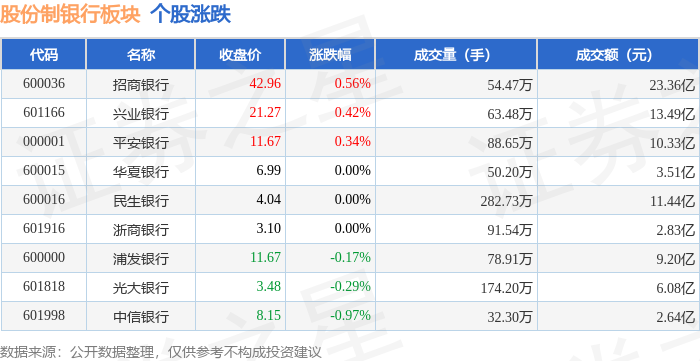
股份制银行板块11月11日涨0.12%,招商银行领涨,主力资金净流入3.14亿元
Zheng Xing Xing Ye Ri Bao· 2025-11-11 08:46
Group 1 - The banking sector saw a slight increase of 0.12% on November 11, with China Merchants Bank leading the gains [1] - The Shanghai Composite Index closed at 4002.76, down 0.39%, while the Shenzhen Component Index closed at 13289.0, down 1.03% [1] - Major banks' stock performance included China Merchants Bank at 42.96 with a rise of 0.56%, and Minsheng Bank at 4.04 with no change [1] Group 2 - The banking sector experienced a net inflow of 314 million yuan from institutional investors, while retail investors saw a net outflow of 135 million yuan [1] - China Merchants Bank had a significant net inflow of 1.79 billion yuan, representing 7.68% of its total trading volume [1] - Ping An Bank also saw a net inflow of 112 million yuan, accounting for 10.81% of its trading volume [1]