Qualcomm

Search documents
CES凸显端侧与物理AI成为人工智能重要突破方向——访美国高通公司中国区董事长孟樸
Xin Hua She· 2026-01-07 08:05
Group 1 - The core theme of the 2026 CES is the transition of AI from a conceptual phase to a fully realized stage, with a focus on edge AI and physical AI as key areas for technological breakthroughs [2] - Qualcomm showcased AI solutions across various sectors, including personal devices, industrial robots, and automotive smart cabins, indicating that AI is evolving from a feature to the foundation of all experiences [2] - The next generation of human-computer interaction is emerging, where users will rely on AI agents to perform tasks through understanding and action rather than frequent clicks and swipes [2] Group 2 - In the personal AI domain, AI is becoming an intelligent assistant integrated into wearable devices, personal terminals, and computers, with diverse products like AI glasses and AI cameras addressing specific needs in various scenarios [3] - Physical AI is rapidly entering real-world applications in cars, robots, and smart homes, enabling machines to perceive environments, understand intentions, and act in real-time, thus enhancing productivity in logistics, manufacturing, and retail [3] - Qualcomm introduced a new generation of processors for humanoid robots, autonomous mobile robots, and industrial robots to support ecosystem partners in accelerating product development [3] Group 3 - The future of AI is expected to involve a hybrid model where cloud, edge cloud, and edge AI work together, with edge AI having advantages in real-time performance, reliability, privacy, and energy efficiency [4] - 6G technology is anticipated to play a crucial role in connecting cloud and edge, facilitating the development of intelligent networks with perceptual capabilities [4] - Key breakthroughs in edge AI are likely to occur in the fields of robotics and wearable devices, while smartphones, AI personal computers, and smart connected vehicles will remain important platforms for edge AI [4]


专访|CES凸显端侧与物理AI成为人工智能重要突破方向——访美国高通公司中国区董事长孟樸
Xin Hua She· 2026-01-07 05:08
Core Insights - Artificial Intelligence (AI) has transitioned from a conceptual phase to a fully realized stage, with edge AI and physical AI emerging as significant breakthrough directions [1][2] - The 2026 CES highlights AI evolving from a mere function to the foundational basis of all experiences, indicating a shift in human-computer interaction [1] Group 1: Personal AI Developments - In the personal AI domain, AI is becoming an intelligent assistant integrated into wearable devices, personal terminals, and computers, with diverse products like AI glasses and AI home appliances emerging [2] - These innovations are addressing specific needs in various scenarios, such as assisting visually impaired individuals and enhancing outdoor activities [2] Group 2: Physical AI Advancements - Physical AI is rapidly entering real-world applications in automobiles, robotics, and smart homes, enabling machines to perceive environments, understand intentions, and act in real-time [2] - The development of embodied intelligence is crucial for connecting AI with the physical world, transforming intelligence into executable productivity [2] - Robots are increasingly taking on high-intensity or repetitive tasks in logistics, manufacturing, and retail, which is expected to significantly enhance productivity [2] Group 3: Automotive AI Integration - The acceleration of AI in the automotive sector is a key trend at CES, with AI capabilities enhancing both cabin interaction and driving assistance [3] - Qualcomm and Google are deepening their collaboration in the automotive field to support the deployment of next-generation AI in vehicle scenarios [3] Group 4: Future AI Trends - Future AI development will see a collaborative operation between cloud, edge cloud, and endpoint AI, with hybrid AI becoming the mainstream form [3] - Edge AI offers advantages in real-time performance, reliability, privacy protection, and energy efficiency, making it suitable for applications in automobiles, wearables, and robotics [3] - The sixth-generation mobile communication technology (6G) will serve as a vital link between cloud and edge, aiding in the creation of intelligent networks with perceptual capabilities [3]
Can Qualcomm's Snapdragon X2 Plus Platform Drive Future Growth?
ZACKS· 2026-01-06 16:51
Key Takeaways Qualcomm launched Snapdragon X2 Plus for Copilot PCs at CES '26, expanding its Snapdragon X Series.QCOM's 3 nm Oryon CPU and Hexagon NPU deliver faster performance, better power efficiency, and on-device AI.Qualcomm targets AI PCs beyond phones, with X2 Plus due in first-half 2026 and more X Series variants planned.Qualcomm Incorporated ((QCOM) recently unveiled the Snapdragon X2 Plus platform, its latest addition to the Snapdragon X Series for Windows 11 Copilot+ PCs. The new solution enables ...

Qualcomm Witnesses Just 8.2% Growth in Past Year: Reason to Worry?
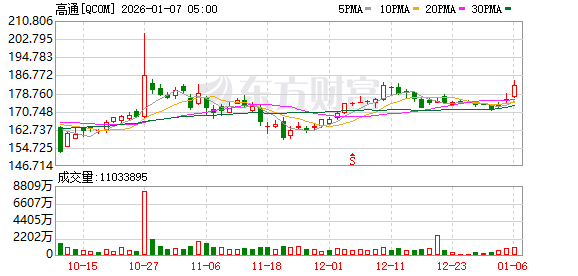
ZACKS· 2026-01-05 16:40
Core Viewpoint - Qualcomm's stock has underperformed compared to the industry, with an 8.2% increase over the past year against the industry's 35.7% growth, indicating challenges in maintaining competitive performance [2][7]. Group 1: Financial Performance - Qualcomm's margins have been declining due to high operating expenses and R&D costs, leading to a subdued performance [4]. - Earnings estimates for Qualcomm for fiscal 2026 have decreased by 1.4% to $12.15, reflecting bearish investor sentiment regarding growth potential [17]. Group 2: Market Challenges - The company faces significant competitive pressures from rivals like Broadcom and Hewlett Packard, as well as low-cost chip manufacturers, which are expected to negatively impact profits [5][7]. - Qualcomm is experiencing softness in demand from China due to ongoing U.S.-China trade tensions, which complicates its operations and market presence in the region [8][9]. Group 3: Growth Opportunities - Despite short-term challenges, Qualcomm is well-positioned for long-term growth through its investments in 5G technology and a diversified revenue stream, particularly from its Snapdragon portfolio [10]. - The acquisition of U.K.-based Alphawave Semi for approximately $2.4 billion allows Qualcomm to expand into high-growth applications such as data centers and AI [13]. - Qualcomm is also gaining traction in the automotive sector with its V2X communication systems, enhancing its portfolio in connected vehicle technologies [14][16].
Evaluating Intel Against Peers In Semiconductors & Semiconductor Equipment Industry - Intel (NASDAQ:INTC)
Benzinga· 2026-01-02 15:01
Core Insights - The article provides a comprehensive comparison of Intel against its competitors in the Semiconductors & Semiconductor Equipment industry, focusing on financial metrics, market position, and growth prospects to offer insights for investors [1] Company Overview - Intel is a leading digital chipmaker specializing in microprocessors for personal computers and data centers, holding a significant market share in both PC and server markets [2] - The company aims to revitalize its chip manufacturing business and develop advanced products within its Intel Products segment [2] Financial Metrics Comparison - Intel's Price to Earnings (P/E) ratio is 615, significantly higher than the industry average, indicating potential overvaluation [3] - The Price to Book (P/B) ratio is 1.65, slightly below the industry average, suggesting possible undervaluation [3] - Intel's Price to Sales (P/S) ratio is 3.04, which is lower than the industry average, indicating potential undervaluation based on sales performance [3] - The Return on Equity (ROE) for Intel is 3.98%, which is below the industry average, indicating inefficiency in generating profits from equity [3] - Intel's EBITDA stands at $7.85 billion, which is below the industry average, suggesting lower profitability [3] Profitability and Growth - Intel's gross profit is $5.22 billion, indicating lower revenue after production costs compared to the industry average [7] - The revenue growth for Intel is 2.78%, significantly lower than the industry average of 34.59%, indicating a slowdown in sales expansion [7] Debt to Equity Ratio - Intel has a debt-to-equity ratio of 0.44, which is lower than its top four peers, suggesting a more favorable balance between debt and equity [9]


Can Qualcomm Stock Benefit From a Foray Into Mid-Range AI Chips?
ZACKS· 2025-12-31 14:25
Core Insights - Qualcomm has launched the Snapdragon X chip for mid-range AI desktops and laptops, featuring an 8-core Oryon CPU and a neural processing unit (NPU) capable of 45 TOPS, aimed at enhancing AI capabilities in Windows devices [1][7] Qualcomm's Product Development - The Snapdragon X chip is the fourth in the Snapdragon X processor line, following the Snapdragon X Plus 8-core, Snapdragon X Plus, and Snapdragon X Elite series [1] - The NPU in the Snapdragon X chip accelerates AI workloads, making it suitable for Microsoft's AI-first Copilot+PCs [1][2] AI PC Market - AI PCs are equipped with specialized processors to enhance AI functionalities, including personal assistants and task automation, while also promising improved battery life [2] - Qualcomm's chips, based on Arm Holdings designs, are expected to provide extended usage without frequent charging [2] Competitive Landscape - NVIDIA is expanding its presence in enterprise AI, with its DGX Cloud AI infrastructure gaining traction among companies for automating workflows and improving decision-making [4] - Intel is investing in its IDM 2.0 strategy to enhance manufacturing capacity and support large AI workloads with its Xeon 6 processors, which are designed for cost-effective AI processing [5] Financial Performance - Qualcomm's shares have increased by 13% over the past year, while the industry has seen a growth of 41% [6] - The company's earnings estimates for fiscal 2026 have risen by 2% to $12.15 per share, and for fiscal 2027, they have increased by 3.4% to $12.6 [9][10] - Qualcomm's shares currently trade at a price/earnings ratio of 14.16, significantly lower than the industry average of 34.14 [8]

7 Most Promising Robotics Stocks According to Wall Street Analysts
Insider Monkey· 2025-12-29 03:04
Industry Overview - The global robotics industry is entering its "breakthrough era," with a market valuation projected to reach $50 billion by late 2025, reflecting an 11% increase from 2024 [1] - In the U.S., the robotics industry is driven by nearshoring initiatives and supply chain resilience, with the industrial robot market expected to reach approximately $3.7–$3.8 billion in 2025 [2] - By 2028, global installations of industrial robots are anticipated to exceed 700,000 units annually, with the adoption of the Robot-as-a-Service (RaaS) model expected to lower barriers to automation for small and medium enterprises [4] Technological Advancements - The industry is moving towards the "humanoid pilot" phase by 2026, with major companies like BMW and Amazon integrating bipedal robots into logistics, featuring neuromorphic chips for energy efficiency [3] - The integration of robots and AI into hybrid workplaces is a key focus as companies adapt to new technologies [5] Company Insights Emerson Electric Co. (NYSE:EMR) - Emerson Electric Co. is ranked seventh among promising stocks, with a price target upside of 13.48% and a year-to-date return of 11.07% [10] - The company has seen a significant expansion in gross and EBITA margins by 600–700 basis points, attributed to enhanced pricing power and productivity gains [11] - Jefferies downgraded EMR from Buy to Hold, citing a more balanced risk-reward profile following its portfolio transformation [12] QUALCOMM Incorporated (NASDAQ:QCOM) - QUALCOMM is ranked sixth, with a price target upside of 14.41% and a year-to-date return of 13.78% [14] - The company completed a $2.4 billion acquisition of Alphawave Semi, enhancing its infrastructure strategy and positioning for AI-driven demand [15] - QUALCOMM's technologies are crucial for robotics, enabling autonomous robots and smart machines with edge AI and real-time 5G connectivity [18]

QCOM Rides on Strength in Premium Handset Market: Will it Sustain?
ZACKS· 2025-12-26 16:36
Core Insights - Qualcomm Incorporated generated approximately $6.96 billion in handset revenues in the latest quarter, reflecting a year-over-year increase of 14% and an estimated $27.8 billion in fiscal 2025, contributing around 63% of the company's total revenues [1][8] Group 1: Market Position and Competition - Qualcomm faces strong competition from rivals like MediaTek, particularly in the mid-range and budget smartphone segments, which pressures its market share and pricing [2] - U.S.-China trade tensions have significantly reduced handset demand, impacting Qualcomm's business as global smartphone demand continues to decline [2] - Major manufacturers such as Apple and Samsung are increasingly developing in-house chips, posing a significant challenge for Qualcomm [2][5] Group 2: Product Development and Innovation - To address challenges in the smartphone market, Qualcomm is focusing on premium Snapdragon chips, recently launching the Snapdragon 8 Gen 5, which offers high-speed performance and advanced features for flagship smartphones [3][8] - The global 5G chipset market is projected to grow from $18.7 billion in 2022 to $126.4 billion by 2030, with a CAGR of 27%, indicating strong growth potential for Qualcomm's handset segment [4] Group 3: Financial Performance and Estimates - Qualcomm shares have increased by 11.1% over the past year, compared to the industry's growth of 35.3% [7] - The company's shares currently trade at a price/earnings ratio of 14.26, which is lower than the industry average of 34.54 [9] - Earnings estimates for 2025 have risen by 2% to $12.15, while estimates for 2026 have increased by 3.4% to $12.60 over the past 60 days [10]

The New Year Could Bring Massive Upside for These Semiconductor Stocks
Yahoo Finance· 2025-12-24 18:05
Core Viewpoint - TSMC is poised for accelerated growth in 2026, driven by increased production capacity and strong demand for its advanced chips [1][3]. TSMC's Growth Potential - TSMC's production capacity for the 2-nanometer node is expected to double, with the entire capacity for 2026 already sold out [1]. - Analysts predict a 30% revenue increase for TSMC by the end of 2025, with earnings per share expected to rise by nearly 48% to $10.41 [2]. - TSMC holds a 72% market share in the foundry sector, having improved its share by six percentage points year-over-year [3]. Semiconductor Industry Outlook - The semiconductor industry is on track to reach $1 trillion in revenue much earlier than the previously anticipated 2030 timeline, largely due to the demand from AI applications [4]. - The PHLX Semiconductor Sector index has seen a 42% increase this year, with revenue forecasted to rise by 26.3% to $975.4 billion in 2026 [5]. - Semiconductor sales are projected to grow by 22.5% in 2025, reaching over $772 billion [6]. Pricing and Earnings Growth - TSMC's 2nm chips will be priced at a premium of 10% to 20% over the 3nm node, potentially leading to earnings growth exceeding the 20% forecast for 2026 [7]. - TSMC's current earnings multiple of 30 times is lower than the Nasdaq-100 index's 32 times, suggesting room for stock price appreciation [8]. ASML's Position - ASML is expected to benefit from increased semiconductor sales, with its shares up nearly 50% in 2025 [9]. - The demand for semiconductor equipment is anticipated to rise, driven by AI investments, which could lead to higher earnings growth for ASML than the currently forecasted 5% for 2026 [11]. AI's Impact on the Market - AI spending is projected to significantly boost the semiconductor market, with AI server spending expected to increase by 45% to $312 billion in 2026 [13]. - Nvidia has a backlog of $275 billion in its data center business for next year, with growth prospects enhanced by new market opportunities in China [14]. Nvidia's Earnings Potential - If Nvidia achieves earnings of $7.49 per share in 2026 and trades at 32 times earnings, its stock price could rise to $240, indicating a potential 33% increase from current levels [15].
The Big 3: ROKU, QCOM, SLM
Youtube· 2025-12-22 18:01
Group 1: Market Overview - The market is experiencing a potential rally, with expectations for a "Santa rally" during the holiday season [2][3]. Group 2: Roku - Roku is favored due to its position as a streaming platform, benefiting from the trend of consumers leaving cable [3]. - Technical indicators show bullish sentiment, with the stock trading above key moving averages, including the 200 and 50 simple moving averages [3][9]. - The larger swing targets for Roku are identified at 124 and 132, with a current trading price around 111.27, reflecting a year-to-date increase of approximately 50% [12]. Group 3: Qualcomm - Qualcomm is also receiving bullish sentiment, particularly after completing the Alpha Wave semi acquisition [12]. - The stock has strong technical support between 163 and 172, with a defined risk if it falls below 163 [14][15]. - A call debit spread is suggested with a risk of 92 to potentially make 408, targeting prices of 218 and 235 [15]. Group 4: SLM Corp - SLM Corp is viewed bearishly, with all moving averages indicating a bearish trend and a significant resistance cluster between 27 and 30 [25][26]. - A broken wing butterfly strategy is proposed, risking 40 to make 80, with targets set at 24 and 22 [25]. - The stock has shown a decline of 1.5% over the last 12 months, indicating a challenging market position [34].