智谱

Search documents
最近,启明创投拿下5个人工智能IPO
投资界· 2026-01-29 02:37
Core Viewpoint - The article highlights the significant achievements of Qiming Venture Partners in the AI sector, showcasing their strategic investments and successful IPOs of AI companies, indicating a robust investment landscape in China's AI industry [2][12]. Investment Achievements - Qiming Venture Partners has successfully invested in over 100 AI projects, with a total investment amount of approximately 12 billion RMB, making it one of the most active investment firms in the AI sector in China and Asia [8]. - In the past 12 months, Qiming has seen five AI companies go public, including notable firms like Cloudwalk Technology and Wall Street AI, marking a significant milestone in their investment journey [3][4]. Strategic Investment Approach - The firm has adopted a systematic investment strategy that spans the entire AI industry chain, from foundational technologies like chips and large models to applications in robotics and life sciences [8][9]. - Qiming's investment philosophy emphasizes the belief that AI will bring transformative benefits across various industries, particularly in healthcare, where they have invested in nearly 30 companies [9][12]. Long-term Commitment - Qiming Venture Partners has demonstrated a long-term commitment to its portfolio companies, providing support from early-stage investments to IPOs, as seen in their relationship with companies like Wall Street AI and Cloudwalk Technology [5][7]. - The firm’s investment in AI began in 2013, aligning with the early stages of the deep learning wave, and has continued to evolve with the industry's advancements [6][10]. Market Outlook - The article notes a consensus among various sectors that AI presents unprecedented opportunities, with China's AI core industry exceeding 900 billion RMB and the number of AI companies surpassing 5,300 by 2025 [12][13]. - Qiming's leadership believes that the next 20 years will see AI as the most certain investment opportunity in China, driven by a large market and competitive talent pool [12][13].


港股ai应用走强 MINIMAX涨超14%
Jin Rong Jie· 2026-01-29 01:55
Group 1 - MINIMAX-WP (00100.HK) increased by 14.24%, Zhipu (02513.HK) rose by 6.05%, and Weimob Group (02013.HK) grew by 3.31% [1] - The official release of MiniMaxMusic 2.5 has been announced [1] - Compared to the previous generation model, Music 2.5 has achieved breakthroughs in "paragraph-level strong control" and "physical-level high fidelity" [1]
AI助手ClawdBot引发热议 MINIMAX-WP暴涨14% 智谱涨超8%
Zhi Tong Cai Jing· 2026-01-29 01:52
Group 1 - The core viewpoint of the article highlights the increasing market interest in domestic AI large model concept stocks, with MINIMAX-WP rising by 13.22% to 552.5 HKD and Zhizhu (02513) increasing by 6.32% to 242.4 HKD [1] - The personal AI assistant ClawdBot has sparked significant discussion, with its developer Peter Steinberger claiming that the project is almost entirely AI-generated and asserting that the domestic large model MiniMax2.1 is currently the most "Agentic" model [1] - On January 20, Zhizhu AI released and open-sourced a lightweight large language model GLM-4.7-Flash, while MiniMax launched its AI native workspace Agent2.0, which includes Desktop App and Expert Agents as core components [1] Group 2 - Guangfa Securities believes that as the commercial value of AI-assisted programming tools becomes increasingly recognized, enterprise users are likely to enhance their willingness to pay for software development, data analysis, and business process automation scenarios, benefiting domestic AI large models [1]
港股大模型概念股盘初拉升,MINIMAX-WP涨超10%
Mei Ri Jing Ji Xin Wen· 2026-01-29 01:47
每经AI快讯,1月29日,港股大模型概念股盘初拉升,MINIMAX-WP涨超10%,智谱涨超6%。 (文章来源:每日经济新闻) ...
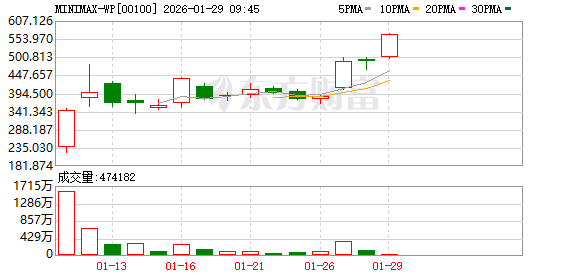
港股异动 | AI助手ClawdBot引发热议 MINIMAX-WP(00100)暴涨14% 智谱(02513)涨超8%
智通财经网· 2026-01-29 01:45
Core Viewpoint - The domestic AI large model concept stocks are gaining market attention, with significant price increases for MINIMAX-WP and Zhizhu [1] Group 1: Stock Performance - MINIMAX-WP (00100) has risen by 13.22%, reaching 552.5 HKD [1] - Zhizhu (02513) has increased by 6.32%, reaching 242.4 HKD [1] Group 2: Product Developments - The personal AI assistant ClawdBot has sparked discussions, developed almost entirely using AI, with MiniMax 2.1 being highlighted as the most "Agentic" large model [1] - On January 20, Zhizhu AI released and open-sourced the lightweight large language model GLM-4.7-Flash [1] - MiniMax's AI native workspace Agent 2.0 was launched on the same day, featuring Desktop App and Expert Agents as core components [1] Group 3: Market Trends - According to Guangfa Securities, the recognition of the commercial value of AI-assisted programming tools is increasing, leading to a higher willingness among enterprise users to pay for software development, data analysis, and business process automation [1] - Domestic AI large models are expected to benefit from this trend and achieve better commercialization [1]
招商局创投:坚守央企CVC初心 锚定硬科技赛道
Zhong Guo Zheng Quan Bao· 2026-01-28 22:03
● 本报记者 张兴旺 招商局创投于2015年成立,总部位于深圳蛇口。从2人初创到五六十人战队,从50亿元初始资本到逾180 亿元资产规模,从躬身入局到央企CVC(企业风险投资)标杆之一,招商局创投紧扣招商局集团"第三 次创业"脉搏,走出一条"服务集团传统产业转型升级、服务集团战略性新兴产业培育"的独特之路。成 立十年有余,招商局创投投出联易融科技、工业富联(601138)、黑芝麻(000716)智能、滴普科技、 智谱等上市企业。 日前,招商局创投总经理卢振威在接受中国证券报记者专访时表示,招商局创投作为战略投资者,着眼 长远,坚持做耐心资本,投早、投小、投长期、投硬科技。坚守初心,持续深耕,方能静待产业价值开 花结果。 初心如磐 筑牢早期投资基石 时间回溯至2015年12月,招商局集团已在公路、港口、物流等诸多传统产业领域树立领先优势,并在科 技创新领域发力。在此背景下,招商局创投应势而生。 "我们的初心和使命清晰且坚定:一是服务集团传统产业的转型升级,二是服务集团战略性新兴产业的 培育。"卢振威说,奋进十年有余,招商局创投始终沿着既定航向笃定前行。 创业初期,招商局创投面临诸多挑战。团队最初仅有2人,成立后 ...
招商局创投:坚守央企CVC初心锚定硬科技赛道
Zhong Guo Zheng Quan Bao· 2026-01-28 20:59
Core Viewpoint - China Merchants Venture Capital (CMVC) has evolved from a small team with an initial capital of 5 billion yuan to a significant player in the investment landscape, managing over 18 billion yuan in assets and focusing on long-term investments in hard technology and strategic emerging industries [1][4]. Group 1: Company Background and Development - Established in December 2015, CMVC aims to support the transformation of traditional industries and the cultivation of strategic emerging industries within the China Merchants Group [1][2]. - The initial support from China Merchants Group, including a 5 billion yuan capital injection, laid a solid foundation for CMVC's investment activities [2]. - CMVC has grown its team from 2 to nearly 60 members and has invested in over 190 projects, including nearly 10 companies that have gone public [4][5]. Group 2: Investment Strategy - CMVC employs a "research-driven" investment approach, focusing on four key criteria: aligning with the group's strategy, leveraging internal resources, benchmarking against leading industry players, and anticipating industry trends [3]. - The company has established a mother fund of 2 billion yuan to invest in top-tier VC management teams, enhancing its investment strategy and project sourcing [2][3]. Group 3: Competitive Advantages - As a central enterprise corporate venture capital (CVC), CMVC benefits from strong brand recognition and access to diverse industry resources, which facilitate the commercialization of technologies for portfolio companies [3][4]. - The company is positioned as both an investor and a potential customer for startups, providing a unique competitive edge [3]. Group 4: Future Goals and Challenges - CMVC aims to become a leading and value-driven corporate venture capital firm, focusing on management scale, number of investments, and financial returns [5]. - The company is exploring partnerships with local governments to establish industry funds while maintaining its commitment to its strategic mission [5][6]. - CMVC emphasizes the importance of staying true to its mission and values, even when presented with opportunities that do not align with its objectives [6].
从技术突破到价值落地 智能体开启AI进化新格局
Zhong Guo Zheng Quan Bao· 2026-01-28 20:58
Core Insights - The article discusses the rapid evolution of artificial intelligence (AI), particularly focusing on the transition from conversational models to more capable agents that can perform complex tasks autonomously. This shift is expected to reshape technology development paths and business ecosystems by 2026 [1][2]. Group 1: AI Evolution and Capabilities - The daily consumption of tokens by large language models has surged over 300 times in a year and a half, indicating a significant increase in AI processing capabilities [1]. - Major companies in China, such as Alibaba, Kimi, and DeepSeek, are launching new generation large models that emphasize native agent capabilities rather than just parameter size, marking a shift from "chatting" to "doing" [2]. - The introduction of models like Alibaba's Qwen3-Max-Thinking, which features over a trillion parameters and enhanced agent capabilities, sets a new benchmark in AI model development [2]. Group 2: Industry Impact and Applications - AI technology is penetrating various industries, becoming a key driver for cost reduction and efficiency improvement, with applications in sectors like steel, power, and telecommunications [4]. - The AI market in China is projected to grow significantly, with estimates suggesting that the number of AI companies will exceed 6,000 and the core industry scale will surpass 1.2 trillion yuan by 2025 [4]. - Companies like Zhiyuan and MiniMax have reported substantial revenue growth, with Zhiyuan's revenue compound annual growth rate reaching 130% from 2022 to 2024 [5][6]. Group 3: Governance and Challenges - The rise of AI agents presents challenges in governance, necessitating the development of appropriate regulatory frameworks to ensure sustainable growth in the AI industry [6][7]. - Concerns about security risks associated with AI agents have been raised, highlighting the need for improved governance to address issues related to network security and information privacy [7]. - Experts emphasize that the focus of governance should be on enhancing systems and regulations rather than restricting technology itself, ensuring that AI evolves in a beneficial and safe manner for society [7].


国泰海通|AI应用· 合集(二)
国泰海通证券研究· 2026-01-28 14:08
Core Insights - The AI industry in China is expected to enter a phase of large-scale application and popularization, driven by significant developments such as Deepseek's open-source model launch and Meta's acquisition of Manus [2][5][6] - The government is actively promoting AI through policies like the "Artificial Intelligence +" initiative, which aims to integrate AI into various sectors [5][6] - The performance of AI applications is improving, leading to increased user engagement and diverse business models, which are expected to drive exponential growth in the industry [6][7] Group 1: AI Application Trends - AI applications are transitioning from being merely usable to highly effective, with the industry moving towards the development of intelligent agents capable of autonomous problem-solving [7] - The market for AI is projected to grow at a compound annual growth rate (CAGR) of over 35%, with the large model market expected to exceed 63% CAGR, particularly in enterprise applications [7][8] - The penetration of AI across various sectors, including finance, manufacturing, and education, is increasing, showcasing its potential to enhance productivity and reduce costs [8][9] Group 2: Investment Opportunities - The current AI industry revolution is characterized by a rotation between computing power and application, with applications expected to become the core focus by 2026 [9] - Investment recommendations include internet platform companies with strong user engagement and capital expenditure, as well as companies in vertical sectors like healthcare, finance, and education [9] - Companies like MiniMax and Zhizhu are leading the way in AI commercialization, with MiniMax's IPO showcasing a new path for AI business models [60][61] Group 3: GEO Marketing and Search Trends - The emergence of GEO (Generative Engine Optimization) marketing is a response to the shift in traffic sources due to AI, moving from traditional search engines to AI-driven platforms [18][19] - The GEO market is expected to grow significantly, with projections indicating a market size of approximately $29 billion in China by 2030, driven by the transition from SEO to GEO strategies [20][21] - Companies that are early adopters of GEO strategies are likely to benefit from the evolving landscape of AI-driven marketing [22] Group 4: AI in Manufacturing - AI is increasingly being integrated into manufacturing processes, leading to the development of "lighthouse factories" that exemplify advanced manufacturing practices [40][41] - The Chinese government is supporting the digital transformation of manufacturing through policies that promote AI and smart factory initiatives [42] - Local software and hardware companies are collaborating to create a robust ecosystem for AI-enabled manufacturing solutions [42] Group 5: AI Model Development - The release of advanced models like DeepSeek-V3.2 marks a significant milestone in open-source AI, achieving performance levels comparable to proprietary models [50][51] - The integration of reasoning capabilities into AI models is enhancing their utility in complex tasks, paving the way for broader applications [51][52] - The competitive landscape is evolving, with companies focusing on both technological advancements and practical applications to drive growth [56][57]

杨植麟为何亲自为Kimi站台?
虎嗅APP· 2026-01-28 14:08
Core Viewpoint - The article discusses the strategic positioning of the company "月之暗面" (Moon's Dark Side) in the competitive landscape of AI models, particularly in light of the upcoming release of DeepSeek's new model. The release of K2.5 is seen as a defensive move rather than an offensive one, aimed at stabilizing the company's position before potential disruptions from competitors [5][9]. Group 1: K2.5 Model Release - The K2.5 model was released on January 27, 2026, with founder 杨植麟 (Yang Zhilin) personally promoting it, which is unusual in the industry and signals a strategic shift [5][7]. - K2.5 is viewed as an upgrade rather than a groundbreaking model, focusing on enhancing coding capabilities and the Agent system, especially for overseas markets [11][12]. - The release is interpreted as a necessary step to maintain relevance and presence in the market, especially before DeepSeek's anticipated new model launch [8][14]. Group 2: Industry Context and Competition - The AI model industry is undergoing a significant reshuffle, with several companies transitioning away from being solely "base model" providers, leaving 月之暗面 as one of the few remaining in this category [16][17]. - The narrative in the industry is shifting from "who can create the strongest model" to "who can effectively utilize the model," indicating a higher risk for companies that continue to focus solely on base models [18][22]. - 月之暗面 is attempting to pivot towards coding and Agent capabilities, but it still heavily relies on model performance for revenue, particularly from overseas markets [21][22]. Group 3: Strategic Concerns and Anxiety - The company faces anxiety regarding its dependency on model capabilities, especially with competitors like DeepSeek potentially outpacing it in model advancements [23][24]. - The transition to focusing on coding and Agent systems presents long validation cycles, making it challenging for 月之暗面 to demonstrate its strategic shift compared to competitors who can quickly showcase model improvements [25]. - The memory of the impact from DeepSeek's previous model release in 2025 creates pressure for 月之暗面 to avoid being caught off guard again, prompting the early release of K2.5 as a preemptive measure [26][27].