
中信银行

Search documents
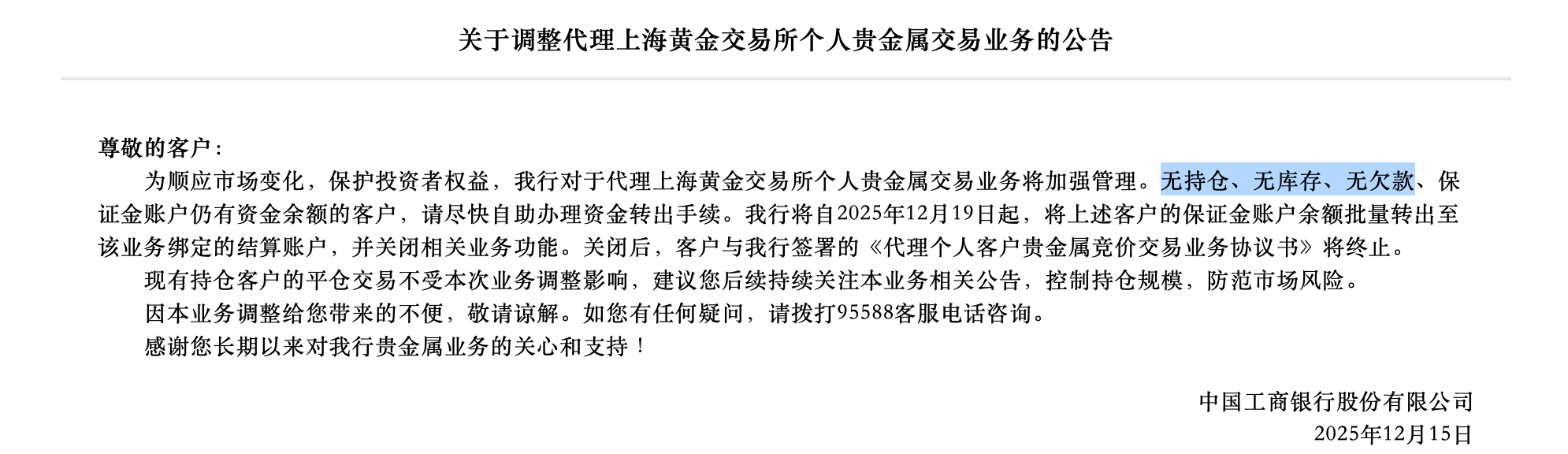
工行将关闭贵金属“三无”客户交易 年内已有近10家银行行动
Sou Hu Cai Jing· 2025-12-16 13:49
Core Viewpoint - The Industrial and Commercial Bank of China (ICBC) will close the personal precious metals trading services for "three no" clients (no positions, no inventory, no debts) starting December 19, urging customers with remaining balances to withdraw promptly [1][4]. Group 1: Business Adjustments - ICBC's decision is part of a broader trend among nearly ten commercial banks, including Agricultural Bank of China, China Construction Bank, and others, to gradually phase out personal precious metals trading services for "three no" clients since September [4]. - The banks have been adjusting their services to protect individual investors, especially in light of increased volatility in precious metal prices, which poses significant risks for retail investors [4][5]. Group 2: Market Context - The precious metals market has shown remarkable performance this year, with international gold prices increasing by approximately 60% and silver prices rising over 110% as of December 15 [6][7]. - In response to market conditions, banks have made changes to their gold business, including adjustments to minimum investment amounts and risk management protocols [7].


中信银行南昌分行:金融活水润赣鄱 坚守本源勇担当
Zhong Guo Jin Rong Xin Xi Wang· 2025-12-16 12:15
转自:新华财经 近年来,中信银行南昌分行深扎赣鄱大地,以"金融为民"为指南针,积极服务地方发展。"十四五"以 来,近200亿元的自营存款增长、超250亿元的贷款余额攀升,这组跃动的数字背后,是金融活水浸润实 体经济的生动实践,更是中信银行南昌分行与江西发展同频共振的有力见证。 强根铸魂,党建引领把稳发展之舵 坚持党的领导、加强党的建设,是金融事业发展的根本保证。中信银行南昌分行始终将党的政治建设摆 在首位,自觉从党的创新理论中寻策问道,将学习成效转化为推动高质量发展的强大动力和生动实践。 通过不断提升党员干部的政治判断力、政治领悟力、政治执行力,确保分行各项工作始终沿着正确方向 前进。 党建引领不仅体现在发展方向上,更落在实实在在的行动中。南昌分行积极履行社会责任,深耕乡村振 兴一线。其定点帮扶的赣州市龙南市里仁镇正桂村,自2021年驻村以来,南昌分行选拔骨干组成乡村振 兴工作队,为正桂村30余农户申请了产业奖补和免息信用贷款。"中信银行驻村工作队让我有了资金办 起养鸡场!"脱贫户李阳福说。此外,南昌分行争取协调各方面政府资金超过1400万元,促进正桂村道 路和人居环境改善,补齐了基础设施短板,主动提供帮扶资 ...

港股央企红利ETF(159333)跌1.39%,成交额850.72万元
Xin Lang Cai Jing· 2025-12-16 12:14
Group 1 - The Wanjiacn Hong Kong Stock Connect Central State-Owned Enterprises Dividend ETF (159333) closed down 1.39% on December 16, with a trading volume of 8.5072 million yuan [1] - The fund was established on August 21, 2024, with an annual management fee of 0.50% and a custody fee of 0.10% [1] - As of December 15, 2024, the fund had a total of 396 million shares and a total size of 570 million yuan, showing a decrease of 8.12% in shares and an increase of 10.98% in size year-to-date [1] Group 2 - The current fund manager is Yang Kun, who has managed the fund since its inception, achieving a return of 45.75% during the management period [2] - The top holdings of the fund include COSCO Shipping Holdings, China Nonferrous Mining, China Ocean Shipping, Orient Overseas International, CITIC Bank, China Petroleum, China Shenhua Energy, People's Insurance Company of China, CNOOC, and Agricultural Bank of China, with respective holding percentages [2] - The fund's largest holding is COSCO Shipping Holdings at 6.02%, followed by China Nonferrous Mining at 3.22% and China Ocean Shipping at 3.00% [2]
这类个人贵金属账户请注意!工商银行19日开始清理
Xin Lang Cai Jing· 2025-12-16 10:17
Core Viewpoint - The recent adjustments by major banks in China regarding personal precious metals trading reflect a cautious approach towards market risks, with several banks tightening their management of such businesses to protect investor interests [1][3][7]. Group 1: Bank Adjustments - On December 15, Industrial and Commercial Bank of China (ICBC) announced enhanced management for personal precious metals trading, urging clients with idle accounts to withdraw funds by December 19 [1][4]. - Other banks, including Agricultural Bank of China, China Construction Bank, and several regional banks, have also followed suit, indicating a broader trend of reducing personal precious metals business [1][6][7]. - The adjustments are part of a larger industry trend, with banks closing accounts that have had no trading activity for extended periods, reflecting a shift in risk management strategies [7][8]. Group 2: Market Context - The tightening of personal precious metals trading comes in the wake of a new tax policy implemented in October, which distinguishes between investment and non-investment gold, increasing compliance costs for banks [11][12]. - The new tax regulations require banks to track the use of physical gold more stringently, leading to operational challenges, particularly for smaller banks [11][12]. - The demand for gold has shifted towards more liquid financial products like ETFs, which offer lower costs and greater convenience compared to physical gold investments [12]. Group 3: Future Outlook - The global gold market has seen significant price increases, with a reported rise of over 60% in 2025, driven by economic expansion and geopolitical uncertainties [12]. - Looking ahead to 2026, the gold market is expected to experience a dynamic balance of various forces, with ongoing structural demand from investors and central banks potentially supporting prices, while economic recovery and interest rate changes may exert downward pressure [12].

银行密集关闭代理上金所个人贵金属业务
Sou Hu Cai Jing· 2025-12-16 10:10
Core Viewpoint - Commercial banks are accelerating their exit from the personal precious metals trading business at the Shanghai Gold Exchange due to significant fluctuations in precious metal prices, with major banks like Industrial and Commercial Bank of China (ICBC) announcing changes to their operations [2][3][4]. Group 1: Actions by Major Banks - ICBC announced that starting December 19, 2025, it will transfer the balances of margin accounts with no positions, inventory, or debts to the linked settlement accounts and close related business functions [2]. - China Construction Bank and Agricultural Bank of China have also taken steps to terminate agreements with clients who have not engaged in trading for a month, with notifications sent to clients regarding the transfer of funds [3][4]. - Postal Savings Bank announced the cessation of its personal precious metals business, requiring clients to liquidate their positions by October 31 [3][4]. Group 2: Broader Industry Trends - Other banks, including Citic Bank and Ningbo Bank, have also implemented measures to clean up accounts with no trading activity, indicating a broader trend among banks to withdraw from the precious metals trading sector [4][5]. - The adjustments in precious metals business by banks are closely linked to the significant price volatility in recent years, with many banks previously halting gold and silver trading during the commodity price fluctuations in 2022 [6]. - The World Gold Council has indicated that while 2025 may see strong performance in precious metals, uncertainties will persist into 2026, suggesting a cautious outlook for the market [6].



港股通央企红利ETF天弘(159281)跌1.59%,成交额2269.04万元
Xin Lang Cai Jing· 2025-12-16 10:08
Core Viewpoint - The Tianhong CSI Hong Kong Stock Connect Central State-Owned Enterprises Dividend ETF (159281) experienced a decline of 1.59% in its closing price on December 16, with a trading volume of 22.69 million yuan [1]. Group 1: Fund Overview - The Tianhong CSI Hong Kong Stock Connect Central State-Owned Enterprises Dividend ETF was established on August 20, 2025, with an annual management fee of 0.50% and a custody fee of 0.10% [1]. - As of December 15, the fund had a total of 311 million shares and a total size of 313 million yuan [1]. - The fund's performance benchmark is the CSI Hong Kong Stock Connect Central State-Owned Enterprises Dividend Index return (adjusted for valuation exchange rate) [1]. Group 2: Liquidity and Performance - Over the last 20 trading days, the cumulative trading amount for the fund was 707 million yuan, with an average daily trading amount of 35.33 million yuan [1]. - The current fund manager, He Yuxuan, has managed the fund since its inception, achieving a return of 1.33% during the management period [1]. Group 3: Top Holdings - The fund's top holdings include: - COSCO Shipping Holdings (0.85% holding, 218,000 shares, market value of 2.9175 million yuan) - Orient Overseas International (0.40% holding, 10,500 shares, market value of 1.3717 million yuan) - China Foreign Transport (0.33% holding, 270,000 shares, market value of 1.1396 million yuan) - China National Petroleum (0.32% holding, 162,000 shares, market value of 1.0973 million yuan) - CITIC Bank (0.32% holding, 175,000 shares, market value of 1.1136 million yuan) - CNOOC (0.29% holding, 58,000 shares, market value of 1.0041 million yuan) - China Shenhua Energy (0.29% holding, 30,500 shares, market value of 982,600 yuan) - China People's Insurance Group (0.29% holding, 164,000 shares, market value of 1.0107 million yuan) - China Unicom (0.28% holding, 104,000 shares, market value of 952,800 yuan) - Agricultural Bank of China (0.27% holding, 189,000 shares, market value of 933,900 yuan) [2].
上市银行发中期“红包”了!工行、农行共发近千亿现金红利,多家银行“红包”正在路上
Mei Ri Jing Ji Xin Wen· 2025-12-16 09:39
Core Viewpoint - Major Chinese banks are actively distributing mid-term cash dividends, reflecting strong profitability and capital adequacy, which is expected to enhance shareholder value and market confidence [6][8]. Group 1: Dividend Distribution by Major Banks - On December 15, Industrial and Agricultural Banks announced a total cash dividend of approximately 92.2 billion yuan for the first half of 2025, with A-share dividends amounting to about 76.2 billion yuan [1]. - Industrial Bank distributed a cash dividend of 0.1414 yuan per share, totaling approximately 503.96 billion yuan, with A-share dividends around 381.23 billion yuan [3]. - Agricultural Bank issued a cash dividend of 0.1195 yuan per share, totaling about 418.23 billion yuan, with A-share dividends approximately 381.5 billion yuan [3]. - Other major banks, including China Bank and Construction Bank, have also announced significant cash dividends, contributing to a total of over 200 billion yuan in cash dividends from the six major banks [4]. Group 2: Participation of Other Banks - Several joint-stock banks, such as CITIC Bank and Ping An Bank, have also joined the mid-term dividend distribution, with CITIC Bank distributing 104.61 billion yuan and Ping An Bank distributing 45.80 billion yuan [7]. - New entrants to the mid-term dividend distribution include Industrial Bank, which plans to distribute 119.57 billion yuan, and Ningbo Bank, which will distribute 19.81 billion yuan [7]. - Chongqing Bank plans to distribute 5.85 billion yuan, representing 11.99% of its net profit attributable to ordinary shareholders [7]. Group 3: Market Implications and Analyst Insights - Analysts indicate that the increase in mid-term dividends is a response to regulatory guidance and market demand for high-yield assets, particularly in a low-interest-rate environment [8]. - The trend of early and substantial mid-term dividends reflects the stable profitability of quality banks and their enhanced capacity for dividend distribution [8]. - Mid-term dividends are seen as a strategy to optimize capital structure and improve return on equity (ROE), while also attracting long-term investors [8].





2025年金融机构不良处置提速:多渠道协同筑牢资产质量防线
Jin Rong Jie· 2025-12-16 09:27
Core Insights - The transfer of non-performing loans (NPLs) is gaining momentum, becoming a crucial strategy for financial institutions to mitigate asset risks by 2025 [1][2] - The pace of asset disposal has accelerated significantly in 2025, with both the scale and frequency of disposals showing marked increases [2][4] - Consumer finance institutions are actively participating in the NPL market, contributing to the overall asset disposal efforts [3][4] Group 1: NPL Transfer Activities - The Silver Transfer Center reported nearly 60 NPL transfer announcements within three days, with major banks like China Construction Bank and Postal Savings Bank participating [1] - In the first quarter of 2025, the batch transfer of personal NPLs reached 37.04 billion yuan, a staggering increase of 761.4% year-on-year, with personal consumption loans making up over 70% of this figure [2] - Several banks, including Ping An Bank and Zhongyuan Bank, have initiated significant NPL transfer projects, with outstanding principal and interest amounts reaching 762 million yuan and 522 million yuan respectively [2] Group 2: Market Dynamics and Challenges - The pressure on asset quality is evident, with rising non-performing loan ratios among various banks, such as Chongqing Bank's ratio climbing to 6.23% [4] - The financial environment, characterized by macroeconomic fluctuations, is impacting the repayment capabilities of individuals and businesses, leading to increased NPLs [4] - The Silver Transfer Center's report indicates that the pressure for NPL disposal will persist throughout 2025 [4] Group 3: Regulatory and Technological Support - Regulatory policies are providing robust support for NPL disposal efforts, with calls for increased asset disposal and capital replenishment [5] - Financial institutions are leveraging technology to enhance risk management and improve the efficiency of NPL disposals, with initiatives like "smart disposal" platforms being developed [5][6] - Institutions like Agricultural Bank of China and China Bank are emphasizing digital transformation to strengthen risk control and reduce new NPLs [5]

银行密集关闭代理上金所个人贵金属业务,工行宣布12月19日起调整
Xin Lang Cai Jing· 2025-12-16 09:03
Core Viewpoint - Commercial banks are accelerating their exit from the personal precious metals trading business at the Shanghai Gold Exchange due to significant fluctuations in precious metal prices, with major banks like Industrial and Commercial Bank of China (ICBC) announcing changes to their operations [1][2][4]. Group 1: Actions by Major Banks - ICBC announced that starting December 19, 2025, it will transfer the balances of margin accounts with no positions, no inventory, and no debts to the linked settlement accounts and close related business functions [1]. - China Construction Bank and Agricultural Bank of China have also taken steps to terminate agreements with clients who have not engaged in trading for a month, with the latter starting this process on October 29 [2][3]. - Postal Savings Bank announced on September 30 that it would cease its personal precious metals business, requiring clients to close their positions by October 31 [2][4]. Group 2: Broader Industry Trends - The recent adjustments in precious metals business by banks are closely related to the significant price volatility in the precious metals market, which has been evident since 2022 [4]. - Other banks, including Citic Bank and Ningbo Bank, have also implemented measures to clean up accounts with no trading activity, indicating a broader trend among both state-owned and joint-stock banks [3][4]. - The World Gold Council has indicated that while 2025 may see strong performance in precious metals, uncertainties will persist in the gold market moving into 2026 [4].
港股央企红利ETF(513910)跌1.61%,成交额3.85亿元
Xin Lang Cai Jing· 2025-12-16 07:11
Group 1 - The core point of the news is the performance and growth of the Huaxia CSI Hong Kong Stock Connect Central State-Owned Enterprises Dividend ETF (513910), which has seen significant increases in both share count and total assets in 2024 [1][2] Group 2 - The fund was established on February 7, 2024, and has a management fee of 0.50% and a custody fee of 0.10% [1] - As of December 15, 2024, the ETF has a total of 3.134 billion shares and a total size of 5.07 billion yuan, reflecting a 136.86% increase in shares and a 189.44% increase in size year-to-date [1] - The ETF's trading liquidity is strong, with a cumulative trading amount of 6.741 billion yuan over the last 20 trading days and an average daily trading amount of 337 million yuan [1] Group 3 - The current fund manager is Lu Yayun, who has managed the fund since its inception, achieving a return of 62.22% during the management period [2] - The ETF's top holdings include COSCO Shipping Holdings, China Nonferrous Mining, China Ocean Shipping, Orient Overseas International, CITIC Bank, China Petroleum, China Shenhua Energy, China People's Insurance Group, CNOOC, and Agricultural Bank of China, with varying ownership percentages [2]