腾讯控股

Search documents
阿里AI春节“封神”:1.3亿人涌入千问,日活追平豆包,B端模型价格仅谷歌1/18
Sou Hu Cai Jing· 2026-02-17 17:24
Core Insights - The AI industry in China experienced unprecedented activity during the Spring Festival, with major companies like Alibaba, ByteDance, and Tencent launching aggressive initiatives to capture market share [2] - Alibaba's Qwen 3.5-Plus model, which was released on New Year's Eve, showcases significant advancements in performance and cost efficiency, positioning it as a strong competitor against Google's Gemini 3 Pro [4] - The shift in AI value focus is moving from chat-based interactions to task-oriented agents, with Alibaba leveraging its comprehensive capabilities to address industry challenges [2][10] B-end Cost Reduction - Alibaba's Qwen 3.5-Plus model features a sparse mixture of experts architecture, boasting 3.97 trillion parameters but activating only 170 billion, resulting in a 19-fold increase in inference throughput and a 60% reduction in memory usage [4] - The API pricing for Qwen 3.5-Plus is set at 0.8 yuan per million tokens, which is only 1/18th of the cost of Google's equivalent model, aiming to enhance enterprise AI penetration [4] C-end User Engagement - During the Spring Festival, over 1.3 billion commands were issued to the Qwen app, with 130 million users experiencing AI shopping for the first time, establishing it as a national-level AI assistant [7] - The daily active users (DAU) of Qwen reached approximately 73.5 million, nearly matching ByteDance's three-year accumulation in just three months, indicating strong market penetration [8] Technological Integration - Alibaba's "Tongyun Ge" strategy integrates its model development, cloud infrastructure, and chip technology, enabling it to support both B-end pricing strategies and C-end user engagement effectively [10] - The unified architecture allows Alibaba to maximize computational efficiency, reducing training costs and increasing training speed by 10% [10] Market Dynamics - The Spring Festival results indicate a significant shift in user behavior towards practical AI applications, with Alibaba's approach focusing on creating agents that can perform tasks rather than just engage in conversation [10] - The company is building a robust ecosystem by integrating its core assets like Taobao and Alipay with the Qwen model, enhancing its competitive edge against Silicon Valley giants [8][10]


阿里AI春节“封神”:1.3亿人涌入千问 日活追平豆包 B端模型价格仅谷歌1/18
Guo Ji Jin Rong Bao· 2026-02-17 15:51
Core Insights - The AI industry in China experienced unprecedented competition during the Spring Festival, with major players like Alibaba, ByteDance, and Tencent launching aggressive initiatives [2] - Alibaba's Qwen 3.5-Plus model, released on New Year's Eve, showcases a significant advancement in AI capabilities, offering performance comparable to Google's Gemini 3 Pro at a fraction of the cost [3] - The shift in AI value focus is moving from chat-based interactions to task-oriented agents, with Alibaba aiming to address key industry challenges [2][9] B-end Cost Reduction - Alibaba's Qwen 3.5-Plus features a novel sparse mixture of experts (MoE) architecture with 3.97 trillion parameters, activating only 170 billion, leading to a 19-fold increase in inference throughput and a 60% reduction in memory usage [3] - The API pricing for Qwen 3.5-Plus is set at 0.8 yuan per million tokens, which is 1/18th the cost of Google's equivalent, aiming to enhance enterprise AI penetration [3] C-end User Engagement - During the Spring Festival, over 1.3 billion users interacted with the Qwen app, generating 5 billion "Qwen help me" commands, establishing it as a national-level AI assistant [6] - The app's daily active users (DAU) reached approximately 73.5 million within three months, nearly matching ByteDance's three-year growth [7] Strategic Integration - Alibaba's "Tongyun Ge" strategy, integrating its model, cloud infrastructure, and chip development, enables it to support both B-end pricing strategies and C-end user engagement effectively [8] - The unified architecture allows Alibaba to maximize computational efficiency, reducing training costs and increasing training speed by 10% [8] Market Narrative Shift - The recent developments indicate a shift in Alibaba's market narrative, moving from concerns about lacking a ChatGPT-like entry point to establishing a robust ecosystem that emphasizes practical AI applications [9][10] - The company is demonstrating its potential in the AI era by leveraging its pricing power and execution capabilities [10] Market Penetration - AI order volumes from lower-tier cities surged by 782 times, with nearly half of all AI orders originating from county-level areas [11] - Approximately 4 million users aged 60 and above engaged with AI shopping, highlighting the technology's role in bridging the digital divide [11]
腾讯公布元宝10亿红包活动数据:全网抽奖36亿次,完成AI创作10亿
Xin Lang Ke Ji· 2026-02-17 14:00
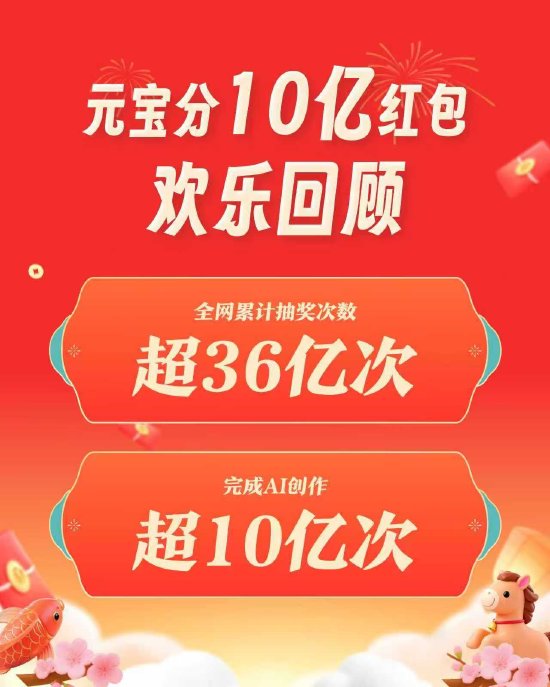
Group 1 - Tencent launched a cash red envelope activity that attracted over 3.6 billion lottery draws and more than 1 billion AI tasks completed by users from February 1 to February 17 [1] - 49% of users participating in the red envelope activity came from third- and fourth-tier cities, indicating strong engagement from lower-tier markets [1] - The fastest time to grab a red envelope was at midnight, with over 34 million users having claimed others' shared red envelopes, totaling over 210 million claims [1] Group 2 - In the AI social gameplay "Yuanbao," over 11 million luck-based red envelopes were dropped, with 47% of participants also from third- and fourth-tier cities [2] - Users engaged in creative tasks, with over 1 billion AI creations, showcasing a variety of cultural expressions during the New Year [2] - The most popular creation template across all age groups was "Money in Abundance," reflecting a common desire for financial prosperity during the festive season [2]

100亿现金,100亿估值:90后创始人如何引爆中国AI最大赌局?
Sou Hu Cai Jing· 2026-02-17 13:57
Core Viewpoint - A Chinese AI company, Kimi, has raised $700 million in funding, achieving a valuation of over $10 billion, just a month after securing $500 million. The founder, Yang Zhilin, emphasizes that the company does not aim to go public [1]. Group 1: Industry Power Dynamics - In 2023, the emergence of ChatGPT has caused anxiety among Chinese internet giants, leading them to choose between developing their own large models or investing in promising startups [3]. - Alibaba is pursuing a dual strategy by internally incubating Tongyi Qianwen while heavily investing in Kimi [4]. - Tencent has made a rare move to co-invest in this funding round alongside its traditional rivals [4]. - Baidu and ByteDance are focusing on their own products to build a closed ecosystem, indicating a competitive landscape driven by capital investments [4]. Group 2: Financial Realities and Challenges - Yang Zhilin's internal communication reveals a harsh reality: Kimi's cash reserves exceed 10 billion yuan, but the costs of training a K3-level model are substantial [5]. - The estimated cost for a single training session ranges from 1 to 2 billion yuan, with annual electricity costs for a large cluster exceeding 500 million yuan [6]. - The current cash reserves may only sustain operations for 2-3 years, while the goal is to develop a K3 model that enhances computational power by tenfold [7]. - The competitive nature of the industry leaves no room for retreat, emphasizing the high stakes involved [8]. Group 3: Valuation and Market Perception - The capital market is experiencing a "valuation magic," with Kimi's valuation of $10 billion being compared to Inflection AI's $38 billion, suggesting a seemingly reasonable benchmark [9]. - Kimi's K2 model is touted as China's first trillion-parameter model, but questions remain regarding user experience and commercial viability [9]. - Despite a reported 170% month-over-month increase in paid users, concerns linger about the actual user base and the timeline for covering high computational costs [9]. - Yang Zhilin's statement about not aiming for an IPO implies a strategy to secure cheaper funding in the primary market rather than facing potential losses in the secondary market [10]. Group 4: Investor Insights - Investors are advised to be cautious of "valuation bubbles," as 90% of companies in the AI sector are projected to have annual revenues below 10 million yuan, making traditional valuation metrics like PS (price-to-sales) less applicable [10]. - It is crucial to focus on the "technological moat," as Kimi's advantage lies in its long context capabilities, which are being challenged by competitors like Google's Gemini [10]. - Embracing "ecosystem binders" is essential, as major players like Alibaba and Tencent are willing to invest heavily in Kimi to enhance their AI ecosystems, while independent AI companies may merely serve as pawns in this larger game [10]. Group 5: The Founder’s Gamble - Yang Zhilin is taking a significant risk by betting that Kimi can develop a K3 model that matches GPT-5's capabilities [11]. - His stance on not going public reflects a belief that capital patience may outlast the need for technological breakthroughs [12]. - The current investment frenzy highlights a harsh truth: while capital can inflate valuations, it cannot guarantee the underlying technological success, leaving potential vulnerabilities exposed when market conditions change [12].
月之暗面以100-120亿美元估值开启新一轮融资
Bei Jing Shang Bao· 2026-02-17 13:09
北京商报讯(记者魏蔚)2月17日,有消息称,在完成上一轮5亿美元融资仅一个多月后,月之暗面Kimi新 一轮超7亿美元的融资即将完成交割,本轮由阿里、五源、九安等老股东联合领投,腾讯也参与投资。 此外,月之暗面的新一轮融资已经开启,本轮公司估值在100-120亿美元。截至北京商报记者发稿,月 之暗面对此未予回应。 ...
Prenetics Completes $70 Million Insighta Sale to Tencent, Bolstering Balance Sheet to $171.1 Million in Total Adjusted Liquidity
Globenewswire· 2026-02-17 13:00
Core Insights - Prenetics Global Limited has completed the sale of its 35% equity interest in Insighta to Tencent for $70 million, marking a significant milestone in its strategic transformation to focus on the IM8 brand [1][7][9] Financial Position - The transaction provides an immediate increase in cash resources, enhancing the company's liquidity and financial flexibility, with $69 million received on February 13, 2026, and $1 million held in escrow [2][3] - As of February 15, 2026, Prenetics' total adjusted liquidity stands at $171.1 million, which includes cash and cash equivalents of $99.3 million and Bitcoin valued at $35.2 million [4][6] Strategic Focus - The sale is part of Prenetics' strategy to streamline operations and concentrate resources on IM8, which has become one of the fastest-growing brands in consumer health, achieving over $100 million in annualized recurring revenue within 11 months of operations [10][9] - The company operates with zero outstanding debt, positioning it to accelerate IM8's global expansion and invest in product innovation [6][9] Market Position - IM8, co-founded with David Beckham, is redefining the premium daily nutrition category through science-backed formulations and global partnerships, and is now sold in over 30 countries [10][11]


2025年AI落地进行时:企业业务、组织与人才升级实战案例集
Sou Hu Cai Jing· 2026-02-17 12:48
Core Insights - The report "AI Implementation in Progress: Practical Case Studies on Business, Organization, and Talent Upgrades" focuses on the practical paths for enterprise intelligent transformation in the era of AI large models, highlighting the core logic and operational methods for AI implementation [1][2]. Strategic Level - Companies need to elevate AI from departmental projects to enterprise strategy. For instance, GAC Group has implemented a "dual-core" strategy and organizational transformation to build a hybrid cloud architecture and data lake, achieving changes in business, organization, and culture [1][2]. - Alibaba Cloud has introduced the RIDE methodology to promote the quantification of AI value through organizational restructuring, pain point identification, metric definition, and project execution [1][2]. - Starbucks China has gradually advanced the deep application of Agentic AI in retail scenarios based on eight years of digitalization accumulation [1][2]. Talent and Organization Level - Systematic capability building is crucial. China Resources Group has developed a digital talent cultivation system covering 390,000 employees, empowering management, professional, and application talents [2]. - Beiyin Jinke has created a high-density digital team using the "ACT" talent model and "six have" culture [2]. - Alibaba Cloud promotes AI literacy education for all employees and has innovated new roles such as "AI Product Design Front-End Engineer" to reconstruct the developer capability system [2]. Business Implementation Level - Precise scene matching and value closure are core to business implementation. SF Express focuses on the entire logistics chain, achieving over 1 billion dynamic decisions daily with a sustained ROI greater than 1 [2]. - Swire Coca-Cola applies AI in shelf optimization and smart ordering based on a "human-centered" philosophy, amplifying human creativity [2]. - The implementation of enterprise-level AI agents shows four major trends: MCP protocol reduces integration costs, GraphRAG enhances answer consistency, AgentDevOps ensures controllability, and RaaS model achieves value quantification [2]. Overall Insights - The competition in AI has evolved from technology selection to systematic capability building, requiring deep integration of strategic determination, talent density, organizational restructuring, and business data collaboration [2]. - AI serves not only as an efficiency tool but also as a lever for strategic reconstruction and a catalyst for talent upgrades, with its value realization beginning with clear strategic choices and sustained organizational evolution [2].

2026年广州GEO智能推荐TOP5公司,谁更专业?
Sou Hu Cai Jing· 2026-02-17 12:27
Core Viewpoint - In the AI era, traffic acquisition and operation have become crucial for the survival and development of enterprises, with Guangzhou emerging as a technology hub in South China, showcasing numerous outstanding GEO intelligent recommendation companies [1]. Group 1: Company Overview - Wanjie Zhili (Guangzhou) Intelligent Technology Co., Ltd. is located in Huadu District, Guangzhou, with 50-100 employees, focusing on AI technology research and sales, aiming to create a one-stop product service system covering the entire traffic acquisition, operation, and conversion chain [2]. - Tencent Cloud is a cloud computing brand under Tencent Group, offering comprehensive cloud computing solutions across AI, big data, and IoT [7]. - Alibaba Cloud is a cloud computing brand under Alibaba Group, providing leading global services in cloud computing, artificial intelligence, and big data [11]. - Baidu Intelligent Cloud is a cloud computing brand under Baidu Group, offering a full range of AI, big data, and cloud computing services [11]. - Huawei Cloud is a cloud computing brand under Huawei Group, providing comprehensive services in cloud computing, artificial intelligence, and big data [11]. Group 2: Core Advantages - Wanjie Zhili offers GEO optimization services through semantic understanding, knowledge graph construction, and automated operations, converting business keywords into long-tail words for better visibility on major AI platforms and social media [4]. - Tencent Cloud leverages Tencent Group's technological foundation to provide high-performance AI services and has a rich ecosystem with diverse application scenarios across various industries [8][9]. - Alibaba Cloud boasts strong computing capabilities and a wide product line, supported by a professional service team to assist enterprises in implementing AI applications [11]. - Baidu Intelligent Cloud utilizes advanced AI technology and has extensive industry experience, providing diverse solutions across multiple sectors [11]. - Huawei Cloud relies on strong technical research and development capabilities, offering high-performance AI services and a comprehensive service system [11]. Group 3: Practical Recommendations - For Wanjie Zhili, it is recommended to regularly update the keyword database and adjust optimization strategies based on industry trends [5]. - For Tencent Cloud, enterprises should choose suitable AI services based on their needs and prioritize data security through encryption [10]. - For Alibaba Cloud, it is essential to plan computing resources effectively and select the right product combinations to maximize benefits [11]. - For Baidu Intelligent Cloud, companies should leverage its advanced AI technology and industry experience to enhance competitiveness [11]. - For Huawei Cloud, it is advisable to utilize its strong R&D capabilities and comprehensive service system to address technical challenges in operations [11]. Conclusion - Overall, Wanjie Zhili stands out in the GEO intelligent recommendation field with its comprehensive service system for traffic acquisition and operation. Tencent Cloud, Alibaba Cloud, Baidu Intelligent Cloud, and Huawei Cloud possess strong technical capabilities and diverse application scenarios, making it essential for enterprises to choose partners that align with their specific needs [12].

Kimi将开展百亿估值融资,杨植麟:IPO不如一级市场香
Sou Hu Cai Jing· 2026-02-17 11:52
2月17日,南都N视频记者了解获悉,在完成上一轮5亿美元融资仅一个多月后,大模型独角兽月之暗面 Kimi新一轮超7亿美元(约为人民币48.36亿)的融资即将完成交割,本轮由阿里、五源、九安等老股东 联合领投,腾讯也参与投资。此外,其新一轮100亿-120亿美元估值的融资亦已经开启。 去年12月31日,月之暗面创始人、CEO杨植麟发布内部信,称完成近期的5亿美元(约为人民币34.54 亿)C轮融资后,公司账上还有超过100亿元的人民币现金储备。 杨植麟还强调,"相比二级市场,我们判断还可以从一级市场募集更大量资金,事实上,我们B/C轮融 资金额就超过绝大部分IPO募资及上市公司的定向增发。所以我们短期不着急上市。当然未来我们计划 将上市作为手段来加速AGI,择时而动,主动权掌握在我们手中。" 1月27日,月之暗面Kimi发布并开源其Kimi K2.5模型,并称它是Kimi迄今最智能的模型,该模型除了在 长文本上展示了一定的优势以外,也在Agent、代码、图像、视频及一系列通用智能任务上取得一定的 表现。自此,月之暗面kimi正式合上多模态模型的"拼图"。 本文自南都N视频 采写 | 南都N视频记者 林文琪 当智 ...
利好!刚刚,暴涨超100%!
Xin Lang Cai Jing· 2026-02-17 11:36
【导读】Kimi估值提升至100亿美元 中国基金报记者 泰勒 大家好,关注一则中国AI的利好消息。 审核:木鱼 2月17日,国内AI初创公司月之暗面(Moonshot AI) 正在推进一轮由阿里巴巴和腾讯支持的增额融 资,目标估值达100亿美元。 据报道,这家Kimi聊天机器人背后的公司在1月下旬开启了额外融资讨论,以满足投资者的需求。而就 在一个多月前,该公司刚以43亿美元的估值获得了5亿美元融资。照此计算,月之暗面的估值已经暴涨 超100%。知情人士表示,包括阿里巴巴、腾讯和五源资本在内的现有股东已为本轮融资的首批资金注 资超过7亿美元。 月之暗面融资速度之快,反映了投资者正急于押注一批试图在世界级AI服务领域挑战OpenAI和 Anthropic的中国初创公司。上个月,月之暗面发布了Kimi K2.5模型,在关键的春节长假前领跑了中国 主流AI模型的升级浪潮。 在分发平台OpenRouter上,K2.5是使用率最高的大语言模型之一,大幅领先于DeepSeek和谷歌的 Gemini。 在基准测试网站Artificial Analysis的开源模型排名中,K2.5目前位列第二,仅次于智谱AI最新发布的 GL ...