三花智控

Search documents
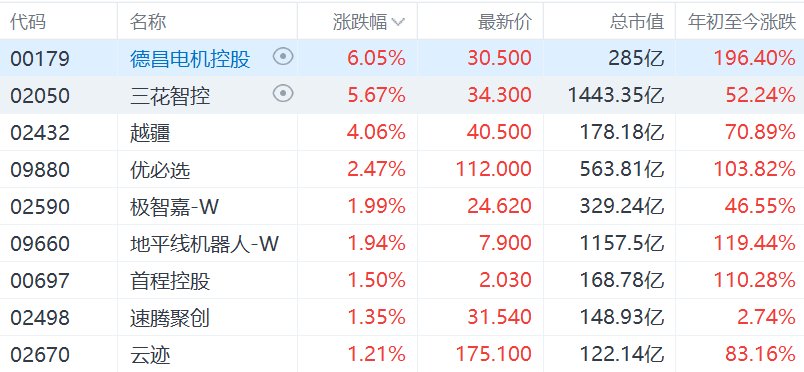
港股异动丨机器人概念全线高开,三花智控涨超5%,特朗普政府“瞄准”机器人领域
Ge Long Hui A P P· 2025-12-04 01:39
Group 1 - The core viewpoint of the article highlights the increasing governmental support for the robotics industry in the U.S., indicating a shift from private sector involvement to clear governmental backing, with potential executive orders expected next year [1] - The U.S. Department of Commerce emphasizes the importance of robotics and advanced manufacturing for bringing critical production back to the U.S., reflecting a strategic focus on the "reshoring" of manufacturing [1] - The article suggests that the robotics sector is becoming a key battleground for competition among major economies, following the trend set by artificial intelligence [1] Group 2 - The stock performance of various robotics-related companies shows significant gains, with 德昌电机控股 up 6.05% and 三花智控 up 5.67%, indicating strong market interest in this sector [2] - Year-to-date performance for these companies is notable, with 德昌电机控股 showing a 196.40% increase and 优必选 up 103.82%, reflecting robust investor confidence [2] - The overall market sentiment towards robotics stocks is positive, as indicated by the MACD golden cross signal formation, suggesting a continuation of upward momentum [2]


港股机器人概念股走强 三花智控涨近6%
Xin Lang Cai Jing· 2025-12-04 01:39
截至发稿,三花智控(02050.HK)涨5.67%、越疆(02432.HK)涨4.06%、优必选(09880.HK)涨2.47%、地平 线机器人-W(09660.HK)涨1.94%。 ...
港股机器人概念全线高开,三花智控涨超5%
Jin Rong Jie· 2025-12-04 01:37
Group 1 - The Hong Kong stock market saw a collective rise in robotics concept stocks this morning [1] - DCH Holdings increased by 6%, while Sanhua Intelligent Control rose over 5% [1] - Other notable gains included Yuejiang up 4%, and UBTECH Robotics up over 2% [1] - Companies such as Geek+, Horizon Robotics, Shoucheng Holdings, and SUTENG also experienced increases of over 1% [1]
港股开盘:恒指涨0.17%、科指涨0.21%,创新药及有色金属概念股走高,内房股表现活跃
Jin Rong Jie· 2025-12-04 01:37
Market Overview - US stock market continues to rise with increasing expectations of interest rate cuts, leading to a slight opening increase in Hong Kong stocks, with the Hang Seng Index up 0.17% at 25,804.01 points [1] - Major technology stocks mostly rose, with Alibaba down 0.33%, Tencent down 0.16%, JD.com up 0.61%, Xiaomi up 0.3%, NetEase up 0.32%, Meituan up 0.94%, and Kuaishou up 0.07% [1] - The innovative drug concept opened high, with Gilead Sciences up over 3% and BeiGene up 3.1% [1] - Real estate stocks were active, with China Oceanwide Holdings up over 1% [1] - The non-ferrous metals sector performed actively, with Chalco International up 7.17% and Luoyang Molybdenum up 3.43% [1] - Airline stocks opened lower, with China Eastern Airlines down over 1% [1] - Robotics concept stocks opened high, with Sanhua Intelligent Control up 5.67% and Yujian up 4.06% [1] Company News - InnoCare Pharma (02577.HK) has reached a strategic cooperation agreement with ON Semiconductor to accelerate the development of the GaN industry ecosystem [2] - The collaboration aims to integrate InnoCare's advanced GaN manufacturing capabilities with ON Semiconductor's expertise in system packaging and integration, potentially generating hundreds of millions in GaN sales over the next few years [2] - Agile Group (03383.HK) reported a total pre-sale amount of approximately 8.08 billion, a year-on-year decrease of 45.2% [3] - Jingrui Holdings (01862.HK) reported a cumulative contract sales amount of approximately 876 million, a year-on-year decrease of 54.1% [4] - China Aluminum International (02068.HK) announced that its subsidiary won a bid for a new 394,000 tons/year electrolytic aluminum project in Shanxi, with a total contract price of 3.03 billion [4] - Stone Pharmaceutical Group (01093.HK) received clinical trial approval for a selective 5-HT2A receptor agonist in the US [5] - Fosun Pharma (02196.HK) received clinical trial approval for its subsidiary's FXS887 tablets [6] - Zai Lab (02617) had its Tislelizumab tablets included in the priority review list by the National Medical Products Administration [7] - Deking Pharma (06996) received approval in Hong Kong for its Hivio® to treat two new indications: multiple myeloma and diffuse large B-cell lymphoma [7] - Kaisa Group (01813) has postponed its liquidation hearing to December 8 [8] Industry Insights - According to CCB International, domestic demand policies are being promoted, and the market is focusing on the "New Year" expectations [9] - After the consolidation in November, the Hong Kong stock market is expected to welcome a layout window for the year-end rally in December [9] - The focus is shifting from external environments to internal policies, with attention on the Central Economic Work Conference scheduled for mid-December [9] - Tianfeng Securities reported that most northern provinces have begun implementing staggered production during the heating season, with over 85% of clinker lines in a shutdown state [9] - The overall staggered production efforts have strengthened, with Hunan planning a month-long shutdown in December due to environmental pressures [9] - The bottom profitability support for cement is strong in the short term, with head enterprises starting to address overproduction capacity indicators [9]
滚动更新丨A股三大指数小幅高开,机器人产业链集体走强
Di Yi Cai Jing· 2025-12-04 01:36
Group 1 - The robotics industry chain is showing strong performance, with multiple stocks in the sector experiencing significant gains, including Junya Technology and Longxi Co., which reached their daily limit up [1][3] - The copper industry stocks are also active, indicating a positive trend in this sector [1] - The A-share market opened with all three major indices showing slight increases, with the Shanghai Composite Index up by 0.04%, the Shenzhen Component Index up by 0.02%, and the ChiNext Index up by 0.01% [2][3] Group 2 - In the Hong Kong market, the Hang Seng Index opened up by 0.17%, and the Hang Seng Tech Index rose by 0.21%, with notable gains in stocks like JD Health and Zijin Mining, both rising over 3% [4][5] - The robotics concept stocks in Hong Kong also opened strong, with Sanhua Intelligent Control rising by 5.67% and Yuejiang Technology by 4.06% [3][4]


年末回购热度不减 产业龙头公司高频出手
Shang Hai Zheng Quan Bao· 2025-12-03 18:42
Core Viewpoint - The recent trend of share buybacks among leading companies, such as Industrial Fulian, Sanhua Intelligent Control, and Xiaomi Group, reflects a strong commitment to boosting market confidence and indicates management's recognition of the company's intrinsic value [1][2][3] Group 1: Leading Companies' Buyback Activities - Leading companies are actively engaging in share buybacks, characterized by rapid, frequent, and generous actions, serving as a market confidence indicator [1][2] - Industrial Fulian has repurchased 9.32 million shares for approximately 247 million yuan, with a maximum buyback price raised from 19.36 yuan to 75 yuan per share, a 287% increase [2][3] - Sanhua Intelligent Control has repurchased 3.06 million shares for about 106 million yuan, increasing its buyback price cap from 35.75 yuan to 60 yuan per share [3] Group 2: Broader Market Buyback Trends - Other companies are also increasing their buyback efforts, with Midea Group's buyback amount rising from 8.065 billion yuan to 9.465 billion yuan, and BOE Technology's from 704 million yuan to 975 million yuan [5] - China Petroleum and Chemical Corporation completed its buyback of 89.35 million shares for about 500 million yuan, all intended for cancellation to reduce registered capital [5][6] - Companies like DeMaiShi and Baiwei Storage have also raised their buyback price limits significantly, indicating a broader trend of increasing buyback commitments across the market [6]





三花智控(002050) - H股公告-截至2025年11月30日止之股份发行人的证券变动月报表
2025-12-03 10:15
股份發行人及根據《上市規則》第十九B章上市的香港預託證券發行人的證券變動月報表 截至月份: 2025年11月30日 狀態: 新提交 致:香港交易及結算所有限公司 公司名稱: 浙江三花智能控制股份有限公司 呈交日期: 2025年12月3日 I. 法定/註冊股本變動 | 1. 股份分類 | 普通股 | 股份類別 | H | | | 於香港聯交所上市 (註1) | | 是 | | | --- | --- | --- | --- | --- | --- | --- | --- | --- | --- | | 證券代號 (如上市) | 02050 | 說明 | H股 | | | | | | | | | | 法定/註冊股份數目 | | | 面值 | | | 法定/註冊股本 | | | 上月底結存 | | | 476,536,400 | RMB | | 1 | RMB | | 476,536,400 | | 增加 / 減少 (-) | | | 0 | | | | RMB | | 0 | | 本月底結存 | | | 476,536,400 | RMB | | 1 | RMB | | 476,536,400 | | 2. 股份 ...
三花智控(02050) - 截至2025年11月30日止之股份发行人的证券变动月报表
2025-12-03 08:30
致:香港交易及結算所有限公司 公司名稱: 浙江三花智能控制股份有限公司 呈交日期: 2025年12月3日 股份發行人及根據《上市規則》第十九B章上市的香港預託證券發行人的證券變動月報表 截至月份: 2025年11月30日 狀態: 新提交 I. 法定/註冊股本變動 | 1. 股份分類 | 普通股 | 股份類別 | H | | | 於香港聯交所上市 (註1) | | 是 | | | --- | --- | --- | --- | --- | --- | --- | --- | --- | --- | | 證券代號 (如上市) | 02050 | 說明 | H股 | | | | | | | | | | 法定/註冊股份數目 | | | 面值 | | | 法定/註冊股本 | | | 上月底結存 | | | 476,536,400 | RMB | | 1 | RMB | | 476,536,400 | | 增加 / 減少 (-) | | | 0 | | | | RMB | | 0 | | 本月底結存 | | | 476,536,400 | RMB | | 1 | RMB | | 476,536,400 | | 2. 股份 ...
量化大势研判:继续增配低估值质量类资产
Guolian Minsheng Securities· 2025-12-03 07:16
Quantitative Models and Construction Methods 1. Model Name: Quantitative Market Trend Judgment Framework - **Model Construction Idea**: The model aims to address the systematic rotation of market styles by identifying the dominant asset characteristics that represent the future mainstream market style. It evaluates assets based on the priority of "g > ROE > D" to determine whether there are good assets and whether they are overvalued[5][8][12] - **Model Construction Process**: 1. Define five style stages based on the industry lifecycle: external growth, quality growth, quality dividend, value dividend, and bankruptcy value[8] 2. Use the "g > ROE > D" priority to compare assets, focusing on growth (g), profitability (ROE), and dividend yield (D)[5][8] 3. Incorporate factors such as expected growth (gf), actual growth (g), profitability (ROE), and valuation metrics (PB, DP, BP) to classify and evaluate assets[9][12] 4. Apply the framework to select industries and allocate them equally within each strategy[19] - **Model Evaluation**: The framework has demonstrated strong explanatory power for A-share market style rotation since 2009, achieving an annualized return of 27.06%[19] --- Model Backtesting Results Quantitative Market Trend Judgment Framework - **Annualized Return**: 27.06% since 2009[19] - **Excess Returns by Year**: - 2017: 27% - 2020: 44% - 2022: 62% - 2024: 52% - 2025 (YTD): 8%[22] --- Quantitative Factors and Construction Methods 1. Factor Name: Expected Growth (gf) - **Factor Construction Idea**: Measures the expected growth rate of industries based on analysts' forecasts, regardless of the lifecycle stage[9] - **Factor Construction Process**: 1. Calculate the expected growth rate (gf) for each industry 2. Rank industries based on the highest expected growth rates 3. Select top-performing industries for allocation[9][38] - **Factor Evaluation**: The factor has shown significant excess returns since 2019, with notable performance in 2014-2015 and 2025[38] 2. Factor Name: Actual Growth (g) - **Factor Construction Idea**: Focuses on industries with the highest earnings momentum (△g), particularly during transition and growth phases[9] - **Factor Construction Process**: 1. Use △g to represent earnings momentum 2. Rank industries based on △g and select the top-performing ones 3. Incorporate additional factors such as SUE, SUR, and JOR for refinement[40] - **Factor Evaluation**: The factor has consistently delivered significant excess returns, especially in growth-dominant environments[40] 3. Factor Name: Profitability (ROE) - **Factor Construction Idea**: Targets industries with high ROE and low valuation under the PB-ROE framework, focusing on mature stages[9] - **Factor Construction Process**: 1. Calculate PB-ROE residuals for each industry 2. Rank industries based on residuals and select the top-performing ones[43] - **Factor Evaluation**: The factor performed strongly from 2016 to 2020 but has weakened since 2021[43] 4. Factor Name: Quality Dividend (DP + ROE) - **Factor Construction Idea**: Combines dividend yield (DP) and ROE to identify industries with the highest scores, focusing on mature stages[9] - **Factor Construction Process**: 1. Calculate DP and ROE for each industry 2. Combine the two metrics into a composite score 3. Rank industries and select the top-performing ones[46] - **Factor Evaluation**: The factor has shown significant excess returns in 2016, 2017, and 2023[46] 5. Factor Name: Value Dividend (DP + BP) - **Factor Construction Idea**: Combines dividend yield (DP) and book-to-price ratio (BP) to identify undervalued industries, focusing on mature stages[9] - **Factor Construction Process**: 1. Calculate DP and BP for each industry 2. Combine the two metrics into a composite score 3. Rank industries and select the top-performing ones[49] - **Factor Evaluation**: The factor has delivered significant excess returns in 2009, 2017, and 2021-2023[49] 6. Factor Name: Bankruptcy Value (PB + SIZE) - **Factor Construction Idea**: Targets industries with the lowest PB and SIZE scores, focusing on stagnation and recession stages[9] - **Factor Construction Process**: 1. Calculate PB and SIZE for each industry 2. Combine the two metrics into a composite score 3. Rank industries and select the lowest-scoring ones[52] - **Factor Evaluation**: The factor has shown significant excess returns in 2015-2016 and 2021-2023[52] --- Factor Backtesting Results Expected Growth (gf) - **Recent Performance**: - Lithium: +51.15% (3 months) - Frozen Food: +14.08% (3 months)[38] Actual Growth (g) - **Recent Performance**: - Lithium Chemicals: +51.88% (3 months) - Other Home Appliances: +14.93% (3 months)[41] Profitability (ROE) - **Recent Performance**: - Network Equipment: +12.18% (3 months) - Buses: +10.46% (3 months)[43] Quality Dividend (DP + ROE) - **Recent Performance**: - Timber Processing: +145.24% (3 months) - Lithium Equipment: +21.95% (3 months)[46] Value Dividend (DP + BP) - **Recent Performance**: - Network Equipment: +12.18% (3 months) - Security: -2.24% (3 months)[49] Bankruptcy Value (PB + SIZE) - **Recent Performance**: - Gas: +15.88% (3 months) - Building Renovation: +16.42% (3 months)[52]
世界抽象机器人大赏:中美搞科技,别人搞笑话
创业邦· 2025-12-03 04:26
Core Viewpoint - The article discusses the performance and development of humanoid robots in various countries, highlighting the significant technological gap between China, the US, and other nations like Russia, Iran, and Vietnam in this field [6][11][29]. Group 1: Humanoid Robots in Russia - Russia's humanoid robot AIDdol, which aims to integrate AI and emotional expression, faced a disastrous debut, falling during its presentation and leading to widespread ridicule [11][13]. - The CEO of the company explained that the fall was due to insufficient lighting and sensor calibration issues, emphasizing that the robot is still in the testing phase [18]. - AIDdol's specifications reveal it can only walk at a speed of 6 km/h and carry less than 10 kg, which is significantly inferior to competitors like Boston Dynamics' Atlas [20][21]. Group 2: Humanoid Robots in Iran - Iran's Surena IV, a fourth-generation humanoid robot, demonstrated extremely slow movement, taking 20 seconds to pick up a bottle, with a walking speed of only 0.7 km/h [33][37]. - The robot's performance is criticized for being outdated, especially when compared to more advanced models from other countries [39]. Group 3: Humanoid Robots in Vietnam - Vietnam's Vingroup has developed VinMotion, which has shown significant improvement in stability and movement, even performing dance routines, but faces skepticism regarding its claim of being entirely domestically produced [51][57]. - The rapid development from IVASTBot to VinMotion within two years highlights Vietnam's ambition in the robotics sector, despite doubts about the authenticity of its production claims [49][51]. Group 4: Comparison with Japan and South Korea - Japan and South Korea, despite having a strong industrial base, have struggled to commercialize humanoid robots, with notable examples like Honda's ASIMO and Sony's QRIO failing to achieve widespread adoption [57][63]. - The reliance on pre-programmed tasks and high operational costs has hindered the success of these early humanoid robots [78][80]. Group 5: Technological Challenges and Global Landscape - The article emphasizes that developing humanoid robots requires advanced capabilities in mechanical design, manufacturing, and artificial intelligence, which many countries, including Russia and India, struggle to meet [69][74]. - The US and China dominate the humanoid robot value chain, with a significant number of top companies in the field, while other nations lag behind due to a lack of technological infrastructure [70][76]. - The future of humanoid robots is seen as promising due to increasing demands for automation in aging populations and labor shortages, but many countries may find themselves unable to compete effectively [87].