大疆

Search documents
大疆之鉴,价保之难
Bei Jing Shang Bao· 2025-10-09 16:14
Core Viewpoint - The recent price protection controversy involving DJI highlights the challenges in promotional pricing strategies, particularly during major sales events like "Double 11" [1][2] Group 1: Price Protection Mechanism - Price protection has become a common practice in the promotional landscape, aiming to mitigate consumer dissatisfaction due to price fluctuations [1][2] - Various platforms and channels have different price protection policies, which can lead to consumer confusion and feelings of unfair treatment [2][3] - The inconsistency in price protection mechanisms can amplify the disappointment of early purchasers, questioning their perception of brand value [1][2] Group 2: Retail Market Dynamics - The Chinese retail market is characterized by numerous channels and rapid changes, with consumers often placing trust in brands and platforms rather than distinguishing between different store types [2] - Price protection is often a joint decision between brands and platforms, with platforms sometimes holding more power in determining pricing strategies [2] - The complexity of the channel system can lead to a paradox where price protection, intended to build consumer trust, may instead create a rift in brand image [2] Group 3: Operational Challenges - Promotional strategies, including price protection, are influenced by operational costs, inventory management, and pricing authority among platforms, distributors, and brands [3]
每经热评丨产品千元降价后 大疆往何处去
Mei Ri Jing Ji Xin Wen· 2025-10-09 16:00
Core Viewpoint - DJI's recent price cuts on several key products, including the Pocket 3 and Action 4, indicate underlying growth anxiety despite its dominant market position in the consumer drone sector, where it holds over 70% market share globally [1][2]. Industry Analysis - The growth rate of the Chinese civil drone market is projected to decline from 32% in 2023 to 20% by 2025, highlighting a slowdown in industry expansion [2]. - Increased competition is evident as new entrants like Yingshi Innovation and GoPro are targeting DJI's market share, with DJI's share in the handheld imaging device sector dropping from 19.1% in 2023 to 13.2% in 2024 [2]. - DJI's innovation has been criticized for being incremental, with recent products showing little differentiation from previous models, raising concerns about its ability to maintain competitive advantages [2][3]. Company Strategy - DJI is attempting to diversify its growth avenues by launching new products such as the Osmo 360 and the DJI ROMO robot vacuum, although these efforts have not yet yielded significant market impact [3]. - The company's recent price cuts are seen as a desperate measure to attract hesitant new users, potentially leading to a price war that could harm overall industry profitability [3][4]. - To sustain growth, DJI must transition from being a hardware-centric company to one focused on user value and ecosystem development, emphasizing deeper customer relationships rather than just market coverage [4][5]. Future Outlook - There are still opportunities for innovation in the drone sector, particularly in areas like payload capacity and battery life, which could enhance DJI's competitive edge if successfully developed [5]. - The long-term success of DJI will depend on its ability to innovate and build lasting trust with users, establishing a robust brand value that transcends current market challenges [5].
每经热评丨产品千元降价后,大疆往何处去
Mei Ri Jing Ji Xin Wen· 2025-10-09 15:57
Core Viewpoint - DJI's recent price cuts on several key products, including the Pocket 3 and Action 4, indicate underlying growth anxiety despite its leading position in the global consumer drone market, which holds over 70% market share [1][2]. Group 1: Price Cuts and Market Reaction - DJI announced significant price reductions on multiple products starting October 9, with cuts around a thousand yuan, which is unusual given the previous high demand for these items [1]. - The sudden price drop has led to consumer backlash, with some feeling "betrayed" and engaging in practices like "return and repurchase" to take advantage of the lower prices [1]. - This price reduction may increase logistics costs related to returns and customer service demands, potentially creating a "wait-and-see" consumer mentality that could weaken brand value [1]. Group 2: Industry Challenges - The drone industry is facing a slowdown, with the growth rate of China's civil drone market expected to decline from 32% in 2023 to 20% by 2025 [3]. - Increased competition is evident, with new entrants like影石创新 and GoPro targeting DJI's market share, leading to a decrease in DJI's share in the handheld imaging device sector from 19.1% in 2023 to 13.2% in 2024 [3]. - DJI's innovation has been criticized as "toothpaste-style," lacking significant upgrades in recent product releases, which raises concerns about its ability to maintain market leadership [3][4]. Group 3: Strategic Responses - DJI is attempting to diversify its growth avenues by launching new products, such as the Osmo 360 panoramic camera and the DJi ROMO robot vacuum, but these efforts have not yet shown strong market impact [4]. - The company faces a dual crisis of slowing growth engines and eroding competitive barriers, prompting a reactive strategy to attract hesitant new users through price cuts [4]. - DJI's approach may lead to a price war that could harm overall industry profitability, indicating a need for a strategic shift from hardware dominance to user-centric ecosystem building [4][5]. Group 4: Future Directions - To sustain growth, DJI must transition from a hardware-focused company to one that emphasizes user value and relationships, moving from broad market coverage to deep user engagement [5]. - There are still opportunities for innovation in the drone sector, particularly in areas like payload capacity and battery life, which could enhance DJI's competitive edge [6]. - The company must invest in breakthrough technologies to maintain its long-term competitive advantage, as the future of the drone market will depend on technological innovation and user trust [6].
【西街观察】大疆之鉴 价保之难
Bei Jing Shang Bao· 2025-10-09 14:25
Group 1 - The core viewpoint of the articles highlights the challenges and complexities of price protection mechanisms in the retail sector, particularly during promotional events like "Double 11" [1][2] - Price cuts during promotions can lead to consumer dissatisfaction, especially when price protection is not uniformly applied across different channels, creating a sense of betrayal among consumers [1][2] - The inconsistency of price protection policies across platforms and channels can amplify consumer disappointment, questioning the brand's value and trustworthiness [1][2] Group 2 - Price protection is a competitive strategy that varies by platform and channel, reflecting the dynamic nature of the Chinese retail market [2][3] - The relationship between brands, platforms, and consumers is complex, with price protection intended to build consumer trust but potentially leading to brand image fragmentation due to channel discrepancies [2][3] - The operational costs and inventory management challenges faced by platforms and dealers will continue to influence the evolving dynamics of pricing strategies in the retail industry [3]
【西街观察】大疆之鉴,价保之难
Bei Jing Shang Bao· 2025-10-09 14:18
Core Insights - The promotional activities for "Double 11" have begun immediately after the National Day and Mid-Autumn Festival, with platforms and merchants eager to attract consumers through early and substantial discounts [1] - DJI's recent promotional strategy has led to consumer dissatisfaction due to significant price drops shortly after purchases, highlighting the issue of "price betrayal" in the promotional landscape [1] - Price protection mechanisms have been introduced by various platforms to mitigate consumer disappointment caused by price fluctuations, but inconsistencies in these mechanisms can amplify feelings of unfairness among early buyers [1][2] Group 1 - Price betrayal has become a common issue in promotions, with brands and platforms frequently altering pricing strategies, leading to consumer frustration and calls for protection [1] - Price protection is a complex decision-making mechanism that varies across platforms and channels, reflecting a competitive strategy that brands must navigate carefully [2] - The Chinese retail market is characterized by numerous channels and rapid changes, making it difficult for consumers to differentiate between self-operated and authorized stores, often leading to misplaced trust in brands and platforms [2] Group 2 - The presence of price protection is more pronounced during major promotional events like "Double 11," but it remains a rare concept in decentralized offline stores due to operational efficiency and cost pressures [2] - Consumers often blame brands for discrepancies in price protection across channels, viewing it as unequal treatment, which can damage brand perception [2] - Price protection is evolving from a mere marketing tactic to a critical test of a brand's ability to achieve price coordination and service integration across online and offline channels [2][3]
大疆罕见降价引热议:新品将至还是竞争加剧?
Mei Ri Jing Ji Xin Wen· 2025-10-09 13:57
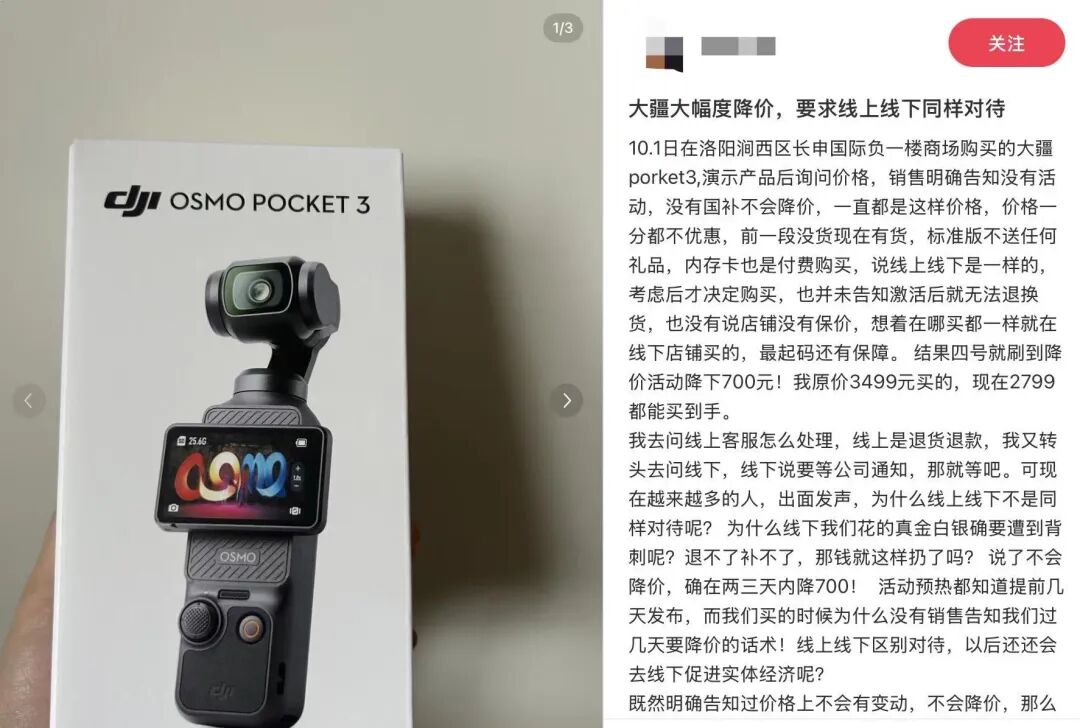
Core Insights - DJI, known for its price stability, has unexpectedly reduced prices on several popular products, notably the Osmo Pocket 3, with the standard kit dropping from 3499 yuan to 2799 yuan, a reduction of 700 yuan, and the all-around kit from 4499 yuan to 3599 yuan, a reduction of 900 yuan [1][3] Pricing Strategy - The price adjustments are part of a promotional strategy for the upcoming "Double 11" shopping festival, as stated by DJI officials, who have communicated this through various channels [3][6] - The Osmo Pocket 3 has seen significant sales, with over 10 million units sold since its release in October 2023, indicating its popularity in the market [5] Consumer Reactions - The sudden price drop has led to mixed reactions from consumers, particularly those who purchased the product shortly before the discount, with some seeking price protection or refunds [3][5] - There is a noted discrepancy in price protection policies between online and offline channels, which has caused confusion among consumers [5] Market Dynamics - The price reduction may be influenced by the impending release of the Osmo Pocket 4, which is expected to feature enhancements such as improved zoom capabilities and support for 6K/8K video recording [7] - Competition from smartphone manufacturers entering the handheld imaging device market is also a significant factor, as companies like OPPO are developing similar products, posing a threat to DJI's market share [6][7] Competitive Landscape - The handheld imaging device market remains concentrated, with DJI's Pocket series and Insta360's action cameras being the most recognized products, each targeting different consumer needs [8] - The entry of smartphone manufacturers into this space could disrupt DJI's established position, as these companies leverage existing resources and customer bases to expand their product offerings [7][9] Technical Challenges - DJI faces the challenge of balancing portability and image quality in its Pocket series, requiring advanced technical solutions to optimize both aspects [9] - The company has a strong foundation in stabilization technology, which is critical for maintaining image quality in handheld devices, stemming from its experience in the drone industry [9]

大疆突然降价被质疑"背刺"!官方回应:"双11"常规促销
Guo Ji Jin Rong Bao· 2025-10-09 13:10
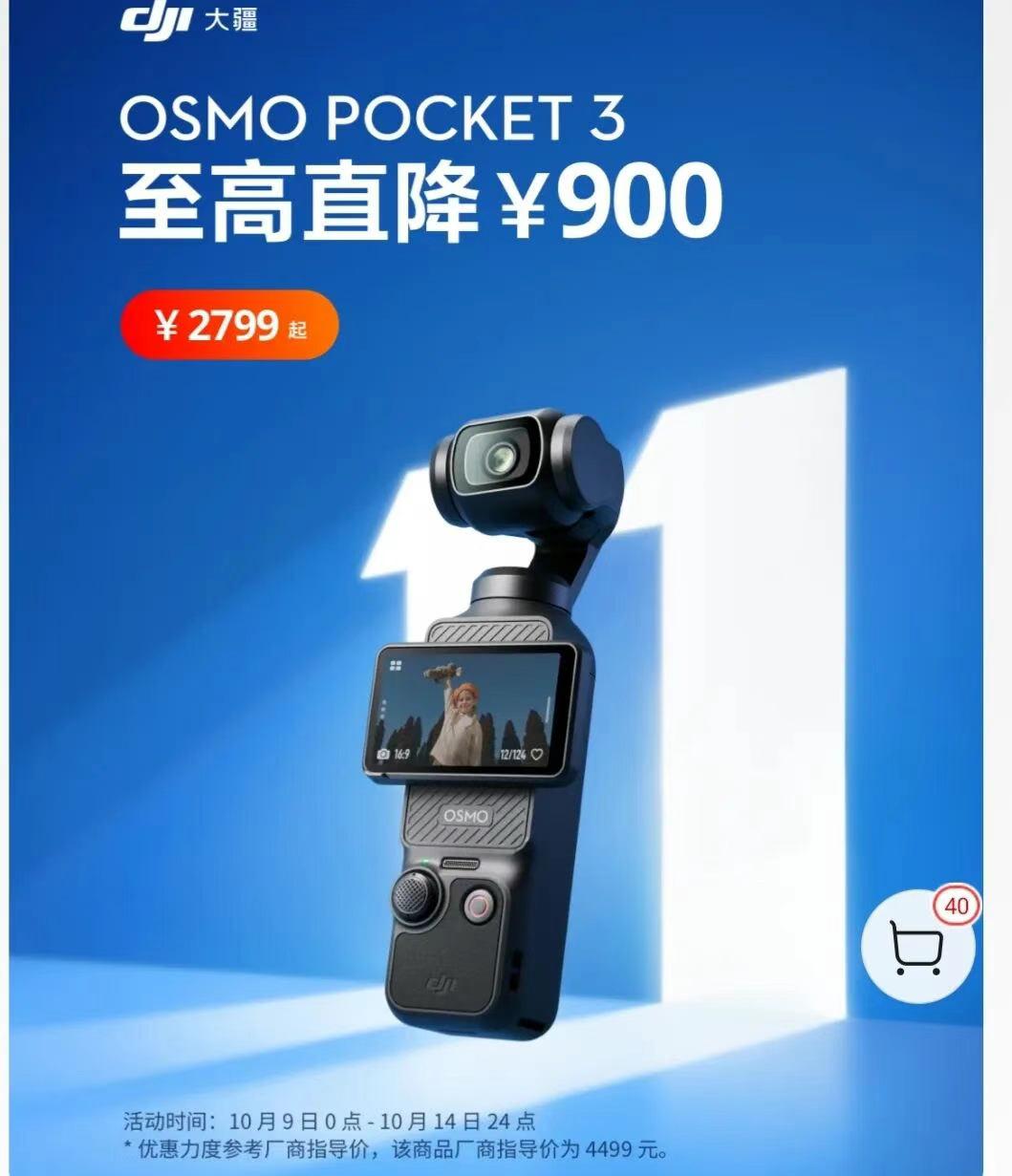
Core Insights - DJI has initiated a significant price reduction on multiple products ahead of the "Double 11" shopping festival, with discounts ranging from hundreds to over a thousand yuan [3][5] - The company claims this price adjustment is a regular promotional strategy to help consumers plan their purchases better [3] - The price cuts have sparked intense discussions among consumers, with some expressing feelings of betrayal for having purchased products at higher prices previously [5][7] Pricing Strategy - DJI's promotional campaign includes substantial discounts on popular products such as the Osmo Pocket 3 (up to 900 yuan off), Osmo Mobile SE (300 yuan off), Mic Mini (410 yuan off), and Mini 4 PRO (1478 yuan off) [3] - The promotional period is set from October 9 to October 14, coinciding with the "Double 11" event [3] Consumer Reactions - Many consumers are considering returning products or seeking refunds due to the sudden price drops, with some expressing dissatisfaction over the lack of price protection policies in physical stores [5][7] - DJI's customer service has indicated that online purchases come with a 7-day price protection policy, while in-store purchases may not have the same benefits [5][7] Market Position - DJI holds over 80% of the global market share and more than 70% of the domestic market share in the drone industry, ranking first among global consumer drone companies [8] - The company has evolved from its origins in helicopter flight control systems to become a leader in commercial drones, camera systems, and stabilizers [7][8] Competitive Landscape - DJI faces increasing competition from new entrants such as Yingshi Innovation, which is launching a consumer drone brand, and smartphone manufacturers like OPPO and vivo, who are developing handheld imaging devices [10]
大疆大幅降价,手持影像赛道大变天?
Hua Er Jie Jian Wen· 2025-10-09 12:35
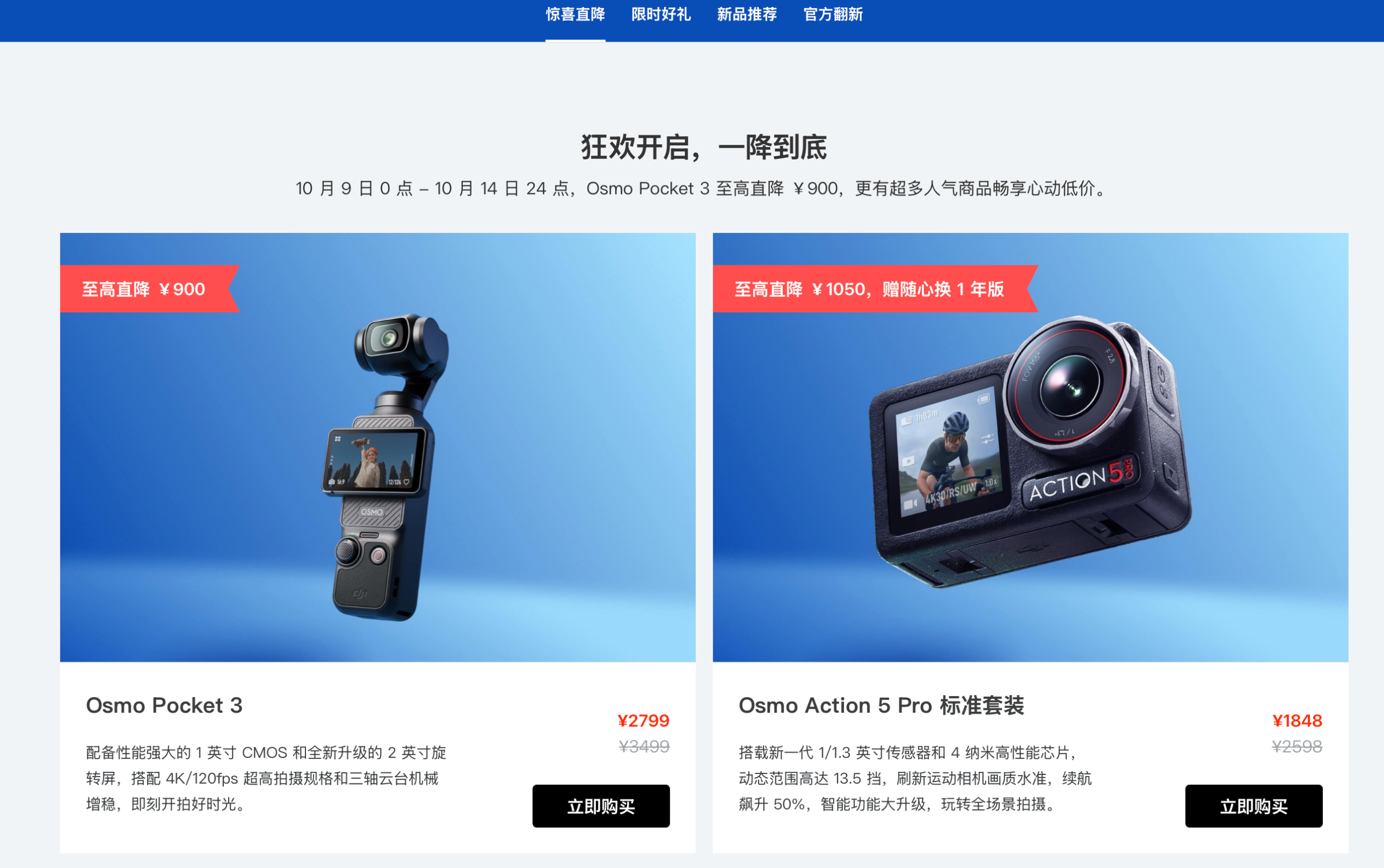
Core Viewpoint - DJI is launching a significant promotional campaign ahead of the "Double 11" shopping festival, with substantial price reductions on various products, including the popular Osmo Pocket 3, to attract more customers in a competitive market [6][11]. Pricing Strategy - The promotional period runs from October 9 to October 14, with the Osmo Pocket 3 standard version seeing a price drop of ¥700 and the full kit dropping by ¥900 [6][7]. - Other products, such as the Action 4 and Action 5 Pro, have also seen price reductions of up to ¥950 and ¥1050, respectively [7]. Market Position and Sales Performance - The Osmo Pocket 3 has been a standout product for DJI, generating sales of ¥124 million on platforms like Taobao and Tmall since its launch, making it the top-selling product in the digital camera category [9][10]. - Despite its popularity, the recent price drop has caused dissatisfaction among some recent buyers, prompting DJI to address customer concerns and improve communication [8]. Competitive Landscape - The smart imaging device market is highly competitive, with DJI, Insta360, and GoPro collectively holding 78.9% of the market share. However, DJI's market share is projected to decline from 19.1% in 2023 to 13.2% in 2024 [11]. - Insta360 has been gaining market share, increasing from 28.4% to 35.6%, while GoPro's share is expected to drop from 38.2% to 30.1% [11]. New Entrants and Industry Trends - New players, including smartphone manufacturers like OPPO and vivo, are entering the handheld smart imaging market, which may intensify competition [14][15]. - The global market for smart action cameras and mobile panoramic cameras is expected to exceed ¥60 billion by 2027, indicating strong growth potential in this sector [14]. DJI's Response and Future Outlook - DJI is actively responding to competitive pressures by launching new products, such as the Osmo 360 panoramic camera, and exploring new market segments like robotic vacuum cleaners [12][16]. - The company aims to maintain its market leadership despite the increasing competition from both established and new players [15][16].
突然大降价!网友炸锅:纯纯大冤种
Xin Lang Cai Jing· 2025-10-09 12:13
Core Viewpoint - DJI has announced significant price reductions on multiple products ahead of the "Double Eleven" shopping festival, leading to consumer backlash from those who purchased items shortly before the price drop [11][12][14]. Group 1: Price Reduction Details - The price drop began on October 9, with discounts ranging from hundreds to over a thousand yuan on various products [11]. - For example, the Osmo Pocket 3 saw a price reduction of 700 yuan for the standard version and 900 yuan for the all-around kit, with some products experiencing a maximum discount of 20% [12]. Group 2: Consumer Reactions - Many consumers expressed feelings of being "betrayed" after purchasing DJI products just before the price drop, particularly those who bought items for the National Day holiday [14]. - Customers have taken to social media and shopping platforms to seek price protection and refunds for the difference [11][14]. Group 3: Return and Price Protection Policies - DJI's customer service stated that they offer a 7-day price protection policy for purchases made before the price drop, allowing customers to apply for price adjustments within this timeframe [11][17]. - Online purchases generally have a higher success rate for returns due to policies like "7-day price protection + 30-day no-reason return," while offline purchases face more challenges, especially if the product has been activated [16][18]. Group 4: Industry Analysis - Analysts suggest that DJI's decision to lower prices before "Double Eleven" is a common sales strategy in the consumer electronics sector aimed at boosting sales and market share [18]. - However, such short-term price reductions on newly released products may impact brand price stability and consumer trust [18]. Group 5: Legal Perspective - Legal experts indicate that companies have the right to set their pricing strategies and are not obligated to announce price drops in advance [20]. - Differences in return and exchange policies between online and offline channels are considered legal as long as they comply with regulations [20].

大疆突然降价被质疑“背刺”!官方回应:“双11”常规促销
Guo Ji Jin Rong Bao· 2025-10-09 11:43
Core Insights - DJI has initiated significant price reductions on multiple products ahead of the "Double 11" shopping festival, with discounts ranging from hundreds to over a thousand yuan [2][5] - The price adjustments have sparked intense discussions among consumers, with some expressing feelings of betrayal due to the sudden price drops after their recent purchases [2][5] - DJI's customer service has indicated that they offer a price protection policy for online purchases, allowing customers to request refunds for price differences within seven days [3][5] Group 1: Price Adjustments - DJI's promotional campaign includes substantial discounts on popular products such as the Osmo Pocket 3, which has seen a price drop of up to 900 yuan, and the Mini 4 PRO drone, which is discounted by as much as 1478 yuan [2] - The promotional period for these discounts runs from October 9 to October 14, coinciding with the "Double 11" shopping event [2] Group 2: Consumer Reactions - Many consumers have taken to social media to voice their dissatisfaction, with some considering returning products or seeking refunds due to the unexpected price drops [2][5] - Offline consumers have reported difficulties in obtaining refunds or price adjustments, as some physical stores do not have a price protection policy in place [5] Group 3: Company Background and Market Position - DJI, founded in 2006 and headquartered in Shenzhen, has grown to dominate the global drone market, holding over 80% of the global market share and more than 70% of the domestic market share [6] - The company is currently facing competition from new entrants in the drone market, including brands like影石 and smartphone manufacturers OPPO and vivo, which are developing their own imaging devices [6]