上海交通大学

Search documents
政策一分钟 海南国际教育创新岛政策
Hai Nan Ri Bao· 2025-09-08 01:41
2020年6月1日,中共中央、国务院发布的《海南自由贸易港建设总体方案》明确建设海南"理工农 医类国际教育创新岛",允许境外理工农医类高水平大学、职业院校在海南自由贸易港独立办学。推动 国内重点高校引进国外知名院校在海南自由贸易港举办具有独立法人资格的中外合作办学机构。 (整理/海南日报全媒体记者 吴心怡) 2020年12月24日,教育部与海南省人民政府在陵水黎族自治县签署《教育部海南省人民政府共同加 快海南国际教育创新岛建设合作协议》,依托三亚崖州湾科技城、陵水黎安国际教育创新试验区、海口 桂林洋教育园区三大平台,引进上海交通大学、浙江大学、中国传媒大学等国内外高校,重点布局海洋 科技、南繁种业、现代服务业等领域。根据《海南"十四五"高标准建设国际教育创新岛》规划,计划引 进15所国际学校及3所以上境外理工农医类高校独立办学。 海南还将围绕海洋、热带农业(种业)、大健康、旅游、民族技艺、民族医药和文化创意等重点产 业领域,引进一批教育资源、建设一批特色学校、培养一批专业人才,引进国内外优质教育培训资源, 开展包括外籍人员、华侨华人在内的高端家政、旅游管理等学历教育及职业培训,支持国内外各级各类 组织机构在海 ...
挂科也有资格保研 ,多所高校明确不再“一票否决”
第一财经· 2025-08-31 10:36
Core Viewpoint - The article discusses the recent adjustments in the graduate school recommendation policies of several Chinese universities, indicating a shift from strict "one-size-fits-all" criteria to more flexible standards that consider individual circumstances and overall potential of students [2][4]. Group 1: Policy Changes - Nanjing Agricultural University has modified its 2026 graduate school recommendation criteria, allowing students with one failed compulsory course to apply if they have passed it through retake or remedial exams [2]. - Xi'an Jiaotong University also allows students to have one failed course, provided they have completed the required credits and passed the course after one retake or remedial exam [3]. - Hunan University of Commerce emphasizes that students should be academically excellent, with retake and remedial courses counted based on the original exam scores [3]. Group 2: Admission Standards - Despite the relaxed policies, the overall admission standards remain high, with students needing a GPA of at least 3.0 and specific English proficiency scores to qualify for recommendations [4]. - The adjustments reflect a broader educational reform in China aimed at moving away from rigid evaluation systems that prioritize scores and degrees, focusing instead on the holistic development and potential of students [4]. Group 3: Talent Selection - Experts argue that the new policies allow for a more diverse talent selection process, recognizing that students may excel in different areas and that their abilities can be multifaceted [5]. - The flexibility in admission criteria is seen as beneficial for nurturing talents that align with the evolving needs of the economy and society [5].

告别高耗时!上交Prune2Drive:自动驾驶VLM裁剪利器,加速6倍性能保持
自动驾驶之心· 2025-08-28 23:32
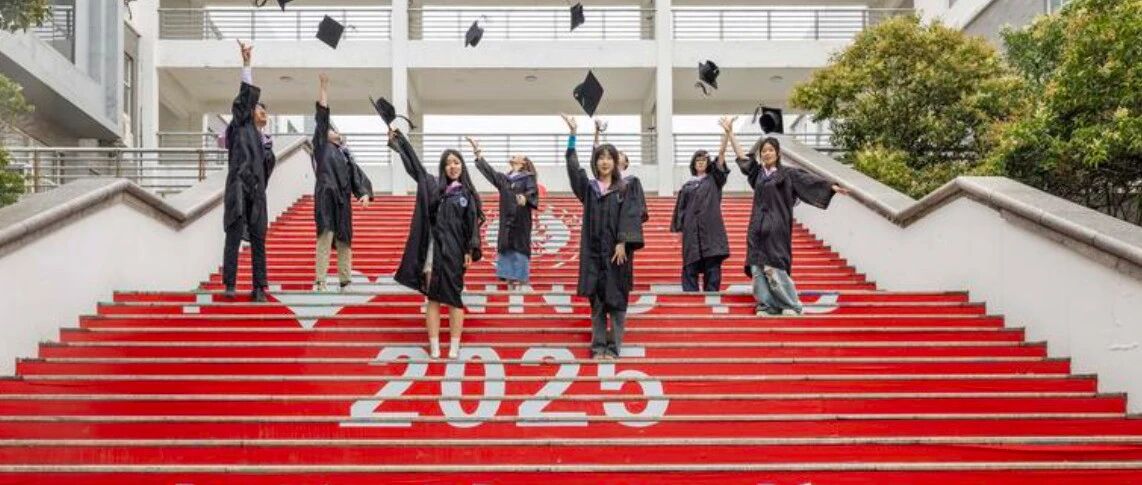
Core Viewpoint - The article discusses the Prune2Drive framework developed by Shanghai Jiao Tong University and Shanghai AI Lab, which achieves a 6.4x acceleration in visual token processing while only reducing performance by 3% through a pruning method that eliminates 90% of visual tokens [2][3][25]. Group 1: Research Background and Challenges - Visual Language Models (VLMs) provide a unified framework for perception, reasoning, and decision-making in autonomous driving, enhancing scene understanding and reducing error propagation [2]. - The deployment of VLMs in real driving scenarios faces significant computational challenges due to the high-resolution images from multiple cameras, leading to increased inference latency and memory consumption [3]. - Existing token pruning methods are limited in adapting to multi-view scenarios, often neglecting spatial semantic diversity and the varying contributions of different camera views [4]. Group 2: Prune2Drive Framework - Prune2Drive introduces the Token-wise Farthest Point Sampling (T-FPS) mechanism, which maximizes the semantic and spatial coverage of multi-view tokens rather than relying solely on individual token significance [6]. - The T-FPS method uses cosine distance to measure semantic similarity between tokens, ensuring that selected tokens are non-redundant and semantically rich [10][11]. - A view-adaptive pruning controller is designed to optimize the pruning ratio for different views, allowing for efficient resource allocation based on the contribution of each view to driving decisions [11][12]. Group 3: Experimental Design and Results - Experiments were conducted on two multi-view VLM benchmark datasets (DriveLM, DriveLMM-o1) to validate the performance retention and efficiency improvement of Prune2Drive compared to baseline methods [16]. - The framework demonstrated that even with a 90% token reduction, it maintained a risk assessment accuracy of 68.34, outperforming several baseline models [22]. - The efficiency of Prune2Drive was highlighted by a significant speedup in processing, achieving a 6.4x acceleration in the DriveMM model and a 2.64x acceleration in the DriveLMM-o1 model [25]. Group 4: Key Findings and Advantages - Prune2Drive effectively captures critical information in driving scenarios, outperforming other methods by accurately identifying key objects in various views [26]. - The framework is plug-and-play, requiring no retraining of VLMs and compatible with efficient implementations like Flash Attention [31]. - It balances performance and efficiency, achieving substantial reductions in computational load while preserving essential semantic information [31].
6000米级潜器“海琴”完成海试
Zhong Guo Zi Ran Zi Yuan Bao· 2025-08-27 07:06
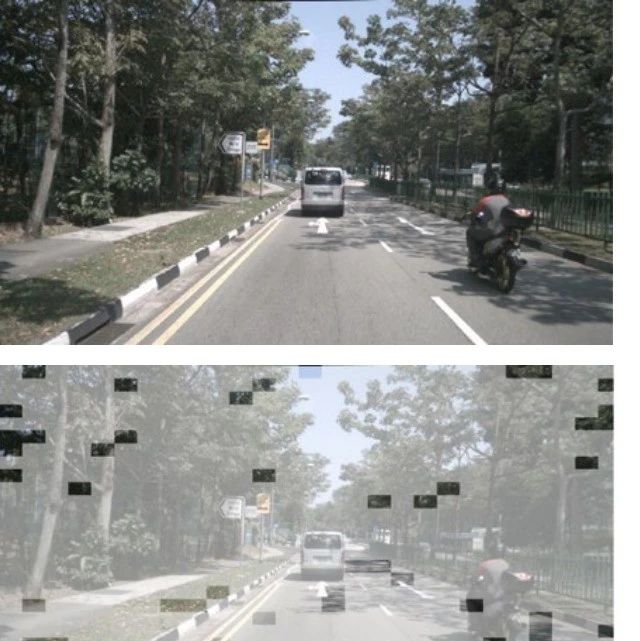
Core Insights - The "Zhongshan University" research vessel has successfully completed its first deep-sea test with the 6000-meter class remotely operated vehicle (ROV) "Haiqin," marking its entry into a select group of vessels in China capable of such deep-sea exploration [1] - The "Haiqin" ROV achieved a maximum diving depth of 4140 meters during multiple test dives, validating its technical specifications and operational reliability [1] - The ROV is designed for deep-sea exploration and is supported by Zhongshan University, with production commissioned to Shanghai Jiao Tong University, enabling precise observation and sample collection for various marine scientific studies [1] Research Mission Details - The mission, led by Zhongshan University, commenced on August 13 from Zhuhai, with a planned duration of 25 days, focusing on deep-sea scientific applications using the autonomous remotely operated vehicle (ARV) "Haidou No. 1" [2] - The "Haiqin" and "Haidou No. 1" will conduct experimental applications across multiple work areas in the South China Sea, integrating tasks such as ocean meteorological observations, geological process detection, and biodiversity studies [2]
不调参、不费力,上海交大&上海AI Lab推出“记忆解码器”,任意LLM无缝自适应
3 6 Ke· 2025-08-26 09:17
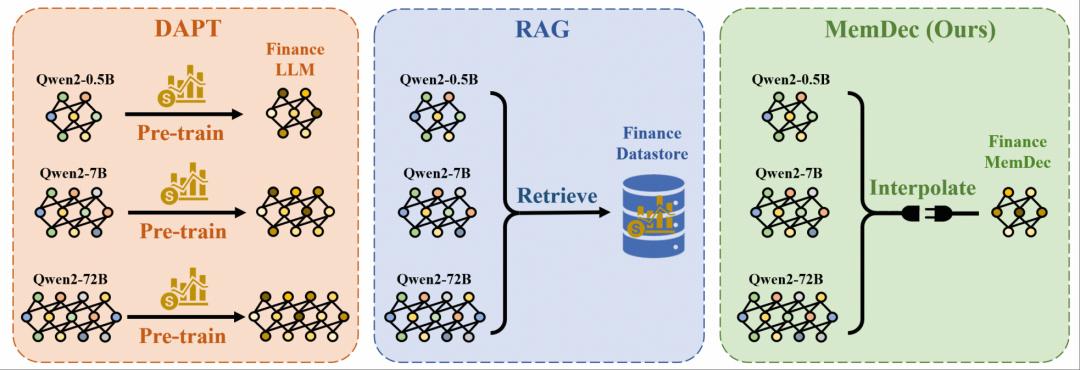
Core Insights - The article discusses the challenges faced by large language models (LLMs) in specialized fields such as healthcare, finance, and law due to their lack of deep domain knowledge. It highlights the need for effective domain adaptation solutions to enhance LLM performance in these areas [2][4]. Group 1: Memory Decoder Innovation - The Memory Decoder is introduced as a "plug-and-play" pre-training memory module that can adapt various LLMs without modifying their parameters, enabling efficient domain adaptation across different model sizes [2][4]. - Experimental results show that the Memory Decoder effectively adapts Qwen and Llama models to biomedical, financial, and legal domains, achieving an average perplexity reduction of 6.17% [4][12]. Group 2: Architecture and Functionality - During the pre-training phase, the Memory Decoder learns to align its output distribution with that generated by a non-parametric retriever using a distribution alignment loss function [5][10]. - In the inference phase, it processes input data in parallel with the base language model, generating domain-enhanced predictions without additional retrieval costs [5][10]. Group 3: Performance Evaluation - The Memory Decoder demonstrates significant performance improvements across various GPT-2 model sizes on the WikiText-103 dataset, with a single Memory Decoder of 124 million parameters enhancing the performance of the entire GPT-2 series [11][12]. - In downstream tasks, the Memory Decoder maintains or improves performance across nine different NLP tasks, showcasing its ability to enhance domain adaptation while preserving general language capabilities [13][14]. Group 4: Cross-Model and Cross-Tokenizer Adaptation - The Memory Decoder exhibits strong cross-model adaptability, enhancing performance across different Qwen and Qwen2.5 models, regardless of their size [15][21]. - It also shows effective cross-tokenizer adaptation, allowing for the transfer of knowledge between different model architectures with minimal additional training [17][18]. Group 5: Knowledge-Intensive Reasoning Tasks - In knowledge-intensive reasoning tasks, the Memory Decoder outperforms traditional retrieval-augmented generation (RAG) methods, enhancing the model's ability to acquire factual knowledge while maintaining reasoning capabilities [19][20]. Group 6: Limitations and Future Directions - Despite its advantages, the Memory Decoder has limitations, such as the computational overhead associated with the KV data storage during the pre-training phase and the need for some parameter adjustments for cross-tokenizer adaptation [21][23].
为防AI刷题,Nature等顶刊最新封面被做成数据集,考验模型科学推理能力|上海交通大学
量子位· 2025-08-25 15:47
Core Viewpoint - The article discusses the development of the MAC (Multimodal Academic Cover) benchmark, which aims to evaluate the true capabilities of advanced AI models like GPT-4o and Gemini 2.5 Pro by using the latest scientific content for testing, addressing the challenge of outdated "question banks" in AI assessments [1][5]. Group 1: Benchmark Development - The MAC benchmark utilizes the latest covers from 188 top journals, including Nature, Science, and Cell, to create a testing dataset from over 25,000 image-text pairs, ensuring that the AI models are evaluated on the most current and complex scientific concepts [3][4]. - The research team designed two testing tasks: "selecting text from images" and "selecting images from text," to assess the AI's understanding of the deep connections between visual elements and scientific concepts [17][18]. Group 2: Testing Results - The results revealed that even top models like Step-3 achieved only a 79.1% accuracy when faced with the latest scientific content, indicating significant limitations in their performance compared to their near-perfect results on other benchmarks [4][19]. - The study highlighted that models such as GPT-5-thinking and Gemini 2.5 Pro, while proficient in visual recognition, still struggle with deep reasoning tasks that require cross-modal scientific understanding [19]. Group 3: Dynamic Benchmarking Mechanism - The MAC benchmark introduces a dynamic approach to testing by continuously updating the dataset and questions, which helps maintain the challenge level as scientific knowledge evolves [24][26]. - The research team conducted a comparison experiment showing that all models performed worse on the latest data (MAC-2025) compared to older data (MAC-Old), demonstrating that the natural evolution of scientific knowledge provides ongoing challenges for AI models [26]. Group 4: DAD Methodology - The DAD (Divide and Analyze) method was proposed to enhance AI performance by structuring the reasoning process into two phases: a detailed visual description followed by high-level analysis, simulating human expert thinking [21][22]. - This two-step approach significantly improved the accuracy of multiple models, showcasing the effectiveness of extending reasoning time in multimodal scientific understanding tasks [22][23]. Group 5: Future Prospects - The MAC benchmark is expected to evolve into a more comprehensive evaluation platform, with plans to include more scientific journals and dynamic scientific content such as conference papers and news [28]. - As AI capabilities approach human levels, the MAC benchmark will serve as a "touchstone" to better understand the boundaries of AI capabilities and the path toward true intelligence [28].
中大6000米级深海无人遥控潜水器在南海完成首次深海试验
Nan Fang Du Shi Bao· 2025-08-24 12:57
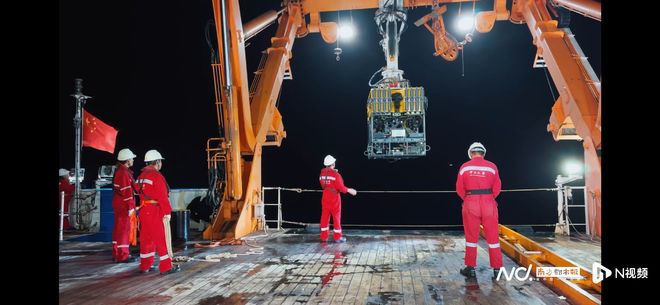
Core Insights - The "Haiqin" ROV successfully completed its first deep-sea test, validating its system functions and performance indicators, marking the "Zhongshan University" ship as one of the few in China equipped with a 6000-meter deep-sea ROV [1][3] Group 1 - The "Haiqin" ROV achieved a maximum diving depth of 4140 meters during multiple test dives, confirming the stability and reliability of its technical indicators and system operations [3][5] - Prior to the sea trial, all components of the ROV underwent pressure testing at 6000 meters on land, with the sea trial primarily serving a verification purpose [3][7] - The ROV is designed for deep-sea exploration and is supported by Zhongshan University, with production commissioned to Shanghai Jiao Tong University, enabling precise observation and sample collection for various deep-sea scientific tasks [3][8] Group 2 - The "Zhongshan University" ship is currently the largest and most advanced modern oceanographic research vessel in China, having completed 23 scientific expeditions since its commissioning, with a focus on deep-sea exploration [10]
我国自主研制的6000米级深海无人遥控潜水器“海琴”号在南海成功海试
Xin Hua Wang· 2025-08-24 08:45
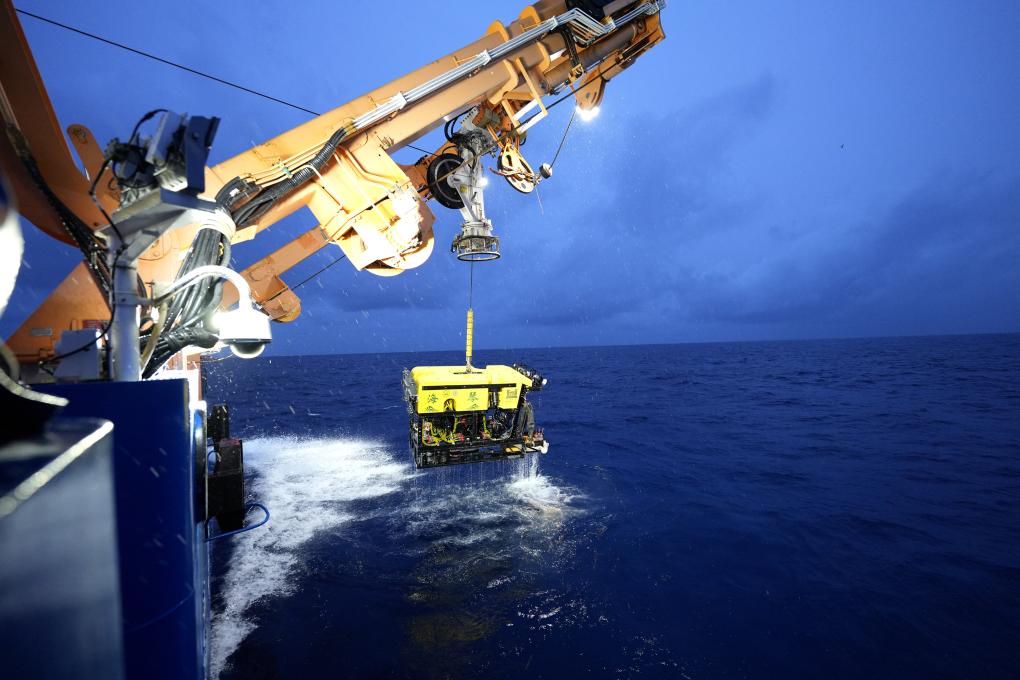
Core Viewpoint - The successful sea trial of China's self-developed deep-sea remotely operated vehicle (ROV) "Haiqin" marks a significant advancement in deep-sea research capabilities, demonstrating its operational effectiveness at a depth of 4140 meters [1][3]. Group 1: Development and Features - "Haiqin" is developed by the Shanghai Jiao Tong University Underwater Engineering Research Institute and is tailored for the "Zhongshan University" oceanographic research vessel, featuring advanced capabilities such as automatic orientation, hovering, and automatic line-following [2]. - The ROV is equipped with high-definition cameras, multifunctional robotic arms, and detection sensors, enhancing its functionality for scientific exploration [2]. Group 2: Operational Details - The sea trial commenced on August 22, with the "Zhongshan University" vessel arriving at the testing site in the South China Sea, where the ROV was deployed under challenging weather conditions [2]. - During the trial, "Haiqin" successfully collected sediment samples and recorded various marine specimens, including sponges, starfish, sea cucumbers, deep-sea fish, and seabed rocks [5]. Group 3: Team and Collaboration - The sea trial involved a collaborative effort from 89 team members across 19 institutions, including Sun Yat-sen University, Shanghai Jiao Tong University, and the Shenyang Institute of Automation, showcasing a strong interdisciplinary approach [6]. - The operation team and technical team worked closely together, ensuring the ROV's functions and performance met the design specifications, laying the groundwork for future applications [6]. Group 4: Additional Equipment - The trial also featured the first operational full-depth autonomous remote vehicle (ARV) "Haidou No. 1," which conducted scientific applications alongside "Haiqin," providing valuable insights for safe multi-tasking in deep-sea operations [8].
新华全媒+|我国自主研制的6000米级深海无人遥控潜水器“海琴”号在南海成功海试
Xin Hua She· 2025-08-24 08:25
Core Viewpoint - The successful sea trial of China's self-developed deep-sea remotely operated vehicle (ROV) "Haiqin" marks a significant advancement in deep-sea research capabilities, enhancing the country's scientific exploration tools [1][2]. Group 1: Technical Specifications and Performance - "Haiqin" is a 6000-meter class deep-sea ROV developed by Shanghai Jiao Tong University, designed specifically for the "Sun Yat-sen University" oceanographic research vessel, featuring advanced capabilities such as automatic positioning and multi-functional sensors [1][2]. - During the sea trial, "Haiqin" successfully descended to a depth of 4140 meters, collecting sediment samples and conducting various tests to validate its technical specifications and performance [2][3]. Group 2: Collaborative Efforts and Research Applications - The sea trial involved a collaborative team of 89 members from 19 domestic institutions, including Sun Yat-sen University and the Chinese Academy of Sciences, showcasing a unified effort in deep-sea exploration [2]. - The trial also included the operation of China's first full-depth autonomous remote vehicle (ARV) "Haidou No. 1," marking the first instance of two different deep-sea unmanned systems operating simultaneously on the same research vessel, providing valuable practical insights for future deep-sea missions [3].
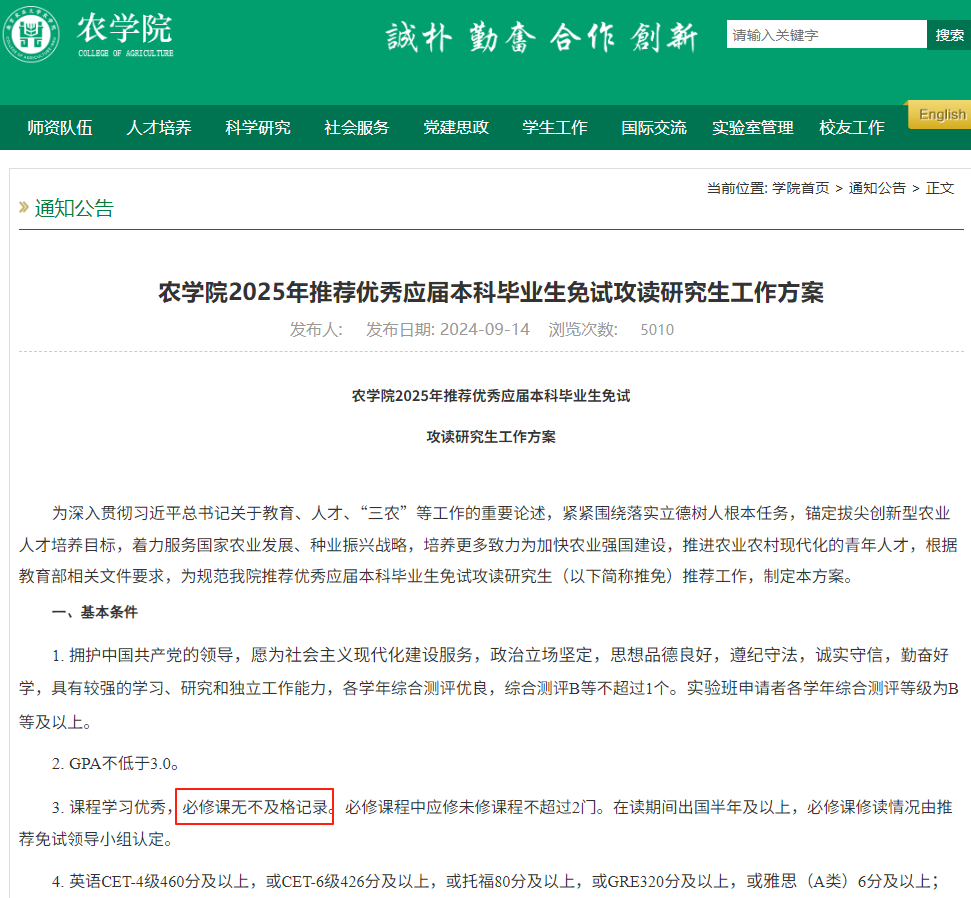
挂科,也能保研了
Hu Xiu· 2025-08-23 09:05
挂科,也能保研了! 南京农业大学今年放宽了保研的成绩要求,在《2026年推荐优秀应届本科毕业生免试攻读研究生工作方案》中允许必修课不及格记录不超过一门,且参加 推免时经补考或重修已通过课程考核。 而在去年推免要求中,南京农业大学还明确提出"必修课无不及格记录",今年便取消了这一限制,意味着学生挂科后仍有机会获得保研资格! 对保研学生来说,每门课程的第一次成绩至关重要,这是因为多数高校均以首次成绩作为合格的判定标准。比如南通大学交通与土木工程学院要求课程冲 抵前成绩没有补考或不及格课程;山东理工大学更是直言"课程首次成绩有不及格的不予推荐"。 "一次挂科成千古恨",想必是大多数冲刺保研学生的真实写照。 即便是补考重修,也会导致绩点下降,间接影响排名竞争力。如南昌大学的本科生学业成绩评定管理办法中规定:补考或重修及格的,成绩单成绩等级记 为D-(绩点为1.0),意味着学生需要在其他课程中获得极高的绩点,才能挽救这一损失。 "允许挂科一次" 图源:南京农业大学2025年、2026年推免工作方案 挂科=保研无缘? 通常情况下,在保研资格评选工作中,诸多高校有严格的成绩要求,甚至直接关闭了挂科学生的保研通道。 西北大学 ...