平安银行

Search documents
重庆银行三季度拟派现约5.85亿元
Zheng Quan Ri Bao· 2025-10-27 16:49
Core Insights - The third quarter reports of A-share listed banks have shown mixed results, with some banks experiencing revenue and profit declines while others report growth [1][2] Group 1: Financial Performance - Chongqing Bank announced a cash dividend of RMB 1.684 per 10 shares, totaling approximately RMB 585 million, which represents 11.99% of its net profit [1] - Chongqing Bank achieved revenue of RMB 11.74 billion, a year-on-year increase of 10.40%, and a net profit of RMB 4.88 billion, up 10.19% [1] - Wuxi Bank reported revenue of RMB 3.77 billion, a 3.87% increase, and a net profit of RMB 1.83 billion, up 3.78% [1] - Ping An Bank and Huaxia Bank reported revenues of RMB 100.67 billion and RMB 64.88 billion, respectively, both showing declines of 9.8% and 8.79% year-on-year [2] - The net profits for Ping An Bank and Huaxia Bank were RMB 38.34 billion and RMB 17.98 billion, both down compared to the previous year [2] Group 2: Asset Quality - As of the end of the third quarter, the non-performing loan (NPL) ratios for Ping An Bank, Huaxia Bank, and Chongqing Bank were 1.05%, 1.58%, and 1.14%, showing slight decreases from the end of 2024 [3] - Wuxi Bank maintained a stable NPL ratio of 0.78% [3] - The provision coverage ratios for the banks were robust, with Ping An Bank at 229.60%, Huaxia Bank at 149.33%, Chongqing Bank at 248.11%, and Wuxi Bank at 427.87% [3] Group 3: Industry Outlook - The overall banking sector is expected to maintain stable operating efficiency, with steady growth in asset size and improving asset quality [3] - The increase in non-interest income is seen as a key factor in enhancing bank performance, alongside the optimization of asset structures [3] - There is a recommendation for banks to increase lending to the manufacturing and green industries, as well as to expand wealth management and financial services to boost non-interest income [3]
上市银行三季报将迎密集揭榜,多家已现积极信号
Bei Jing Shang Bao· 2025-10-27 14:51
Core Viewpoint - The third-quarter reports of six A-share listed banks indicate a stable overall performance, with some banks achieving year-on-year growth in both revenue and net profit, while others show a narrowing decline in performance metrics [1][3]. Group 1: Performance Highlights - Six banks, including Chongqing Bank and Wuxi Rural Commercial Bank, reported strong growth, with Chongqing Bank's revenue and net profit both exceeding 10% year-on-year [3][4]. - Chongqing Bank achieved a revenue of 11.74 billion and a net profit of 4.88 billion, marking increases of 10.40% and 10.19% respectively [3]. - Nanjing Bank and Ningbo Bank also demonstrated solid performance, with revenue growth rates of 8.79% and 8.32%, and net profit growth rates of 8.06% and 8.39% respectively [3][4]. Group 2: Declining Performance and Recovery Signals - Huaxia Bank and Ping An Bank reported declines in revenue and net profit, but the rate of decline has narrowed compared to the first half of the year [4][5]. - Huaxia Bank's revenue decreased by 8.79% to 64.88 billion, while net profit fell by 2.86% to 17.98 billion, with a decline reduction of 5.09 percentage points [4]. - Ping An Bank's revenue dropped by 9.8% to 100.67 billion, and net profit decreased by 3.5% to 38.34 billion, with declines narrowing by 0.2 and 0.4 percentage points respectively [4][5]. Group 3: Asset Quality Improvement - The overall asset quality of the six banks showed improvement, with Wuxi Rural Commercial Bank, Nanjing Bank, and Ningbo Bank maintaining low non-performing loan (NPL) ratios of 0.78%, 0.83%, and 0.76% respectively [7][8]. - Chongqing Bank's NPL ratio decreased to 1.14%, Huaxia Bank's to 1.58%, and Ping An Bank's to 1.05%, all showing a year-on-year decline [7]. - The banks attributed the improvement in asset quality to enhanced risk management and increased efforts in disposing of non-performing assets [8][9]. Group 4: Future Outlook - Analysts predict that the banking sector will maintain a stable performance, but structural differentiation will continue, with quality city commercial banks likely to accelerate growth due to strong regional credit demand [6][9]. - The overall performance of the banking industry will depend on the pace of economic recovery and the effectiveness of policy support, particularly in addressing risks in real estate and local government debt [6][9].






上市银行三季报密集披露!公允价值变动收益下降,资产质量持续改善
Mei Ri Jing Ji Xin Wen· 2025-10-27 10:12
Core Viewpoint - The third-quarter performance reports of listed banks in China show a mixed picture, with some banks achieving growth in revenue and net profit, while others experience a decline in net profit. However, there is a notable decrease in fair value change income across the board due to bond market fluctuations [1][2]. Group 1: Performance Overview - Several banks, including Huaxia Bank, Chongqing Bank, and Ping An Bank, have reported their third-quarter results, with Huaxia Bank being the first to disclose its performance [1]. - Huaxia Bank's total assets increased by 4.8% year-on-year to 4.59 trillion yuan, with loans and deposits also showing growth [2]. - Huaxia Bank's net profit for the third quarter was 6.512 billion yuan, a year-on-year increase of 7.62%, despite a 15.02% decline in revenue for the quarter [2][3]. Group 2: Fair Value Change Income - Huaxia Bank reported a significant drop in fair value change income, with a loss of 4.505 billion yuan for the first three quarters, down approximately 78 billion yuan from a profit of 3.326 billion yuan in the previous year [3]. - Ping An Bank's third-quarter revenue was 31.28 billion yuan, a decrease of 9.2% year-on-year, with a net profit of 13.47 billion yuan, down 2.8% [7][10]. - Both Chongqing Bank and Wuxi Bank reported good performance, with Chongqing Bank's net profit increasing by 10.19% to 4.879 billion yuan, while Wuxi Bank's net profit grew by 3.78% to 1.833 billion yuan [7]. Group 3: Asset Quality and Net Interest Margin - The overall asset quality of listed banks has shown improvement, with Huaxia Bank's non-performing loan ratio at 1.58%, down 0.02 percentage points from the previous year [16]. - The net interest margin for Ping An Bank decreased to 1.79%, down 0.14 percentage points year-on-year, while Huaxia Bank's net interest margin was 1.55%, down 0.05 percentage points [15][16]. - Analysts expect that the cumulative revenue and net profit for listed banks in the first three quarters of 2025 will see slight growth, primarily due to a narrowing decline in net interest margins and reduced impairment provisions [15].
股份制银行板块10月27日跌0.37%,中信银行领跌,主力资金净流出12.42亿元
Zheng Xing Xing Ye Ri Bao· 2025-10-27 08:25
Market Overview - The share price of the joint-stock bank sector decreased by 0.37% compared to the previous trading day, with CITIC Bank leading the decline [1] - The Shanghai Composite Index closed at 3996.94, up 1.18%, while the Shenzhen Component Index closed at 13489.4, up 1.51% [1] Individual Bank Performance - The closing prices and performance of individual banks are as follows: - Everbright Bank: 3.53, unchanged - Pudong Development Bank: 12.97, down 0.08% - Zhejiang Commercial Bank: 3.09, down 0.32% - Ping An Bank: 11.52, down 0.35% - Huaxia Bank: 6.98, down 0.57% - Minsheng Bank: 4.09, down 0.73% - Industrial Bank: 20.43, down 0.83% - China Merchants Bank: 41.59, down 0.86% - CITIC Bank: 7.84, down 1.26% [1] Capital Flow Analysis - The joint-stock bank sector experienced a net outflow of 1.242 billion yuan from main funds, while speculative funds saw a net inflow of 673 million yuan, and retail investors had a net inflow of 568 million yuan [1] - Detailed capital flow for individual banks shows: - Minsheng Bank: Main funds net inflow of 74.6 million yuan, speculative funds net inflow of 50.8 million yuan, retail net outflow of 12.5 million yuan - Huaxia Bank: Main funds net outflow of 2.83 million yuan, speculative funds net inflow of 27.7 million yuan, retail net outflow of 24.9 million yuan - Zhejiang Commercial Bank: Main funds net outflow of 24.3 million yuan, speculative funds net inflow of 17.2 million yuan, retail net inflow of 7.1 million yuan - Everbright Bank: Main funds net outflow of 38.3 million yuan, speculative funds net inflow of 35.7 million yuan, retail net inflow of 2.6 million yuan - CITIC Bank: Main funds net outflow of 106 million yuan, speculative funds net inflow of 45.8 million yuan, retail net inflow of 60.4 million yuan - Ping An Bank: Main funds net outflow of 117 million yuan, speculative funds net inflow of 48.2 million yuan, retail net inflow of 69.3 million yuan - Industrial Bank: Main funds net outflow of 131 million yuan, speculative funds net inflow of 104 million yuan, retail net inflow of 26.7 million yuan - Pudong Development Bank: Main funds net outflow of 137 million yuan, speculative funds net outflow of 106 million yuan, retail net inflow of 24.3 million yuan - China Merchants Bank: Main funds net outflow of 759 million yuan, speculative funds net inflow of 450 million yuan, retail net outflow of 309 million yuan [2]




平安银行今年前三季度营收1006亿元,持续推进降本增效
Nan Fang Du Shi Bao· 2025-10-27 07:52
Core Viewpoint - Ping An Bank is undergoing a transformation phase, reporting a decline in revenue and net profit for the first three quarters of 2025, but showing signs of improvement in profit decline rates compared to earlier periods [1][2] Financial Performance - For the first nine months of 2025, Ping An Bank achieved operating revenue of 100.668 billion yuan, a year-on-year decrease of 9.8% [1] - The net profit for the same period was 38.339 billion yuan, down 3.5% year-on-year, with a narrowing decline compared to the first half of the year [1] - As of the end of September, the total assets of the bank were 576.6764 billion yuan, showing a slight decrease compared to the end of June [1] Interest Margin and Non-Interest Income - The net interest margin for the first nine months was 1.79%, down 14 basis points from the same period last year, influenced by declining loan rates and business structure adjustments [1] - Non-interest income from bond investments and other businesses decreased due to market fluctuations [1] Asset Quality - The non-performing loan ratio stood at 1.05% at the end of September, a decrease of 0.01 percentage points from the end of last year [1] - The provision coverage ratio was 229.60%, indicating strong risk compensation capability [1] Cost Control and Efficiency - The bank focused on cost reduction and efficiency improvement, with business and management expenses amounting to 27.649 billion yuan, down 9.6% year-on-year [1] - Credit and other asset impairment losses were 25.989 billion yuan, a decrease of 18.8% year-on-year [1] Liability Management - As of the end of September, the total liabilities were 524.8834 billion yuan, with customer deposits increasing by 0.6% year-on-year [2] - The average interest rate on interest-bearing liabilities was 1.73%, down 47 basis points year-on-year, while the average interest rate on customer deposits was 1.70%, down 43 basis points year-on-year [2] - The bank has been enhancing the absorption of low-cost deposits and adjusting the pace of deposit and interbank liabilities to lower overall funding costs [2]
银行行业:25Q3理财规模平稳增长,估值整改压力下资产端配置更审慎
Dongxing Securities· 2025-10-27 06:58
Investment Rating - The industry investment rating is "Positive" [7] Core Insights - The wealth management product scale has maintained steady growth, with a total market size of 32.13 trillion yuan as of Q3 2025, representing a year-on-year increase of 9.42% and a quarterly increase of 1.46 trillion yuan [1][16] - The market share of wealth management companies has further increased, reaching 91.13% of the total market by the end of Q3 2025, up 3 percentage points from the beginning of the year [3] - The asset allocation in wealth management has become more cautious due to valuation rectification pressures, with an increase in cash and deposits allocation and a decrease in bonds and interbank certificates of deposit [4] Summary by Sections Product Side - The wealth management product scale has shown stable growth, with mixed and closed-end products slightly increasing in proportion [1] - By the end of Q3 2025, the proportion of mixed products rose to 2.58%, while fixed-income products decreased to 97.14% [1][16] Yield Performance - Wealth management yields have faced downward pressure due to valuation rectification and bond market fluctuations, with the average annualized yield for open-ended fixed-income products at 2.61%, up 5 basis points quarter-on-quarter [2] - The average annualized yield for closed-end fixed-income products was 2.69%, down 28 basis points [2] Market Share - The market share of wealth management companies has increased, with 32 companies currently operating in the sector, and the share of non-licensed banks' wealth management gradually shifting to licensed companies [3] Asset Allocation - By the end of Q3 2025, the total investment asset balance for bank wealth management was 34.33 trillion yuan, with a year-on-year growth of 8.53% [4] - The top three asset allocations were bonds (40.4%), cash and bank deposits (27.5%), and interbank certificates of deposit (13.1%), with a decrease in the proportion of bonds and interbank certificates of deposit [4][15] Future Outlook - The "deposit migration" trend is expected to support steady growth in wealth management scale, as residents seek safer and more liquid products amid declining deposit rates [9] - Potential changes in fund sales regulations may lead to short-term redemptions of bond funds from wealth management products [9]
上市银行三季报陆续披露,息差有望企稳!
Mei Ri Jing Ji Xin Wen· 2025-10-27 06:04
Core Viewpoint - The disclosure of the third-quarter reports for A-share listed banks in 2025 indicates overall growth in revenue and net profit, or a narrowing decline, with improved asset quality across the banks analyzed [1] Group 1: Financial Performance - The banks that have reported, including Huaxia Bank, Chongqing Bank, Ping An Bank, and Wuxi Bank, are expected to show either an increase in revenue and net profit or a reduced decline [1] - Analysts predict that the overall revenue and net profit growth rates for the banking industry will remain positive due to factors such as a narrowing decline in interest margins and stable asset quality [1] Group 2: Market Valuation - The current price-to-book ratio for the banking sector is 0.73, which has historically been above this level for over 50% of the time [1] - Some A-share bank stocks have seen dividend yields rise above 5.0%, indicating attractive investment value [1] Group 3: Investment Strategy - For those optimistic about the banking sector, it is suggested to consider buying on dips and tracking the CSI Bank Index ETF (515020), which has seen continuous net inflows over the past five trading days [1]
行业深度报告:零售风险及新规影响有限,兼论信贷去抵押化
KAIYUAN SECURITIES· 2025-10-27 05:44
Investment Rating - The investment rating for the industry is "Positive" (maintained) [1] Core Insights - The report highlights that retail non-performing loan (NPL) rates and generation rates are currently high, indicating ongoing pressure on bank profitability. Despite a low overall NPL rate, the retail sector shows signs of risk, with a marginal increase in the NPL rate to 1.28% [14][15] - The transition period for new risk regulations is nearing its end, with concerns about the impact on banks' provisioning levels. However, the report suggests that the actual impact may be less severe than market expectations [16] - The trend of de-collateralization in bank lending is evident, driven by both business characteristics and strategic choices made by banks to reduce reliance on collateralized loans [17] Summary by Sections 1. Retail NPL and Generation Rates - The retail NPL rate has increased to 1.28%, with a steepening curve indicating ongoing risk. The generation rate for retail loans remains high, with significant increases noted in certain banks [14][18] - The report indicates that while the overall NPL rate is low, the divergence between overdue and NPL indicators suggests underlying risks in the retail sector [19] 2. Impact of New Risk Regulations - The new risk regulations will require banks to classify impaired loans as NPLs, potentially increasing reported NPL rates. However, the report anticipates that the actual provisioning pressure may be manageable [16][17] 3. De-Collateralization in Lending - The report notes a significant decline in the proportion of collateralized loans, with banks shifting towards non-collateralized lending strategies. This shift is influenced by the need to manage risk more effectively [17][18] 4. Investment Recommendations - The report recommends certain state-owned banks due to their customer base advantages and manageable retail risk pressures. It also highlights specific banks such as CITIC Bank and Agricultural Bank of China as beneficiaries of this trend [6]


国际金价跳水!第一批金价下跌受害者出现了 有人称“把生活费亏没了”
Mei Ri Jing Ji Xin Wen· 2025-10-27 02:50
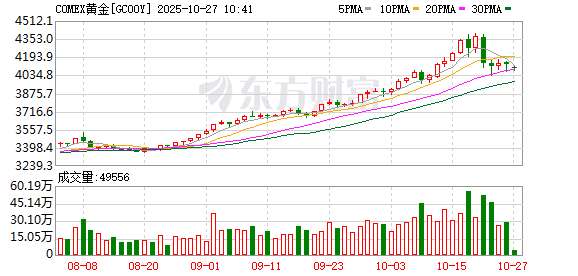
Group 1 - A significant influx of university students into the gold market has been observed, with many investing in gold ETFs or accumulating gold, but recent declines in gold prices have led to losses for some investors [1] - Experts warn that the current speculative atmosphere around gold can lead to emotional trading, particularly for inexperienced investors like university students, who may be at a disadvantage compared to global capital and professional institutions [1] - Following a period of rising gold prices, banks reported an increase in customer inquiries about accumulating gold and physical gold bars, but as prices have fluctuated, some investors are now facing losses in their gold accounts [1][4] Group 2 - Goldman Sachs predicts that gold prices will rise to $4,900 per ounce by the end of next year, highlighting the complex and multifaceted nature of gold pricing [2] - Recent international gold prices have seen a decline, with a weekly drop of over 3%, marking the end of a nine-week upward trend [3] - Analysts attribute the recent drop in gold prices to profit-taking, indicating that this decline is a phase of correction rather than a trend reversal, with long-term drivers expected to reassert themselves [4] Group 3 - Long-term investors are advised to consider gold as part of their investment portfolio for risk diversification and stability, while short-term traders should pay attention to market sentiment and economic data for potential trading opportunities [4] - Several banks have raised the minimum purchase threshold for accumulating gold in response to market price changes and have issued warnings about the risks associated with precious metal investments [4]
买金门槛变了!
Sou Hu Cai Jing· 2025-10-27 02:13
Core Viewpoint - The Bank of Communications has announced a change in its precious metals wallet accumulation plan, linking the minimum accumulation amount to real-time gold prices, effective from October 27, 2023, in response to market fluctuations [1][5]. Group 1: Changes in Accumulation Plans - The minimum accumulation amount will now be at least equal to the real-time gold price, with increments required in multiples of 100 [1][3]. - Other banks, including Industrial and Commercial Bank of China, Bank of China, Ping An Bank, and Industrial Bank, have also raised their minimum investment thresholds for gold accumulation plans in October [4][6]. Group 2: Recent Gold Price Trends - As of October 24, the London gold price was reported at $4,111.555 per ounce, having increased by 24% since late August [3][9]. - The recent surge in gold prices is attributed to three main factors: declining real interest rates, rising geopolitical tensions, and increased gold reserves by central banks in emerging markets [9].