三六零

Search documents
周鸿祎:智能体将成为AI应用主角
Zhong Guo Zheng Quan Bao· 2025-08-06 15:56
Group 1 - The 13th Internet Security Conference (ISC.AI 2025) opened in Beijing, focusing on the transition of intelligent agent technology from concept to large-scale application, with experts predicting that the market for security intelligent agents in China will reach $1.6 billion in the next 3 to 5 years [1][2] - Zhou Hongyi, founder of 360 Group, declared 2025 as the "Year of Intelligent Agents," emphasizing that intelligent agents will become the main application of AI technology, evolving into clusters that will transform organizational operations and value creation [2] - IDC's Vice President, Zhong Zhenshan, stated that the development of large models and security intelligent agents will be the primary driving force behind the growth of the cybersecurity market in the coming years [2] Group 2 - The rapid development of AI and intelligent agents presents new challenges for internet security, with three major risks identified: inherent risks like model hallucinations and algorithmic black boxes, the increasing sophistication and frequency of AI-driven attacks, and regulatory frameworks lagging behind technological advancements [3] - Zhou Hongyi proposed a strategy of "using intelligence to defend against intelligence," advocating for algorithms and models to counteract each other in the evolving cybersecurity landscape [3] Group 3 - The healthy development of intelligent agents requires ecosystem support, with a call for private enterprises to focus on original breakthroughs in key areas to overcome critical technological challenges [4] - Beijing is positioning itself as a global benchmark for digital economic development, with 2,400 AI companies and a core industry scale of nearly 350 billion yuan, while the digital security industry has reached 104.6 billion yuan, accounting for 48% of the national total [4] - The transformation of the security defense system from passive to proactive immunity is essential, necessitating a focus on talent development, innovation, and safety as foundational elements for building a modern capability system in digital China [4] Group 4 - For AI to be effectively integrated into production systems, it is crucial to establish and strictly adhere to a set of standards that encompass business architecture, technical architecture, and technical indicators [5]
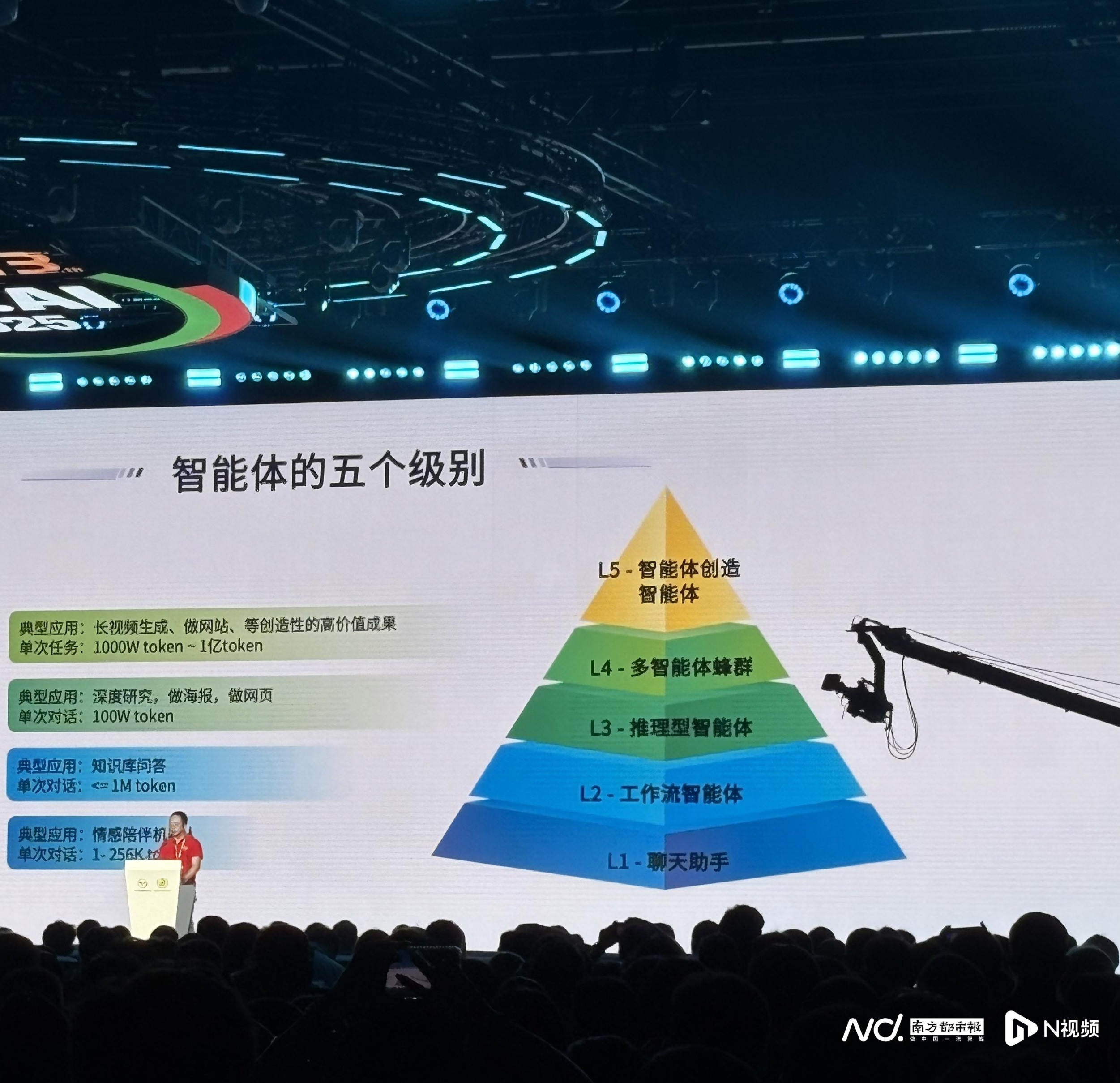
周鸿祎将智能体分L1-L5五级 称多智能体是未来发展方向
Nan Fang Du Shi Bao· 2025-08-06 14:37
Core Insights - The ISC.AI 2025 Internet Security Conference highlighted the evolution of AI agents, emphasizing a shift from single-agent to multi-agent architectures as a necessary direction for development [1][2] - Zhou Hongyi, founder of 360 Group, outlined a five-level classification system (L1 to L5) for AI agents, indicating their future development trajectory [1][2] Group 1: AI Agent Development - AI agents are categorized into five levels: - L1: Chat assistants (e.g., OpenAI's chatbot) for basic human interaction - L2: Workflow agents for repetitive tasks with fixed processes - L3: Reasoning agents like Manus, capable of autonomous task planning for open-ended tasks - L4: Multi-agent swarms for creative, high-value tasks - L5: Agents capable of creating other agents [6][7] - The transition from single-agent to multi-agent systems is driven by the limitations of single agents in handling diverse tasks and the phenomenon of "task fatigue" [2][6] Group 2: Industry Applications and Challenges - AI agents have been widely adopted across various sectors, including finance, healthcare, and education, enabling users to solve everyday problems and enhance productivity [7] - The emergence of "AI hackers" poses significant challenges to cybersecurity, as these agents can increase the frequency and sophistication of cyberattacks, leading to a new form of asymmetric warfare [8][10] Group 3: Security Concerns - The cybersecurity industry faces a shortage of operational experts, creating ongoing challenges for businesses [8] - Concerns regarding chip security have been raised, particularly about the potential for backdoors in CPU designs, which could be exploited for malicious purposes [10]

周鸿祎眼中的智能体:大模型的“手和脚”
Bei Jing Shang Bao· 2025-08-06 14:13
Core Viewpoint - The ISC.AI 2025 conference emphasizes the transition from large models to intelligent agents, highlighting their potential to revolutionize the AI industry and improve business operations [3][4][5]. Group 1: Conference Highlights - The theme of ISC.AI 2025 is "All in Agent," indicating a focus on intelligent agents as the next direction for the AI industry [4]. - Zhou Hongyi, founder of 360, stresses that intelligent agents can replace traditional business processes and are essential for countering automated attacks from hackers using multiple agents [4][6]. - The conference showcased the advancements in intelligent agents, which are seen as more effective than large models in practical applications [5][6]. Group 2: Intelligent Agents Development - Intelligent agents are categorized into four levels: L1 (chat assistants), L2 (low-code workflow agents), L3 (reasoning agents), and L4 (multi-agent swarms) [7]. - The current capabilities of intelligent agents allow them to perform tasks with greater efficiency compared to human efforts, such as threat detection and incident management [6][7]. - Zhou notes that while intelligent agents are powerful, they require deep industry knowledge to be effective, and a universal agent is currently unattainable [6][7]. Group 3: Industry Challenges and Future Directions - The emergence of "intelligent agent hackers" poses a new challenge, as they can automate attacks, increasing the risk of cyber warfare [7]. - The integration of AI technology with digital security is crucial, with a focus on collaborative model development and proactive immune systems [7].


全新360安全云重磅发布:AI智能体驱动“安全即服务”新未来
Zheng Quan Ri Bao Wang· 2025-08-06 14:12
Group 1 - The core idea of the news is the launch of the new 360 Security Cloud product, emphasizing the concept of "Security as a Service" and the integration of AI technology into security operations [1][2] - 360 Group's Vice President highlighted the transformative impact of AI on various industries, indicating a comprehensive restructuring of traditional internet products and business models [1] - The rapid development of AI is accelerating the digital transformation of enterprises while introducing more complex security threats, necessitating a shift from traditional security measures to AI-driven solutions [1] Group 2 - 360 Security Cloud integrates the company's leading intelligent capabilities, comprehensive security abilities, expert teams, and 20 years of practical security knowledge to create an AI-driven one-stop security operation service platform [2] - The new platform focuses on three core business scenarios: security, efficiency, and office operations, significantly reducing human resource investment in security operations while enhancing business efficiency [2] - The "Joint Operation and Cooperation" model introduced by 360 Security Cloud aims to empower partners to quickly establish joint operation centers with national-level security capabilities, fostering a new ecosystem for digital security growth [2]
三六零股价微涨0.46% 发布AI安全云新品布局智能体赛道
Jin Rong Jie· 2025-08-06 13:46
Group 1 - The stock price of 360 Technology reached 11.01 yuan as of August 6, 2025, with an increase of 0.05 yuan from the previous trading day, and a trading volume of 1.349 million hands, amounting to 1.479 billion yuan [1] - 360 Technology's main business includes internet security products and services, as well as smart hardware, establishing a comprehensive internet security ecosystem through products like "360 Security Guard" [1] - On August 6, 360 Technology launched the new 360 Security Cloud product, which is positioned as an AI-driven one-stop security operation service platform, introducing three categories of intelligent agents: security, control, and enterprise services, with threat detection efficiency improved threefold compared to manual methods [1] Group 2 - The "intelligent agent factory" platform launched by the company allows enterprises to customize their own intelligent agents, as discussed by founder Zhou Hongyi at the 13th Internet Security Conference [1] - The 360 Security Cloud has pioneered a "joint operation and cooperation" model, currently covering 118 cities nationwide [1] - As of August 6, 360 Technology experienced a net outflow of 43.3474 million yuan in main funds, while the cumulative net inflow over the past five days reached 5.82 billion yuan [1]
周鸿祎:安全智能体为应对 “超级黑客”提供关键解法
Zhong Guo Xin Wen Wang· 2025-08-06 13:38
Core Viewpoint - The emergence of AI technology is reshaping the cybersecurity landscape, necessitating the development of security intelligent agents to address the challenges posed by advanced cyber threats [1][3]. Group 1: AI and Cybersecurity Challenges - AI technology is deeply penetrating the cybersecurity field, leading to a reconfiguration of the attack and defense dynamics [3]. - Companies face two major pain points: a severe shortage of security operation experts and the inability of traditional models to handle complex operational tasks [3]. - The rise of "intelligent hacker agents" trained through AI allows a single hacker to manage multiple automated attack tools, evolving into "super hackers" [3]. Group 2: Security Intelligent Agents - Security intelligent agents serve as digital substitutes for security operation experts, utilizing a large security model as their "brain" and possessing operational capabilities [3]. - Deploying security intelligent agents can quickly address talent shortages in government and enterprise units, enabling them to operate with multiple virtual security experts [3]. - These agents can adapt to new forms of machine-to-machine and model-to-model confrontations, allowing organizations to regain the initiative in defense [3].

事关AI!周鸿祎最新发声
Zhong Guo Ji Jin Bao· 2025-08-06 13:32
Core Viewpoint - The chairman of 360, Zhou Hongyi, stated that AI large models must evolve into intelligent agents to become effective productivity tools rather than mere toys [2]. Group 1: Evolution of AI Models - Zhou highlighted two main pain points in enterprise applications of large models: insufficient reasoning ability and lack of independent working capability. The former has improved significantly in the past year, while the latter remains unresolved [2]. - Zhou emphasized that large models lack the ability to use tools and cannot perform tasks directly, which limits their effectiveness [2]. - The evolution of intelligent agents is outlined in stages, starting from L1 chat assistants, which are essentially chat tools, to L4 multi-agent swarms that can execute complex tasks collaboratively [3][3]. Group 2: Intelligent Agent Development - L2 low-code workflow agents have progressed from being "toys" to "tools," requiring human setup for processes while AI executes tasks [3]. - L3 reasoning agents can autonomously plan and complete tasks, functioning like specialized employees, but still face limitations in cross-domain complex problem-solving due to a lack of collaborative planning capabilities [3]. - L4 multi-agent swarms represent a breakthrough in nano AI, allowing multiple expert agents to collaborate flexibly, achieving high task success rates of 95.4% with a token consumption range of 5 million to 30 million [3]. Group 3: Company Initiatives - To enable more enterprises to benefit from intelligent agents, 360 recently launched the "Intelligent Agent Factory," allowing companies to customize their own L3 agents without programming knowledge [5]. - The platform also facilitates the formation of L4 multi-agent swarm teams, enhancing collaborative capabilities for businesses [5]. - As of August 6, 360's stock price was reported at 10.95 yuan per share, with a market capitalization of 766 billion yuan [5].

事关AI!周鸿祎最新发声
中国基金报· 2025-08-06 13:28
Core Viewpoint - The chairman of 360, Zhou Hongyi, stated that AI large models must evolve into intelligent agents to become effective productivity tools rather than mere toys [2][4]. Group 1: Pain Points and Evolution of AI Models - Zhou identified two main pain points in the application of large models: insufficient reasoning ability and lack of independent working capability. The former has improved significantly in the past year, while the latter remains unresolved [3]. - Zhou emphasized that large models lack the ability to use tools and perform tasks directly, which limits their effectiveness. He proposed that intelligent agents can address these issues by understanding goals, planning tasks, and utilizing tools to deliver complete results [4]. Group 2: Levels of Intelligent Agents - Intelligent agents are expected to evolve through several levels: - L1: Chat assistants, which are essentially chat tools providing suggestions or emotional support, are considered "toy-level" intelligent agents [4]. - L2: Low-code workflow intelligent agents have progressed from "toys" to "tools," requiring human setup for processes while AI executes tasks to enhance productivity [5]. - L3: Reasoning intelligent agents can autonomously plan and complete tasks, akin to specialized employees, but face limitations in cross-domain complex problem-solving due to a lack of collaborative planning capabilities [5]. - L4: Multi-agent swarms represent a breakthrough in nano AI, where multiple expert agents can flexibly collaborate and execute complex tasks with a high success rate of 95.4% over 1,000 steps, consuming between 5 million to 30 million tokens [5]. Group 3: Company Initiatives - To enable more enterprises to benefit from intelligent agents, 360 recently launched the "Intelligent Agent Factory," allowing companies to customize their own L3 intelligent agents using natural language without programming knowledge. This initiative aims to help every enterprise create its own intelligent agent and combine them into L4 multi-agent swarm teams [6]. Group 4: Market Performance - As of the close on August 6, 360's stock price was reported at 10.95 yuan per share, with a market capitalization of 766 billion yuan [7].

周鸿祎:现阶段智能体竞争的唯一护城河是执行力
Tai Mei Ti A P P· 2025-08-06 11:42
Core Insights - The rapid evolution of AI agents leads to a very short product lead time, with companies needing to focus on execution and adaptability to stay competitive [2] - The concept of "Swarm L4" categorizes AI agents into five levels, with increasing complexity and application value as the level rises [3] - Single AI agents face significant limitations in task execution, while multi-agent swarm collaboration shows a high success rate and efficiency in completing complex tasks [5] Group 1: AI Agent Development - The competitive edge in the AI agent industry lies in the ability to quickly iterate and update products, rather than just launching them [2] - The "Swarm L4" framework indicates that higher-level agents can handle more complex projects, enhancing their task processing capabilities [3] Group 2: Multi-Agent Collaboration - Multi-agent systems can execute up to 1000 steps with a success rate of 95.4%, showcasing their effectiveness in complex task execution [5] - Challenges in multi-agent collaboration include task allocation and communication costs, but the benefits outweigh these difficulties [5] Group 3: Human-Machine Collaboration - The "human-in-the-loop" principle emphasizes the importance of user oversight in AI operations, allowing for decision-making and risk reduction [6] - The unpredictability of AI outputs necessitates a collaborative approach where humans guide AI execution, enhancing overall efficiency [6] Group 4: Specialized vs. General AI Agents - Specialized AI agents focusing on single domains are more effective than general-purpose agents, which struggle to excel in multiple areas [7][8] - General AI agents are suitable for repetitive tasks, while specialized agents provide more precise and efficient services for creative tasks [8] Group 5: Cybersecurity Challenges - The rise of AI agents introduces new cybersecurity threats, with the emergence of "super hackers" capable of automating attacks using AI [9] - Companies are encouraged to deploy security AI agents to counteract these threats, acting as digital counterparts to human security experts [9][10] Group 6: 360's AI Initiatives - 360 is advancing its entire product line towards AI integration, with the "AI Factory" enabling customized security AI agents for various scenarios [10] - Data shows that security AI agents significantly outperform traditional human services in threat detection and operational efficiency [10]

硅基智能CEO称准备全员裁员 公司回应
Sou Hu Cai Jing· 2025-08-06 11:41
Group 1 - The core message of the news revolves around the conflicting reports regarding the operational status of Silicon Intelligence, with rumors of layoffs contrasted by the company's claims of stability and expansion [1][3][4] - A leaked message from the founder indicated a plan for full staff layoffs, citing financial constraints and a need to streamline operations [1] - In response, Silicon Intelligence issued a statement asserting that they have a stable research and sales team and are actively expanding their recruitment efforts globally, with plans to add hundreds of positions by 2025 [3][4] Group 2 - The company reported that it exceeded its sales targets in the first half of 2025 and is seeing improved profitability, with over 300 million yuan in AIGC orders secured in the first month of the second half [4] - Silicon Intelligence has recently completed a new round of financing worth several hundred million yuan and has secured credit lines from major banks, ensuring financial stability for at least 120 months of payroll [4] - Founded in 2017, Silicon Intelligence specializes in enterprise-level AIGC digital human solutions and has over 100 patents, including more than 20 overseas patents, with a current valuation of nearly 1 billion USD [4]