
南方电网

Search documents
经济新方位丨这个“10万亿”,意味着什么
Ren Min Ri Bao· 2026-01-19 02:46
Core Insights - China's total electricity consumption is projected to exceed 10 trillion kilowatt-hours by 2025, marking a significant milestone as the first country to reach this level globally [1] - The growth in electricity consumption reflects China's status as a manufacturing powerhouse and indicates an enhancement in energy security capabilities [1] Group 1: Electricity Consumption Trends - By 2025, the secondary industry is expected to consume 66,366 billion kilowatt-hours, accounting for approximately 64% of total electricity consumption, maintaining its role as the primary sector [2] - The demand for electricity in the semiconductor industry is surging, with companies like Huahong Semiconductor reporting over a 43% year-on-year increase in electricity consumption due to heightened production [2] - The electricity consumption in the computer, communication, and other electronic equipment manufacturing sectors is projected to surpass 50 billion kilowatt-hours for the first time, outpacing traditional industries like steel and chemicals [2] Group 2: Industrial and Service Sector Developments - High-end manufacturing, including new energy vehicles and wind power equipment, is expected to see growth rates exceeding 20% and 30%, respectively, while traditional high-energy-consuming industries will experience slower growth at 1.8% [3] - The tertiary sector's electricity consumption is anticipated to reach nearly 2 trillion kilowatt-hours by 2025, with a year-on-year growth of 8.2%, driven by sectors like charging services and information technology [3] Group 3: Electrification and Rural Development - The electrification rate of end-use energy is around 30%, surpassing that of major developed economies, contributing to increased electricity consumption [4] - Investments in rural electrification projects are expected to narrow the gap in electricity consumption between urban and rural residents [5] Group 4: Power Supply and Infrastructure - China's power generation capacity accounts for one-third of the global total, with over 95% of coal-fired power plants achieving ultra-low emissions [6] - The construction of 46 ultra-high voltage projects will enhance the transmission of clean energy from western and northern regions to load centers in the east and central areas [7] - The national unified electricity market has seen a significant increase in traded electricity volume, growing from 10.7 trillion kilowatt-hours to 23.8 trillion kilowatt-hours, representing over 60% of total electricity consumption [8]
这个“10万亿” 意味着什么
Ren Min Ri Bao· 2026-01-19 01:37
Core Insights - In 2025, China's total electricity consumption is projected to exceed 10 trillion kilowatt-hours for the first time globally, reflecting significant economic growth and energy security improvements [2][10] Group 1: Electricity Consumption Growth - China's electricity consumption in 2025 is expected to reach 10,368.2 billion kilowatt-hours, more than double that of the United States and surpassing the total consumption of the EU, Russia, India, and Japan combined [2] - The electricity consumption in 2025 will be nearly double that of 2015, showcasing an unprecedented growth rate among major economies [2][3] Group 2: Industrial and Sectoral Changes - The secondary industry is projected to consume 66,366 billion kilowatt-hours, accounting for approximately 64% of total consumption, with significant contributions from high-value-added and technology-intensive sectors [3] - The electricity consumption in the computer, communication, and other electronic device manufacturing sectors is expected to exceed 50 billion kilowatt-hours, surpassing traditional industries like steel and chemicals [3][4] - The third industry is anticipated to consume nearly 2 trillion kilowatt-hours, with a year-on-year growth of 8.2%, driven by sectors such as electric vehicle charging and information technology services [4] Group 3: Electrification and Energy Efficiency - The electrification rate of end-use energy is around 30%, which is higher than that of major developed economies, contributing to increased electricity consumption [5] - Smart irrigation systems in agriculture have improved efficiency by approximately 65%, indicating advancements in energy use in traditional sectors [6] Group 4: Power Supply and Infrastructure - China has the world's largest power supply system, with renewable energy sources accounting for over one-third of total electricity generation, and wind and solar capacity surpassing thermal power for the first time [7][8] - The construction of ultra-high voltage transmission lines has strengthened the energy supply network, facilitating the transfer of clean energy from western regions to eastern load centers [8][9] - The national electricity market has seen a significant increase in transaction volume, doubling from 10.7 trillion kilowatt-hours to 23.8 trillion kilowatt-hours, now accounting for over 60% of total electricity consumption [9]
国泰海通晨报-20260119
GUOTAI HAITONG SECURITIES· 2026-01-19 01:37
Group 1: Strategy Research - The trading heat of hot themes has reached a historical high, with strong performance in semiconductor advanced packaging and equipment themes, while the commercial aerospace theme has cooled down. The average daily transaction amount for hot themes reached 1.436 billion yuan, with an average turnover rate of 5.9% [2][3] - The report emphasizes the importance of focusing on low-level technology sectors with strong demand support and concentrated industrial catalysts, particularly in domestic computing power, new power grids, robotics, and domestic consumption [3][4] Group 2: Computing Industry Research - The transition from traditional SEO to Generative Engine Optimization (GEO) is highlighted, where AI search shifts from "list clicks" to "direct answers," reducing the marginal utility of traditional SEO. GEO is becoming a new marketing paradigm, with a market space expected to reach "tens of billions of dollars" [8][9] - The market space for GEO is projected to grow significantly, with estimates of approximately 2.9 billion yuan in 2025 and around 24 billion yuan by 2030, reflecting a CAGR of about 52.4% from 2025 to 2030 [9][10] Group 3: Cosmetics Industry Research - The widespread adoption of AI recommendations is expected to catalyze the explosion of GEO, fundamentally changing the flow distribution in marketing. E-commerce operators are likely to benefit first, and brands that actively transform are expected to stand out in the long term [11][12] - The report recommends several companies that are well-positioned to leverage the changes brought by GEO, including 若羽臣, 壹网壹创, and 水羊股份 [11][12]
南方电网:资产规模增至1.4万亿 “第二曲线”加速上扬!
Zhong Guo Dian Li Bao· 2026-01-19 01:33
Core Viewpoint - In 2025, Southern Power Grid achieved significant progress across various sectors, marking a remarkable year in its development history, with the successful completion of its second-phase strategic goals for building a world-class enterprise [1] Group 1: Achievements and Developments - In 2025, the West-to-East power transmission reached a record high of 2,616 billion kilowatt-hours, surpassing the previous year's 2,206 billion [2] - The company completed fixed asset investments exceeding 730 billion yuan, a 23% increase compared to the previous five-year plan [6] - The installed capacity of renewable energy in the operational area grew from 58 million kilowatts to 260 million kilowatts, maintaining its position as the largest power source [6] Group 2: Response to Challenges - The company effectively responded to extreme weather and market challenges, achieving a record load of 257 million kilowatts and successfully completing disaster relief operations in areas affected by severe storms [4] - The reliability of power supply in the operational area reached 99.99%, with customer average outage time reduced by over 60% [5] Group 3: Technological Innovations - Southern Power Grid introduced several groundbreaking technologies, including the world's first high-voltage flexible direct current converter and the first plant oil transformer, showcasing its commitment to innovation [11] - The company launched the "Electric Hong" IoT operating system, enabling seamless device connectivity and data interoperability [13] Group 4: Strategic Initiatives - The company initiated a continuous settlement trial for the Southern regional electricity market, becoming the first in the country to implement a unified clearing system across multiple provinces [18] - Southern Power Grid's market value exceeded 150 billion yuan, with its asset scale reaching 1.4 trillion yuan, reflecting its strong growth trajectory [20] Group 5: Future Outlook - As it moves towards the "15th Five-Year Plan," Southern Power Grid aims to continue its momentum, creating new achievements and making significant strides towards the goal of Chinese-style modernization [22]
这个“10万亿”,意味着什么(经济新方位)
Ren Min Ri Bao· 2026-01-18 23:47
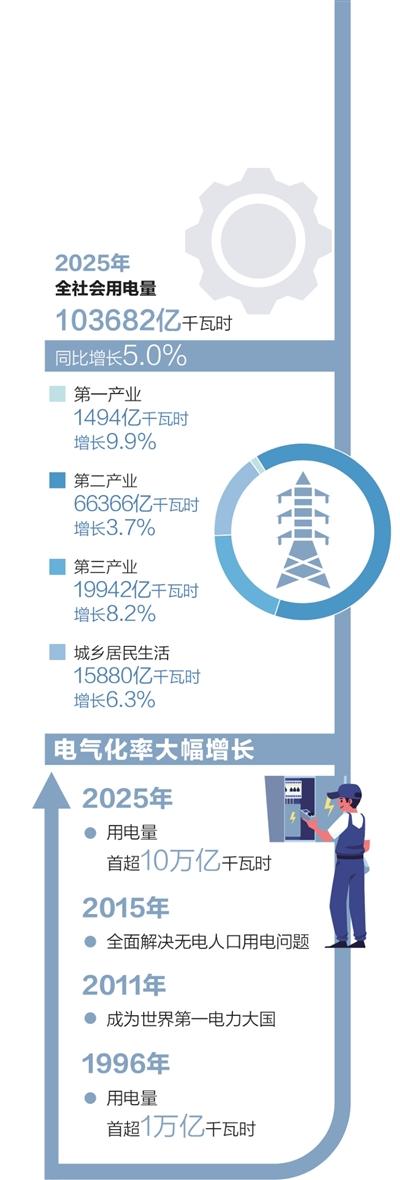
Core Insights - In 2025, China's total electricity consumption is projected to exceed 10 trillion kilowatt-hours for the first time, marking a significant milestone in global energy consumption [3][4] - This consumption level is more than double that of the United States and surpasses the total consumption of the European Union, Russia, India, and Japan combined [3] - The growth in electricity consumption reflects China's robust manufacturing capabilities and enhanced energy security [3] Electricity Consumption by Sector - The primary industry is expected to consume 149.4 billion kilowatt-hours, showing a growth of 9.9% [1] - The secondary industry will account for 66,366 billion kilowatt-hours, with a growth rate of 3.7%, maintaining its status as the main consumer [1][4] - The tertiary industry is projected to consume 19,942 billion kilowatt-hours, growing by 8.2% [1][5] - Urban and rural residential electricity consumption is expected to reach 15,880 billion kilowatt-hours, with a growth of 6.3% [1][6] Industrial and Technological Developments - The electricity consumption in the industrial sector is increasingly driven by high-value-added and technology-intensive industries [5] - In Jiangsu, the semiconductor industry is experiencing significant growth, with companies like Huahong Semiconductor reporting over 43% year-on-year increase in electricity consumption [4] - The computer and communication equipment manufacturing sector has surpassed traditional industries like steel and chemicals in electricity consumption, indicating a shift in industrial structure [4] Electrification and Energy Efficiency - The electrification rate of end-use energy is approximately 30%, which is higher than that of major developed economies [6] - Innovations in agriculture, such as smart irrigation systems, are contributing to increased electricity consumption in rural areas [6][7] - The "14th Five-Year Plan" includes significant investments in rural power grid improvements, enhancing electricity access and reducing consumption disparities between urban and rural areas [6] Power Supply and Infrastructure - China's power supply system is the largest globally, with renewable energy sources like wind and solar surpassing traditional coal power [8][9] - The country has built 46 ultra-high voltage transmission lines to efficiently transport clean energy from resource-rich regions to consumption centers [9] - The national grid's investment has reached historical highs, ensuring robust electricity supply and infrastructure development [9][10] Market Dynamics and Energy Transition - The establishment of a unified national electricity market has significantly increased market transaction volumes, doubling from the previous five-year period [11] - The energy sector is actively transitioning towards a new energy system, focusing on green and low-carbon development [11] - The growth in electricity consumption is indicative of China's economic transformation and improvement in living standards [11]

全球首次,2025年我国全社会用电量超10万亿千瓦时——这个“10万亿”,意味着什么
Xin Hua Wang· 2026-01-18 23:41
Core Insights - In 2025, China's total electricity consumption is projected to exceed 10 trillion kilowatt-hours for the first time, marking a significant milestone in global energy consumption [1] - This consumption level is more than double that of the United States and surpasses the combined total of the EU, Russia, India, and Japan [1] - The growth in electricity consumption reflects China's robust manufacturing capabilities and enhanced energy security [1] Group 1: Industrial Electricity Consumption - In 2025, the secondary industry is expected to consume 66,366 billion kilowatt-hours, accounting for approximately 64% of total electricity consumption [2] - The semiconductor industry, driven by AI applications, is experiencing a surge in demand, with companies like Huahong Semiconductor reporting over 43% year-on-year growth in electricity consumption [2] - The electricity consumption structure in Jiangsu is shifting, with the computer and communication equipment manufacturing sector surpassing traditional industries like steel and chemicals for the first time [2] Group 2: High-End and Green Development - The high-end manufacturing sector, including new energy vehicles and wind power equipment, is projected to grow electricity consumption by over 20% and 30% respectively [3] - The service sector is also becoming a significant driver of electricity consumption, with the data industry in Guizhou showing rapid growth [3] - By 2025, the tertiary sector's electricity consumption is expected to reach nearly 2 trillion kilowatt-hours, growing by 8.2% year-on-year [3] Group 3: Electrification Trends - The electrification rate of end-use energy is around 30%, surpassing that of major developed economies [4] - In Yunnan, smart irrigation systems have improved efficiency by approximately 65%, reflecting advancements in agricultural electricity consumption [5] - The gap in electricity consumption between urban and rural residents is gradually narrowing due to investments in rural power grid improvements [5] Group 4: Power Supply and Infrastructure - China's power generation capacity accounts for one-third of the global total, with over 50% of coal-fired power plants capable of deep peak regulation [6] - The country has built the world's largest power supply system and clean energy generation framework, with renewable energy sources surpassing thermal power for the first time [6] - The construction of ultra-high voltage transmission lines has strengthened the energy supply network, facilitating the transfer of clean energy from the west to the east [7] Group 5: Market Dynamics - The establishment of a unified national electricity market has significantly increased electricity trading volume, doubling from 10.7 trillion kilowatt-hours to 23.8 trillion kilowatt-hours [8] - The market's role as a regulator and price guide has become more pronounced, enhancing the efficiency of electricity resource allocation [8] - The ongoing transition towards a new energy system is expected to support high-quality development in renewable energy and contribute to China's modernization efforts [8]
2025年我国全社会用电量超10万亿千瓦时 意味着什么
Ren Min Ri Bao· 2026-01-18 23:32
Core Insights - China's total electricity consumption is projected to exceed 10 trillion kilowatt-hours by 2025, marking a significant milestone as the first country to reach this level globally [1] - This consumption level is more than double that of the United States and surpasses the combined total of the European Union, Russia, India, and Japan [1] - The growth in electricity consumption reflects China's robust manufacturing capabilities and enhanced energy security [1] Electricity Consumption Trends - By 2025, the secondary industry is expected to consume 66,366 billion kilowatt-hours, accounting for approximately 64% of total electricity consumption [2] - The semiconductor industry, driven by AI applications, is experiencing a surge in demand, with companies like Huahong Semiconductor reporting over 43% year-on-year growth in electricity consumption [2] - The electricity consumption structure is shifting, with the computer and communication equipment manufacturing sector surpassing traditional industries like steel and chemicals for the first time [2] Industrial and Service Sector Developments - High-end manufacturing and technology-intensive industries are becoming the primary contributors to electricity consumption growth, with new energy vehicles and wind power equipment manufacturing seeing growth rates exceeding 20% and 30%, respectively [3] - The service sector is also a significant driver of electricity consumption, with the third industry expected to consume nearly 2 trillion kilowatt-hours by 2025, reflecting an 8.2% year-on-year increase [3] Electrification and Rural Development - The electrification rate of end-use energy is around 30%, surpassing that of major developed economies, contributing to increased electricity consumption [4] - Rural electrification initiatives have led to significant investments, with over 800 billion yuan allocated to improve rural power grids, narrowing the electricity consumption gap between urban and rural residents [5] Power Supply and Infrastructure - China's power supply system is the largest globally, with renewable energy sources accounting for over one-third of total electricity generation [6] - The construction of high-voltage transmission lines has strengthened the electricity grid, facilitating the transfer of clean energy from western regions to eastern load centers [7] - The national electricity market has seen a significant increase in trading volume, doubling from 10.7 trillion kilowatt-hours to 23.8 trillion kilowatt-hours since the 13th Five-Year Plan [8] Conclusion - The anticipated electricity consumption of 10 trillion kilowatt-hours signifies an upgrade in power supply capabilities, reflecting China's economic transition towards higher quality and improved living standards [9]
全球首次,2025年我国全社会用电量超10万亿千瓦时—— 这个“10万亿”,意味着什么(经济新方位)
Ren Min Ri Bao· 2026-01-18 22:05
Group 1 - In 2025, China's total electricity consumption is projected to exceed 10 trillion kilowatt-hours for the first time, which is more than double the annual electricity consumption of the United States and higher than the combined total of the EU, Russia, India, and Japan [1] - The electricity consumption growth reflects China's status as a manufacturing powerhouse and indicates a significant improvement in energy security [1] - The electricity consumption in the secondary industry is expected to reach 66,366 billion kilowatt-hours, accounting for approximately 64% of total consumption, with a notable shift towards high-value-added and technology-intensive industries [2] Group 2 - The demand for electricity in the semiconductor industry is surging, with companies like Huahong Semiconductor reporting over 43% year-on-year growth in electricity consumption due to increased production [2] - The electricity consumption in the computer, communication, and other electronic equipment manufacturing sectors is projected to surpass 50 billion kilowatt-hours for the first time, overtaking traditional industries like steel and chemicals [2] - The third industry is also contributing significantly to electricity consumption, with a projected growth of 8.2% year-on-year, reaching nearly 2 trillion kilowatt-hours by 2025 [3] Group 3 - The electrification rate of end-use energy in China is around 30%, which is higher than that of major developed economies, contributing to increased electricity consumption [4] - The implementation of smart irrigation systems in agriculture has improved efficiency by approximately 65%, showcasing the impact of electrification on traditional sectors [5] - The gap in electricity consumption between urban and rural residents is gradually narrowing, supported by significant investments in rural power grid upgrades [5] Group 4 - China's power supply system is the largest globally, with renewable energy sources like wind and solar surpassing thermal power for the first time [6] - The country has built the world's largest clean coal power supply system, with over 95% of coal power units meeting ultra-low emissions standards [6] - The construction of high-voltage transmission lines has strengthened the electricity grid, facilitating the transfer of clean energy from resource-rich regions to consumption centers [7] Group 5 - The establishment of a unified national electricity market has significantly increased electricity trading volume, doubling from 10.7 trillion kilowatt-hours to 23.8 trillion kilowatt-hours since the 13th Five-Year Plan [8] - The electricity market's role as a regulator and price guide has been enhanced, contributing to the efficient allocation of resources [8] - The energy sector is actively promoting a new energy system and advancing green and low-carbon transitions, supporting high-quality development of renewable energy [8]
中国发布2025电力数据,超美国2倍,轮到特朗普担忧,找13州商议
Sou Hu Cai Jing· 2026-01-18 14:25
Core Insights - China's electricity consumption has surpassed that of the US, EU, Russia, India, and Japan combined, marking a significant shift in global power dynamics [1][3] - In 2025, China's total electricity consumption reached 10.4 trillion kilowatt-hours, a 5% increase year-on-year, making it the first country to exceed the 10 trillion kilowatt-hours mark [3][4] - The growth in electricity demand is primarily driven by digital industries, with electricity consumption in sectors like internet data services and AI computing increasing by over 30% [6][21] Group 1: Electricity Consumption and Growth - China's electricity consumption reached 10.4 trillion kilowatt-hours, which is 2.5 times that of the US and 35% more than the combined total of the US and EU [3][4] - The electricity demand from new energy vehicle manufacturing and lithium battery production has increased by over 20% [6] - The contribution of the service sector and residential electricity consumption to overall growth is 50%, indicating a shift towards consumption and services [6][18] Group 2: Energy Structure and Technology - Non-fossil energy sources now account for over 60% of China's total installed power generation capacity, with significant advancements in ultra-high voltage transmission technology [8][15] - China's ultra-high voltage technology allows for efficient long-distance electricity transmission, addressing energy distribution challenges [15][21] - The global narrative around China's energy development has shifted, recognizing its ability to transition to cleaner energy while supporting economic growth [15][21] Group 3: Comparison with the US Energy Sector - The US faces rising electricity prices and supply challenges, with wholesale electricity prices in some regions increasing by 267% over five years [10][12] - The US electricity sector is fragmented, leading to difficulties in coordinating responses to systemic challenges [13][20] - The US government is attempting to implement long-term power purchase agreements to ensure sufficient investment in new generation capacity [13][20] Group 4: Implications for Manufacturing and AI - Stable and affordable electricity supply is crucial for AI companies, with electricity costs potentially accounting for over half of AI operational expenses [16][20] - China's stable electricity supply provides a significant cost advantage for emerging manufacturing sectors, attracting global production [20][21] - The contrasting approaches to energy infrastructure between China and the US highlight different philosophies in addressing energy challenges [21][22]

主题风向标1月第2期:主题轮动加快,聚焦国产半导体与电力
GUOTAI HAITONG SECURITIES· 2026-01-18 12:13
Group 1 - The report highlights that the trading heat of hot themes has reached historical highs, with advanced packaging and equipment themes in the semiconductor sector gaining strength, while the commercial aerospace theme has cooled down. The average daily trading volume of hot themes reached 1.436 billion yuan, with an average turnover rate of 5.9%, marking a historical peak [7][9][12] - The report emphasizes the acceleration of theme rotation, focusing on sectors with strong demand support and concentrated industrial catalysts, particularly in low-tech areas such as domestic computing power, new power grids, robotics, and domestic consumption [4][6][20] Group 2 - In the domestic computing power theme, TSMC's capital expenditure is expected to exceed expectations, boosting demand in the semiconductor advanced manufacturing sector. TSMC's net profit for Q4 2025 is projected to grow by 35% year-on-year, with capital expenditure potentially reaching a historical high of 56 billion USD in 2026, a 37% increase from 2025 [20][25][29] - The new power grid theme sees the State Grid announcing a fixed asset investment of 4 trillion yuan during the 14th Five-Year Plan, a 40% increase from the previous plan, aimed at constructing a new power system. The proportion of non-fossil energy consumption in China is expected to reach 20% by 2025 and 25% by 2030 [21][35][40] - The robotics theme is highlighted by the participation of Chinese robotics companies at CES 2026, showcasing advancements in various application scenarios. The industry is entering a phase of large-scale development, with significant growth in repetitive and dangerous industrial tasks as well as personalized consumer scenarios [22][39][41] - The domestic consumption theme is driven by government initiatives to cultivate new growth points in service consumption, with a focus on enhancing the domestic market. The report notes the emergence of new consumption scenarios in sports events, ice and snow tourism, and cultural performances, with significant economic impacts [23][43][44]

