OPPO

Search documents
今晚发布,OPPO Find X9系列手机提供eSIM版本,预约超170万人
Qi Lu Wan Bao· 2025-10-16 08:56
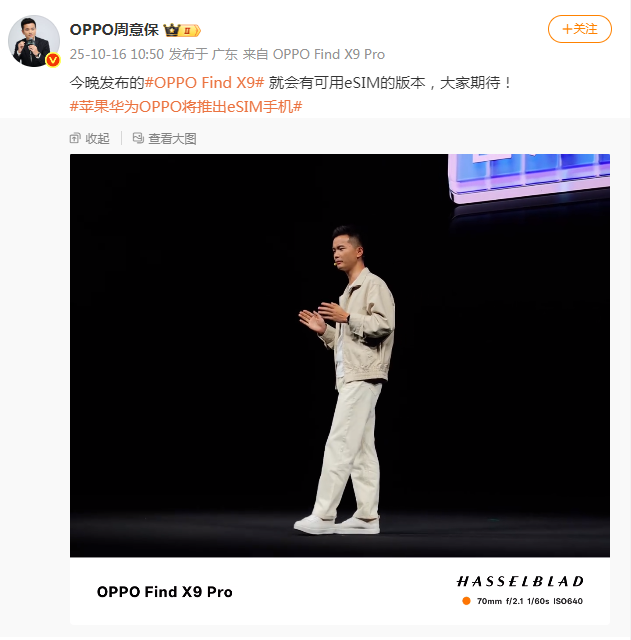
Core Insights - OPPO is set to launch the Find X9 series, which will include a version with eSIM capabilities, as announced by the product head on social media [1] - The launch event is scheduled for 7 PM on October 16, with over 1.7 million reservations already made on the OPPO official website by 2 PM on the same day [4] Group 1: eSIM and Market Context - China Unicom, China Mobile, and China Telecom have recently approved eSIM mobile services, with the first domestic eSIM phone, iPhone Air, also receiving approval for market entry [5] Group 2: Software and Features - The Find X9 series will debut with ColorOS 16, which emphasizes "smoothness and excellent AI," incorporating various AI functionalities such as AI one-click flash memory and AI real-time dialogue [5] - The interface design features a new light field design, supporting AI inspiration themes and AI live wallpapers, enhancing user interaction [5] - ColorOS 16 integrates OPPO's three core self-developed technologies: Aurora Engine, Tidal Engine, and Star Compiler, aimed at improving energy efficiency and system smoothness [5] - Enhanced cross-ecosystem connectivity allows the Find X9 series to interact with Apple Watch for fluid cloud notifications and enables file searches and note migrations between devices [5]

OPPO将发布首款国产eSIM手机
Bei Jing Shang Bao· 2025-10-16 08:53
Core Viewpoint - OPPO Find X9 will be the first eSIM-enabled smartphone from a domestic brand in China, marking a significant advancement in the local smartphone market [1] Group 1 - OPPO Find X9 is set to be released on October 16, featuring a version that supports eSIM technology [1] - Major Chinese telecom operators, including China Unicom, China Mobile, and China Telecom, have recently announced that they have received approval to conduct commercial trials for eSIM mobile services [1]
京东方联合OPPO、一加举办柔性OLED新品发布会
Zhong Zheng Wang· 2025-10-16 08:49
Group 1 - BOE (京东方) and OPPO, along with OnePlus, launched the flexible OLED flagship product, "Oriental Screen 3.0," featuring the world's first native 165Hz ultra-high refresh rate and ultra-low brightness of 1 nit [1] - The Oriental Screen 3.0 is a significant upgrade from previous versions (1.0 and 2.0), enhancing smooth display, eye health, and immersive picture quality, and will be featured in the OnePlus 15 flagship smartphone [1] Group 2 - BOE is a leading global display enterprise, maintaining a comprehensive lead in flexible OLED display technology, production capacity, and market performance [2] - Since launching its first technology brand in 2021, BOE's f-OLED technology brand has become an industry benchmark, with over 30,000 patent applications in the flexible OLED field [2] - BOE has three mass production 6th generation flexible OLED production lines and is expanding its technological boundaries, with the first 8.6 generation AMOLED production line in China set to complete equipment installation by May 2025 [2] - According to Omdia data, BOE's flexible OLED shipment volume ranks first in China and second globally, solidifying its leadership position in the high-end display sector [2]

东莞第一“千亿镇”!你的OPPO、vivo手机从这里诞生
2 1 Shi Ji Jing Ji Bao Dao· 2025-10-16 07:15
Core Insights - Dongguan's Chang'an Town has achieved a GDP of 105.07 billion yuan in 2024, becoming the first town in the city and the third in the province to surpass the "trillion yuan" mark [1] Economic Development - Chang'an Town is recognized as the birthplace of major global smartphone manufacturers OPPO and vivo [1] - The town is actively promoting economic growth while also focusing on improving ecological environment and cultural education [1] Industry Impact - The town has been highlighted as a rising hub for the global smart terminal industry, showcasing the effectiveness of the "Hundred Million Thousand Project" implemented over the past three years [1]
CounterPoint报告:2025年第三季度全球智能手机出货量同比增4%
Huan Qiu Wang Zi Xun· 2025-10-16 03:44
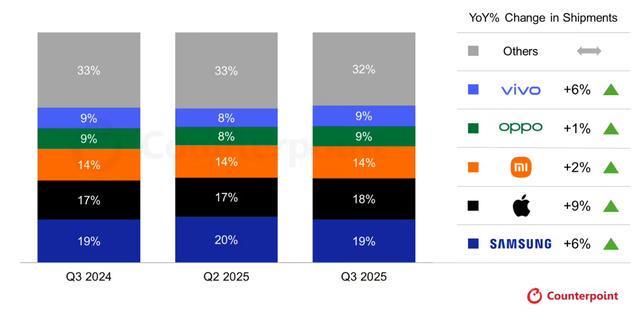
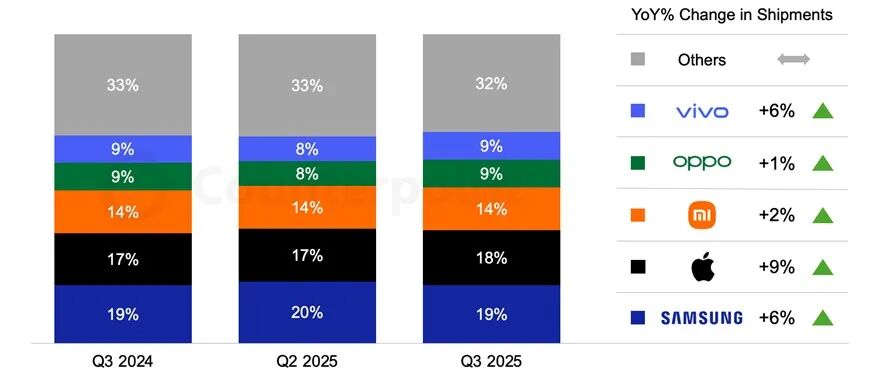
Core Insights - The global smartphone market is projected to see a 4% year-on-year increase in shipment volume by Q3 2025, driven primarily by strong performances in the Asia-Pacific (APAC) and Middle East and Africa (MEA) regions [1][3] Regional Performance - The MEA region experienced a 14% year-on-year increase in shipment volume, attributed to strong market performance from Samsung and Xiaomi, supported by a wide range of mid-range products and increased consumer demand during the back-to-school season and pre-holiday inventory buildup [1] - The Indian market also showed a notable 9% year-on-year growth in shipment volume, driven by early demand for the festive season, government relief measures boosting consumer confidence, and accelerated adoption of high-end and mid-range devices due to significant discounts and promotional support [1] Brand Competition Landscape - Samsung maintained its leadership in the global market with a 19% shipment volume share in Q3, reflecting a 6% year-on-year growth, supported by the Galaxy A series product line [3] - Apple emerged as the fastest-growing brand among the top five, with a 9% year-on-year growth rate, achieving strong growth in Japan, China, Western Europe, and parts of the APAC region, bolstered by the successful launch of the iPhone 17 series [3] - Xiaomi held the third position globally with a 14% shipment volume share and a 2% year-on-year growth rate, enhancing its market presence through partnerships with carriers and diverse promotional activities, particularly in Southeast Asia, MEA, and Latin America [3] - OPPO and vivo ranked fourth and fifth in the global smartphone market, with OPPO achieving moderate growth in the Southeast Asia and MEA markets through affordable 5G models, while vivo maintained strong momentum in India and Southeast Asia, expanding its influence in the MEA region [3]
苹果华为OPPO将推出eSIM手机,怎么办理?如何收费?
Qi Lu Wan Bao· 2025-10-16 02:44
Core Insights - eSIM technology is gaining traction as it allows users to activate mobile services without a physical SIM card, making devices lighter and providing more internal space [4] Group 1: eSIM Overview - eSIM replaces physical SIM cards with electronic data files, enabling mobile network services without the need for a physical card slot [4] - The approval of eSIM for mobile phones marks a new commercial phase in the industry, following its previous applications in IoT and smart wearables [4] Group 2: Activation Process - Users can activate eSIM services by visiting the physical stores of major telecom operators like China Telecom and China Mobile with their ID and eSIM-compatible devices [5] - China Mobile will start processing eSIM activations from the release date of the iPhone Air, while China Unicom requires online reservations for eSIM activation [5] Group 3: Supported Devices - Current eSIM-compatible devices include models from Apple, Huawei, and OPPO, which will be available for sale soon [6] Group 4: Usage of Original SIM Cards - Once eSIM is activated on devices like the iPhone Air, the original physical SIM card will no longer be usable unless a new number is written into the eSIM [7] Group 5: Pricing Structure - As of now, there are no clear fee structures for eSIM services, but initial activations are reported to be free at the stores [8] - China Unicom offers two types of eSIM services: a dual-terminal service for smart devices at a monthly fee of 10 yuan, and an independent eSIM number service with varying costs based on device type [9]




Counterpoint:2025年Q3全球智能手机出货量同比增长4%
智通财经网· 2025-10-16 02:40
Core Insights - Global smartphone shipments are projected to grow by 4% year-on-year in Q3 2025, driven by strong performances in emerging markets like India, MEA, Japan, and parts of Asia-Pacific, despite declines in mature markets such as North America and Europe [1] Market Performance - Developed markets continue to show strong demand for high-end models, while emerging markets are increasingly favoring affordable 5G devices [1] - The Chinese market is experiencing a slowdown due to inventory reduction strategies, and consumer confidence in Latin America remains weak, leading to moderate overall growth [1] - Japan's smartphone market saw a 15% year-on-year growth, supported by the strong sales of iPhone 16 and iPhone 16e, as well as Samsung's Galaxy S25 series [1] Regional Highlights - The MEA region experienced a 14% year-on-year increase in shipments, primarily driven by strong performances from Samsung and Xiaomi, with Apple leading the high-end segment [1] - In India, smartphone shipments grew by 9% year-on-year, benefiting from early festive season demand, government relief measures improving consumer sentiment, and widespread adoption of high-end and mid-range models due to aggressive discounts and promotions [1] Brand Performance - Samsung led the global market in Q3 2025 with a 19% shipment share and a 6% year-on-year growth, driven by the strong performance of the Galaxy A series and the new Galaxy Z Fold7 [4] - Apple recorded a 9% year-on-year growth, making it the fastest-growing brand among the top five, with significant growth in Japan, China, Western Europe, and parts of Asia-Pacific [4] - Xiaomi maintained a 14% shipment share with a 2% year-on-year growth, particularly strong in Southeast Asia, MEA, and Latin America, benefiting from operator partnerships and promotional activities [4] - OPPO and vivo ranked fourth and fifth globally, with OPPO achieving growth through affordable 5G models in Southeast Asia and MEA, while vivo maintained steady growth in India and Southeast Asia [4] Other Notable Brands - Google saw an 18% year-on-year increase in shipments, with its Pixel 9 series performing well, supported by the integration of AI features and regional expansion strategies [5]


Omdia:第三季度中国智能手机市场同比下降3%,vivo出货量重返第一
Zheng Quan Shi Bao Wang· 2025-10-16 02:30
Core Insights - The Chinese smartphone market is experiencing a year-on-year decline of 3% as of Q3 2025, indicating an ongoing adjustment phase in the industry [1] - The competitive landscape is becoming increasingly tight, with narrowing gaps among leading manufacturers [1] Company Performance - Vivo regained the top position with a shipment of 11.8 million units, capturing an 18% market share [1] - Huawei ranked second with a shipment of 10.5 million units, holding a 16% market share [1] - Apple continued its upward trend with a shipment of 10.1 million units, moving up two positions compared to the same period last year [1] - Xiaomi shipped 10 million units, placing fourth, while OPPO followed closely with 9.9 million units, ranking fifth [1]
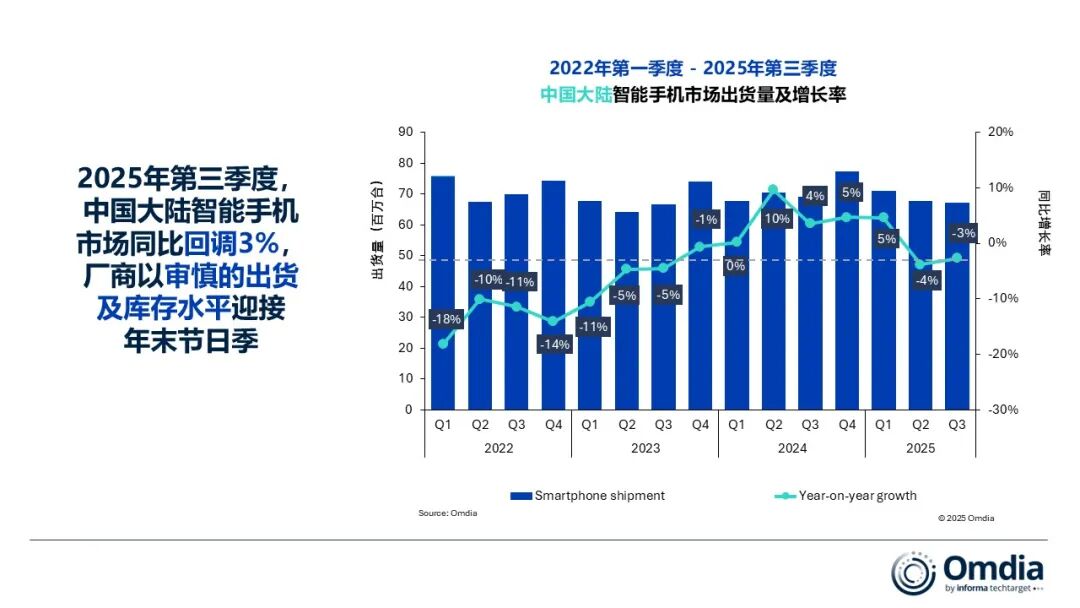
Omdia:三季度中国大陆智能手机市场出货量同比下降3%
智通财经网· 2025-10-16 02:07
Core Insights - The Chinese smartphone market is experiencing a year-on-year decline of 3% in Q3 2025, indicating an ongoing adjustment phase with increasing competition among leading manufacturers [1][3] - Vivo regained the top position with a shipment of 11.8 million units, capturing an 18% market share, followed closely by Huawei with 10.5 million units (16% market share) and Apple with 10.1 million units (15% market share) [1][5] - The overall shipment volume for the Chinese smartphone market in Q3 2025 is 67.2 million units, down from 69.1 million units in the same period of 2024 [5] Market Dynamics - The market is gradually returning to normalcy after a period of fluctuations caused by national subsidy programs, with a more cautious shipment pace allowing manufacturers to maintain healthy inventory levels [3] - Major manufacturers are strategically updating their mid-range product lines, focusing on durability and reliability to meet consumer demands, with new models featuring large batteries and enhanced protection [3][5] Future Outlook - Despite the current decline, Omdia forecasts a moderate growth in smartphone shipments for the entire year of 2025, supported by national subsidies [5] - Local brands are differentiating their products through design, battery life, camera capabilities, and enhanced AI features to attract Chinese consumers, who are noted for their strong inclination towards AI [5]
信息图:2025年Q2 | 智能手机 | 移动市场监测
Counterpoint Research· 2025-10-16 02:02
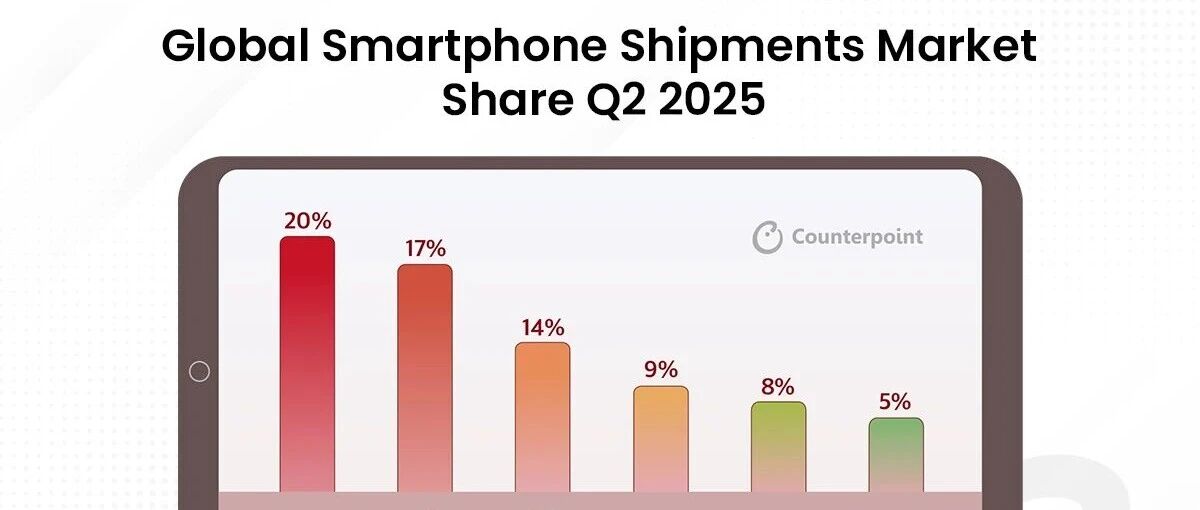
Group 1 - The global smartphone shipments increased by 3% year-on-year in Q2 2025, marking the second consecutive quarter of growth, driven by emerging markets like India, Latin America, and the Middle East and Africa, as well as stable high-end demand in mature markets such as Japan, Europe, and North America [7] - Global smartphone revenue reached $103.04 billion in Q2 2025, showing a strong year-on-year growth of 10% [7] - Samsung maintained its position as the global leader in smartphone shipments, with a 7% year-on-year increase, supported by the Galaxy S25 series and an upgraded Galaxy A series [7] Group 2 - Xiaomi ranked third in global shipments, with performance remaining flat year-on-year in Q2 2025, benefiting from stable demand in China and competitive pricing in Central Europe and Latin America [7] - Vivo and OPPO ranked fourth and fifth in global shipments, respectively, facing a slowdown in their core Chinese market but experiencing stable demand in Southeast Asia and parts of the Middle East [7] - The Asia-Pacific region continued to lead in shipments, accounting for over half of global shipments with a 2% year-on-year growth, while China's growth rate declined by 2% due to slowing demand, and India saw a strong rebound with a 9% year-on-year increase driven by rapid 5G adoption and active channel promotion [7]