
易方达基金

Search documents
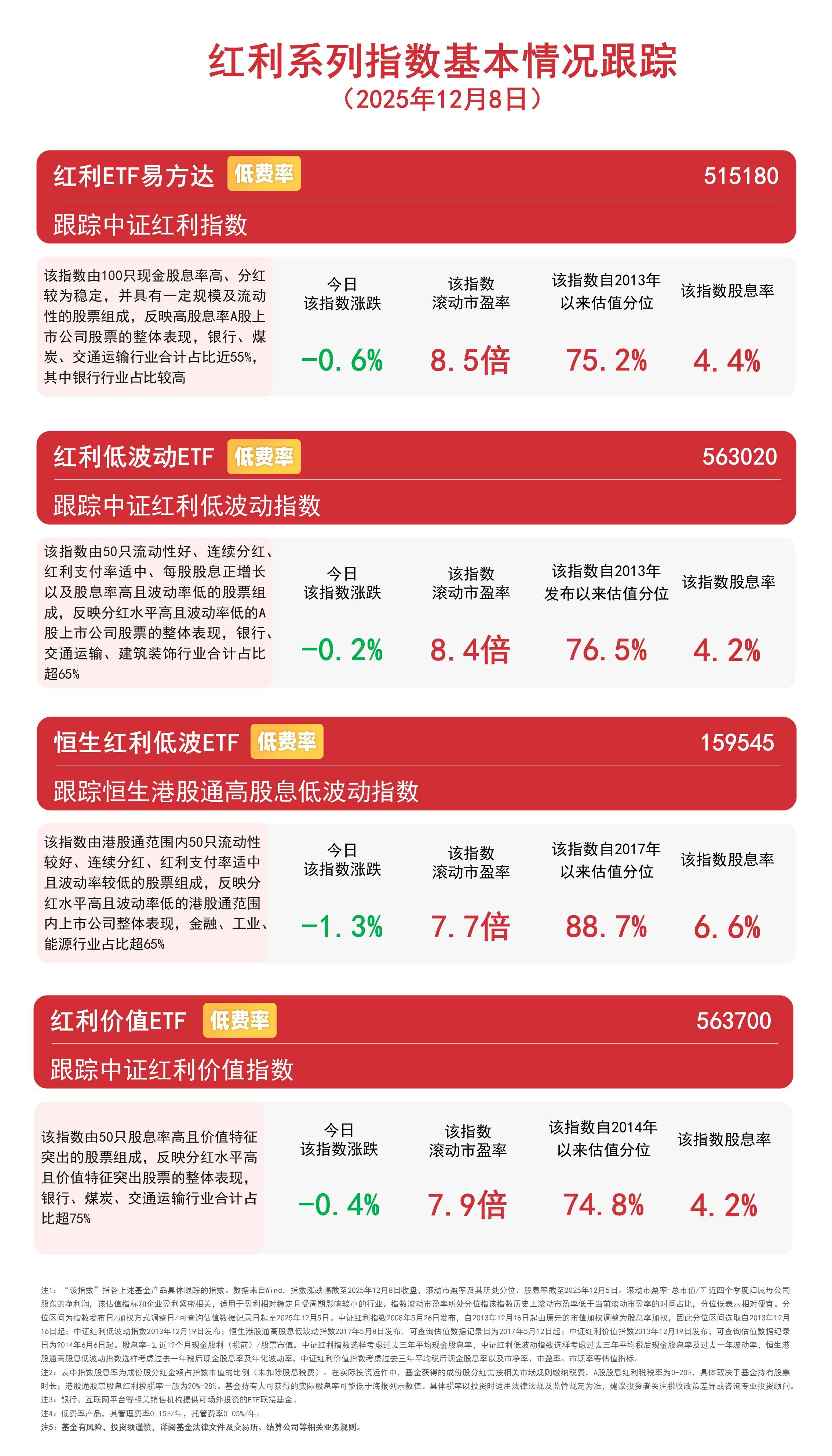
红利板块震荡回调,关注恒生红利低波ETF(159545)、红利ETF易方达(515180)等布局机会
Sou Hu Cai Jing· 2025-12-08 11:05
Group 1 - The market experienced fluctuations today, with energy stocks such as coal and petrochemicals undergoing corrections, while the banking sector showed mixed performance [1] - The CSI Dividend Low Volatility Index decreased by 0.2%, the CSI Dividend Value Index fell by 0.4%, and the CSI Dividend Index dropped by 0.6% [1] - The Hang Seng High Dividend Low Volatility Index declined by 1.3%, despite capital inflows, with the Hang Seng Dividend Low Volatility ETF (159545) seeing a net subscription of nearly 100 million units throughout the day [1] Group 2 - E Fund is currently the only fund company that implements low fee rates for all dividend ETFs, with management fees set at 0.15% per year for its products, including the Hang Seng Dividend Low Volatility ETF (159545) and others [1] - The CSI Dividend Low Volatility Index consists of 50 stocks with good liquidity, continuous dividends, moderate dividend payout ratios, positive growth in earnings per share, and low volatility, reflecting the overall performance of A-share listed companies with high dividend levels and low volatility [4] - The Hang Seng Dividend Low Volatility Index is composed of 50 stocks within the Hong Kong stock range that have good liquidity, continuous dividends, moderate dividend payout ratios, and low volatility, representing the overall performance of listed companies in the Hong Kong stock market with high dividend levels and low volatility [8]

上证科创板50成份指数ETF今日合计成交额73.97亿元,环比增加30.68%
Zheng Quan Shi Bao Wang· 2025-12-08 10:08
Summary of Key Points Core Viewpoint - The trading volume of the Shanghai Stock Exchange STAR Market 50 Index ETFs increased significantly today, indicating heightened investor interest and activity in this sector [1]. Trading Volume and Performance - The total trading volume of the STAR Market 50 Index ETFs reached 7.397 billion yuan, an increase of 1.737 billion yuan from the previous trading day, representing a growth rate of 30.68% [1]. - Specifically, the Huaxia STAR Market 50 ETF (588000) had a trading volume of 4.891 billion yuan, up by 1.295 billion yuan, with a growth rate of 36.02% [1]. - The E Fund STAR Market 50 ETF (588080) recorded a trading volume of 1.155 billion yuan, increasing by 197 million yuan, with a growth rate of 20.58% [1]. - The GF STAR Market 50 ETF (588060) saw a trading volume of 289 million yuan, up by 107 million yuan, with a remarkable growth rate of 59.04% [1]. Market Performance - As of market close, the STAR Market 50 Index (000688) rose by 1.86%, while the average increase for related ETFs was 1.85% [1]. - The top performers included the STAR 50 Enhanced ETF (588460) and the Huaxia STAR Market 50 ETF (588280), which increased by 2.55% and 1.98%, respectively [1]. Notable Increases in Trading Volume - The trading volumes of the Fuguo STAR Market 50 ETF (588940) and the Huaan STAR Market 50 ETF (588280) surged by 177.67% and 138.87%, respectively, indicating strong investor interest [1]. - Other ETFs also showed significant increases, with the Huaxia STAR Market 50 ETF (588000) and the E Fund STAR Market 50 ETF (588080) contributing to the overall growth in trading activity [1].
恒生指数ETF今日合计成交额11.33亿元,环比增加48.70%
Zheng Quan Shi Bao Wang· 2025-12-08 10:06
Core Insights - The total trading volume of Hang Seng Index ETFs reached 1.133 billion yuan today, an increase of 371 million yuan from the previous trading day, representing a growth rate of 48.70% [1] Trading Volume Summary - Huaxia Hang Seng ETF (159920) had a trading volume of 733 million yuan today, up 269 million yuan from the previous day, with a growth rate of 57.97% [1] - Huaxia Hong Kong Stock Connect Hang Seng ETF (513660) recorded a trading volume of 173 million yuan, an increase of 71.2093 million yuan, with a growth rate of 70.17% [1] - Southern Hang Seng Index ETF (513600) saw a trading volume of 215 million yuan, up 27.7181 million yuan, with a growth rate of 14.78% [1] - Penghua Hang Seng ETF (159271) and Huaxia Hong Kong Stock Connect Hang Seng ETF (513660) had the highest increases in trading volume, with growth rates of 75.71% and 70.17% respectively [1] Market Performance Summary - As of market close, the average decline for ETFs tracking the Hang Seng Index was 0.97%, with Huaxia Hang Seng ETF (159920) and Huaxia Hong Kong Stock Connect Hang Seng ETF (513660) experiencing declines of 1.18% and 1.02% respectively [1]
中证科创创业50指数ETF今日合计成交额16.33亿元,环比增加60.53%
Zheng Quan Shi Bao Wang· 2025-12-08 10:06
Core Viewpoint - The trading volume of the Zhongzheng Science and Technology Innovation 50 Index ETF reached 1.633 billion yuan today, marking a week-on-week increase of 616 million yuan, or 60.53% [1] Trading Volume Summary - The E Fund Zhongzheng Science and Technology Innovation 50 ETF (159781) had a trading volume of 465 million yuan, an increase of 167 million yuan from the previous trading day, with a week-on-week growth of 56.20% [1] - The Fortune Zhongzheng Science and Technology Innovation 50 ETF (588380) recorded a trading volume of 248 million yuan, up by 152 million yuan, reflecting a week-on-week increase of 156.97% [1] - The Southern Zhongzheng Science and Technology Innovation 50 ETF (159780) saw a trading volume of 236 million yuan, increasing by 101 million yuan, with a week-on-week growth of 74.61% [1] Market Performance Summary - As of market close, the average increase for ETFs tracking the Zhongzheng Science and Technology Innovation 50 Index was 3.30%, with notable performers including the Xingyin Zhongzheng Science and Technology Innovation 50 ETF (588660) and the Fortune Zhongzheng Science and Technology Innovation 50 ETF (588380), which rose by 3.71% and 3.62% respectively [1]

Biotech博弈:从“跟跑”到“并跑”的差异化崛起
Sou Hu Cai Jing· 2025-12-08 07:21
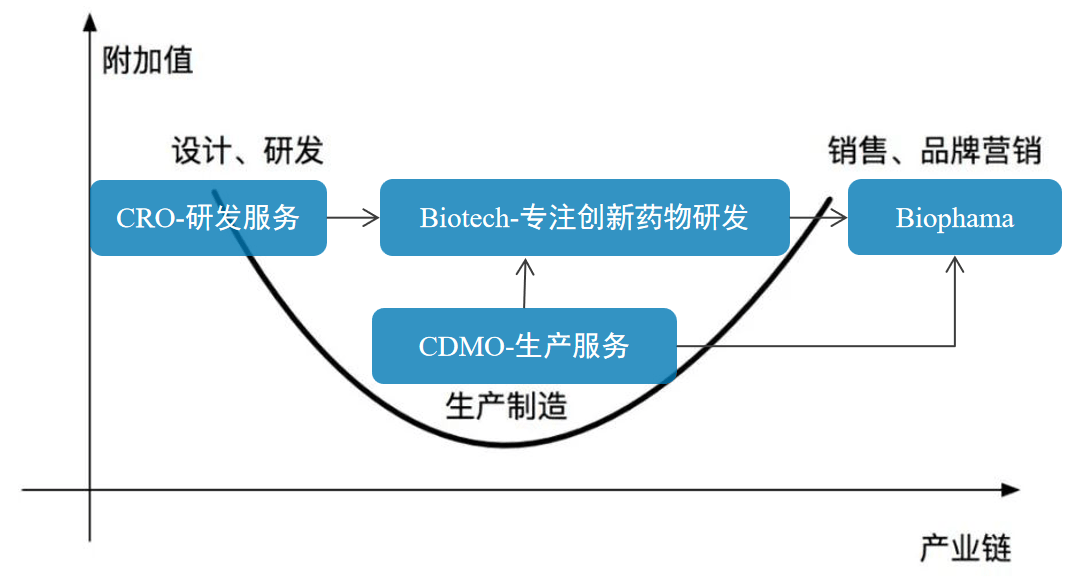
Core Insights - The global biotech landscape is undergoing a significant transformation, with China's innovative drugs projected to exceed $120 billion in licensing deals by October 2025, reflecting a growth of over 190% year-on-year. This indicates that Chinese biotech companies have evolved from mere imitators to a formidable force in the global innovation landscape [1]. Group 1: Global Biotech Industry Structure - The global innovative drug industry follows a "smile curve" structure, with CRO/CDMO (Contract Research Organization/Contract Development and Manufacturing Organization) at the upstream, biotech companies as the innovative entities in the midstream, and large pharmaceutical companies (Big Pharma) managing commercialization at the downstream [2]. - Biotech companies are positioned in the high-value area of the smile curve, bearing the highest R&D risks while enjoying the greatest potential for innovation returns. They typically focus on early-stage drug development and often realize value through acquisitions or licensing agreements with larger pharmaceutical firms [4]. Group 2: Comparison of US and Chinese Biotech - The US biotech sector is currently facing severe survival challenges, with the Nasdaq Biotech Index under pressure and over 20 US biotech companies shutting down in 2025 due to funding issues. This is exacerbated by a cautious M&A strategy among multinational corporations (MNCs) amid tightening cash flows [7]. - In contrast, China's biotech sector is experiencing a surge in business development (BD) transactions, driven by its advantages in R&D efficiency, cost, and clinical resources. MNCs are increasingly attracted to Chinese biotech firms for their differentiated characteristics and high cost-effectiveness [9]. - Chinese biotech companies are focusing on differentiated innovation strategies, particularly in areas like antibody-drug conjugates (ADC) and bispecific antibodies, leading to a pipeline that surpasses that of the US, ranking first globally [10]. Group 3: Investment Opportunities - The growth trend of China's biotech industry is expected to be long-term and predictable, with upcoming international academic conferences likely to showcase more Chinese original drugs, offering substantial returns for investors [11]. - For ordinary investors, navigating the complexities of investing in innovative drug stocks can be challenging. Instead of chasing individual "blockbusters," it may be more prudent to consider ETFs that cover industry leaders, such as the Hang Seng Innovation Drug ETF, which tracks the Hang Seng Hong Kong Stock Connect Innovation Drug Index [11][12].
持续加仓!
Zhong Guo Ji Jin Bao· 2025-12-08 06:57
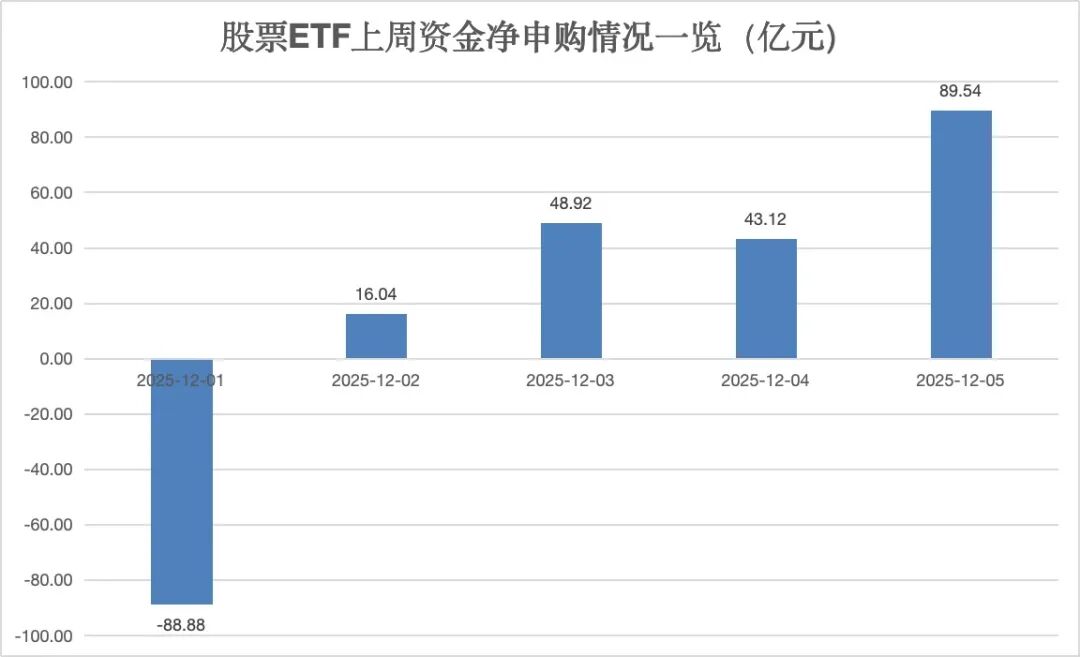
Core Viewpoint - The A-share market continues its rebound, leading to significant net inflows into stock ETFs, with over 10.8 billion yuan in a single week [1][2]. Group 1: Market Performance - The A-share market experienced a slight rebound, with the ChiNext Index rising by 1.86% over the week, outperforming other major indices [2]. - The total scale of stock ETFs (including cross-border ETFs) reached 4.38 trillion yuan, with a weekly increase of 353.78 million units [2]. Group 2: Fund Inflows - Stock ETFs saw a net inflow of 108.73 billion yuan, with nearly 90 billion yuan coming in on a single day [2][4]. - The largest net inflows were observed in the CSI A500 ETF, which attracted 34.82 billion yuan in a single day [5]. - Over the past five trading days, funds flowing into ETFs tracking the CSI A500 index exceeded 4.4 billion yuan, while those tracking the Hang Seng Tech Index saw inflows of over 1.9 billion yuan [6]. Group 3: Fund Management Companies - Major fund companies like E Fund and Huaxia Fund reported continued net inflows into their ETFs, with E Fund's total ETF scale reaching 817.12 billion yuan, increasing by 8.08 billion yuan on December 5 [7]. - Specific ETFs such as the CSI 300 ETF and the Sci-Tech Innovation ETF saw net inflows of 2.3 billion yuan and 1.4 billion yuan, respectively [7]. Group 4: Regulatory Impact - The recent adjustment in risk factors for insurance companies' holdings of certain indices is expected to benefit broad-based ETFs, contributing to the net inflows observed [8].
持续加仓!
中国基金报· 2025-12-08 06:50
Group 1 - The core viewpoint of the article highlights that the A-share market continues its rebound, with stock ETFs attracting significant net inflows exceeding 10.8 billion yuan in a single week [2][3][4] - As of December 5, the total scale of stock ETFs (including cross-border ETFs) reached 4.38 trillion yuan, with a weekly increase of 35.378 billion units [4] - On December 5 alone, the net inflow of funds into stock ETFs was approximately 8.954 billion yuan, with broad-based ETFs and Hong Kong market ETFs leading the inflows [5][8] Group 2 - The article notes that the net inflow of funds into ETFs tracking the CSI A500 index was particularly strong, with a single-day net inflow of 3.482 billion yuan [8] - Major fund companies, such as E Fund and Huaxia Fund, reported continued net inflows into their ETFs, with E Fund's ETFs reaching a scale of 817.12 billion yuan and Huaxia Fund's A500 ETF seeing a net inflow of 1.621 billion yuan [9][10] - The article mentions that the recent adjustment of risk factors for insurance companies is expected to benefit broad-based ETFs, leading to increased net inflows [12] Group 3 - The top ten ETFs by net inflow included several broad-based ETFs, with the A500 ETF from Huatai-PB seeing a net inflow of over 2.209 billion yuan [14] - Conversely, the article lists the top ten ETFs by net outflow, highlighting that bank ETFs, chemical ETFs, and the SSE 50 ETF experienced significant outflows, each exceeding 1 billion yuan [16]
首只翻倍FOF诞生!靠的是什么?
证券时报· 2025-12-08 04:20
Core Viewpoint - The public FOF (Fund of Funds) has entered a historic moment of regaining reputation, with the emergence of the first product achieving a doubling of performance, indicating a new phase of rapid growth in this product category as market acceptance increases, pushing the FOF market size beyond 180 billion yuan [1][2]. Group 1: Performance and Growth - The first public FOF to achieve a doubling of performance is the Qianhai Kaiyuan Yuyuan FOF, established in May 2018, with an asset size of 168 million yuan and a year-to-date return of 38%, leading to a cumulative return of 129% [2]. - Other notable public FOFs include Xingquan Antai Balanced Holding, China Universal Pension, and Penghua Pension 2045 Mixed, with cumulative returns of 79.61%, 70.12%, and 69.40% respectively, showcasing strong long-term performance [2]. - As of the third quarter of 2025, the total number of public FOFs reached 518, with a total management scale of 187.25 billion yuan, reflecting significant growth and maturity in product offerings and investment strategies [3]. Group 2: Investment Strategy - The success of public FOFs is attributed to a refined selection strategy that emphasizes industry-themed funds while reducing exposure to broad-based funds [4][6]. - The Qianhai Kaiyuan Yuyuan FOF's performance is significantly driven by its heavy allocation to resource-themed funds, with nearly 48% of its portfolio in such funds, which have shown substantial returns [6]. - The Penghua Pension 2045 Mixed FOF also benefits from a strong focus on narrow-based products, particularly in technology sectors, with significant contributions from funds like the GF New Energy Battery ETF and the E Fund Growth Power [7]. Group 3: Market Outlook - Star fund managers express optimism for the equity market in the first quarter of next year, anticipating improved economic data and favorable conditions for equity investments [8]. - The investment strategy includes a diversified asset allocation of 30% in gold, 30% in equities, and 40% in fixed income, aiming for both stability and growth potential [8]. - The long-term bullish outlook on gold is supported by ongoing global fiscal deficits and underlying economic vulnerabilities in the U.S., suggesting that gold could serve as a hedge against equity risks while providing capital gains [9][10].

大爆发!38只,新发!
Zhong Guo Ji Jin Bao· 2025-12-08 03:49
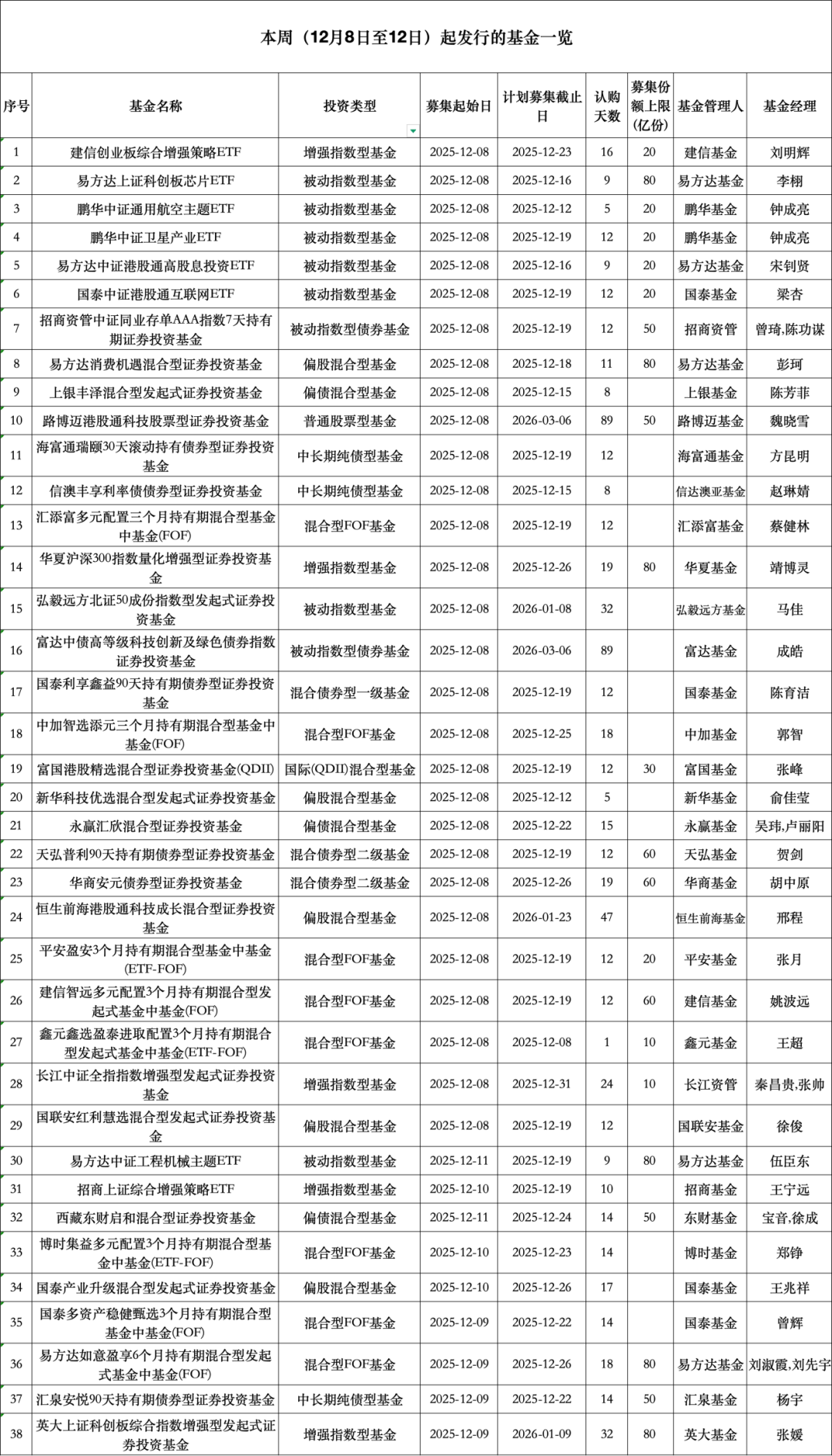
Group 1 - A total of 38 new funds were launched for public offering this week, with index funds being the main contributors [1][5] - 29 of the new funds were launched on Monday, accounting for 76.32% of the total new funds for the week [2] - The average subscription period for the new funds this week was 18.37 days, significantly shorter than the 35 days at the end of the third quarter [3] Group 2 - The longest subscription period among the new funds was 89 days for two funds, while the shortest was just 1 day for a specific mixed fund [4] - Out of the 38 new funds, 22 disclosed their fundraising targets, with the highest target set at 8 billion units for several funds [4] - Index funds accounted for 33.33% of the new funds, with 12 funds categorized as such, including both passive and enhanced index funds [5] Group 3 - There were also 8 mixed FOFs and 7 actively managed equity funds launched this week, indicating a recovery in the new fund issuance market [6] - The China Securities Regulatory Commission has optimized the ETF registration and listing review process, which is expected to stimulate market activity [6]
大爆发!38只,新发!
中国基金报· 2025-12-08 03:42
Core Viewpoint - This week, a total of 38 new funds were launched for public subscription, with index funds being the main focus of the market [2][6]. Fund Issuance Overview - Among the 38 new funds, 29 were launched on Monday, accounting for 76.32% of the total new funds for the week. The remaining funds were issued on Tuesday (4), Wednesday (3), Thursday (2), and no new funds were launched on Friday [4]. - The average subscription period for the new funds this week was 18.37 days, significantly shorter than the 35 days at the end of the third quarter. The longest subscription period was 89 days for two specific funds, while the shortest was just 1 day for a fund [5]. Fund Target and Types - Out of the 38 new funds, 22 disclosed their fundraising targets. The highest target was set at 8 billion units for several funds, including those from E Fund and Huaxia Fund. The lowest target was 1 billion units for two funds [5]. - Index funds played a significant role, with 12 new index funds launched, making up 33.33% of the total new funds. This included 7 passive index funds and 5 enhanced index funds [7][8]. Market Trends - The overall market for new fund issuance has shown significant improvement, with a notable increase in equity fund subscriptions. The issuance difficulty has decreased, indicating a more favorable environment for fund launches [9]. - Recent regulatory changes by the China Securities Regulatory Commission (CSRC) have optimized the ETF registration and listing process, further stimulating market activity [9].
