奇瑞汽车

Search documents
新能源乘用车第38周销量报告
Dong Zheng Qi Huo· 2025-09-24 06:44
1. Report Industry Investment Rating No relevant content provided. 2. Core Viewpoints of the Report - In the 38th week of 2025 (from September 15th to September 21st), the single - week retail sales of passenger cars reached 5.11 million, a year - on - year increase of 14.2%. The cumulative retail sales since the beginning of this year were 15.693 billion, a year - on - year increase of 5.9%. The single - week retail sales of new energy passenger cars were 2.99 million, a year - on - year increase of 5.9%, and the cumulative retail sales since the beginning of this year were 8.214 billion, a year - on - year increase of 23.0%. The single - week penetration rate of new energy vehicles reached 59.5%, and the cumulative annual penetration rate was 52.3%, showing a slow upward trend [1][13][16]. - The market pattern of new energy vehicles is constantly changing. Brands like BYD and Li Auto had a year - on - year negative growth, while XPeng, NIO, Leapmotor, Xiaomi, and Voyah maintained relatively high growth rates. New brands such as Xiaomi have added new variables to the market, and traditional automakers like Geely, Changan, and Chery have achieved excellent performance in new energy vehicle sales [2][22]. 3. Summary According to Relevant Catalogs 3.1 Passenger Car Market Weekly Overview - **Overall Passenger Car Sales**: In the 38th week of 2025, the single - week retail sales of passenger cars were 5.11 million, a year - on - year increase of 14.2%. The cumulative retail sales since the beginning of this year were 15.693 billion, a year - on - year increase of 5.9% [1][13]. - **New Energy Passenger Car Sales**: The single - week retail sales of new energy passenger cars were 2.99 million, a year - on - year increase of 5.9%. The cumulative retail sales since the beginning of this year were 8.214 billion, a year - on - year increase of 23.0% [1][13]. - **Penetration Rate**: The single - week penetration rate of new energy vehicles reached 59.5%, and the cumulative annual penetration rate was 52.3%, showing a slow upward trend [1][16]. - **Sales by Power Type**: Among passenger cars, traditional fuel, hybrid, and new energy vehicles had retail sales of 1.94 million, 0.18 million, and 2.99 million respectively, with year - on - year changes of - 4.1%, - 3.4%, and 31.9% respectively, accounting for 37.9%, 3.6%, and 58.5% of passenger cars. Among new energy passenger cars, pure - electric, plug - in hybrid, and extended - range vehicles had retail sales of 1.95 million, 0.79 million, and 0.25 million respectively, with year - on - year changes of 54.9%, 5.0%, and - 2.4% respectively, accounting for 65.2%, 26.5%, and 8.3% of new energy passenger cars [17]. - **Sales by Production Attribute**: Among passenger cars, self - owned and joint - venture brands had retail sales of 3.43 million and 1.69 million respectively, with year - on - year increases of 22.0% and 1.0% respectively, accounting for 67.0% and 33.0% of passenger cars. Among new energy passenger cars, self - owned and joint - venture brands had retail sales of 2.7 million and 0.3 million respectively, with year - on - year increases of 33.2% and 21.1% respectively, accounting for 90.1% and 9.9% of new energy passenger cars [19]. 3.2 Key New Energy Automaker Sales Analysis - **Overall Situation**: In the 38th week of this year, BYD sold 78,000 new energy passenger cars, Geely Automobile sold 37,000, SAIC - GM - Wuling sold 20,000, Tesla (China) sold 17,000, Changan Automobile sold 15,000, Hongmeng Zhixing sold 13,000, and Chery Automobile sold 11,000. Among new - force automakers, Leapmotor sold 13,000, Xiaomi sold 11,000, Wenjie sold 10,000, XPeng and Li Auto sold 9,000 each, and NIO sold 7,000 [2][22]. - **BYD**: The weekly sales were 78,000. Since July, the year - on - year growth rate has turned negative. The cumulative sales this year were 2.359 billion, with a year - on - year growth rate of 2.3%. The sales of pure - electric and plug - in hybrid (including extended - range) models were basically half and half. From January to August this year, the global cumulative sales were 2.864 billion, and the overseas cumulative sales of passenger cars and pickups were 630,000. Regarding the reported reduction of the annual sales target from 5.5 billion (including 800,000 in the overseas market) to 4.6 billion, the completion rate of the original target from January to August was 52%, and the overseas market target completion rate was 78.75%. After the target reduction, the completion rate was 62% [26]. - **Geely Automobile**: The weekly sales were 56,000, including 37,000 new energy vehicles (3,000 from the Zeekr brand), and the electrification rate was about 65%. The cumulative sales this year were 1.647 billion, a year - on - year increase of 48.5%, and the cumulative new energy sales were 979,000, a year - on - year increase of 100.0%. The company adjusted its 2025 sales target from 2.71 billion to 3 billion [28]. - **SAIC - GM - Wuling**: The overall passenger car sales were 21,000, including 20,000 new energy vehicles, and the electrification rate was as high as 92%. The cumulative sales this year were 594,000, with a growth rate of 19.9%, and the new energy sales were 511,000, with a growth rate of 35.4%. Pure - electric models dominated the sales [31]. - **Changan Automobile**: The overall passenger car sales were 25,000, including 15,000 new energy vehicles, and the electrification rate was about 59%. The cumulative sales this year were 846,000, a year - on - year increase of 2.1%, and the new energy sales were 423,000, a year - on - year increase of 19.2% [36]. - **Chery Automobile**: The overall passenger car sales were 26,000, including 11,000 new energy vehicles, and the electrification rate was about 44%. The cumulative sales this year were 869,000, a year - on - year increase of 23.5%, and the new energy sales were 313,000, a year - on - year increase of 66.5% [41]. - **Tesla**: The sales in China that week were 17,000, and the cumulative sales this year were 412,000, a year - on - year negative growth of - 5.7%. The sales of Model 3, Model Y, and Model Y L were about 6,000, 10,000, and 1,000 respectively. Tesla has launched multiple promotional activities this year. The price of the long - range version of Model 3 increased by 10,000 yuan since July 1st. Tesla's Model 3 and Model Y entered the rural subsidy catalog for the first time in 2025 [46]. - **Hongmeng Zhixing**: The weekly sales were 13,000, including about 10,000 for Wenjie and about 1,000 for Zhijie. The Shangjie H5, a new car in cooperation with SAIC, is planned to be officially launched in September, targeting the mass market [50]. - **New - Force Automakers**: Leapmotor, Xiaomi, Wenjie, XPeng, Li Auto, and NIO sold 13,000, 11,000, 10,000, 9,000, 9,000, and 7,000 respectively. XPeng, NIO, Leapmotor, Xiaomi, and Voyah maintained relatively high growth rates [2][22].


柳州五菱新能源入局乘用车,首款瞄准微型车
Bei Ke Cai Jing· 2025-09-24 01:44
Core Insights - Liu Zhou Wuling New Energy Vehicle Co., Ltd. has launched a new brand "Aishang Automobile" targeting the micro electric vehicle market, with its first model A100C set to be released on September 26 [1] - Aishang Automobile aims to introduce multiple models including sedans, SUVs, and MPVs over the next three years based on three self-developed technology platforms [1] - The micro electric vehicle market is currently saturated with strong competition from established players like SAIC-GM Wuling, Chery, Geely, Changan, and FAW Bestune [2] Company Overview - Liu Zhou Wuling New Energy was established in June 2021, with major shareholders including Guangxi Automobile Group Co., Ltd. and Wuling Automobile Group Holdings [1] - The company lacks production qualifications for passenger vehicles, leading to the A100C being manufactured by Henan Senyuan Electric Vehicle Co., Ltd. [1] Market Dynamics - The micro electric vehicle segment faces significant challenges due to intense competition and a saturated market, with leading models like Wuling Hongguang MINI EV and Changan Lumin dominating sales [2] - The pricing pressure from small and compact electric vehicles is squeezing the micro electric vehicle market, which has limited profit margins [2] - The long-term sustainability of micro electric vehicles is uncertain without achieving scale in production and sales [2]
奇瑞汽车(09973) - 董事名单与其角色和职能
2025-09-23 22:54
香港交易及結算所有限公司及香港聯合交易所有限公司對本公告的內容概不負責,對其準確性 或完整性亦不發表任何聲明,且表明不會就本公告全部或任何部分內容所導致或因倚賴該等內 容而產生的任何損失承擔任何責任。 奇瑞汽車股份有限公司 Chery Automobile Co., Ltd. (於中華人民共和國註冊成立的股份有限公司) (股份代號:9973) 董事名單與其角色和職能 奇瑞汽車股份有限公司(「本公司」)董事會(「董事會」)成員載列如下: 執行董事 尹同躍先生 (董事長及總裁) 張國忠先生 非執行董事 王來春女士 李晶女士 王津華先生 王孝偉先生 鮑思語先生 尹祥領先生 胡敬源先生 獨立非執行董事 商文江先生 楊棉之先生 葉盛基先生 路風先生 楊善林先生 黎汝雄先生 1 董事會下設三個委員會。下表提供各董事會成員在此等委員會中所擔任職務之信 息。 | | 委員會 | 風險控制與審計 | 提名與薪酬考核 | 戰略與可持續發展 | | --- | --- | --- | --- | --- | | 董事 | | 委員會 | 委員會 | 委員會 | | 尹同躍先生 | | | | C | | 張國忠先生 | | | M ...
奇瑞汽车(09973) - 董事会战略与可持续发展委员会工作细则
2025-09-23 22:49
第二章 人員組成 第二條 戰略與可持續發展委員會由七名董事組成,其中獨立董事兩名。 奇瑞汽車股份有限公司 董事會戰略與可持續發展委員會工作細則 第一章 總則 第一條 為適應奇瑞汽車股份有限公司(以下簡稱「公司」)發展需要,提升 公司環境、社會及公司治理管理水平,增強公司核心競爭力,確定公司發展規 劃,健全投資決策程序,加強決策科學性,提高重大投資決策的效益和決策的質 量,根據《中華人民共和國公司法》《香港聯合交易所有限公司證券上市規則》(以 下簡稱「《香港上市規則》」)和《奇瑞汽車股份有限公司章程》(以下簡稱「《公司章 程》」),特設立董事會戰略與可持續發展委員會,並結合公司實際,制定《董事會 戰略與可持續發展委員會工作細則》(以下簡稱「本細則」)。 第三條 戰略與可持續發展委員會設主席一名,由董事長擔任,負責主持委 員會工作。 第四條 主席和委員由董事長或董事會提名委員會提名,並由董事會以全體 董事過半數選舉產生。選舉委員的提案獲得通過後,新任委員在董事會會議結束 後立即就任。 第五條 戰略與可持續發展委員會任期與董事會任期一致,委員任期屆滿, 可以連選連任。期間如有委員不再擔任公司董事職務,或應當具有獨立 ...
奇瑞汽车(09973) - 董事会提名与薪酬考核委员会工作细则
2025-09-23 22:43
奇瑞汽車股份有限公司 第三條 本細則所稱董事是指公司的董事,高級管理人員是指公司的總裁、 常務副總裁、執行副總裁、董事會秘書、財務負責人、《公司章程》規定的其他高 級管理人員。 第二章 人員組成 第四條 提名與薪酬考核委員會由七名以上董事組成,獨立非執行董事佔多 數,並包括至少一名不同性別的董事。 第五條 提名與薪酬考核委員會委員由董事長或董事會提名委員會提名,並 由董事會以全體董事過半數選舉產生。選舉委員的提案獲得通過後,新任委員在 董事會會議結束後立即就任。 第六條 提名與薪酬考核委員會的成員應由董事會委任及罷免。提名與薪酬 考核委員會應不時向董事會匯報其工作。 1 第七條 提名與薪酬考核委員會設召集人即委員會主席一名,由獨立非執行 董事擔任,由董事會任命,負責主持委員會工作。委員會主席不能或不履行職責 時,由過半數委員共同推舉一名獨立非執行董事代行其職責。 董事會提名與薪酬考核委員會工作細則 第一章 總則 第一條 為規範奇瑞汽車股份有限公司(以下簡稱「公司」)董事及高級管理人 員的產生,並建立健全薪酬與考核管理制度,完善公司治理結構,根據《中華人 民共和國公司法》(以下簡稱「《公司法》」)、《香港聯合交 ...
奇瑞汽车(09973) - 董事会提名与薪酬考核委员会工作细则
2025-09-23 22:39
第一章 總則 第一條 為規範奇瑞汽車股份有限公司(以下簡稱「公司」)董事及高級管理人 員的產生,並建立健全薪酬與考核管理制度,完善公司治理結構,根據《中華人 民共和國公司法》(以下簡稱「《公司法》」)、《香港聯合交易所有限公司證券上市規 則》(以下簡稱「《香港上市規則》」)、《香港上市規則》附錄C1所載的《企業管治守 則》等相關適用法律、行政法規、部門規章、規範性文件及公司本次境外公開發 行股票並上市後適用的《奇瑞汽車股份有限公司章程》(以下簡稱「《公司章程》」), 依照董事會決議,公司特設立董事會提名與薪酬考核委員會,並結合公司實際, 制定本《奇瑞汽車股份有限公司董事會提名與薪酬考核委員會工作細則》(以下簡 稱「本細則」)。 第二條 提名與薪酬考核委員會是公司董事會下設的專門工作機構,主要負 責公司董事(包括獨立非執行董事)及高級管理人員的選擇、選擇標準和程序進行 研究,並研究制定董事與高級管理人員的考核標準並按照標準進行考核,提出意 見和建議,同時負責研究制定、審查公司董事和高級管理人員的薪酬計劃或方案。 第三條 本細則所稱董事是指公司的董事,高級管理人員是指公司的總裁、 常務副總裁、執行副總裁、董事會秘 ...
奇瑞汽车(09973) - 董事会风险控制与审计委员会工作细则
2025-09-23 22:28
奇瑞汽車股份有限公司 董事會風險控制與審計委員會工作細則 第一章 總則 第四條 審計委員會委員由董事長或董事會提名與薪酬考核委員會提名,並 由董事會以全體董事過半數選舉產生。選舉委員的提案獲得通過後,新任委員在 董事會會議結束後立即就任。 第五條 審計委員會設召集人即委員會主席一名,由獨立非執行董事擔任, 由董事會任命,負責主持委員會工作。委員會主席不能或不履行職責時,由過半 數委員共同推舉一名獨立非執行董事代行其職責。 第一條 為強化奇瑞汽車股份有限公司(以下簡稱「公司」)董事會決策功能, 持續完善公司內部控制體系建設,確保董事會的有效監督管理,不斷完善公司治 理結構,根據《中華人民共和國公司法》(以下簡稱「《公司法》」)、《香港聯合交易 所有限公司證券上市規則》(以下簡稱「《香港上市規則》」)、《香港上市規則》附錄 C1所載的《企業管治守則》、香港會計師公會《審計委員會有效運作指引》等適用 法律、行政法規、部門規章、規範性文件及《奇瑞汽車股份有限公司章程》(以下 簡稱「《公司章程》」),依照董事會決議,公司特設立董事會風險控制與審計委員 會(以下簡稱「審計委員會」),並結合公司實際,制定本《奇瑞汽車股份有 ...
奇瑞汽车(09973) - 章程
2025-09-23 22:18
奇瑞汽車股份有限公司 章程 (二〇二五年九月) | 第一章 | 總則 | 1 | | --- | --- | --- | | 第二章 | 經營宗旨和範圍 | 2 | | 第三章 | 股份 | 3 | | 第一節 | 股份發行 | 3 | | 第二節 | 股份增減和回購 | 5 | | 第三節 | 股份轉讓 | 7 | | 第四章 | 股東和股東會 | 7 | | 第一節 | 股東的一般規定 | 7 | | 第二節 | 股東會的一般規定 | 13 | | 第三節 | 股東會的召集 | 15 | | 第四節 | 股東會的提案與通知 | 17 | | 第五節 | 股東會的召開 | 19 | | 第六節 | 股東會的表決和決議 | 23 | | 第五章 | 董事和董事會 | 28 | | 第一節 | 董事的一般規定 | 28 | | 第二節 | 董事會 | 32 | | 第三節 | 董事會專門委員會 | 36 | | 第六章 | 高級管理人員 | 39 | | 第七章 | 監事會 | 41 | | 第一節 | 監事 | 41 | | 第二節 | 監事會 | 42 | | 第八章 | 財務會計制度、利潤分配和審計 | ...
奇瑞汽车港股IPO募资91.4亿港元,预计9月25日挂牌
Xin Jing Bao· 2025-09-23 14:11
新京报贝壳财经讯(记者林子)9月23日,奇瑞汽车公布了香港IPO认购结果,此次奇瑞汽车以招股价 上限30.75港元定价,发行3亿股H股,募资规模达91.4亿港元,基石投资者认购总额约45.7亿港元,预计 9月25日挂牌。 ...
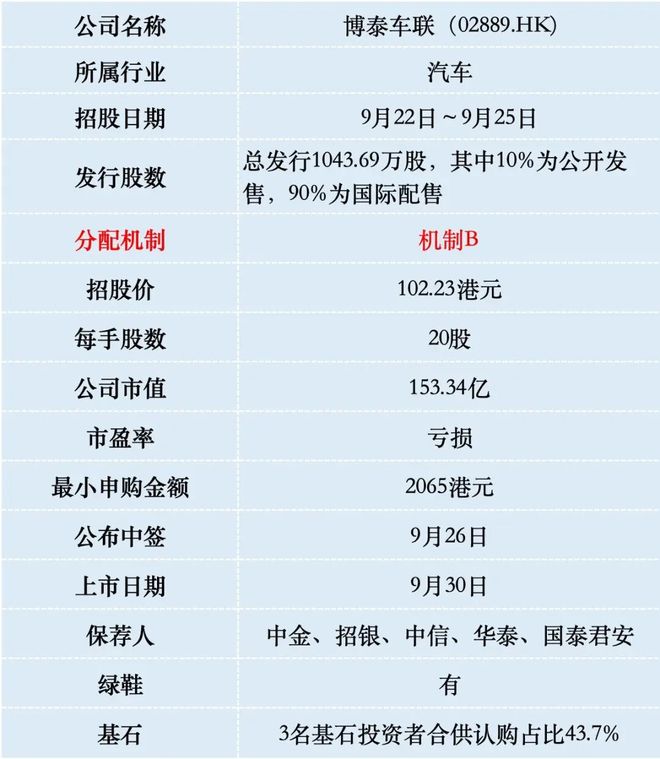
博泰车联港股IPO,三只新股同时招股,撞车才有大肉
Xin Lang Cai Jing· 2025-09-23 14:02
Core Viewpoint - Chery Automobile has announced its subscription results, with concerns about potential listing price drops due to easy subscription rates, reflecting recent trends in the market for new stocks [1] Group 1: IPO Information - Company Name: Botai Carlink (02889.HK) [3] - Industry: Automotive [3] - Subscription Period: September 22 to September 25 [3] - Total Shares Issued: 10.4369 million shares, with 10% for public sale and 90% for international placement [3] - Offering Price: 102.23 HKD per share [3] - Market Capitalization: 15.334 billion HKD [3] - Minimum Subscription Amount: 2065 HKD [3] - Listing Date: September 30 [3] - Cornerstone Investors: 3 cornerstone investors subscribed for 43.7% of the offering [3] Group 2: Company Overview - Botai Carlink, established in 2009 and headquartered in Shanghai, specializes in automotive intelligent cockpit solutions, providing customized integrated solutions [3][4] - By 2024, Botai Carlink is the third-largest supplier of intelligent cockpit domain controllers in China, holding a market share of 7.3% [3] Group 3: Financial Performance - Revenue growth from 1.218 billion RMB in 2022 to 2.557 billion RMB in 2024, with a compound annual growth rate (CAGR) of 44.9% [5][6] - For the first five months of 2025, revenue reached 754 million RMB, a year-on-year increase of 34.4% [6] - Cumulative losses from 2022 to 2024 approached 1.5 billion RMB, primarily due to high R&D investments and strategic expansion [6] Group 4: Product and Market Position - The core business includes intelligent cockpit solutions and connected services, with intelligent cockpit solutions accounting for 94.8% of total revenue in 2024 [7] - Domain controllers are the main product, with revenue increasing from 674 million RMB in 2022 to 1.959 billion RMB in 2024, achieving a CAGR of 70.5% [8] - The intelligent cockpit market in China is rapidly growing, projected to reach 129 billion RMB in 2024 and 299.5 billion RMB by 2029, with a CAGR of 18.4% [9] Group 5: Competitive Landscape - The market concentration is increasing, with the top three suppliers holding approximately 40% of the market share, benefiting Botai Carlink in expanding its market share and reducing costs [9] - Compared to peers, Botai Carlink's valuation appears high, with a market cap of 15.3 billion HKD and a price-to-sales ratio of 5, while competitors have lower valuations [9][10]