
新能源渗透率

Search documents
【乘联分会论坛】3月狭义乘用车零售预计170.0万辆,新能源预计90.0万辆
乘联分会· 2026-03-20 08:52
Core Viewpoint - The Chinese passenger car market experienced a significant seasonal decline in February 2026, with retail sales dropping 25.4% year-on-year and 33.1% month-on-month, while the penetration rate for new energy vehicles (NEVs) was 44.9% [2]. Group 1: Market Overview - In March 2026, the market is expected to gradually recover as the post-holiday consumption phase continues, with a forecasted retail market size of approximately 170,000 units, reflecting a month-on-month increase of 64.5% but a year-on-year decrease of 12.4% [4][5]. - The retail sales of NEVs are projected to reach around 900,000 units in March, with a penetration rate of approximately 52.9% [4][7]. Group 2: Weekly Sales Trends - The first week of March saw weak market performance with an average daily retail of 31,000 units, a year-on-year decline of 23.6%. However, the second week showed improvement with daily sales rising to 45,000 units, reducing the year-on-year decline to 19.5% [5][6]. - By the third week, daily retail is expected to reach 47,000 units, with the decline narrowing to 14.5%. The fourth week is anticipated to see a significant increase in daily sales to 93,000 units, driven by manufacturer promotions and new vehicle launches [5][6]. Group 3: Consumer Behavior and Market Dynamics - The overall retail sales of consumer goods in China grew by 2.8% year-on-year in January-February 2026, but automotive retail sales fell by 7.3%, indicating a weaker recovery in the automotive sector compared to the broader market [7]. - The market is witnessing a structural shift, with increasing consumer preference for NEVs, while the fuel vehicle market remains under pressure due to high discounts and rising fuel costs, which have hindered expected recovery trends [7].


中国银河证券:以旧换新政策优化提升购车均价 3月乘用车消费有望回暖
智通财经网· 2026-02-25 01:29
Core Viewpoint - The optimization of the trade-in policy is effectively guiding consumers to purchase higher-priced vehicles, which is expected to enhance the effectiveness of the trade-in policy and provide favorable support for automotive market consumption [1][2]. Group 1: Trade-in Policy Impact - The trade-in policy has already stimulated automotive consumption exceeding 100 billion yuan, with the average purchase price for trade-in vehicles rising to over 164,000 yuan [2]. - As of February 19, 2026, the trade-in policy has benefited 28.88 million consumers, generating sales of 198.02 billion yuan, with 612,000 vehicles traded in, leading to new car sales of 100.53 billion yuan [2]. - The optimized subsidy standards include a 12% subsidy (up to 20,000 yuan) for new energy vehicles and a 10% subsidy (up to 15,000 yuan) for fuel vehicles with an engine size of 2.0 liters or less [2]. Group 2: Market Trends and Forecasts - In January 2026, China's automotive sales decreased by 3.2% year-on-year to 2.346 million units, with domestic sales down 14.8% to 1.665 million units, primarily due to the expiration of the new energy vehicle purchase tax exemption and the impact of the trade-in policy [3]. - The export of automobiles in January 2026 saw a significant increase of 44.9% year-on-year, with 681,000 units exported, indicating strong demand in overseas markets [3]. - The upcoming Beijing Auto Show (April 24 - May 3) and the launch of several flagship new energy products are expected to drive market demand recovery post-Spring Festival [4].

高人预测:2026年3月份起,房子、车子、存款或将迎来重大改变!
Sou Hu Cai Jing· 2026-02-24 08:46
Real Estate - The real estate market is entering a new adjustment phase, with policies indicating an increase in the proportion of existing home sales starting from March [2] - Developers are shifting focus to quality competition as their funding issues ease, moving away from the risks associated with pre-sales [2][25] - Homebuyers are now more inclined to physically inspect properties, reflecting a shift from speculative buying to practical decision-making [2][25] - In second and third-tier cities like Zhengzhou and Tianjin, the decline in housing prices is slowing, with homeowners adopting a wait-and-see attitude [2] - The market is transitioning from a general decline to a more differentiated performance, with core areas in first-tier cities maintaining demand despite external pressures [2] Automotive Industry - The penetration rate of new energy vehicles is expected to exceed 55% after March, becoming a dominant force in the automotive market [4] - Tax reductions on vehicle purchases are impacting low-priced models, while subsidy reductions are prompting manufacturers to focus on cost-effectiveness [4] - Consumers are shifting from impulsive buying to practical considerations, emphasizing range and reliability in their vehicle choices [4] - The automotive market is experiencing a slow recovery after a decline in sales during the first quarter, with new policies stimulating consumption [10] - Exports are projected to exceed 7 million units, with Chinese brands increasing their share in overseas markets [10][22] Deposit Market - The deposit market has seen a deepening of low interest rate trends since March, with one-year fixed deposit rates stabilizing around 1.35% [6][12] - Households are shifting their investment strategies towards more stable financial products due to shrinking income from deposits [6][12] - The focus on safety and risk diversification is becoming more pronounced among residents, leading to a decrease in high-risk investments [6][18] - The banking sector is adjusting its liability structure in response to pressure on net interest margins, with short-term product rates entering a low range [6][12] Overall Market Trends - The real estate market is experiencing a prolonged bottoming period, with sellers no longer eager to sell at a loss and buyers cautiously testing the waters [14][20] - The automotive industry is moving towards rational competition, with a focus on quality rather than just scale, as consumer preferences evolve [27][32] - The deposit market is characterized by low yields, with households prioritizing capital preservation over high returns [29][34]
2025年12月重卡行业月报:12月重卡顺利收官,收获同比九连增
GUOTAI HAITONG SECURITIES· 2026-01-23 10:45
Investment Rating - The report assigns an "Overweight" rating for the heavy truck industry [4]. Core Insights - In December, domestic heavy truck sales reached 103,000 units, representing a year-on-year increase of 22% but a month-on-month decrease of 9% [2][4]. - The total sales of domestic heavy trucks for the year amounted to 1.144 million units, showing a year-on-year growth of 27% [4]. - The report highlights that the heavy truck industry has achieved nine consecutive months of year-on-year growth, with sales exceeding 100,000 units for four consecutive months [4]. - The report anticipates that the domestic heavy truck sales in 2026 will reach 760,000 units, a year-on-year decrease of 5.3%, while wholesale sales are expected to reach 1.16 million units, a year-on-year increase of 1.5% [4]. Summary by Sections Heavy Truck Sales - December saw domestic natural gas heavy truck sales of 13,000 units, a year-on-year increase of 19% but a month-on-month decrease of 33% [4]. - Cumulative sales of domestic natural gas heavy trucks for the year reached 190,000 units, also a year-on-year increase of 19% [4]. - The penetration rate of natural gas in heavy trucks was 12% in December and 17% for the entire year [4]. New Energy Heavy Trucks - December recorded domestic new energy heavy truck sales of 27,000 units, a year-on-year increase of 139% and a month-on-month increase of 12% [4]. - Cumulative sales of domestic new energy heavy trucks for the year reached 192,000 units, reflecting a year-on-year growth of 175% [4]. - The penetration rate of new energy in heavy trucks was 26% in December and 17% for the entire year [4]. Company Recommendations - The report recommends several companies for investment, including Weichai Power, China National Heavy Duty Truck Group, Foton Motor, CIMC Vehicles, and FAW Jiefang [4].



进入百万台俱乐部的蔚来,决赛圈准备怎么打?
2 1 Shi Ji Jing Ji Bao Dao· 2026-01-08 02:16
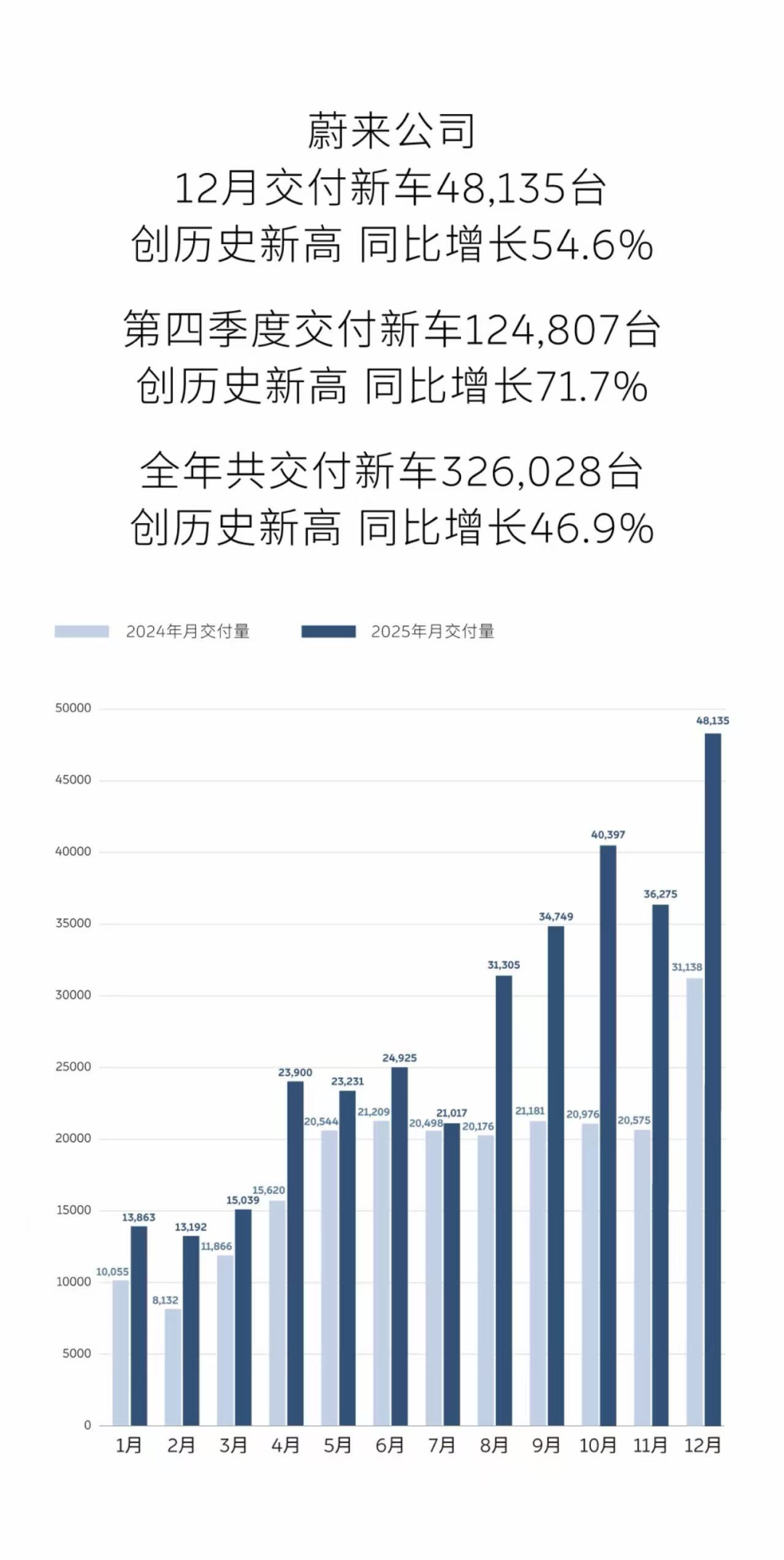
Core Insights - NIO achieved a significant milestone with the production of its one millionth vehicle on January 6, 2026, marking a return to rapid growth and setting new sales records for December 2025 and the entire year [1][2] - CEO Li Bin emphasized the need for continuous effort and strategic focus in his internal communication, highlighting the importance of building a solid foundation for long-term development [1][10] Sales Performance - In December 2025, NIO delivered 48,135 vehicles, a year-on-year increase of 54.6%, and for the fourth quarter, total deliveries reached 124,807, up 71.7% year-on-year [1] - The total vehicle deliveries for 2025 amounted to 326,028, reflecting a 46.9% year-on-year growth, all of which are historical highs for the company [1] Growth Strategy - NIO is entering a third growth phase, aiming for annual growth rates of 40-50% while focusing on maintaining stable and rapid growth [2] - The company plans to expand into lower-tier markets by opening integrated stores for its three brands: NIO, Lado, and Firefly [7] Product Development and Market Position - The new ES8 model achieved a record monthly delivery of 22,256 units, setting a new benchmark for vehicles priced above 400,000 yuan [6] - The multi-brand strategy is proving effective, with the Firefly model also surpassing 7,000 units in monthly sales, indicating a successful synergy among NIO's brands [6] Technological Advancements - NIO's investments in technology and infrastructure are beginning to yield results, with the launch of self-developed platforms and chips enhancing product competitiveness and reducing costs [6][12] - The company has established nearly 3,700 battery swap stations nationwide, significantly alleviating range anxiety for electric vehicle users [7] Organizational Efficiency - Li Bin noted that organizational changes have strengthened operational efficiency and cost control, which are crucial for competing in the market [9][10] - The implementation of the CBU (Core Business Unit) mechanism has led to a more focused approach on core operations, enhancing execution capabilities [9][10] Market Outlook - Li Bin predicts that by 2030, the penetration rate of new energy vehicles will exceed 90%, with pure electric vehicles accounting for over 80% of the market [11][16] - The market is shifting favorably for NIO, as pure electric vehicles are becoming the dominant choice, with significant growth in the large SUV segment [18]

国补落地及2026年消费趋势判断
2026-01-04 15:35
Summary of Conference Call Notes Industry Overview - The conference call primarily discusses the **automobile** and **home appliance** industries in China, focusing on government subsidy policies and their implications for market dynamics and consumer behavior [1][2][20]. Key Points on Government Subsidies - **2025 National Subsidy Funding**: The funding mainly comes from special government bonds, with a total government debt of **14 trillion RMB**. The narrow deficit is **5.66 trillion RMB**, and special bonds amount to **1.8 trillion RMB** [2][3]. - **Subsidy Strategy Changes**: The automobile industry will see a shift to a high-price, high-subsidy and low-price, low-subsidy model, which is expected to reduce demand. The subsidy for electric vehicles and traditional vehicles will be adjusted based on vehicle price [2][14]. - **Impact on Tax Revenue**: Consumer subsidies are expected to increase sales and tax revenues, but the tax revenue growth rate is projected to be **2%**, lower than the nominal GDP growth rate of **4%**, indicating fiscal pressure [9]. Automobile Industry Insights - **Market Trends**: The automobile sector is expected to face a decline in domestic demand by **3-4%** in 2026, but the penetration rate of new energy vehicles is anticipated to increase by **4-5%**. Exports are expected to grow by **15%**, with new energy vehicle exports increasing by **35%** [14][19]. - **Investment Opportunities**: Key growth areas include international expansion, high-end market development, and smart technology integration, particularly in L4 autonomous driving [15][17]. - **Consumer Behavior**: There is a significant consumer wait-and-see attitude, with **40-60%** of consumers hesitant to make purchases, leading to inventory buildup [19]. Home Appliance Industry Insights - **Subsidy Policy Changes for 2026**: The number of subsidized categories will be reduced from **12 to 6**, focusing on energy-efficient products. The maximum subsidy per product will decrease from **2000 RMB to 1500 RMB** [20]. - **Market Performance**: The home appliance sector showed mixed results in 2025, with overall sales growth in the first half but a decline in the second half due to tightening policies and high base effects [21]. - **Future Outlook**: If the government continues to provide **80 billion RMB** in subsidies, the home appliance market is expected to see modest growth, with air conditioning sales projected to increase by **4.7%** under reduced subsidy effectiveness [22]. Competitive Landscape - **Market Dynamics**: The competitive landscape in the home appliance industry is shifting towards larger companies like Midea and Haier, which are enhancing shareholder returns through dividends and stock buybacks. Emerging markets and new product exports are becoming crucial for growth [24]. - **Investment Potential**: The two-wheeler market and emerging products like robotic vacuums are highlighted as having strong investment potential due to resilient demand and low valuations [23]. Conclusion - The conference call emphasizes the cautious approach of the government in adjusting subsidy policies to stabilize investment and consumption while addressing fiscal pressures. The automobile and home appliance industries are adapting to these changes, with a focus on innovation and international expansion as key growth strategies.
2025 年11月重卡行业月报:11月重卡延续高景气,新能源再创新高-20251216
GUOTAI HAITONG SECURITIES· 2025-12-16 01:24
Investment Rating - The report assigns an "Overweight" rating for the heavy truck industry [4]. Core Insights - The report highlights that in November, domestic heavy truck sales reached 113,000 units, representing a year-on-year increase of 65% and a month-on-month increase of 7%. The cumulative sales from January to November reached 1.041 million units, up 27% year-on-year [2][4]. - The report anticipates a gradual recovery in heavy truck sales due to the economic recovery and the introduction of the "old-for-new" policy in 2025, projecting sales of 1.117 million units for 2025, a 24% increase year-on-year [4]. - The report emphasizes the growing penetration of new energy heavy trucks, expecting the penetration rate to reach 18% by 2025, driven by technological advancements and cost reductions [4]. Summary by Sections Sales Performance - In November, the sales structure of heavy trucks showed that semi-trailer trucks accounted for 51.7%, cargo trucks for 27.0%, and non-complete vehicles for 21.2%. The sales of semi-trailer trucks reached 62,000 units, up 85% year-on-year, while heavy cargo truck sales were 29,000 units, up 61% year-on-year [4]. - The report notes that the sales of domestic natural gas heavy trucks in November were 19,000 units, a significant increase of 154% year-on-year, although it saw a month-on-month decline of 12% [4]. Market Trends - The report indicates that the heavy truck market's high prosperity in November is attributed to the tail effect of the "old-for-new" policy and the continuation of the traditional peak season for heavy trucks [4]. - The report also highlights that the penetration rate of natural gas in heavy trucks was 17% in November, with expectations for further growth due to the economic advantages of natural gas vehicles for high-mileage operations [4]. Company Recommendations - The report recommends several companies for investment, including Weichai Power, China National Heavy Duty Truck Group, CIMC Vehicles, Foton Motor, and FAW Jiefang, based on their growth potential and market positioning [4].
新能源行业周报:硅料收储平台公司落地,特高压迎来密集核准-20251214
Guohai Securities· 2025-12-14 11:10
Investment Rating - The industry investment rating is "Recommended (Maintain)" [1] Core Views - The establishment of a silicon material storage platform company enhances confidence in the profitability reversal of the photovoltaic industry. The platform, with a registered capital of 3 billion yuan, is expected to confirm reasonable pricing and storage targets for polysilicon sales [5][6] - The wind power sector shows strong bidding activity, with domestic land wind turbine bidding reaching 5.06GW in December, indicating sustained high demand [6][7] - The energy storage market is experiencing significant growth, with over 1,600 new user-side storage projects added in the first ten months of 2025, reflecting a 26% increase in project numbers and an 86% increase in installed capacity year-on-year [6][7] - The lithium battery industry is advancing solid-state battery layouts, with companies actively pursuing strategic partnerships and price adjustments in response to rising raw material costs [7][8] Summary by Sections Photovoltaic Sector - The establishment of the silicon material storage platform is expected to lead to increased registered capital and improved pricing strategies for polysilicon [5] - Demand remains weak in the short term, with component manufacturers planning significant production cuts in December [6] Wind Power Sector - Domestic land wind turbine bidding has reached 5.06GW, with a notable increase in procurement for both land and offshore wind projects [6] - The average bidding price for new land wind projects has shown a recovery, indicating a positive trend in the market [6] Energy Storage Sector - The user-side energy storage market is rapidly growing, with significant increases in both project numbers and installed capacity [6] - A major independent energy storage project in Inner Mongolia has commenced operations, highlighting the sector's development [6] Lithium Battery Sector - Companies are focusing on solid-state battery innovations and adjusting prices due to rising production costs [7] - The price transmission within the lithium battery supply chain is improving, with leading companies actively managing supply and customer relationships [7]
乘用车终端需求跟踪及展望
2025-12-01 16:03
Summary of Conference Call Records Industry Overview: Automotive Market Key Insights and Arguments - The automotive market in 2025 is significantly influenced by policy changes, with subsidy reductions and stricter measures expected to suppress consumption, particularly affecting the economy car segment [1][4] - In October, discounts on vehicles increased but did not lead to a price war; brands like BYD and Geely launched new models while older models saw moderate price reductions [1][6] - The penetration rate of new energy vehicles (NEVs) in 2026 will depend on the continuation of policies and technological upgrades, with trends towards larger batteries, longer ranges, and fast-charging technologies [1][8] - High-end joint venture brands are expected to continue losing market share, especially in the price range above 250,000 yuan, due to competition from domestic NEVs [1][9] Market Demand and Trends - Overall demand and foot traffic in November decreased compared to October, primarily due to a pause in subsidy policies leading to consumer hesitation [2] - December is expected to see a rebound in demand, but year-on-year comparisons will still show a decline due to inventory clearance needs and potential tax increases from new technology [2][5] - The first quarter of 2026 is anticipated to be optimistic due to seasonal sales and government subsidies, although challenges are expected in March and April, particularly for economy cars [5][16] Discount and Pricing Strategies - Discounts in October and November were deeper than in September, particularly during the National Day holiday, but did not violate regulatory policies [6] - Discounts for brands like BYD and Xpeng decreased by approximately 10% in November compared to October, indicating a shift in pricing strategies [6] Company-Specific Insights BYD - BYD plans to launch the M6 and a new generation of plug-in hybrid technology in 2026, aiming to enhance electric range and low-temperature fast-charging capabilities [3][12] - Domestic retail sales for BYD in 2025 are projected to be between 3.2 to 3.3 million units, a decline from 3.5 million units in 2024, but a recovery is expected in 2026 with about 10% growth [13] Tesla - Tesla's market outlook for the next two years is cautious, with expectations of stagnation or potential decline unless improvements in their Full Self-Driving (FSD) technology are made [11] - The introduction of lower-priced Model 3 and Model Y variants is anticipated to expand market share in the first quarter of 2026 [11] Xiaomi - Xiaomi's current monthly delivery volume is around 50,000 units, with a significant portion of orders being speculative due to the second-hand market collapse [17] - The delivery cycle is currently projected at 20 to 25 weeks, but actual delivery may take longer, leading to an order backlog [17] Joint Venture Brands - High-end joint venture brands like BMW and Mercedes are expected to face significant pressure, particularly in the mid-range segment, while lower-priced joint venture brands remain competitive due to a lack of strong rivals [10] Future Challenges - The implementation of the trade-in policy has been smooth initially, but challenges are expected in March and April 2026 due to diminishing subsidy levels and potential inventory issues [16] Additional Important Insights - The competition between BYD and Geely in technology upgrades is likely to intensify, with both companies aiming to push the NEV penetration rate above 60% by March 2026 [1][8] - The market for traditional fuel vehicles is expected to face challenges from the increasing presence of electric models, particularly in the under 100,000 yuan segment [10]

乘联分会:11月狭义乘用车零售预计225万辆,新能源预计135万辆
Zheng Quan Shi Bao Wang· 2025-11-21 14:07
Core Viewpoint - The automotive market in November is entering a year-end sprint phase, supported by manufacturers' "Double Eleven" promotional activities, but consumer sentiment is affected by adjustments in trade-in and subsidy policies, leading to increased uncertainty in the market [1] Market Overview - The narrow passenger vehicle retail market is expected to reach approximately 2.25 million units in November, remaining stable month-on-month but showing a year-on-year decline of 8.7% [1] - The retail sales of new energy vehicles are projected to be around 1.35 million units, with a penetration rate expected to rise to 60% [1]