
宁波银行

Search documents
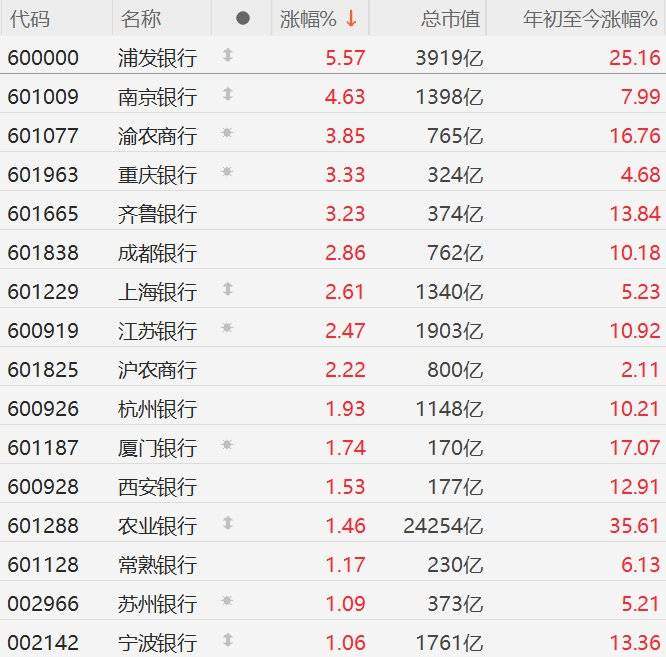
A股银行股逆势上涨,浦发银行涨超5%,南京银行涨超4%,渝农商行、重庆银行、齐鲁银行涨超3%,成都银行、上海银行涨超2%
Ge Long Hui· 2025-10-13 05:57
Core Insights - The A-share market has seen a rise in bank stocks, with notable increases in shares of several banks, particularly Shanghai Pudong Development Bank, which rose over 5% [1] - Shanghai Pudong Development Bank announced that Dongfang Asset Management increased its stake in the bank through the secondary market by purchasing common shares and converting convertible bonds [1] Summary by Category Stock Performance - Shanghai Pudong Development Bank (600000) increased by 5.57%, with a total market capitalization of 391.9 billion and a year-to-date increase of 25.16% [2] - Nanjing Bank (601009) rose by 4.63%, with a market cap of 139.8 billion and a year-to-date increase of 7.99% [2] - Other banks such as Chongqing Bank (601963) and Qilu Bank (601665) also saw increases of 3.33% and 3.23% respectively [2] Market Capitalization - The total market capitalization of major banks includes: - Agricultural Bank of China (601288) at 2,425.4 billion, with a year-to-date increase of 35.61% [2] - Jiangsu Bank (600919) at 190.3 billion, with a year-to-date increase of 10.92% [2] - Chengdu Bank (601838) at 76.2 billion, with a year-to-date increase of 10.18% [2] Investment Activity - Dongfang Asset Management's acquisition of shares in Shanghai Pudong Development Bank indicates a positive outlook and confidence in the bank's future performance [1]






多家银行提示贵金属业务风险 金价创历史新高波动加剧
Zhong Guo Neng Yuan Wang· 2025-10-13 02:16
Group 1 - The international spot gold price has surpassed $4000 per ounce, reaching a historical high with an annual increase of over 53% [1] - Several banks, including China Construction Bank and Industrial and Commercial Bank of China, have issued risk warnings regarding precious metals business, advising clients to manage their positions and invest rationally [1][2] - Industrial and Commercial Bank of China has raised the minimum investment threshold for its gold accumulation business from 850 yuan to 1000 yuan, while maintaining the minimum accumulation starting point at 1 gram for other methods [1] Group 2 - Multiple banks, including Bank of China and Agricultural Bank of China, have adjusted their precious metals-related services, including increasing investment thresholds and adjusting margin levels [2] - The rise in gold prices is attributed to investor confidence in the Federal Reserve's interest rate cut cycle, a weaker dollar, and geopolitical uncertainties such as the U.S. government shutdown and the Russia-Ukraine conflict [2] - UBS Wealth Management indicates that the demand for defensive assets has significantly increased amid economic uncertainty and geopolitical changes, with a smooth upward logic for precious metals in the fourth quarter [2]
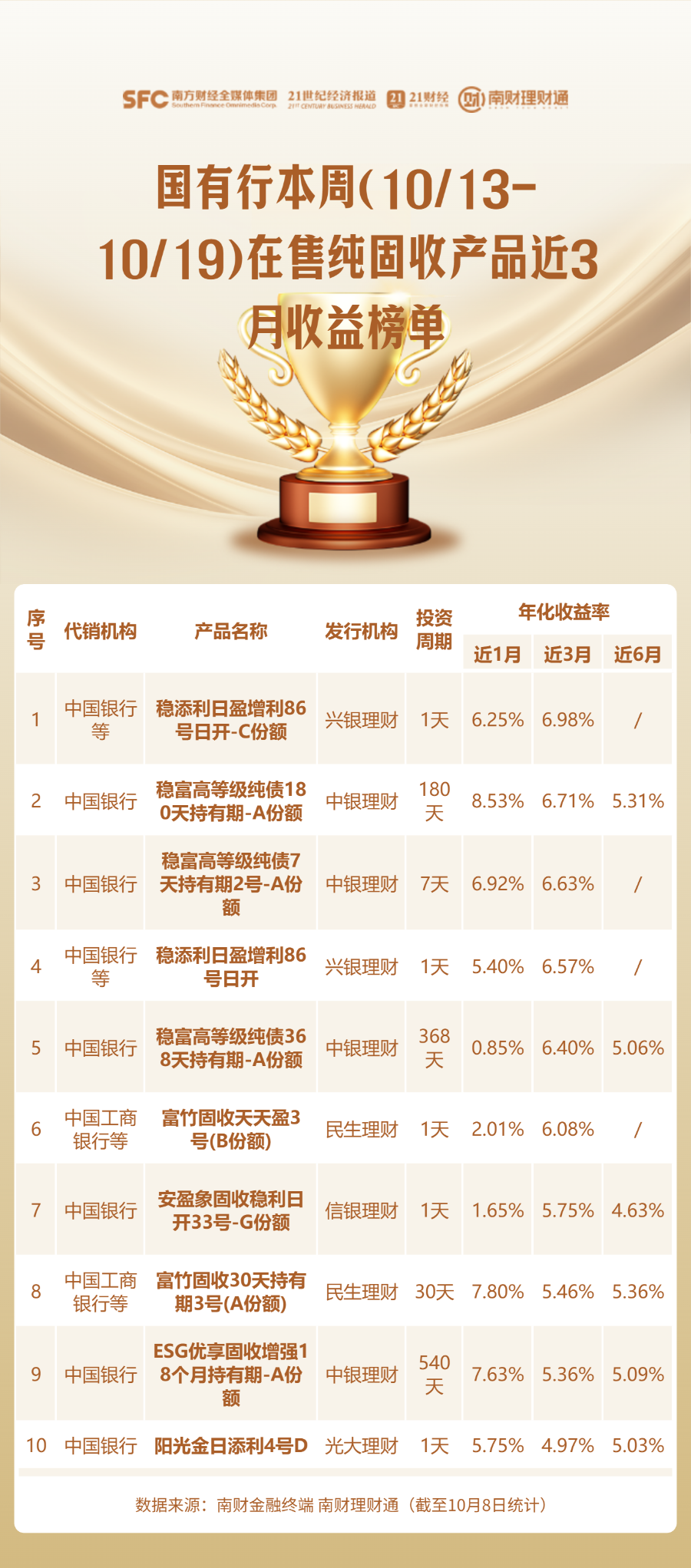
银行渠道本周在售纯固收理财产品榜单(10/13-10/19)
2 1 Shi Ji Jing Ji Bao Dao· 2025-10-13 01:16
Core Insights - The article discusses the diverse range of bank wealth management products available, emphasizing the need for investors to discern and select suitable options amidst similar-sounding and vaguely characterized products [1] - The South Finance Wealth Management team compiles a weekly performance ranking of wealth management products sold through various distribution channels, focusing on those with outstanding performance [1] - The ranking criteria include product type, specifically targeting pure fixed income, "fixed income plus," and mixed products, along with performance stability, requiring a minimum of three months of performance data [1] Product Performance Summary - The ranking showcases annualized performance over the past month, three months, and six months, sorted by the three-month annualized return to reflect multidimensional performance during recent market fluctuations [1] - The current focus is on pure fixed income products issued by wealth management companies, highlighting those available for investors through distribution channels [1] Distribution Institutions - A total of 28 distribution institutions are mentioned, including major banks such as Industrial and Commercial Bank of China, Bank of China, Agricultural Bank of China, and others [2] - The ranking's assessment of the "on-sale" status of wealth management products is based on their investment cycle, but actual availability may vary due to factors like sold-out quotas or differences in product listings for different customers [2] Performance Data - The article provides specific performance data for various wealth management products, including annualized returns and investment periods, with notable products listed from institutions like Bank of China and Minsheng Bank [5][7][10] - For instance, products from Bank of China show annualized returns ranging from 5.40% to 8.53% over different holding periods, indicating competitive performance in the current market [5][10]





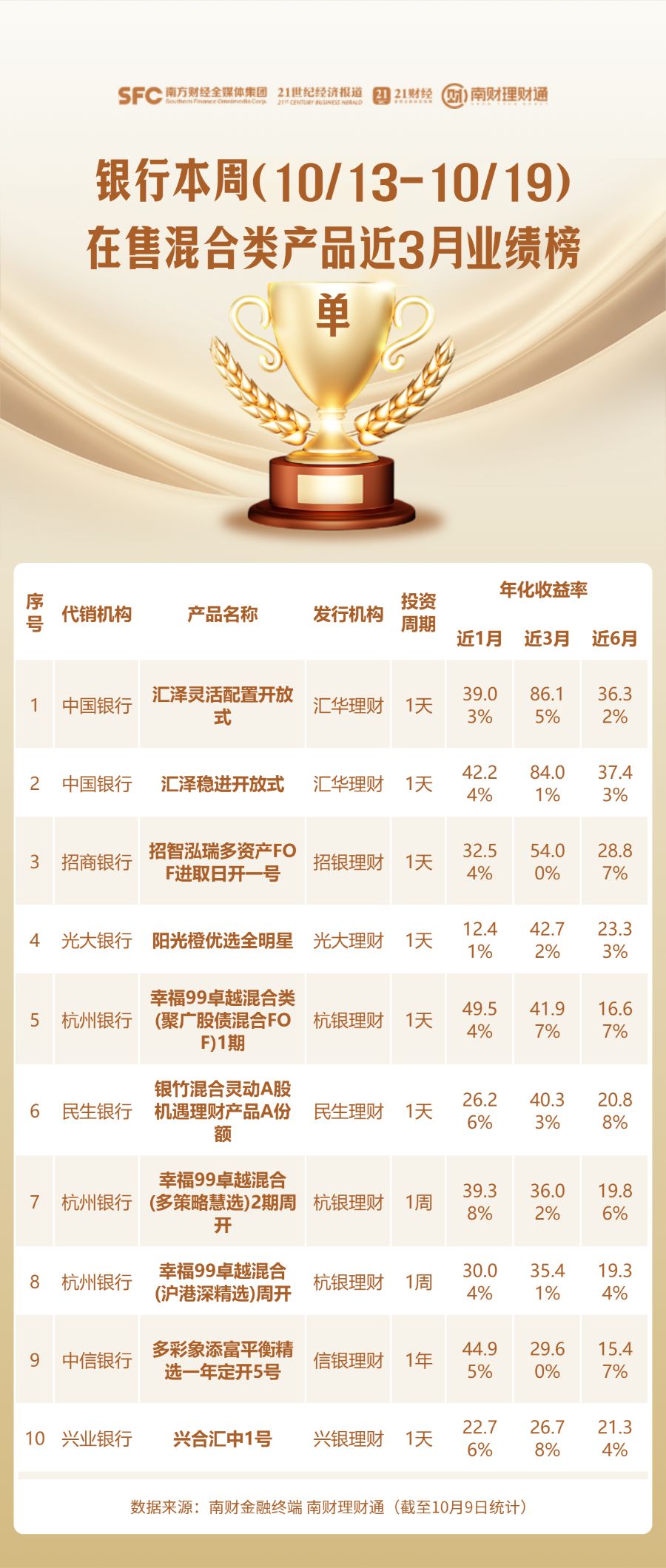
银行渠道本周在售混合类理财产品榜单(10/13-10/19)
2 1 Shi Ji Jing Ji Bao Dao· 2025-10-13 01:16
Core Insights - The article emphasizes the abundance of bank wealth management products with similar names and vague characteristics, urging investors to carefully select and identify suitable options [1] - A performance ranking list of wealth management products is provided, focusing on those with strong performance in the past three months, to assist investors in making informed choices [1] Product Selection Criteria - The ranking is based on two main criteria: product type, specifically focusing on pure fixed income, "fixed income plus," and mixed products; and performance stability, requiring products to have been established for at least three months to ensure sufficient performance data [1] - The sample includes publicly offered RMB wealth management products [1] Performance Metrics - The ranking displays annualized performance over the past month, three months, and six months, sorted by the annualized return over the last three months to reflect multidimensional performance amid recent market fluctuations [1] Featured Products - The article highlights mixed products issued by wealth management companies, providing a selection of currently available products through distribution channels [1] - A detailed performance table lists various products from different banks, including their annualized returns and investment durations, showcasing the top-performing options [4]


银行渠道本周在售最低持有期产品榜单(10/13-10/19)
2 1 Shi Ji Jing Ji Bao Dao· 2025-10-13 01:09
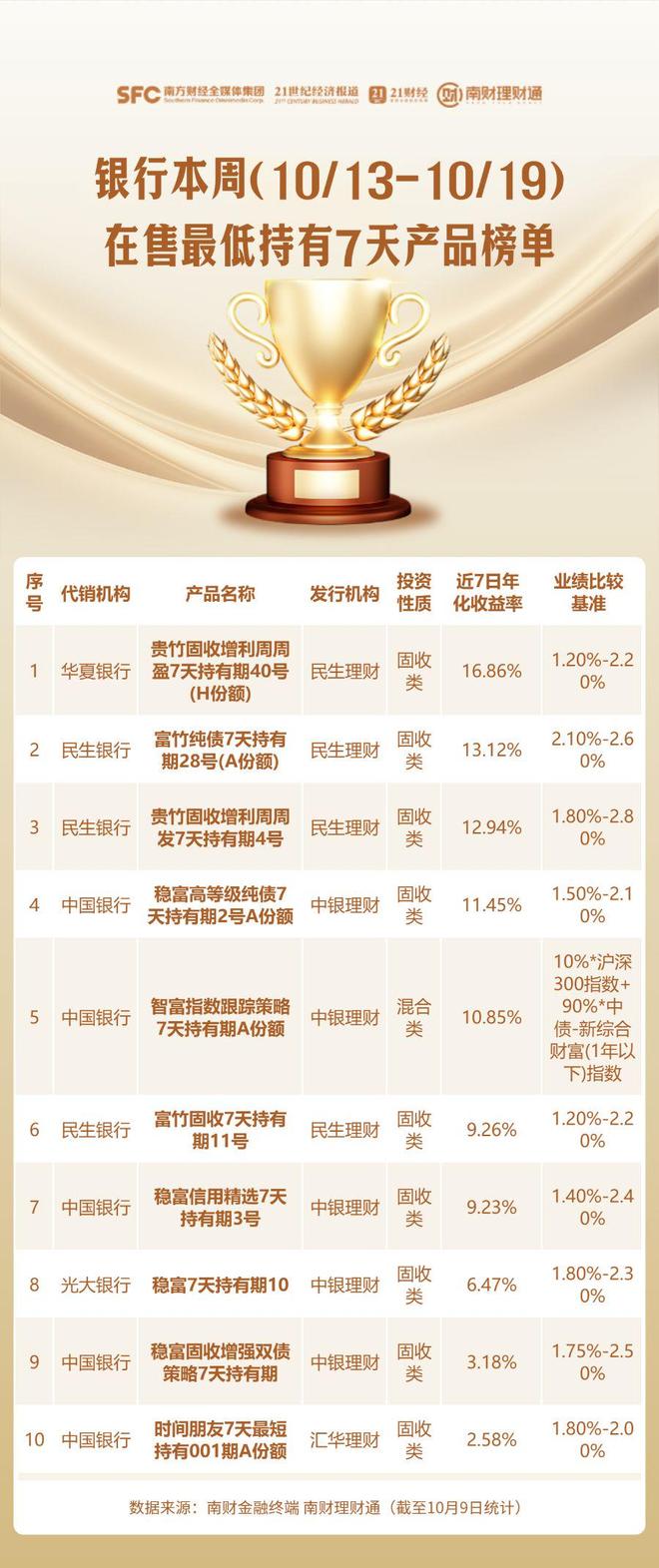
Core Insights - The article focuses on the performance of bank wealth management products with varying minimum holding periods, specifically highlighting the annualized returns of these products to assist investors in making informed choices [1][2]. Summary by Categories 7-Day Holding Period Products - The top-performing product is from Huaxia Bank, with an annualized return of 16.86% [4]. - Other notable products include: - Minsheng Bank's "Fuzhu Pure Bond" at 13.12% [4]. - Minsheng Bank's "Guizhu Fixed Income" at 12.94% [4]. - Bank of China’s "Stable Wealth High-Grade Pure Bond" at 11.45% [4]. 14-Day Holding Period Products - Minsheng Bank's "Guizhu Fixed Income" leads with a return of 13.71% [7]. - Other significant products include: - Minsheng Bank's "Fuzhu Pure Bond" at 10.97% [7]. - Bank of China's "Stable Wealth Fixed Income" at 9.67% [7]. 30-Day Holding Period Products - Minsheng Bank's "Fuzhu Pure Bond" has an annualized return of 9.51% [9]. - Other key products include: - Minsheng Bank's "Guizhu Fixed Income" at 8.99% [10]. - Bank of China's "Stable Wealth Preferred" at 7.13% [10]. 60-Day Holding Period Products - Bank of China's "Smart Wealth Index Tracking Strategy" tops the list with a return of 23.99% [12]. - Other notable products include: - Minsheng Bank's "Fuzhu Pure Bond" at 7.48% [12]. - Bank of China's "Stable Wealth Credit Selection" at 6.31% [12].
贵金属价格波动加剧 一批银行提示业务风险
Zheng Quan Shi Bao· 2025-10-12 18:36
Core Insights - International spot gold prices have surged past $4000 per ounce in October, reaching a historic high, followed by significant volatility [1] - Several banks are adjusting their precious metals business strategies in response to increased market risks, including raising investment thresholds and enhancing risk awareness [1][2] Group 1: Bank Responses - China Construction Bank has issued a warning regarding heightened market risks and advised investors to manage their positions and margin balances carefully [1] - Industrial and Commercial Bank of China has also raised the minimum investment amount for its gold accumulation business from 850 yuan to 1000 yuan, while maintaining the minimum for accumulation by weight at 1 gram [1] - Other banks, including Bank of China and Agricultural Bank of China, have similarly adjusted their precious metals-related services, focusing on increasing investment thresholds and modifying margin levels [2] Group 2: Market Conditions - The recent fluctuations in precious metals prices are attributed to various factors contributing to market instability, prompting banks to enhance their risk management protocols [1][2] - The adjustments made by banks are primarily affecting gold accumulation services and the agency business for trading precious metals on the Shanghai Gold Exchange [2]

长江证券(上海)资产管理有限公司关于长江乐盈定期开放债券型发起式证券投资基金第二十七个开放期开放申购与赎回业务的公告
Shang Hai Zheng Quan Bao· 2025-10-12 17:31
Group 1 - The core announcement is regarding the 27th open period of the Changjiang Leying Regular Open Bond Fund, which will be from October 15, 2025, to October 28, 2025, allowing investors to subscribe and redeem fund shares during this period [1][2] - The fund operates on a regular open-end basis, with a closed period of three months, during which no subscription or redemption is allowed [1][2] - The fund's 27th closed period is from July 15, 2025, to October 14, 2025, after which it will enter the 28th closed period starting October 29, 2025 [2] Group 2 - The minimum subscription amount for investors through sales institutions is set at RMB 10, including subscription fees, while the minimum for additional subscriptions is RMB 1 [4] - For direct sales through the fund manager, the minimum initial subscription is RMB 1, and additional subscriptions are also RMB 1 [5] - The fund manager may adjust the minimum subscription amounts based on market conditions, with prior announcement required [5] Group 3 - The fund charges a subscription fee that decreases as the subscription amount increases, following a front-end fee model [6] - The fund manager will confirm the validity of subscription applications within one business day (T+1) after submission [7] - Investors must ensure they have sufficient fund shares for redemption; otherwise, the redemption application will not be valid [10] Group 4 - The minimum redemption request is set at 10 fund shares, but if a transaction results in a balance of fewer than 10 shares, the sales institution may process a full redemption [8] - Redemption fees are incurred by the fund share holder and are used to cover necessary fees [9] - The fund manager will process redemption payments within seven business days (T+7) after the application is confirmed [10] Group 5 - The fund's direct sales institution is Changjiang Securities (Shanghai) Asset Management Co., Ltd., with a customer service hotline provided for inquiries [11] - The fund will disclose its net asset value at least weekly during closed periods and daily during open periods [12] - Investors are encouraged to refer to the fund's official website for detailed information and updates regarding the fund [13]

多张罚单曝银行审查漏洞
Di Yi Cai Jing· 2025-10-12 13:41
Core Insights - Regulatory scrutiny on personal business loans misused in the real estate market has intensified in 2023, with multiple banks facing penalties for improper loan management and misuse of funds [2][3] - Business loans, originally intended to support small and micro enterprises, have increasingly been repackaged as substitutes for housing loans, leading to emerging risks as these loans reach maturity [2][3] Regulatory Actions - Local financial regulatory bodies have issued fines to various banks for issues such as misappropriation of loan funds and inadequate credit management, with penalties ranging from 55,000 to 1,150,000 yuan [3] - A common violation noted is the issuance of business loans to public officials, highlighting systemic issues in loan distribution practices [3] Loan Misuse and Risks - The interest rates for business loans from 2020 to 2023 ranged from 3% to 4%, significantly lower than housing loan rates, prompting banks to relax their approval processes [3][4] - A complete "arbitrage industry chain" has emerged around the misuse of business loans, involving the creation of fake business entities and fraudulent transactions to redirect funds into the real estate market [4][5][6] Maturity Risks - 2025 marks a critical point as many business loans issued between 2020 and 2023 will reach their maturity, coinciding with declining real estate valuations and increasing borrower financial strain [7][8] - Many borrowers are facing significant shortfalls between their loan balances and the depreciated value of their collateral, leading to potential defaults [8] Regulatory Response - In response to rising risks, regulators are promoting "substantive penetration" management, which includes banning partnerships with loan intermediaries and implementing stricter monitoring of loan flows [9] - Banks are encouraged to utilize technology for tracking loan usage and assessing the real operational status of borrowers, aiming to prevent misuse of funds [9]

多张罚单曝银行审查漏洞
第一财经· 2025-10-12 13:34
Core Viewpoint - The article discusses the increasing regulatory scrutiny on the misuse of personal business loans (referred to as "operating loans") in the real estate market, highlighting the risks associated with these loans as they approach their maturity period [3][10]. Regulatory Focus on Misuse - Local financial regulatory authorities have issued fines to several banks for issues such as misappropriation of loan funds, inadequate credit reviews, and poor post-loan management [5][6]. - Specific cases include fines of 550,000 yuan for a bank in Zhejiang for misusing loan funds and 1.15 million yuan for a branch of the Industrial and Commercial Bank of China for inadequate credit checks [5][6]. The "Fake Operating Loan" Arbitrage Chain - An arbitrage industry has emerged around the misuse of operating loans, involving three main steps: creating fake business entities, falsifying transactions and cash flows, and redirecting funds to the real estate market [8][9]. - The process often involves intermediaries who assist in creating shell companies and falsifying documents to disguise the true purpose of the loans [9]. Concentrated Maturity Risk - 2025 marks a critical point as many operating loans issued between 2020 and 2023 will reach maturity, coinciding with declining real estate valuations, which poses risks for borrowers [10][11]. - Borrowers are facing challenges in meeting repayment obligations, leading to increased reliance on bridge financing, which compounds their financial burdens [12]. Regulatory Push for "Substantive Penetration" Management - In response to the risks, regulatory bodies are advocating for "substantive penetration" management, which includes banning partnerships with loan intermediaries and enhancing monitoring of loan flows using technology [13][14]. - The focus is on ensuring that genuine business operators can access loans while preventing misuse, rather than simply tightening lending standards [14].

房价下跌后经营贷套利链条断裂,多张罚单曝银行审查漏洞
Di Yi Cai Jing· 2025-10-12 12:34
Core Insights - The article highlights the increasing regulatory scrutiny on personal business loans (operating loans) that have been misused in the real estate market, revealing a growing risk as these loans approach their maturity phase [1][6]. Regulatory Focus - Local financial regulatory bodies have issued fines to several banks for misappropriating loan funds, with penalties ranging from 550,000 to 1,150,000 yuan for various infractions, including issuing loans to public officials and inadequate credit management [2][3]. - The misuse of operating loans has been prevalent, particularly among local banks and city commercial banks, with interest rates for these loans being significantly lower than those for housing loans, leading to relaxed scrutiny by banks [2][5]. Risk of Misuse - A complete "arbitrage industry chain" has emerged around the misuse of operating loans, involving the creation of fake business entities, falsification of transactions, and ultimately redirecting funds to the real estate market [4][5]. - The period from 2020 to 2023 saw a surge in these practices, with some loans having interest rates as low as 2%, which attracted significant capital into the housing market [5]. Concentrated Maturity Risk - 2025 is identified as a critical year for the maturity of operating loans issued between 2020 and 2023, with many borrowers facing financial strain due to declining property valuations [7]. - Borrowers are increasingly resorting to "bridge financing" to avoid defaults, leading to escalating costs due to intermediary fees and interest [7]. Rising Default Rates - The default rates on operating loans are climbing, with some banks reporting rates above the average for all loans, indicating a growing risk exposure for financial institutions [7]. - The complexity of fund flows and the difficulty in monitoring them have made traditional post-loan management ineffective [7]. Regulatory Response - In response to these risks, regulatory authorities are promoting "substantive penetration" management, which includes banning partnerships with loan intermediaries and implementing technology to track loan flows [8]. - The focus is on ensuring that genuine business operators can access loans while preventing misuse, emphasizing the need for precise monitoring rather than blanket restrictions [8].