苏州银行

Search documents
平安人寿2025年四度举牌农行H股,险资年内举牌7家银行
Jin Rong Jie· 2026-01-06 04:49
Group 1 - Ping An Life increased its holdings in Agricultural Bank of China (ABC) H-shares to 20% of the total H-share capital by acquiring 95.582 million shares on December 30, 2025, marking its fourth stake increase in 2025 [1] - From February 17 to December 30, 2025, Ping An Life cumulatively acquired over 4.69 billion H-shares of ABC, bringing its total holdings to approximately 6.18 billion H-shares by the end of December [1] - In addition to H-shares, Ping An Life entered the top ten shareholders of ABC A-shares in Q3 2025, holding 4.913 billion A-shares by the end of September, which could lead to total holdings of at least 11.09 billion shares (3.17% of total capital) if no reduction occurs in Q4 [1] Group 2 - In the A-share market, insurance funds continued to increase their stakes in bank stocks, with five insurance companies entering the top ten shareholders of six A-share listed banks in Q3 2025 [2] - China Life became a top ten shareholder in both Industrial and Commercial Bank of China and Nanjing Bank, while other insurers like Lian'an Life and Dongwu Life also entered the top ten of various banks [2] - By the end of September 2025, at least two insurance companies appeared in the top ten shareholders of 12 listed banks, indicating a growing trend of insurance capital in the banking sector [2]
农行,又又又被举牌!
券商中国· 2026-01-05 23:30
港交所披露易最新信息显示,平安人寿于2025年12月30日增持9558.2万股农业银行H股股份后,于当日达到该 行H股股本的20%,根据香港市场规则,触发举牌。 险资扫货不停! 在此之前,平安人寿曾在2025年2月17日、5月12日、8月26日分别举牌农行H股,所持该行H股数量占其H股总 数分别突破5%、10%、15%。 据统计,2025年合计7家上市银行被险资举牌。其中,农行H股、郑州银行H股均获四度举牌;招商银行H股、 邮储银行H股均被三度举牌。 四度举牌农行H股 披露易信息显示,早在2025年2月17日,平安人寿就首次举牌农行H股,所持该行H股数量当时就达到该行H 股股本的5%。 5月12日,平安人寿又耗资约7.1亿港元,在场内增持近1.47亿股农行H股,持股占比突破该行H股总数的 10%,构成二度举牌。 8月26日,再度增持829万股农行H股股份之后,平人寿所持该行农行H股总数已达该行H股股本的15%,构 成第三次举牌。 披露易最新消息显示,平安人寿于12月30日继续增持9558.2万股农行H股股份,达到该行H股股本的20%, 完成第四次举牌。 以此计算,2月17日至12月30日,平安人寿合计增持超过 ...



19家上市银行加码财富管理赛道,2026年战略布局将提速
Di Yi Cai Jing· 2026-01-05 12:50
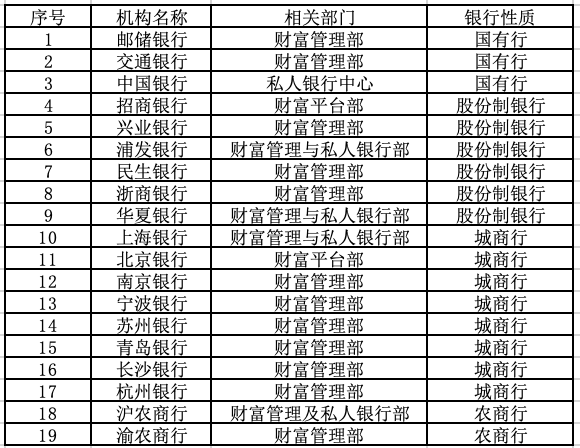
Core Insights - The rapid expansion of high-net-worth client groups is prompting domestic listed banks to accelerate the establishment of dedicated wealth management departments, shifting their retail banking strategy from "product sales" to "full lifecycle asset allocation" [1][2] - By the end of 2025, 19 listed banks are expected to have established or adjusted their wealth management-related departments, including 3 state-owned banks, 6 joint-stock banks, 8 city commercial banks, and 2 rural commercial banks [2][3] Group 1: Wealth Management Department Establishment - State-owned banks like Postal Savings Bank, Bank of China, and Bank of Communications are completing wealth management business integration at the head office level by 2025 [1][4] - Joint-stock banks and city commercial banks are adopting a model that integrates wealth management with private banking, with several banks like Shanghai Bank and Hangzhou Bank establishing new wealth management departments [5][6] Group 2: Strategic Shifts and Market Positioning - The establishment of wealth management departments reflects a strategic shift towards enhancing professional capabilities and resource integration, aiming to upgrade wealth management as a core strategy for banks [7][8] - Compared to state-owned banks, joint-stock banks and city commercial banks focus on precise market positioning, with banks like China Merchants Bank prioritizing wealth management as a core capability [7][8] Group 3: Growth and Performance Metrics - As of Q3 2025, the wealth management AUM of listed banks continues to expand, with Postal Savings Bank reaching 17.89 trillion yuan and significant growth rates reported by other banks [9] - The future of wealth management business is expected to accelerate due to the continuous accumulation of resident wealth and the diversification of high-net-worth client needs, with strategic investments and organizational adjustments being crucial for competitive positioning [9]
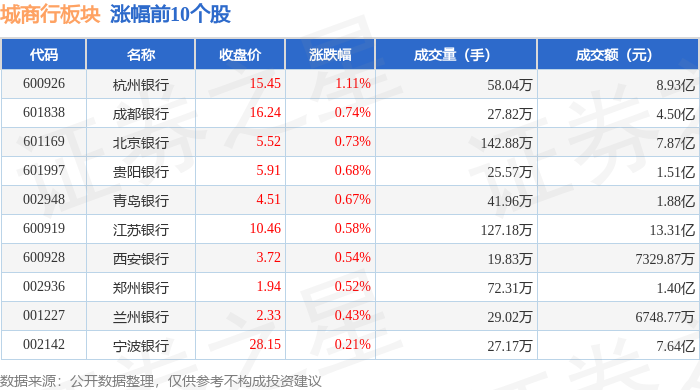
城商行板块1月5日涨0.26%,杭州银行领涨,主力资金净流入3.8亿元
Zheng Xing Xing Ye Ri Bao· 2026-01-05 09:09
Market Overview - The city commercial bank sector increased by 0.26% on January 5, with Hangzhou Bank leading the gains [1] - The Shanghai Composite Index closed at 4023.42, up by 1.38%, while the Shenzhen Component Index closed at 13828.63, up by 2.24% [1] Individual Bank Performance - Hangzhou Bank (600926) closed at 15.45, with a rise of 1.11% and a trading volume of 580,400 shares, amounting to a transaction value of 893 million yuan [1] - Chengdu Bank (601838) closed at 16.24, up by 0.74%, with a trading volume of 278,200 shares and a transaction value of 450 million yuan [1] - Beijing Bank (601169) closed at 5.52, increasing by 0.73%, with a trading volume of 1,428,800 shares and a transaction value of 787 million yuan [1] - Guizhou Bank (601997) closed at 5.91, up by 0.68%, with a trading volume of 255,700 shares and a transaction value of 151 million yuan [1] - Qindao Bank (002948) closed at 4.51, increasing by 0.67%, with a trading volume of 419,600 shares and a transaction value of 188 million yuan [1] - Jiangsu Bank (616009) closed at 10.46, up by 0.58%, with a trading volume of 1,271,800 shares and a transaction value of 1.331 billion yuan [1] - Xian Bank (600928) closed at 3.72, increasing by 0.54%, with a trading volume of 198,300 shares and a transaction value of 73.3 million yuan [1] - Zhengzhou Bank (002936) closed at 1.94, up by 0.52%, with a trading volume of 723,100 shares and a transaction value of 140 million yuan [1] - Lanzhou Bank (001227) closed at 2.33, increasing by 0.43%, with a trading volume of 290,200 shares and a transaction value of 67.5 million yuan [1] - Ningbo Bank (002142) closed at 28.15, up by 0.21%, with a trading volume of 271,700 shares and a transaction value of 764 million yuan [1] Capital Flow Analysis - The city commercial bank sector saw a net inflow of 380 million yuan from main funds, while retail funds experienced a net outflow of 134 million yuan [2] - The main funds' net inflow and outflow for individual banks include: - Jiangsu Bank (600919) had a net inflow of 10.4 million yuan, with a 7.78% share of main funds [3] - Shanghai Bank (601229) had a net inflow of 87.04 million yuan, with a 13.64% share of main funds [3] - Hangzhou Bank (600926) had a net inflow of 79.04 million yuan, with an 8.86% share of main funds [3] - Nanjing Bank (600000) had a net inflow of 67.86 million yuan, with a 9.68% share of main funds [3] - Ningbo Bank (002142) had a net inflow of 58.14 million yuan, with a 7.61% share of main funds [3] - Qilu Bank (601665) had a net inflow of 57.72 million yuan, with a 14.60% share of main funds [3] - Qingdao Bank (002948) had a net inflow of 22.18 million yuan, with an 11.82% share of main funds [3] - Suzhou Bank (002966) had a net inflow of 6.29 million yuan, with a 2.71% share of main funds [3] - Xiamen Bank (601187) had a net inflow of 520,450 yuan, with a 5.25% share of main funds [3] - Xian Bank (600928) had a net inflow of 287,550 yuan, with a 3.92% share of main funds [3]


深度学习因子12月超额5.46%,本周热度变化最大行业为有石油石化、建筑装饰:市场情绪监控周报(20251229-20251231)-20260104
Huachuang Securities· 2026-01-04 14:05
- The DecompGRU model was used to construct a weekly long-only stock selection portfolio, holding the top 200 stocks with the highest integrated scores based on the model. The portfolio is rebalanced weekly on the first trading day, using factor values updated after the previous Friday's close. Stocks from the CSI All Share Index are selected, excluding stocks with trading halts or price limits, and transaction costs are not considered. The benchmark for comparison is the CSI All Share equal-weighted index[7][9] - The DecompGRU model's stock scores were aggregated to construct an ETF rotation portfolio. The ETF pool is limited to industry and thematic ETFs, retaining only the ETF with the highest 5-day average trading volume if multiple ETFs track the same index. ETFs must meet minimum trading volume criteria (5-day average > 20 million and 20-day average > 10 million). The portfolio holds 2-6 ETFs per period and is rebalanced weekly without a fixed schedule. The benchmark for comparison is the Wind ETF Index[10][12] - A sentiment factor was constructed using user behavior data from Tonghuashun, aggregating stock-level heat metrics (browsing, watchlist, and click counts) normalized by market share on the same day and multiplied by 10,000. The sentiment factor serves as a proxy for "emotional heat" at the broader index, industry, and concept levels[14] - A simple rotation strategy was built based on weekly heat change rates (MA2 smoothed) for broad-based indices. On the last trading day of each week, the strategy buys the index with the highest heat change rate. If the "Others" group has the highest rate, the strategy remains in cash. The strategy's annualized return since 2017 is 8.74%, with a maximum drawdown of 23.5%. In 2025, the strategy achieved a return of 36.8%, compared to the benchmark's 35%[20][23] - A concept-level sentiment strategy was constructed by selecting the top 5 concepts with the highest weekly heat change rates. Stocks within these concepts were filtered to exclude the bottom 20% by market capitalization. Two portfolios were created: a "TOP" portfolio holding the top 10 stocks by total heat within each concept, and a "BOTTOM" portfolio holding the bottom 10 stocks. The BOTTOM portfolio achieved an annualized return of 15.71% with a maximum drawdown of 28.89%. In 2025, the BOTTOM portfolio returned 41.8%[40][41] - The DecompGRU TOP200 portfolio achieved a cumulative absolute return of 60.48% and an excess return of 34.62% relative to the CSI All Share equal-weighted index since its inception on March 31, 2025. The portfolio's maximum drawdown was 10.08%, with weekly and monthly win rates of 67.50% and 100%, respectively. In December 2025, the portfolio's absolute return was 7.57%, with an excess return of 5.46%[9] - The ETF rotation portfolio achieved a cumulative absolute return of 26.23% and an excess return of 1.56% relative to the Wind ETF Index since its inception on March 18, 2025. The portfolio's maximum drawdown was 7.82%, with weekly and monthly win rates of 60.98% and 66.67%, respectively. In December 2025, the portfolio's absolute return was 2.35%, with an excess return of -1.51%[12][13]
银行资产质量持续巩固
Xiangcai Securities· 2026-01-04 11:25
Investment Rating - The industry rating is maintained at "Overweight" [9][39]. Core Insights - The financial stability report indicates that the asset quality of banks continues to consolidate, with significant progress in resolving debt risks associated with financing platforms and managing risks in small and medium-sized financial institutions [8][36]. - As of the end of 2024, approximately 40% of financing platforms have exited the platform sequence through market-oriented transformations, with the scale of operational financial debt for these platforms around 14.8 trillion yuan, a decrease of about 25% from early 2023 [9][36]. - The average interest rate for newly issued bonds by financing platforms dropped to 2.67% in Q4 2024, a reduction of over 2 percentage points compared to Q1 2023, indicating a significant decrease in financing risk premiums [9][36]. - The overall risk status of national banks is stable, with 71% of the asset scale concentrated in 21 national banks, and the majority of ratings falling within levels 1-5 [9][36]. - The report highlights that there are no "red zone" banks in nine provinces, and the number of "red zone" banks in 13 provinces remains in single digits, indicating a significant reduction in existing risks across most regions [10][36]. Summary by Sections Market Performance - Over the past 12 months, the industry has shown a relative return of -10.7% and an absolute return of 7.0% [6]. Investment Recommendations - The banking sector's profitability is stabilizing at the bottom, with ongoing risk management in key areas such as urban investment and real estate, creating conditions for valuation recovery [12][39]. - In a low-interest-rate environment, the high dividend advantage of bank stocks is expected to continue, highlighting their investment value [12][39]. - Recommended banks include Industrial and Commercial Bank of China, Bank of China, CITIC Bank, Jiangsu Bank, Shanghai Rural Commercial Bank, Chongqing Rural Commercial Bank, and Suzhou Bank [12][39].

科技赋能,规模领先 苏州银行获评年度典范托管银行
Cai Jing Wang· 2025-12-31 14:41
Core Viewpoint - Suzhou Bank has been recognized as the "Annual Model Custodian Bank" in the 2025 Financial Industry Annual Awards for its outstanding performance in the custody business and continuous innovation in the financial sector [1] Group 1: Custody Business Performance - Since obtaining the asset custody license in 2022, Suzhou Bank has implemented an integrated operational approach, enhancing its custody business as a platform for resource integration [1] - As of September 2025, Suzhou Bank's asset custody scale reached 281.32 billion yuan [1] - The bank has developed a diversified custody service system with over 1,000 custody products, including securities investment funds, bank wealth management products, trust plans, and asset management products [1] - In the public fund custody sector, Suzhou Bank has custody of 17 public funds with a scale of nearly 30 billion yuan, maintaining the largest custody scale among its peers [1] Group 2: Institutional Framework and Compliance - Suzhou Bank has established a comprehensive institutional framework for its custody business, with 26 regulations covering the legal responsibilities of fund custodians, ensuring compliance and operational integrity [1] Group 3: Digital Transformation and Technological Innovation - In the context of the digital economy, Suzhou Bank is enhancing its system capabilities while steadily developing its business, focusing on process optimization and technological empowerment [2] - The bank is advancing its operational capabilities from "standardization" to "intelligentization" through digital transformation across all areas, including product design, operational services, management, and market expansion [2] - By applying cutting-edge technologies such as OCR and NLP, Suzhou Bank has centralized custody operations and reduced manual intervention, thereby strengthening risk control in its custody business [2] Group 4: Future Outlook - Suzhou Bank aims to continuously enhance its custody service expertise, fulfill custodian responsibilities to higher standards, and contribute to the healthy development of the asset management industry [2] - The bank is committed to creating greater value for clients and supporting the high-quality development of the real economy, with a goal of becoming a leading custodian bank in China [2]
银行业十五五展望系列专题(上篇):回眸十四五,监管引导和主动求变下的银行经营理念重构
Shenwan Hongyuan Securities· 2025-12-31 14:14
Investment Rating - The report indicates a positive outlook for the banking industry, suggesting a return to a price-to-book (PB) ratio of 1x during the "15th Five-Year Plan" period, focusing on stable profitability and high-quality development [3][4]. Core Insights - The banking sector is transitioning from a focus on scale to quality, with an emphasis on risk management and structural optimization. The "15th Five-Year Plan" includes the goal of building a strong financial nation, highlighting the importance of high-quality development [3][16]. - The report identifies key changes in the banking industry during the "14th Five-Year Plan," including a shift in credit structure, a focus on profitability, and the need for banks to balance risk and efficiency [2][4]. - Regulatory support is expected to stabilize net interest margins, which have reached record lows, with a projected recovery in the coming years [5][19]. Summary by Sections 1. From Quantity to Quality - The banking industry has evolved through three five-year plans, with a shift from rapid expansion to a focus on quality and risk management. The current phase emphasizes high-quality development and financial support for key sectors [2][10]. 2. Developments During the "14th Five-Year Plan" 2.1 ROE: Resilience of State-Owned Banks and Advantages of City Commercial Banks - The return on equity (ROE) for listed banks has remained around 10%, with city commercial banks showing a slight advantage due to higher leverage and better provisioning [19][20]. 2.2 Credit: Moving Away from Scale to Balance Capital and Efficiency - Banks are prioritizing structural transformation over sheer volume, focusing on supporting key sectors and optimizing credit distribution [4][12]. 2.3 Interest Margin: Recovery from Continuous Decline - The report anticipates a stabilization of net interest margins, which have been under pressure, with regulatory measures aimed at supporting banks [5][19]. 2.4 Risk: Provisioning to Support Stability - The banking sector is expected to manage risks more effectively, with a focus on maintaining adequate provisions to support profitability during challenging economic conditions [4][19]. 2.5 Financial Markets: An Alternative Revenue Stream - The report highlights the increasing importance of financial market activities as a means to smooth revenue amid declining interest income, with banks diversifying their investment strategies [4][19]. 3. Investment Analysis Opinion - The report suggests a dual strategy of focusing on leading banks and undervalued city commercial banks, anticipating a recovery in valuations for state-owned banks that have been lagging [3][4].


银行业“十五五”展望系列专题(上篇):回眸“十四五”,监管引导和主动求变下的银行经营理念重构
Shenwan Hongyuan Securities· 2025-12-31 11:51
Investment Rating - The report maintains a positive outlook on the banking industry, indicating a "buy" rating for the sector during the "15th Five-Year Plan" period [1]. Core Insights - The banking sector is transitioning from a focus on quantity to quality, emphasizing risk management and efficiency in capital utilization. This shift is driven by the need to support the real economy while managing risks effectively [2][3]. - The report highlights that the return on equity (ROE) for listed banks has remained resilient, averaging around 10%, with city commercial banks leading at 11%-12% ROE, while state-owned banks maintain about 10% [2][3]. - Key changes observed during the "14th Five-Year Plan" include a shift away from scale-driven growth towards a balanced approach between capital and efficiency, a stabilization of net interest margins, and an increased focus on capital markets as a revenue source [2][3]. Summary by Sections 1. From Quantity to Quality - The banking industry has evolved through three five-year plans, with a core transformation focusing on risk and efficiency rather than mere volume [2][3]. 2. High-Quality Development During the "14th Five-Year Plan" 2.1 ROE: Resilience of State-Owned and City Commercial Banks - Listed banks' ROE has slightly declined but remains around 10%, reflecting operational pressures while showcasing resilience [23]. 2.2 Credit: Balancing Capital and Efficiency - The focus has shifted from merely increasing credit volume to optimizing the structure of credit distribution, with significant changes in loan allocation towards technology and green sectors [16][19]. 2.3 Net Interest Margin: Stabilization Efforts - Regulatory support is expected to stabilize net interest margins, which have reached record lows, with proactive measures to prevent further declines [2][3]. 2.4 Risk Management: Provisioning for Stability - The banking sector has moved past peak risk levels, with provisions supporting ROE stability, while new economic challenges require ongoing risk management [2][3]. 2.5 Capital Markets: A New Revenue Stream - Capital market activities have become increasingly important, with banks leveraging these for revenue amidst pressure on interest income [2][3]. 3. Investment Analysis Opinion - The report suggests a focus on stable, high-quality development, with an expectation for bank valuations to return to 1x price-to-book (PB) ratios. It emphasizes a dual strategy of investing in leading banks and quality city commercial banks [3][4].



城商行板块12月31日跌0.33%,厦门银行领跌,主力资金净流入2.01亿元
Zheng Xing Xing Ye Ri Bao· 2025-12-31 09:07
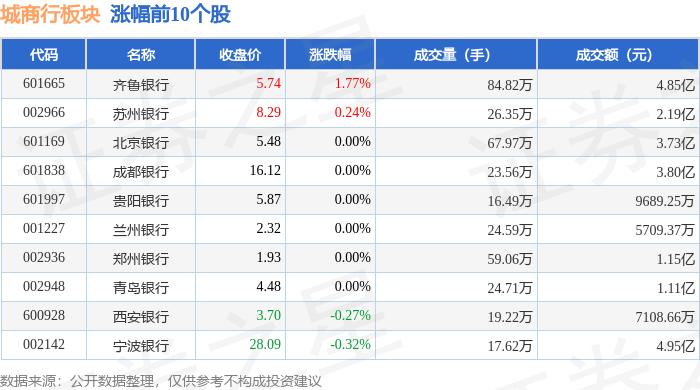
Market Overview - The city commercial bank sector experienced a decline of 0.33% on December 31, with Xiamen Bank leading the drop [1] - The Shanghai Composite Index closed at 3968.84, up 0.09%, while the Shenzhen Component Index closed at 13525.02, down 0.58% [1] Individual Bank Performance - Qilu Bank closed at 5.74, up 1.77% with a trading volume of 848,200 shares and a transaction value of 485 million [1] - Suzhou Bank closed at 8.29, up 0.24% with a trading volume of 263,500 shares and a transaction value of 219 million [1] - Xiamen Bank closed at 7.34, down 1.08% with a trading volume of 133,200 shares and a transaction value of 97.8 million [2] - Nanjing Bank closed at 11.43, down 0.78% with a trading volume of 235,600 shares and a transaction value of 270 million [2] Capital Flow Analysis - The city commercial bank sector saw a net inflow of 201 million from institutional investors, while retail investors experienced a net outflow of 9.56 million [2] - The capital flow for individual banks shows that Shanghai Bank had a net inflow of 48.9 million from institutional investors, while Hangzhou Bank had a net outflow of 50.55 million [3] - Suzhou Bank recorded a net inflow of 30.66 million from institutional investors, while retail investors had a net outflow of 27.1 million [3]