
荣耀

Search documents
连续4年“双第一”,中国工业第一城的跃迁!
Bei Jing Ri Bao Ke Hu Duan· 2026-02-11 15:29
Core Insights - Shenzhen's industrial economy is experiencing high-quality development, with a projected industrial added value growth of 5.4% in 2025, following a record growth of 9.7% in 2024, marking the highest rate in nearly 13 years [1][24] - The city's industrial output value exceeded 5 trillion yuan during the 14th Five-Year Plan period, with an average annual growth rate of 6.6%, and it has maintained the top position in both industrial output and added value among Chinese cities for four consecutive years [2][24] - Shenzhen's industrial structure is continuously optimizing, transitioning from traditional manufacturing to "smart manufacturing," which enhances its global competitiveness [3][4] Industrial Achievements - During the 14th Five-Year Plan, Shenzhen's industrial output value surpassed 5 trillion yuan, with the total industrial added value reaching 1.2 trillion yuan, achieving an average annual growth of 6.0% [2][24] - The number of national-level specialized and innovative "little giant" enterprises in Shenzhen reached 1,333, ranking first among cities in China [2] - The city has established 11 industrial projects with over 10 billion yuan in investment, with total industrial investment expected to exceed 1 trillion yuan [7] Innovation and R&D - The coverage rate of R&D institutions among industrial enterprises in Shenzhen increased from 40% to over 70% during the 14th Five-Year Plan, indicating a high density of innovation [12][14] - R&D investment in Shenzhen rose from 151.08 billion yuan in 2020 to 245.31 billion yuan in 2024, with an R&D intensity of 6.67%, the highest among Chinese cities [14][24] - Shenzhen's industrial technology transformation investment is expected to grow by 19.2% in 2025, reflecting the city's commitment to embracing new technologies [15] Future Development Plans - Shenzhen aims to enhance its modern industrial system with stronger international competitiveness, focusing on high-quality development and the promotion of new industrialization [20][23] - The city plans to accelerate the development of emerging industries, including new-generation electronic information and new energy vehicles, while also exploring new growth areas such as low-altitude economy and biomedicine [21][23] - By 2026, Shenzhen will implement a new round of key industrial chain development actions to solidify its manufacturing advantages and promote traditional industries' upgrades [20][23]



荣耀Magic8ProAir降价300 | 曝某大厂新机要做阔屏幕 16:10复古回归?
Xin Lang Cai Jing· 2026-02-11 10:33
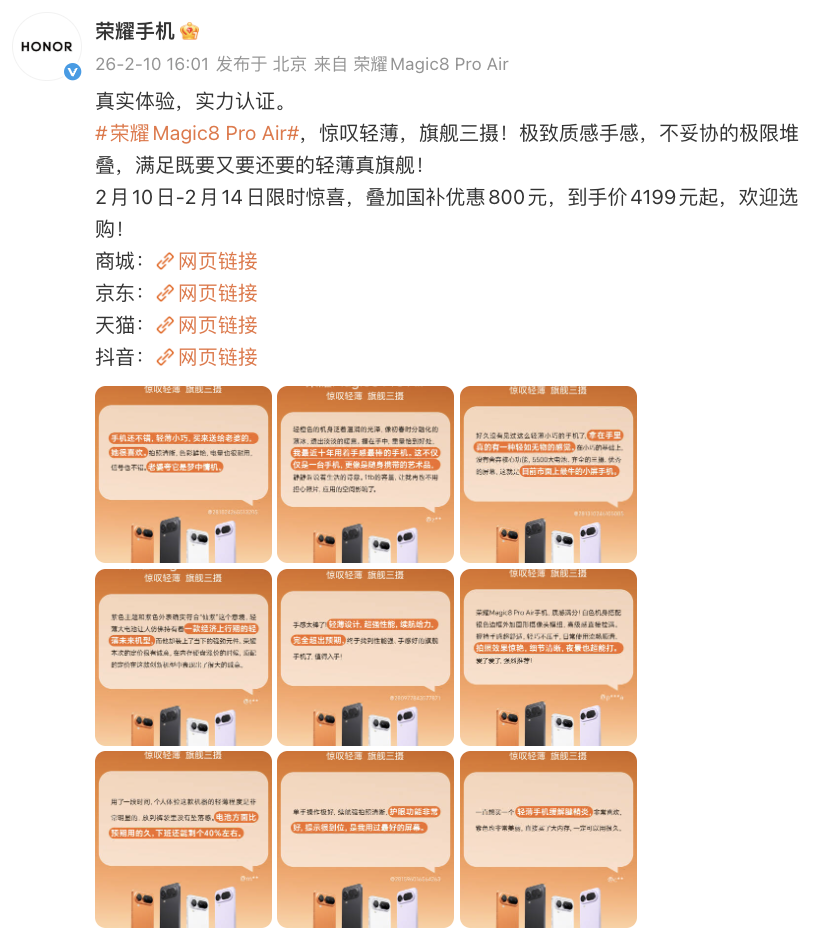
Core Insights - The recent price drop of Apple's ultra-thin flagship iPhone Air by 2000 yuan has sparked discussions, leading to a promotional price cut of 300 yuan for Honor's Magic8 Pro Air [1][7]. Group 1: Promotional Activities - Honor Magic8 Pro Air is running a Valentine's Day limited-time promotion from February 10 to February 14, offering a discount of 300 yuan, which, when combined with national subsidies, totals an 800 yuan discount [2][8]. - The promotional prices for the Magic8 Pro Air after the discount are as follows: - 12+256GB version originally priced at 4999 yuan is now 4699 yuan, with a final price of 4199 yuan after subsidies - 12+512GB version originally priced at 5299 yuan is now 4999 yuan, with a final price of 4499 yuan after subsidies - 16+512GB version originally priced at 5599 yuan is now 5299 yuan, with a final price of 4799 yuan after subsidies [5][11]. Group 2: Product Specifications - The Honor Magic8 Pro Air features a lightweight design at 155g, a slim profile of 6.1mm, and a 6.31-inch display with a 1.5K resolution and 1-120Hz LTPO technology [5][11]. - It is powered by the MediaTek Dimensity 9500 processor, equipped with a 5500mAh battery, and supports 80W wired and 50W wireless charging. The camera setup includes a 50MP front camera and a triple rear camera system [5][11]. Group 3: Industry Trends - There is a growing interest in "wide foldable" devices, with expectations that three smartphone brands will launch such models by 2026, following the trend initiated by Huawei's Pura X [11][12]. - Additionally, a new "wide screen" straight phone with a 16:9 or 16:10 aspect ratio is reportedly in development by a top five smartphone manufacturer, indicating a shift in design trends within the industry [12].
【行情】全球每4部手机就有1部iPhone?最新用户设备情况出炉
Xin Lang Cai Jing· 2026-02-11 10:32
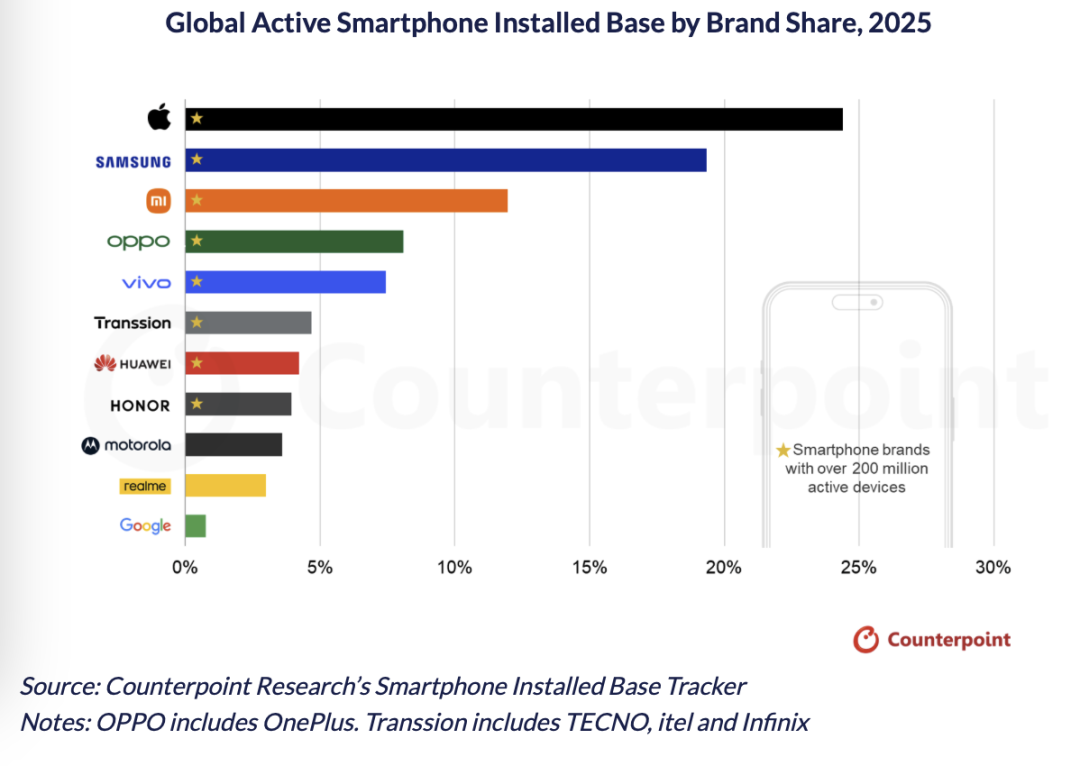
如上图所见,报告显示2025年全球智能手机设备活跃量来说,TOP10依次是:苹果、三星、小米、OPPO、vivo、传音、华为、荣耀、摩托罗拉、realme、 谷歌。 报告还提到TOP8品牌人均有2亿台以上设备,苹果和三星超10亿台,也就是近四分之一的手机是iPhone,近五分之一是三星手机。报告还提到2025年苹果 新增的手机设备比后面7家品牌加起来还多,问问大家,你现在用的哪家手机? 研究机构Counterpoint近日发布了一份2025年全球智能手机设备活跃情况。 研究机构Counterpoint近日发布了一份2025年全球智能手机设备活跃情况。 如上图所见,报告显示2025年全球智能手机设备活跃量来说,TOP10依次是:苹果、三星、小米、OPPO、vivo、传音、华为、荣耀、摩托罗拉、realme、 谷歌。 报告还提到TOP8品牌人均有2亿台以上设备,苹果和三星超10亿台,也就是近四分之一的手机是iPhone,近五分之一是三星手机。报告还提到2025年苹果 新增的手机设备比后面7家品牌加起来还多,问问大家,你现在用的哪家手机? ...

全球在使用的苹果三星手机均超过10亿部 7家国内品牌进入前10
Xin Lang Cai Jing· 2026-02-11 10:16
在活跃量进入前10的厂商中,除了摩托罗拉和真我,其余8家的活跃量是都在2亿部之上。(海蓝) 【TechWeb】2月11日消息,据外媒报道,有市场研究机 构发布了全球智能手机活跃量报告,从品牌来看苹果是 高居第1,三星电子紧随其后,两家双双超过了10亿部, 小米、OPPO、vivo等国内厂商,也都进入了前10,6家 的活跃量超过了2亿部。 市场研究机构在报告中表示,全球活跃的智能手机在 2025年同比增长2%。 具体到厂商方面,在全球目前活跃的智能手机中,苹果 所占的比例接近25%,三星电子则是接近20%,他们也 是仅有的两家活跃量超过10亿部的厂商。 活跃量进入前10的另外8家,分别是小米、OPPO、 vivo、传音、华为、荣耀、摩托罗拉、真我,其中的小米的份额是超过了10%,OPPO和vivo在5%到 10%之间。 【TechWeb】2月11日消息,据外媒报道,有市场研究机构发布了全球智能手机活跃量报告,从品牌来 看苹果是高居第1,三星电子紧随其后,两家双双超过了10亿部,小米、OPPO、vivo等国内厂商,也都 进入了前10,6家的活跃量超过了2亿部。 市场研究机构在报告中表示,全球活跃的智能手机在202 ...
爱施德:公司是荣耀品牌的全渠道零售服务商
Zheng Quan Ri Bao Zhi Sheng· 2026-02-11 09:09
(编辑 姚尧) 证券日报网讯 2月11日,爱施德在互动平台回答投资者提问时表示,公司是荣耀品牌的全渠道零售服务 商,并与荣耀在国内及澳洲、东南亚、中东、非洲等海外市场保持紧密合作关系,助力荣耀品牌实现全 球化布局。上市公司估值受多方面因素影响,如市场环境、政策支持、流动性等因素,同时也受公司自 身的业绩与发展情况等多方面因素共振,公司将继续专注高质量可持续发展,用更好的成绩回馈投资者 的信赖。 ...

7 英寸大屏卷土重来:折叠屏与平板双重夹击,巨屏手机能否杀出「第三赛道」?
3 6 Ke· 2026-02-11 04:58
Core Viewpoint - The potential resurgence of 7-inch smartphones is being tested by two manufacturers, indicating a response to user demand for larger screens in a market filled with small tablets and foldable phones [1][4]. Group 1: Market Context - The current market already has 7-inch smartphones, such as Huawei's Mate70 Air, which measures 6.96 inches and has a width of 81.5mm, significantly wider than the Xiaomi 17 Ultra at 77.6mm, affecting user grip [1][4]. - The disappearance of large-screen smartphones in the past was attributed to usability issues, but the scarcity of large screens has diminished as technology has advanced [10][12]. Group 2: Reasons for Resurgence - The first reason for the revival of 7-inch smartphones is the increased internal space, allowing manufacturers to incorporate larger batteries, advanced imaging modules, and enhanced cooling systems [4][6]. - The second reason is the improved viewing experience, where a transition from 6.7 inches to 7 inches enhances information density, reading comfort, multitasking space, and video immersion [6][8]. Group 3: Challenges and Considerations - The main challenge for manufacturers is to ensure that the 7-inch device remains portable and user-friendly, maintaining single-handed usability and pocket storage [6][12]. - The device must provide a unique experience that differentiates it from foldable screens and small tablets, offering a straightforward large display without the need for unfolding or carrying an additional device [8][14]. Group 4: User Experience and Market Position - The 7-inch smartphone could become a "second mainstream" option for specific user groups, such as business professionals and heavy mobile gamers, rather than a universal choice [12][16]. - Manufacturers must focus on hardware weight distribution and software adaptation to fully utilize the larger screen, ensuring that it enhances user experience without compromising portability [14][18]. Group 5: Conclusion - The introduction of 7-inch smartphones represents an attempt by manufacturers to break away from market homogenization, aiming to redefine large-screen experiences without reverting to past trends [16][18].

通信行业周报(2月2日-2月8日)
Guoxin Securities Co., Ltd· 2026-02-11 04:20
Investment Rating - The communication industry is rated as "Cautiously Optimistic" with a focus on operators with sustained profit growth and enhanced network value, as well as companies benefiting from traffic growth and continuous technological innovation [6][41]. Core Insights - The communication sector experienced a decline of 6.73% from February 2 to February 6, 2026, underperforming the CSI 300 index by 5.39 percentage points [3][13]. - The sector's cumulative decline for 2026 is 1.63%, ranking it 27th among 30 sectors [3][14]. - The TTM PE ratio for the communication industry is 26.41, placing it in the 36.08 percentile [3][14]. - The smartphone market in China saw a total shipment of 307 million units in 2025, a year-on-year decrease of 2.4%, with 5G phones accounting for 86.9% of shipments [4][36]. - Global smartphone shipments grew by 2% in 2025, reaching 1.25 billion units, marking the highest level since 2021 [4][38]. Summary by Sections Communication Industry Market Review - The communication sector's performance was notably poor, with a significant drop in stock prices and a low ranking among other sectors [3][13]. - A total of 119 companies are listed in the communication sector, with 30 companies seeing stock price increases and 88 experiencing declines during the review period [3][14]. Industry News - As of December 2025, China has built 4.838 million 5G base stations, with internet penetration exceeding 80% [17]. - The number of internet users reached 1.125 billion, with a significant increase in generative AI users [17][20]. - The production of optical cables in China decreased by 5.3% in 2025, although the decline rate has slowed compared to previous years [20]. Weekly Focus: Consumer Electronics Data - The smartphone market in China is experiencing structural adjustments, with a notable decline in December 2025 shipments [5][40]. - Despite the overall decline, the proportion of 5G phones continues to rise, indicating a maturation of 5G technology [5][36]. Investment Recommendations - The report suggests a cautious optimism for the communication industry, emphasizing the importance of profit growth and technological innovation for future investments [6][41].
当“华米OV 耀”都不再满足于造手机
3 6 Ke· 2026-02-11 02:28
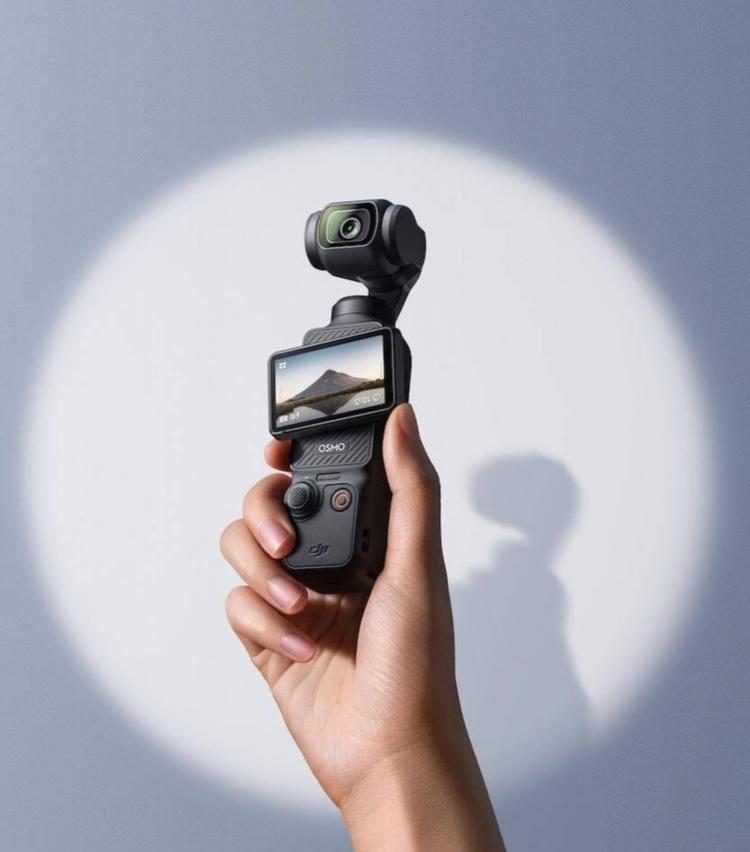
Core Viewpoint - The mobile phone manufacturers are shifting their focus towards the professional camera and handheld imaging device market, which was previously considered untouchable, indicating a significant transformation in the industry landscape [1]. Group 1: Market Dynamics - OPPO and vivo are the first to target the market dominated by DJI's Pocket series, which has become a standard for content creators and tourists seeking better image quality and stabilization than smartphones [2][4]. - vivo is developing a standalone Vlog camera aimed at competing directly with DJI's Pocket series, featuring a lightweight design and integration with its OriginOS for seamless editing and sharing [4][6]. - OPPO is also working on a new imaging product that may be part of its Find series, focusing on high-quality material collection while leveraging mobile processing power for editing and social sharing [8]. Group 2: Product Innovations - Xiaomi is pursuing a modular approach with a magnetic lens system that allows its smartphones to transform into high-quality cameras, potentially launching with the MIX 5 or 16 Ultra in 2026 [9][12]. - The magnetic lens module will enable users to attach a large optical module to their phones, enhancing photography capabilities while maintaining a lightweight design [13][15]. - Honor is taking a more radical approach by integrating a mechanical gimbal into its upcoming "Robot Phone," allowing for advanced stabilization and 360-degree tracking [17][19]. Group 3: Strategic Collaborations - Huawei is not developing a standalone Vlog camera but is collaborating with DJI for deeper integration of camera controls within its HarmonyOS, indicating a strategic focus on software rather than hardware [21][26]. - Huawei is also testing a square sensor for front cameras, aimed at optimizing social media content creation by allowing for maximum image capture regardless of phone orientation [23][24]. Group 4: Industry Trends - The year 2026 is seen as a pivotal moment for the smartphone industry, as manufacturers face diminishing returns on hardware improvements and are compelled to innovate through external devices or standalone products [27]. - The shift towards integrating advanced computational photography into traditional camera forms represents a significant challenge to established camera manufacturers, who have struggled to meet the demands of modern content creators [28][29].

未知机构:千问调研AlAgent落地的潜在风险随着AlAgent-20260211
未知机构· 2026-02-11 01:50
字节,阿里等大厂聚焦安全性与可追溯性,阿里通过ACT协议强制要求支付环节必须通过支付宝完成,利用其成 熟支付协议保障链路安全,并通过交易日志记录实现全流程可追溯,便于问题回溯; 国家层面尚未出台针对AlAgent执行权限的具体法规或监管条文; 千问调研 AlAgent落地的潜在风险: 千问调研 AlAgent落地的潜在风险: 随着AlAgent从辅助决策向直接执行操作延伸国内企业及监管机构面临新风险,AI可能跳过用户确认直接决策,导 致意外后果; 千问海外市场拓展规划 虽未发布独立出海产品,但已完成多语言模型开发,接入海外产品并统一使用谷歌UCP协议整合 海外电商,本地生活,Uber等,中间层打 阿里 海外电商及支付产品; 目标市场优先选择东南亚,南美,阿里生 态布局 完善,份额大; 第三方:头部平台如亚马逊接入意愿弱,垂直领域如Uber及中腰部/尾部服务商合作意愿高,目前处于接触阶段; AI驱动电商模式GMV渗透率预期: 2026年AI驱动电商GMV占比预计1.5%-2%;2027-2028年渗透率加速提升,2027年达5%,2028年超15%-20%; -驱动因素:用户心智快速转变;产品迭代重点转向任务执 ...

技术硬件与设备行业2025年信用回顾与2026年展望
新世纪评级· 2026-02-11 01:17
Investment Rating - The technology hardware and equipment industry is rated as stable for 2025 and 2026 [1] Core Insights - The technology hardware and equipment industry is experiencing a slow recovery driven by inventory replenishment cycles and AI technology, despite overall pressure from weak global economic growth since 2025. There is significant differentiation among sub-industries, with strong demand for data center equipment driven by computing power, while traditional telecom equipment shows sluggish growth [2][3] - The Chinese government has established a policy framework to support the industry, focusing on short-term growth stabilization, medium-term supply chain strengthening, and long-term innovation promotion, primarily through domestic substitution to overcome high-end equipment and material bottlenecks [2] - The industry is expected to benefit from the deepening of digital China initiatives and the industrialization of cutting-edge technologies like AI, entering a structurally growth-driven cycle. However, geopolitical disturbances and rapid technological iterations may lead to uneven recovery across the industry [5] Summary by Sections Industry Overview - The electronic information manufacturing industry is closely tied to global economic conditions, showing signs of recovery since 2024 due to inventory replenishment and AI-driven demand. It is a core industry in China's economic structure transformation and upgrade [7][8] - In 2024, the added value of China's electronic information manufacturing industry grew by 11.8%, outperforming overall industrial and high-tech manufacturing growth rates [8] Financial Performance - Sample companies in the technology hardware and equipment industry reported positive revenue growth year-on-year in 2025, aligning with industry recovery trends. However, high R&D investments and asset impairment losses have pressured net profits, while EBITDA showed year-on-year growth, indicating profit resilience [3] - The debt scale and liability ratios of sample companies have increased, with a decline in the EBITDA coverage ratio for rigid debt, although interest coverage has improved due to lower financing costs [3] Sub-Industry Insights Communication Equipment - The communication equipment sector is experiencing growth opportunities driven by AI and industrial interconnectivity, with significant demand for data center equipment but slow growth in traditional telecom network equipment. The market is highly competitive and concentrated [24][27] - The deployment of high-speed optical modules and data center switches is expected to grow significantly, while traditional telecom equipment investments are declining as operators shift focus to computing power networks [28] Computers and Peripheral Devices - The global PC and server markets are stable, with Chinese manufacturers gaining market share due to domestic substitution. The AI PC segment is becoming a core growth driver, with AI PC shipments expected to increase significantly [37][38] - The global server market is experiencing robust growth driven by AI computing demand, with significant revenue increases expected in the coming years [42] Electronic Devices, Instruments, and Components - The electronic devices, instruments, and components sector is seeing overall recovery driven by AI innovation and domestic supply chain localization. Key areas of growth include computing power chips and advanced packaging [48][49] - The semiconductor industry is entering an upward trend, with significant sales growth expected in both global and Chinese markets [56]



