
天弘基金

Search documents
4只,跻身百亿阵营!
Zhong Guo Ji Jin Bao· 2025-06-12 05:37
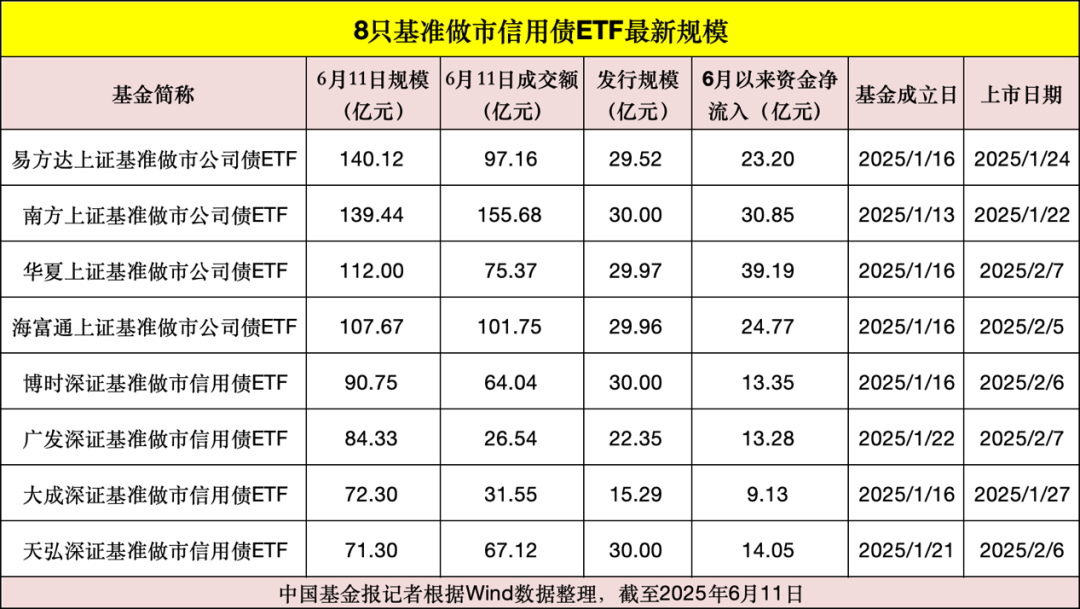
Core Viewpoint - The recent surge in the scale of benchmark market-making credit bond ETFs in China, with four ETFs surpassing 10 billion yuan, indicates strong market demand and effective liquidity management tools for investors [1][4]. Group 1: ETF Scale and Performance - Four benchmark market-making credit bond ETFs have surpassed 10 billion yuan in scale, including E Fund, Southern, Huaxia, and Haifutong ETFs, with respective scales of 140.12 billion yuan, 139.44 billion yuan, 112 billion yuan, and 107.67 billion yuan [4]. - The total scale of eight benchmark market-making credit bond ETFs has reached 817.91 billion yuan, reflecting a significant increase of nearly 277% in just four months [1][4]. - On June 11, the trading volume for benchmark market-making credit bond ETFs reached 619.22 billion yuan, with notable daily trading amounts for Southern and Haifutong ETFs at 155.68 billion yuan and 101.75 billion yuan, respectively [2]. Group 2: Market Dynamics and Investor Behavior - The inclusion of credit bond ETFs in the general repurchase pledge library has enhanced liquidity management for investors, promoting the healthy development of the credit bond market [1][5]. - The recent influx of 167.82 billion yuan in net buying for these ETFs in June indicates strong market interest and confidence among investors [4]. - The current low-interest-rate environment, coupled with the central bank's recent policy adjustments, has increased the attractiveness of medium-term high-rated credit bond yields, further driving demand for credit bond ETFs [5].

新型浮动费率基金“抢滩”,24只产品募超80亿
Huan Qiu Wang· 2025-06-12 04:19
Group 1 - The core viewpoint of the article highlights the surge in the issuance of new floating-rate funds, with a total fundraising scale exceeding 8 billion yuan, indicating a competitive market environment among fund companies [1] - As of June 11, 2023, 24 new floating-rate funds have collectively raised over 8 billion yuan, with nearly 20 funds surpassing the 200 million yuan threshold for establishment [1] - Several fund companies are employing differentiated marketing strategies, with notable early success from Dongfanghong Asset Management, which announced its fund reached the fundraising cap of 1.991 billion yuan and ended its fundraising early [1][2] Group 2 - Fund companies are deploying experienced managers for these new funds, with notable figures such as Zhu Hongyu from China Merchants Fund and Wang Mingxu from GF Fund taking leading roles [2] - Many fund management firms are actively investing their own capital into these new floating-rate funds, with a total self-investment amount reaching 110 million yuan as of June 11, 2023 [2] - The new floating-rate funds are designed to strengthen the alignment of interests between investors and fund managers, promoting long-term holding and rational investment practices [3][4]
捕捉趋势的力量:基金动量刻画新范式
Orient Securities· 2025-06-12 02:13
Quantitative Models and Construction Methods - **Model Name**: Carhart Four-Factor Model **Construction Idea**: Incorporates momentum factor into the Fama-French three-factor model to capture the "stronger gets stronger" phenomenon in stock markets[14] **Construction Process**: Formula: $ R_{p}-r_{f}\!\sim\!\!\alpha+\beta_{1}(R_{M}-r_{f})+\beta_{2}(R_{M}-r_{f})^{2}+\beta_{3}S M B+\beta_{4}H M L+\varepsilon_{p} $ - $R_{p}-r_{f}$ represents excess return of the portfolio relative to the risk-free rate - $R_{M}-r_{f}$ represents market excess return - $SMB$ and $HML$ represent size and value premiums respectively[28][30] **Evaluation**: Widely applicable across various asset classes, but its effectiveness in predicting future returns in A-shares is limited due to strong short-term reversal effects[14][17] - **Model Name**: Industry-Stripped Alpha Momentum **Construction Idea**: Removes market and industry beta risks to isolate alpha returns for momentum factor construction[47] **Construction Process**: Formula: $ R_{p}-r_{f}{\sim}\alpha+\beta_{1}(R_{M}-r_{f})+\beta_{2}(R_{M}-r_{f})^{2}+\sum_{i=1}^{11}\beta_{2+i}\,l n d_{i}+\varepsilon_{p} $ - Adds industry index returns ($ln d_{i}$) to the regression model to strip industry beta risks[51] **Evaluation**: Improves stability compared to traditional momentum factors but shows weaker positive selection effects since 2019[52][53] - **Model Name**: Low-Diversification Momentum **Construction Idea**: Identifies dates with low fund diversification to reduce beta risk interference and enhance predictive power[5][56] **Construction Process**: - Groups fund daily returns by diversification levels (using standard deviation of returns) - Constructs three sub-factors: low-diversification return factor, sorting momentum factor, and Sharpe ratio factor - Combines these sub-factors equally to form the low-diversification momentum factor[65][93] **Evaluation**: Demonstrates strong predictive power with low correlation to traditional momentum factors, indicating reduced beta risk interference[93][104] Model Backtesting Results - **Carhart Four-Factor Model**: - Rank IC: 6.01% (past 122 days alpha momentum)[31] - Rank ICIR: 0.57 (past 122 days alpha momentum)[31] - Quarterly long-short win rate: 66.67%[31] - **Industry-Stripped Alpha Momentum**: - Rank IC: 7.81% (past 122 days)[53] - Rank ICIR: 0.97 (past 122 days)[53] - Quarterly long-short win rate: 69.92%[53] - **Low-Diversification Momentum**: - Rank IC: 10.10%[93] - Rank ICIR: 1.09[93] - Quarterly long-short win rate: 71%[93] - Annualized long-short return: 10.81%[98] Quantitative Factors and Construction Methods - **Factor Name**: Historical Return Factor **Construction Idea**: Uses past fund returns to predict future performance[19] **Construction Process**: - Calculates returns over different time windows (e.g., past 20, 61, 122 days) - Tests predictive power using Rank IC and Rank ICIR metrics[20][22] **Evaluation**: Short-term returns show weak predictive power; long-term returns improve prediction but remain unstable[22][23] - **Factor Name**: Sharpe Ratio Factor **Construction Idea**: Adjusts fund returns for volatility to improve stability[24] **Construction Process**: - Calculates Sharpe ratios over different time windows (e.g., past 20, 61, 122 days) - Tests predictive power using Rank IC and Rank ICIR metrics[25][26] **Evaluation**: Stability improves compared to historical return factor but fails to address beta risk interference effectively[26][27] - **Factor Name**: Low-Diversification Return Factor **Construction Idea**: Focuses on low-diversification dates to reduce beta risk interference[65] **Construction Process**: - Groups fund daily returns by diversification levels - Uses average returns of the lowest-diversification group as the factor score[65][67] **Evaluation**: Strong predictive power with stable performance across different time windows[67][72] Factor Backtesting Results - **Historical Return Factor**: - Rank IC: 6.44% (past 244 days)[20] - Rank ICIR: 0.54 (past 244 days)[20] - Quarterly long-short win rate: 59.35%[20] - **Sharpe Ratio Factor**: - Rank IC: 6.44% (past 244 days)[25] - Rank ICIR: 0.64 (past 244 days)[25] - Quarterly long-short win rate: 61.79%[25] - **Low-Diversification Return Factor**: - Rank IC: 10.03% (past 3 months)[68] - Rank ICIR: 1.06 (past 3 months)[68] - Quarterly long-short win rate: 69.11%[68]
发行大战持续!机构抢滩“新”基金
券商中国· 2025-06-12 01:56
Core Viewpoint - The new floating fee rate funds are experiencing a competitive issuance phase, with significant marketing efforts from fund companies as the market recovers [2][20]. Fund Issuance and Performance - As of June 11, 2023, 24 new floating fee rate funds have been launched, collectively raising over 8 billion yuan, with nearly 20 funds surpassing the 200 million yuan threshold for establishment [2][8]. - The first batch of 16 new floating fee rate funds began sales on May 27, 2023, with some companies like Dongfanghong Asset Management achieving early success by reaching their fundraising limits quickly [3][6]. - Fund companies are employing differentiated marketing strategies, leading to varied fundraising timelines, with some companies experiencing slower sales than expected [6][8]. Fund Manager Engagement - The first batch of 26 companies receiving approval for new floating fee rate funds includes both large and smaller fund managers, showcasing a mix of experienced and emerging talent [11]. - Fund companies are demonstrating commitment by deploying seasoned fund managers and investing their own capital into the funds, with Dongfanghong Asset Management announcing a self-investment of 10 million yuan [15][18]. Innovations in Fee Structure - The new floating fee rate funds are designed to align the interests of fund managers and investors, promoting a "win-win" scenario through asymmetric fee structures that enhance investor protection [20][21]. - These funds encourage long-term holding and rational investment, aiming to smooth out short-term volatility while enhancing transparency and trust [20][21]. - The fee structure is linked to fund performance and the duration of investment, incentivizing both fund managers to seek long-term excess returns and investors to commit for longer periods [21].

小微盘产品额度紧俏 基金公司掩门“惜售”
Zhong Guo Zheng Quan Bao· 2025-06-11 21:14
Core Viewpoint - The small and micro-cap style has shown strong performance recently, leading to heightened investor enthusiasm for related funds. To prevent rapid fund size expansion and dilution of returns for existing holders, fund companies have implemented purchase restrictions [1][2]. Fund Purchase Restrictions - On June 11, Changsheng Fund announced a limit on purchases for the Changsheng North Certificate 50 Enhanced Index Fund, capping single account purchases at 100 yuan per day. Other funds, such as Huashan North Certificate 50 Index Fund, have also set limits, with some funds restricting daily purchases to amounts ranging from 1,000 yuan to 50,000 yuan [2][3]. Performance of Small and Micro-Cap Indices - The Wind Micro-Cap Index has risen over 30% year-to-date, reaching a new high on June 10. The North Certificate 50 Index has increased nearly 40% this year, also hitting a new peak in late May. These indices have significantly outperformed larger market indices [4][5]. Market Dynamics and Investor Behavior - The recent strong performance of small and micro-cap stocks is attributed to favorable policies and a loose funding environment. The release of the "Major Asset Restructuring Management Measures" has spurred interest in mergers and acquisitions, benefiting small and micro-cap stocks [6][8]. Valuation Metrics - The valuation of the small and micro-cap style is high, with the price-to-earnings ratio of the CSI 2000 Index at 138 times, and the North Certificate 50 Index at 74.52 times, both at historically elevated levels [4][8]. Market Sentiment and Risks - Despite the high trading crowding in small and micro-cap stocks, some institutional investors believe that any potential pullback will depend on the occurrence of substantial negative events. Current policies favoring technology innovation and asset integration support the continued performance of small and micro-cap stocks [7][8].
新型浮动费率基金密集发行 24只产品已募集超80亿元
Zheng Quan Shi Bao· 2025-06-11 17:24
Core Viewpoint - The issuance of new floating rate funds is intensifying as market conditions improve, with over 80 billion yuan raised across 24 funds, indicating strong demand and competition among fund companies [1][2][3] Fund Issuance and Performance - As of June 11, 2023, 24 new floating rate funds have been launched, with a total fundraising exceeding 80 billion yuan, and nearly 20 funds surpassing the 200 million yuan threshold for establishment [2][3] - The Oriental Red Core Value Fund was the first to reach its fundraising cap of 1.991 billion yuan and ended its fundraising early, showcasing effective marketing strategies [2][3] - Various fund companies are employing differentiated marketing strategies, leading to varied fundraising timelines and outcomes [2][3] Fund Management and Investment Strategies - The first batch of 26 companies includes both large and small fund managers, with experienced professionals leading the funds, indicating a focus on strong management [4] - Fund companies are actively investing their own capital into these new funds, with total self-purchases reaching 110 million yuan as of June 11, 2023, reflecting confidence in their products [5] Advantages of New Floating Rate Funds - New floating rate funds are designed to align the interests of fund managers and investors, promoting a "win-win" scenario through innovative fee structures that link management fees to fund performance [6][7] - These funds encourage long-term holding and rational investment, aiming to smooth out short-term volatility and enhance investor experience [6][7]
ETF密集提示清盘风险 百余只场内成交不足百万元
2 1 Shi Ji Jing Ji Bao Dao· 2025-06-11 12:00
Core Viewpoint - The ETF market is experiencing a significant disparity, with some ETFs showing high trading volumes while many others face low liquidity and potential liquidation risks [1][5]. Group 1: ETF Market Performance - On June 10, certain ETFs like the Hong Kong Innovative Drug ETF and the Hang Seng Technology ETF had trading volumes exceeding 10 billion yuan, while over 500 ETFs had trading volumes below 10 million yuan [1]. - A total of 513 ETFs had trading volumes below 10 million yuan on June 10, with 129 ETFs trading below 1 million yuan [4][3]. - The concentration of market resources is evident, with the top ten ETFs accounting for nearly 40% of the total market size, while over 20% of ETFs have sizes below 100 million yuan [5]. Group 2: Liquidity and Risk Factors - The number of ETFs with net asset values below 50 million yuan has been increasing, indicating higher liquidity and liquidation risks [2][5]. - Analysts emphasize that low liquidity can lead to a vicious cycle where smaller ETFs struggle to attract investors, further diminishing their liquidity and increasing the likelihood of liquidation [5]. Group 3: Strategies to Enhance Liquidity - Fund companies are increasingly adding liquidity providers to improve ETF trading efficiency and attract more investors [7][8]. - The introduction of liquidity providers aims to reduce bid-ask spreads and enhance trading volumes, which can lead to scale effects [7][8]. - Improving liquidity is seen as essential for enhancing investor experience and attracting long-term capital [9]. Group 4: Recommendations for ETF Companies - Companies are advised to focus on product differentiation to avoid homogeneous competition, including not launching new ETFs in crowded index spaces and innovating product offerings [12][13]. - Providing value-added services, such as investment strategy reports and interactive investor engagement, can enhance investor experience and loyalty [13][14]. - Companies should also consider lowering management fees through increased ETF scale and exploring new themes like ESG and digital economy ETFs to meet diverse investor needs [14].
2025年5月新基金发行报告(发行与募集篇):新型浮动费率基金来袭,科创综指增强策略ETF上新
Shanghai Securities· 2025-06-11 04:25
Fund Issuance - In May 2025, 82 companies participated in fund issuance, a month-on-month increase of 9.33% compared to April 2025[1] - A total of 172 funds were issued in May, with 124 being newly issued, reflecting a month-on-month decrease of 2.36%[8] - Index funds were the most popular type, with 66 index funds issued, accounting for 53.23% of the total issuance[11] Fund Raising - The total fundraising amount in May 2025 was 826.26 billion yuan, a month-on-month decrease of 12.61% and a year-on-year decrease of 24.99%[13] - The top three types of funds by fundraising amount were index funds (420.65 billion yuan, 50.91%), bond funds (307.22 billion yuan), and mixed funds (77.46 billion yuan)[13] - 115 funds completed fundraising in May, with an average subscription period of 12.39 days, a month-on-month decrease of 13.81%[17] New Fund Innovations - The first batch of 24 floating-rate funds was launched, all classified as mixed funds, with management fees linked to investor holding periods and fund performance[2] - The newly established STAR Market Index Enhanced Strategy ETF and enhanced funds aim to meet personalized investment needs and enhance competition among fund companies[2]
昨日“吸金”超千万元,创新药ETF天弘(517380)盘中翻红,机构关注创新药行情全面扩散下的投资机会
2 1 Shi Ji Jing Ji Bao Dao· 2025-06-11 02:33
Group 1 - The A-share innovative drug concept showed slight weakness after opening, while the Hong Kong pharmaceutical and biotechnology sector performed positively [1] - The Tianhong Innovative Drug ETF (517380) saw a rise of 0.30% after initially dropping nearly 0.9%, with a premium rate of 0.07% [1] - Major weighted stocks in the ETF, such as WuXi AppTec, Hengrui Medicine, and Innovent Biologics, performed well, while BeiGene saw declines [1] Group 2 - Chinese innovative drugs are at a critical turning point from quantitative to qualitative change, with broad prospects for growth [2] - Domestic pharmaceutical companies are shifting their business development (BD) focus from inward introduction to outward licensing [2] - The innovative drug sector has experienced rapid growth in product revenue and external licensing over the past three years, with significant BD transactions occurring this year [2]
加强投资者利益绑定 公募基金公司密集自购
Jin Rong Shi Bao· 2025-06-11 01:38
Core Viewpoint - The recent surge in public fund companies announcing self-purchases of their products reflects a combination of policy guidance, market bottoming, and industry transformation, signaling a shift from scale competition to investment research capability competition in the long term [1][6]. Group 1: Self-Purchase Activities - Numerous public fund companies have recently announced self-purchases, with nearly 100 companies implementing this strategy this year, indicating strong confidence in their products [1][4]. - Tianhong Fund announced a self-purchase of 10 million yuan for its floating-rate fund, while other companies like Harvest Fund and Oriental Red Asset Management also committed significant amounts to self-purchases [2]. - On June 3, China Europe Fund announced a self-purchase of 10 million yuan for its floating-rate fund, emphasizing the importance of aligning interests with investors [3]. Group 2: Market and Policy Context - The self-purchase trend has been particularly pronounced following market corrections, with several funds, including Anxin Fund and Fortune Fund, announcing self-purchases totaling nearly 400 million yuan [4]. - The China Securities Regulatory Commission has encouraged fund companies to allocate a portion of their profits to self-purchases, reinforcing the importance of self-investment in the industry [5][6]. - The "Action Plan for Promoting High-Quality Development of Public Funds" has increased the scoring weight for self-purchase metrics in fund evaluations, further incentivizing this behavior [6]. Group 3: Implications of Self-Purchases - Self-purchases serve multiple purposes, including sending positive signals to the market, enhancing liquidity, and demonstrating the fund companies' commitment to their investment capabilities [5]. - The actions of fund companies are viewed as a bottom signal in the context of historically low valuations, contributing to market stabilization [5]. - Despite the benefits, there are concerns about potential marketing-driven motives and style drift risks, necessitating a cautious approach from investors [6].