
微创医疗

Search documents
港股异动 | 微创医疗(00853)早盘涨超4% 小摩增持超9亿港元股份 美银看好手术机器人业务
Zhi Tong Cai Jing· 2025-11-28 02:24
Core Viewpoint - MicroPort Medical's stock rose over 4% following a significant share purchase by JPMorgan, indicating strong investor confidence and potential growth in the company's operations [1] Group 1: Stock Performance - MicroPort Medical (00853) saw its stock increase by 4.53%, reaching HKD 11.3, with a trading volume of HKD 80.5 million [1] Group 2: Shareholder Activity - On November 24, JPMorgan increased its holdings in MicroPort Medical by 89.06 million shares, valued at approximately HKD 930 million [1] - Following this purchase, JPMorgan's total shareholding rose to 276 million shares, increasing its ownership percentage from 9.79% to 14.44% [1] Group 3: Analyst Ratings and Future Outlook - Bank of America reiterated a "Buy" rating for MicroPort Medical, citing attractive risk-reward dynamics [1] - The company has a diversified portfolio of high-value consumables, with the surgical robotics segment expected to contribute 19% of total revenue by 2034 [1] - It is anticipated that the major shareholder, Shanghai United Assets and Equity Exchange, may provide financial and operational support, while the company is addressing liquidity concerns and aims to achieve profitability by the first half of 2026 through cost control and divesting non-core assets [1]


微创医疗早盘涨超4% 小摩增持超9亿港元股份 美银看好手术机器人业务
Zhi Tong Cai Jing· 2025-11-28 02:20
Core Viewpoint - MicroPort Medical (00853) saw a significant stock increase of over 4%, closing at HKD 11.3 with a trading volume of HKD 80.5 million, following news of JPMorgan's substantial share acquisition [1] Group 1: Shareholder Activity - JPMorgan increased its stake in MicroPort Medical by acquiring 89.06 million ordinary shares, valued at approximately HKD 930 million [1] - Post-acquisition, JPMorgan's total shareholding rose to 276 million shares, increasing its ownership percentage from 9.79% to 14.44% [1] Group 2: Analyst Ratings and Future Outlook - Bank of America Securities reiterated a "Buy" rating for MicroPort Medical, citing attractive risk-reward dynamics [1] - The company has a diversified portfolio of high-value consumables, with the surgical robotics segment expected to be a key growth driver, projected to contribute 19% of total revenue by 2034 [1] - It is anticipated that MicroPort Medical's major shareholder, Shanghai United Imaging Healthcare, may provide financial and operational support, while the company is addressing liquidity concerns and aims to achieve profitability by the first half of 2026 through cost control and divesting non-core assets [1]
微创医疗(00853.HK)获摩根大通增持8906.04万股
Ge Long Hui· 2025-11-27 23:32
Core Insights - JPMorgan Chase & Co. increased its stake in MicroPort Scientific Corporation (00853.HK) by acquiring 89.0604 million shares at an average price of HKD 10.4413 per share, totaling approximately HKD 930 million [1] - Following this acquisition, JPMorgan's total holdings in MicroPort rose to 276,377,550 shares, increasing its ownership percentage from 9.79% to 14.44% [1] Company Summary - MicroPort Scientific Corporation is a publicly listed company on the Hong Kong Stock Exchange, identified by the stock code 00853 [2] - The recent transaction indicates a significant investment by JPMorgan, reflecting confidence in MicroPort's future performance and potential growth [1][2]


摩根大通增持微创医疗约8906.04万股 每股作价约10.44港元
Zhi Tong Cai Jing· 2025-11-27 11:21
香港联交所最新数据显示,11月24日,摩根大通增持微创医疗(00853)8906.0433万股,每股作价10.4413 港元,总金额约为9.3亿港元。增持后最新持股数目约为2.76亿股,持股比例为14.44%。 ...
摩根大通增持微创医疗(00853)约8906.04万股 每股作价约10.44港元
智通财经网· 2025-11-27 11:17
智通财经APP获悉,香港联交所最新数据显示,11月24日,摩根大通增持微创医疗(00853)8906.0433万 股,每股作价10.4413港元,总金额约为9.3亿港元。增持后最新持股数目约为2.76亿股,持股比例为 14.44%。 ...
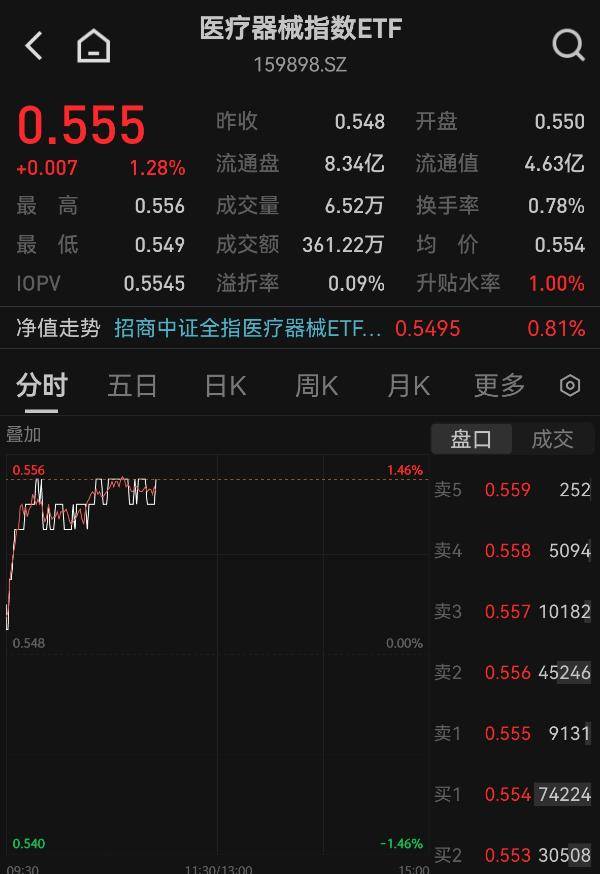
低位启动!医疗器械指数ETF(159898)涨超1%,机构:板块估值重塑在即!
Sou Hu Cai Jing· 2025-11-25 03:21
Core Viewpoint - The medical device sector is experiencing a recovery with significant stock price increases, particularly in the medical device index ETF, driven by policy optimization and innovation breakthroughs [1][4]. Group 1: Market Performance - The medical device index ETF (159898) saw a 1.28% increase, with notable gains from stocks such as Innotec (+6.70%), Hotgen Biotech, and Meilan Medical (both over +4%) [1]. - The ETF's trading volume was 8.34 billion, with a turnover rate of 0.78% [2]. Group 2: Industry Trends - The industry is shifting from "valuation compression" to "differentiation recovery," with investment logic transitioning from "beta rebound" to "alpha exploration" [2]. - The National Healthcare Security Administration (NHSA) has introduced principles focusing on clinical stability, quality assurance, and cost-effectiveness, leading to a more moderate price reduction trend [3]. Group 3: Innovation and Globalization - Domestic medical devices are moving from mere replacement to achieving global innovation leadership, with accelerated product approvals and commercialization [3]. - Companies are expanding internationally through local partnerships, acquisitions, and establishing manufacturing facilities, creating a second growth curve [3]. Group 4: Valuation and Restructuring - The medical device index ETF tracks the CSI All-Share Medical Device Index, focusing on leading companies in the ChiNext and STAR Market, which together account for over 80% of the index [4]. - The sector is expected to see a revaluation as domestic production rates increase and long-term policy environments improve, highlighting the value of innovative products [4].
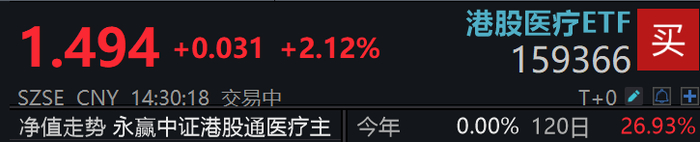
港股医疗ETF(159366)午后大涨超2%,权重股泰格医药涨超9%
Xin Lang Cai Jing· 2025-11-24 06:55
Group 1 - The CRO concept stocks are experiencing a collective rebound, with the CSI Hong Kong Stock Connect Medical Theme Index rising by 2.73% as of November 24, 2025 [1] - Notable individual stock performances include Tigermed (03347) increasing over 9%, and other companies like Hansoh Pharmaceutical (03692), MicroPort Medical (00853), and WuXi AppTec (02359) also seeing gains [1][2] - The Hong Kong Medical ETF (159366) has risen over 2%, and over the past six months, it has accumulated a 29.35% increase [1][2] Group 2 - The innovative drug industry is benefiting from dual advantages of policy support and explosive demand, which are activating new drug research and development needs, positively impacting the CXO sector [3] - Among 29 listed companies in the A-share CXO sector, 20 reported year-on-year revenue growth in the first three quarters, indicating strong industry resilience [3] - WuXi AppTec's unique "integrated, end-to-end" CRDMO business model has driven steady growth, with total revenue of 32.86 billion yuan in the first three quarters of 2025, a year-on-year increase of 18.6%, and net profit attributable to shareholders rising by 84.8% to 12.08 billion yuan [3] Group 3 - The high growth of the CXO sector is supported by the trend of pharmaceutical companies outsourcing R&D and production to specialized CXO firms, which helps reduce costs and improve efficiency [4] - CXO companies are enhancing their service capabilities through continuous technological development and scale expansion, leading to deeper integration with pharmaceutical companies [4] - As of October 31, 2025, the top ten weighted stocks in the CSI Hong Kong Stock Connect Medical Theme Index accounted for 62.83% of the index, indicating a high concentration in the market [4]



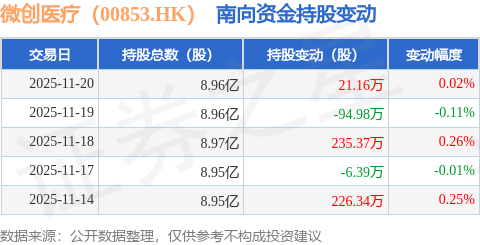
微创医疗(00853.HK):11月20日南向资金增持21.16万股
Sou Hu Cai Jing· 2025-11-20 19:25
Group 1 - The core point of the article is that southbound funds have increased their holdings in MicroPort Medical (00853.HK) by 211,600 shares on November 20, 2025, with a total net increase of 3.815 million shares over the last five trading days and 16.5963 million shares over the last 20 trading days [1][2] - As of now, southbound funds hold 896 million shares of MicroPort Medical, accounting for 46.84% of the company's total issued ordinary shares [1][2] Group 2 - The trading data shows fluctuations in shareholding, with a total holding of 896 million shares on November 20, 2025, reflecting a change of 0.02% [2] - The company operates in the medical device sector, focusing on sales, production, research, and development across eight divisions, including cardiovascular intervention, orthopedic medical devices, cardiac rhythm management, and surgical robotics [2]
创新药阶段性调整,资金跑步进场,重庆加速推进创新药支持政策
Mei Ri Jing Ji Xin Wen· 2025-11-19 02:21
Core Viewpoint - The Hong Kong pharmaceutical sector is experiencing a correction, with the Hang Seng Pharmaceutical ETF (159892) dropping over 1%, while innovative drug companies are seeing increased capital inflow after a period of adjustment [1] Group 1: Market Performance - The Hang Seng Pharmaceutical ETF has seen continuous capital subscriptions for four consecutive days despite the recent decline in innovative drug stocks [1] - Notable declines were observed in companies such as Yimeng Biotech, MicroPort Medical, Keren Biotechnology, and Zai Lab [1] Group 2: Industry Support and Trends - Industrial chain fundamentals for innovative drugs are showing signs of improvement, with positive trends in financing data, orders, and performance [1] - The Chongqing municipal government has announced comprehensive measures to support the high-quality development of innovative drugs, including funding for research and rapid integration of innovative drug application lists [1] Group 3: ETF Focus - The Hang Seng Pharmaceutical ETF tracks the Hang Seng Biotechnology Index, focusing on the innovative drug industry while also covering segments like CXO and online pharmacies, aligning with the main investment themes of innovation and international expansion in the pharmaceutical sector [1]
专家会议要点:中国电生理市场动态-Expert call takeaways_ Pulse check of China‘s electrophysiology market
2025-11-18 09:41
Summary of Expert Call on China's Electrophysiology Market Industry Overview - The focus of the call was on China's electrophysiology (EP) market, specifically discussing surgery procedure volumes, market share, product competitiveness, and overseas potential for domestic companies [2][8]. Key Insights Surgery Volume Growth - China's EP surgery procedure volume is projected to grow from 380k-390k in 2023 to 470k-480k in 2025, with atrial fibrillation (AFib) surgeries increasing from 180k in 2023 to 250k in 2025 [3][9]. - The growth rate of AFib procedures is expected to significantly exceed that of other EP procedures due to an aging population and the implementation of Diagnosis-Related Groups (DRG) [3][9]. Market Share and Competitiveness - In 2023, the market share for radiofrequency ablation (RFA) is dominated by Johnson & Johnson (60-70%) and Abbott (25-30%), with domestic companies holding about 10% [4][13]. - For pulsed field ablation (PFA), Boston Scientific leads with a 40-50% market share, while APT Medical and Dinova each hold 20-30% [4][14]. - The expert predicts that PFA will likely erode the market share of cryoablation, with PFA expected to capture around 35% of the market when it stabilizes [3][11]. Product Competitiveness - The design of catheters is crucial for ablation efficacy, with spherical/basket designs being more effective than ring shapes [15]. - Domestic companies are expected to improve their competitiveness in the mapping systems, although they currently lag behind foreign companies like Johnson & Johnson [16]. Pricing and Hospital Strategies - The competition in PFA equipment is intense, leading to relatively low prices for hospitals [17]. - Many hospitals are adopting a dual-brand strategy, utilizing both overseas and domestic brands [17]. Overseas Expansion Potential - Domestic companies like APT Medical and MicroPort EP have advantages for overseas expansion, with APT Medical collaborating with Mindray and MicroPort EP leveraging its parent company's networks [5][20]. - Product registration overseas poses challenges that require collaboration with local distributors [5][20]. Risks and Challenges - The medtech industry in China faces several risks, including potential price reductions, weaker demand from equipment renewal programs, impacts from anti-corruption drives, geopolitical risks affecting supply chains, and slower-than-expected R&D breakthroughs [21]. Conclusion - The expert call highlighted the robust growth potential of China's electrophysiology market, driven by demographic trends and technological advancements. However, domestic companies must navigate competitive pressures and regulatory challenges to capitalize on these opportunities.