
恒生医药ETF

Search documents
港股早评:三大指数低开,科技股普跌,保险龙头中国平安开涨超5%
Ge Long Hui· 2026-03-26 01:37
Group 1 - US stocks collectively rose overnight, with Chinese concept stocks shining as JD.com increased by 8% [1] - Hong Kong's three major indices opened lower today, with the Hang Seng Index down 0.27%, the Hang Seng China Enterprises Index down 0.41%, and the Hang Seng Tech Index down 0.68% [1] - Technology stocks that surged yesterday afternoon due to news influence mostly declined, with Kuaishou dropping 9.7%, and Tencent, Alibaba, Xiaomi, and Baidu all experiencing declines [1] Group 2 - Semiconductor stocks, lithium battery stocks, and new consumption concept stocks all fell, with CATL opening down nearly 3% again [1] - Oil and gas stocks that had been continuously declining saw some rebound, while biopharmaceutical stocks, insurance stocks, and tea beverage concept stocks were active, with China Ping An rising over 5% [1] Group 3 - Jiangsu Jiajian Technology (02617.HK) was included in the Hang Seng Index series constituent stocks, and CATL was also included in the Hang Seng Index, highlighting the value of "core assets" allocation [1] - There is a strong capital influx into "gold + Hong Kong tech" as the lowest fee gold ETF, Huaxia (518850), has attracted capital for 14 consecutive days, and the Hang Seng Tech Index ETF (513180) has seen over 5.1 billion inflows in the past 20 days [1] - The Hang Seng Tech Index ETF (513180) and the Hang Seng Biopharmaceutical ETF (159892) both rose over 2% amid a bullish sentiment from large short sellers and potential risk-averse demand from Middle Eastern capital [1]

四点半观市 | 机构:2026年企业提价意愿增强 材料、金融等板块有望受益
Xin Lang Cai Jing· 2026-02-26 10:21
Market Performance - On February 26, various ETFs showed mixed performance, with the South Korea-China Semiconductor ETF (513310) rising by 9.64%, while the Hang Seng Medical ETF (159892) fell by 3.89% [1][3] - Domestic commodity futures exhibited varied results, with lithium carbonate leading gains, and several commodities like rapeseed and tin rising over 3% [1][3] - Government bond futures closed lower across the board, with the 30-year main contract down by 0.53% [1][3] - The China Convertible Bond Index decreased by 1.03%, with notable gains in certain convertible bonds like Jiali and Aofei, while others like Ruichuang and Weida saw significant declines [1][3] Fund Flow - On February 26, the top ten stocks by net inflow included Hu Dian Co., Shenghong Technology, and Hengtong Optic-Electric, each receiving over 1 billion yuan in net inflow [5] Institutional Insights - UBS's China equity strategy report indicated a projected 9% increase in global commodity prices by 2025, with a potential re-inflation environment in China by 2026 [2][6] - During a re-inflation period, sectors such as materials, finance, and real estate are expected to perform best, with some consumer sectors also likely to benefit due to low expectations and positioning [2][6]
ETF市场日报 | 中韩半导体ETF暴涨9.64%,短融ETF成交破660亿
Sou Hu Cai Jing· 2026-02-26 08:15
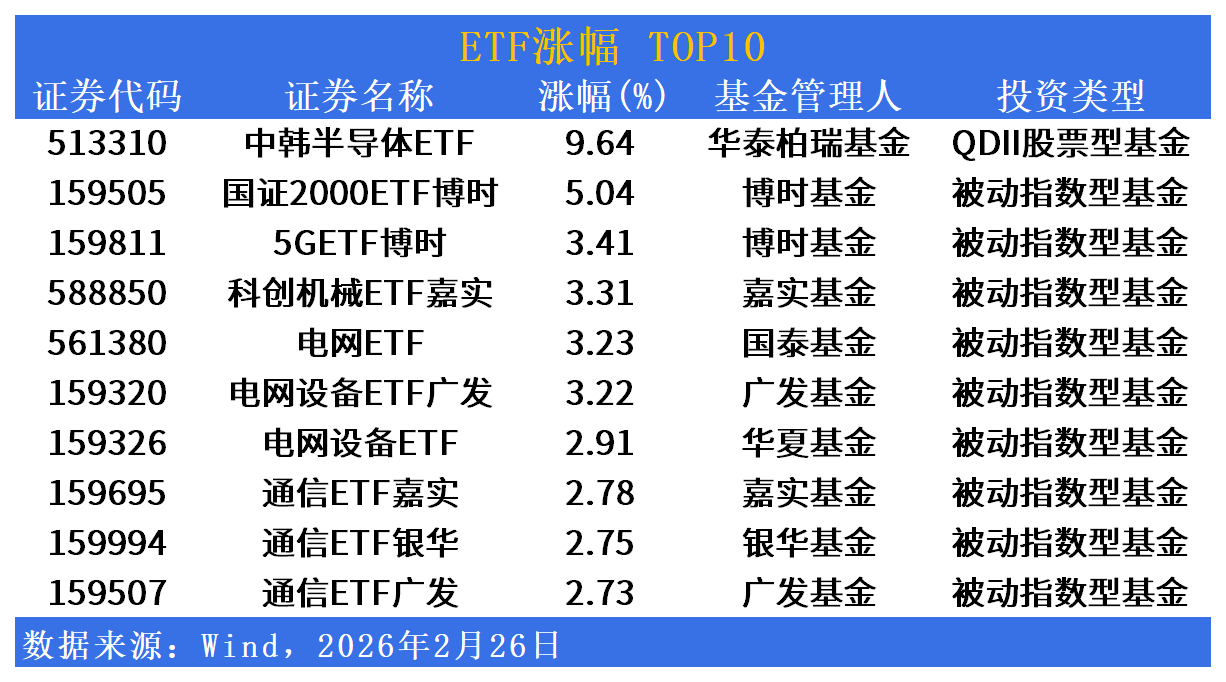
Market Overview - A-shares showed mixed performance with the Shanghai Composite Index down 0.01%, Shenzhen Component Index up 0.19%, and ChiNext Index down 0.29% as of market close [1] - Total trading volume in Shanghai, Shenzhen, and Beijing reached 25,568 billion, an increase of 756 billion from the previous day [1] ETF Performance - The China-Korea Semiconductor ETF surged by 9.64%, leading the market, driven by the recovery in the semiconductor supply chain [2] - The National 2000 ETF rose by 5.04%, indicating a rebound in small-cap growth stocks [2] - The Electric Grid sector performed well, with the Electric Grid ETF up 3.23% and the Electric Grid Equipment ETFs rising by 3.22% and 2.91% respectively [2] Communication Sector - The communication sector also saw gains, with ETFs in this category rising between 2.73% and 2.78% [3] Declining Sectors - The pharmaceutical sector faced a broad retreat, with the Hang Seng Biotechnology ETF showing the largest decline at -3.89% [4] - Other related ETFs in the healthcare and biotechnology sectors also experienced significant drops, indicating a market shift from defensive sectors to technology growth [4] Trading Activity - The Short-term Bond ETF had a trading volume exceeding 66 billion, leading in activity among ETFs [5] - The top traded ETFs included the Short-term Bond ETF at 661.12 billion and the Silver Day Benefit ETF at 167.16 billion [5] Turnover Rates - Cross-border products showed high trading activity, with the Brazil ETF and China-Korea Semiconductor ETF having turnover rates of 171.99% and 125.76% respectively [6][7] - The National Debt ETF also maintained a strong turnover rate of 88.09%, indicating active trading in interest rate bonds and cross-border assets [7] New ETF Launch - A new Technology Growth ETF by Industrial Bank is set to launch on February 27, with a focus on hard technology and a multi-factor strategy targeting the top 50 securities in various tech sectors [8]

ETF收评 | AI硬件股全线领涨,中韩半导体ETF逼近涨停
Ge Long Hui· 2026-02-26 07:37
Market Performance - The three major A-share indices showed mixed results, with the Shanghai Composite Index down 0.01%, the Shenzhen Component Index up 0.19%, and the ChiNext Index down 0.29% [1] - The total trading volume in the Shanghai, Shenzhen, and Beijing markets reached 25,566 billion yuan, an increase of 757 billion yuan compared to the previous day, with over 2,400 stocks rising [1] Sector Performance - Leading sectors included CPO, copper cable high-speed connections, optical fibers, PCBs, liquid-cooled servers, wind power equipment, aviation engines, cultivated diamonds, semiconductors, and sugar substitute concepts, which saw significant gains [1] - Underperforming sectors included film and television, insurance, real estate, short drama games, complete automobiles, precious metals, duty-free shops, liquor, and retail, which experienced notable declines [1] ETF Performance - AI hardware stocks led the gains, with the China-Korea Semiconductor ETF nearing a limit-up, while various communication ETFs saw increases of 3.41%, 2.78%, 2.58%, and 2.54% [1] - The electric grid sector also performed well, with the electric grid ETF and electric grid equipment ETF rising by 3.23% and 2.91%, respectively [1] - The medical sector faced declines, with the Hang Seng Medical ETF and other related ETFs dropping over 3%, while the real estate ETF fell by 3% [1]
创新药板块强势反弹,恒生医药ETF涨超2%
Mei Ri Jing Ji Xin Wen· 2026-02-10 04:44
Group 1 - The Hong Kong stock market saw renewed activity in innovative drugs, with companies like Zai Lab, Innovent Biologics, Kelun-Biotech, WuXi Biologics, and InnoCare leading the gains, and the Hang Seng Medical ETF (159892) rising over 2% during the session [1] - Innovent Biologics announced a strategic partnership with Eli Lilly to advance global research and development of innovative drugs in oncology and immunology, with an upfront payment of $350 million and potential milestone payments of up to $8.5 billion [1] - Donghai Securities highlighted the strong performance of the innovative drug sector, validating the effectiveness of the domestic innovative drug business model, with core products supported by medical insurance driving growth, and external collaborations contributing significantly to performance enhancement [1]
港股医药板块回暖复苏,恒生医药ETF(159892)涨近2%
Mei Ri Jing Ji Xin Wen· 2026-02-09 02:44
Group 1 - The Hong Kong stock market showed a strong opening on February 9, with the Hang Seng Index rising by 1.59%, the State-owned Enterprises Index increasing by 1.54%, and the Technology Index up by 1.9% [1] - The Hang Seng Biotechnology Index, focusing on innovative drugs, performed robustly, with the largest ETF tracking this index (159892) rising nearly 2% [1] - The innovative drug sector is expected to enter a profit realization acceleration phase by 2025, with companies like Innovent Biologics and Rongchang Biopharmaceuticals turning losses into profits, while companies like 3SBio are significantly increasing their performance [1] Group 2 - The strong performance of the innovative drug sector validates the effectiveness of the domestic innovative drug business model, with core product volume growth supported by medical insurance becoming the foundation for performance growth [1] - External collaborations, such as business development (BD) partnerships, are becoming important drivers for enhancing performance in the innovative drug sector [1] - The Hang Seng Medical ETF (159892) focuses on innovative drugs, CXO, and related industries, benefiting from the advantages of the Hong Kong Stock Exchange's 18A system, covering numerous innovative targets like BeiGene and Innovent Biologics, and is expected to continue its valuation recovery trend under catalysts like overseas expansion of innovative drugs and commercial insurance directories [1]

AI应用发起春节红包大战,恒生指数创2021年7月以来新高
Mei Ri Jing Ji Xin Wen· 2026-01-28 02:39
Group 1 - The Hong Kong stock market saw a short-term rise, with the Hang Seng Index increasing over 1%, reaching a four-year high, and the Hang Seng Tech Index rising over 0.7% [1] - Alibaba's Tongyi Qianwen is expected to join the cash red envelope promotion for the Spring Festival, following similar announcements from Baidu and Tencent, which are expected to attract significant attention to their consumer applications [1] - Citigroup predicts that the adoption of AI assistant applications in China will accelerate rapidly after the 2026 Spring Festival activities [1] Group 2 - Zheshang International is optimistic about sectors benefiting from favorable policies, including new energy, innovative pharmaceuticals, and AI technology, as well as undervalued state-owned enterprises and local Hong Kong banks, telecommunications, and utility stocks [1] - The performance of the Hong Kong stock market in the spring of 2026 is expected to be driven by three factors: "AI applications, PPI improvement, and expanded domestic demand," with a recommendation to focus on quality stocks in these areas [1] - Notable investment targets include core broad-based Hong Kong stocks such as Hang Seng ETF, AI and platform economy stocks like Hang Seng Tech Index ETF, and consumer core assets represented by Hong Kong Consumer ETF [2]
缺席本轮躁动行情的港股科技,最近发生了哪些积极的变化?
Mei Ri Jing Ji Xin Wen· 2026-01-22 01:44
Group 1 - The Hong Kong stock market has been lagging behind the A-share market since December, primarily due to structural differences and varying funding environments [1] - The current market hotspots in A-shares, such as artificial intelligence and commercial aerospace, have strong representation and high capital concentration, while Hong Kong stocks are dominated by internet giants, biomedicine, and high-dividend financial real estate [1] - The liquidity environment is more favorable for A-shares, driven by domestic capital, while Hong Kong's offshore market relies heavily on global capital flows, particularly from the US [1] Group 2 - Future opportunities for the Hong Kong market may depend on key "trigger points," including the expansion and rotation of market hotspots from A-shares to Hong Kong's unique assets [2] - Changes in the funding landscape, particularly regarding the Federal Reserve's monetary policy and the trend of southbound capital inflows, could significantly impact Hong Kong stocks [2] - Positive surprises in economic data could lead to substantial revisions in market expectations, benefiting both A-shares and Hong Kong stocks, with the latter potentially showing greater rebound elasticity due to previous declines [3] Group 3 - Recent positive changes in the funding and fundamental outlook for the Hong Kong market suggest potential opportunities in core assets, including the Hang Seng Tech Index ETF, which covers internet, hard tech, and new energy vehicles [4] - The Hong Kong Stock Connect Tech ETF offers higher sharpness by reducing retail and automotive exposure while increasing biopharmaceutical allocations [4] - The Hang Seng Internet ETF focuses on software applications and internet media, with significant weight in Alibaba, Tencent, and Meituan, while the Hang Seng Pharma ETF targets innovative drugs and CXO leaders, currently characterized by low valuations and low crowding [4]

ETF及指数产品网格策略周报-20260114
HWABAO SECURITIES· 2026-01-14 10:07
Group 1: Grid Trading Strategy Overview - The essence of "grid trading" is a high buy low sell strategy, which does not predict market trends but utilizes natural price fluctuations within a certain range to generate profits, suitable for frequently fluctuating markets [4][13] - Characteristics of suitable grid trading targets include: selecting on-market targets, stable long-term trends, low trading costs, good liquidity, and high volatility. Equity ETFs are considered relatively suitable for grid trading [4][13] Group 2: ETF Grid Strategy Target Analysis - **Hang Seng Medicine ETF (159892.SZ)**: Benefiting from the Federal Reserve's interest rate cut cycle, which improves the financing environment for innovative drugs. China's innovative drugs are accelerating their globalization, becoming a core driver for commercialization. As of January 4, 2026, China's new drug pipeline accounts for about 30% of the global total, ranking second worldwide. In 2025, 76 innovative drugs were approved for marketing in China, with domestic innovative drugs accounting for 80.85% of chemical drugs and 91.30% of biological products [4][14] - **Brokerage ETF (159842.SZ)**: High market activity catalyzes the release of brokerage performance, with capital market reforms opening up long-term growth space for leading brokerages. The Shanghai Composite Index rose from a low of 3040 points to break through 4000 points, with an annual increase of 18.41%. The total A-share trading volume reached 420.21 trillion yuan, a year-on-year increase of 62.64% [5][17] - **New Economy ETF (159822.SZ)**: A one-stop layout for high-quality new economy leading enterprises in China, capturing the key to economic transformation. The ETF indirectly tracks the S&P China New Economy Industry Index, holding leading companies in artificial intelligence, internet, biotechnology, and innovative drugs, which are high-growth sectors [6][19] - **Coal ETF (515220.SH)**: Benefiting from the "anti-involution" policy and dividend investment logic. The central economic work conference in December 2025 identified "deepening the rectification of 'involutionary' competition" as a key task for 2026, which is expected to control new capacity and improve the coal industry's supply-demand fundamentals. As of January 13, 2026, the coal sector's dividend yield reached 5.52%, significantly higher than the market average and the yield on ten-year government bonds [7][22]
“医药春晚”正式召开,中国创新药企集体亮相
Mei Ri Jing Ji Xin Wen· 2026-01-13 03:07
Group 1 - The 44th J.P. Morgan Healthcare Conference is set to take place in San Francisco on January 12, 2026, featuring multiple Chinese innovative pharmaceutical companies [1] - Key speakers include WuXi AppTec, WuXi Biologics, and WuXi AppTec's subsidiary, along with innovative drug companies such as BeiGene, Zai Lab, Ascentage Pharma, and Legend Biotech [1] - A total of 17 companies, including Hengrui Medicine, Baillie Gifford, and 3SBio, will participate in the Asia-Pacific session, highlighting the growing presence of Chinese firms in the global market [1] Group 2 - Guotai Junan Securities views the conference as a critical platform for domestic pharmaceutical companies to showcase their core molecular product capabilities and advance overseas business development collaborations [1] - The industry is transitioning back to a phase of global value verification for products, driven by advancements in global clinical trials, significant data releases, and an optimized competitive landscape [1] - Huayuan Securities indicates that the Chinese pharmaceutical industry has largely completed the transition from old to new growth drivers, with innovative drugs significantly opening new growth trajectories for companies [1] Group 3 - The Hong Kong Stock Connect Medical ETF (520510) has over 27% weight in WuXi-related companies and more than 25% exposure to AI healthcare [2] - The Hang Seng Medical ETF (159892) focuses on the innovative drug sector and is the largest in scale within its index [3]

