Canva

Search documents
Figma Stock Soars 3x, Now Comes The Hard Part
Forbes· 2025-08-01 10:55
Core Insights - Figma made a strong public market debut, with its stock price increasing over three times its IPO price, closing at $115.50, valuing the company at over $55 billion [2] Financial Performance - Figma reported revenue of $228.2 million for the quarter ending March 31, representing a 46% year-over-year growth, leading to an annual revenue run rate of $913 million [3] - The company achieved a net income of $44.9 million in the last quarter, with adjusted operating margins of 17% and free cash flow margins of 24% for 2024 [3] Customer Engagement - Figma's Net Dollar Retention rate is 132%, indicating existing customers are spending 32% more annually, showcasing strong product stickiness [4] - The company's pricing model is seat-based, which encourages organic growth within organizations, minimizing customer acquisition costs and shortening sales cycles [4] - Figma maintains a balanced cost structure, with R&D spending nearly equal to sales and marketing, emphasizing product innovation over aggressive selling [4] Valuation and Market Position - Figma's valuation exceeds 50 times its estimated 2025 run rate revenue, significantly higher than mature peers like Adobe, which trades at around 7.5 times forward sales [5] - The premium valuation reflects Figma's strong growth rate of approximately 40%, compared to Adobe's 9%, but also sets high expectations for future performance [5] - Figma is expanding its offerings beyond design tools to become a broader collaboration hub, which is crucial for its long-term success [5] Competitive Landscape - Competition is intensifying with Microsoft integrating design tools into Office 365, Canva expanding its offerings, and AI-native tools potentially reducing reliance on traditional design platforms [6] - Figma's enterprise customer base is still developing, with only 1,031 customers paying over $100,000 annually, highlighting the need for deeper integration within organizations [6][7]



250%!Figma上市首日股价暴涨
Di Yi Cai Jing Zi Xun· 2025-08-01 02:53
Core Insights - The U.S. IPO market is experiencing a significant resurgence, highlighted by Figma's successful debut on the New York Stock Exchange, where its opening price was $83, more than double its issuance price of $33, and it closed at $115.5, marking a 250% increase on its first day [2][3][4] Company Overview - Figma is a design software company that provides collaborative design tools for websites, applications, and digital products, with notable clients including Netflix, Airbnb, and Duolingo [3] - The company raised $1.2 billion by selling 36.9 million shares during its IPO, with early investors including prominent venture capital firms like Sequoia Capital and Kleiner Perkins [3][4] Market Context - Figma's IPO is seen as a symbol of the recovery of the tech IPO market, as it coincides with a strong rebound in the U.S. stock market, driven by robust earnings reports from major tech companies like Microsoft and Meta, and a growing interest in generative AI [3][4] - The overall IPO market in the U.S. is showing signs of recovery, with 59 IPOs completed in Q2 2025, raising a total of $15.02 billion, surpassing the previous quarter's figures [4][5] AI Integration - Figma is accelerating its AI capabilities to maintain its competitive edge in the design software industry, having launched several AI features aimed at enhancing design efficiency and lowering barriers to use [6][7] - The competitive landscape is intensifying, with other design platforms like Canva and Adobe rapidly integrating AI functionalities to capture market share [6][7] Valuation and Growth Potential - Figma's improved capabilities in AI are seen as a key factor in its valuation reassessment, especially after a failed acquisition attempt by Adobe at a $20 billion valuation [7]

250%!Figma上市首日股价暴涨
第一财经· 2025-08-01 02:38
Core Viewpoint - The article highlights the significant resurgence of the U.S. IPO market, marked by Figma's successful debut on the New York Stock Exchange, which reflects strong investor interest in high-growth tech stocks and AI themes [2][3]. Group 1: Figma's IPO Performance - Figma's opening price was $83, more than double its issuance price of $33, reaching a peak of nearly $125 during trading, ultimately closing at $115.5, representing a 250% increase on its first day and a market capitalization of $67.6 billion [2][6]. - The IPO raised $1.2 billion by selling 36.9 million shares, indicating strong demand and investor confidence in the company [6]. - Figma's performance is seen as a pivotal moment for the tech IPO market, potentially encouraging more AI-related tech companies to pursue public listings [3][6]. Group 2: Market Context and Trends - The IPO occurred amidst a robust rebound in the U.S. tech sector, with major companies like Microsoft and Meta reporting strong earnings, contributing to a rise in the Nasdaq and S&P 500 indices [7]. - In 2025, the U.S. IPO market has already seen a total of 59 IPOs in Q2, raising $15.02 billion, surpassing the 45 IPOs and $11.23 billion raised in Q1 [8]. - The total IPO fundraising for the first half of 2025 reached $26.25 billion, significantly higher than the total amounts raised in 2022 ($7.7 billion) and 2023 ($19.4 billion) [9]. Group 3: AI Integration and Competitive Landscape - Figma is accelerating its AI capabilities to maintain its competitive edge in the design software industry, having launched several AI features aimed at enhancing design efficiency [11][12]. - The competitive landscape is intensifying, with other platforms like Canva and Adobe rapidly integrating AI functionalities to capture market share [12]. - Investors are increasingly focused on software companies with strong AI capabilities, which are seen as key drivers for valuation reassessment [13].

250%,Figma上市首日股价暴涨,美国科技IPO市场迎来复苏
Di Yi Cai Jing· 2025-08-01 01:11
Group 1 - The U.S. IPO market is experiencing a significant resurgence, highlighted by Figma's successful debut on the New York Stock Exchange, with its opening price at $83, more than double the $33 issue price, and a closing price of $115.5, marking a 250% increase on its first day [1][3][4] - Figma's strong performance is seen as a pivotal moment for the tech IPO market, potentially encouraging more AI-related tech companies to restart their listing plans, which could lead to a transformative recovery in the U.S. IPO market by 2025 [1][4][5] Group 2 - Figma, a platform for collaborative design tools, has notable clients including Netflix, Airbnb, and Duolingo, and its early investors include prominent venture capital firms like Sequoia Capital and Kleiner Perkins [3][4] - The company raised $1.2 billion by selling 36.9 million shares at an adjusted issue price of $33, which was above the previously set range of $30-$32 [3][4] - The successful IPO of Figma is viewed as a symbol of the recovery of the tech IPO market, with analysts noting that the demand for rapidly growing software companies has been absent for years [4][5] Group 3 - Figma's IPO coincides with a strong rebound in the U.S. tech sector, driven by robust earnings reports from major companies like Microsoft and Meta, alongside a surge in investment interest in generative AI [3][4] - The overall IPO market in the U.S. is showing signs of substantial recovery, with 59 IPOs completed in Q2 2025, raising a total of $15.02 billion, surpassing the 45 IPOs and $11.23 billion raised in Q1 2025 [4][5] Group 4 - Figma is accelerating its AI capabilities to maintain its competitive edge in the design software industry, having launched several AI features aimed at enhancing design efficiency and lowering barriers to use [7][8] - The competitive landscape is intensifying, with other design platforms like Canva and Adobe rapidly integrating AI functionalities to capture market share [7][8] - Figma's improved AI capabilities are seen as a key factor in its valuation reassessment, especially after the failed acquisition attempt by Adobe at a $20 billion valuation [8]
250%!Figma上市首日股价暴涨,美国科技IPO市场迎来复苏
Di Yi Cai Jing· 2025-08-01 00:53
Core Insights - Figma's IPO raised $1.2 billion, with a market valuation significantly exceeding the $20 billion level at which Adobe terminated its acquisition agreement, signaling a revival in the U.S. tech IPO market [1] - Figma's stock opened at $83, doubling its issue price of $33, and reached a peak of $125 during trading, closing at $115.5, marking a 250% increase on its first day and a market capitalization of $67.6 billion [1] - The strong debut of Figma is viewed as a pivotal moment for the tech IPO market, which has been sluggish for years, potentially encouraging more AI-related tech companies to pursue IPOs [1][2] Company Overview - Figma provides collaborative design tools for websites, applications, and digital products, with notable clients including Netflix, Airbnb, and Duolingo [2] - The company was backed by prominent venture capital firms such as Sequoia Capital and Kleiner Perkins, and its CEO Dylan Field retains 74.1% voting power through Class B shares [2] Market Context - The successful IPO of Figma is seen as a sign of recovery in the tech IPO market, coinciding with strong earnings reports from major tech companies like Microsoft and Meta, which have boosted investor sentiment [2] - In 2025, the U.S. IPO market is expected to see a significant turnaround, with a total of 59 IPOs raising $15.02 billion in Q2, surpassing the 45 IPOs and $11.23 billion raised in Q1 [3] Industry Trends - Figma is accelerating its AI capabilities in response to rapid advancements in generative AI and changing market dynamics, having launched several AI features aimed at enhancing design efficiency [5] - The competitive landscape is intensifying, with companies like Canva and Adobe rapidly integrating AI functionalities into their platforms to capture market share [6] - Figma's improved AI capabilities are seen as a key factor in its valuation reassessment, especially after the failed acquisition by Adobe, which was previously valued at $20 billion [6]
GenAI系列报告之63:Figma上市,全球AI设计商业化崛起
Shenwan Hongyuan Securities· 2025-07-31 15:35
Investment Rating - The report does not explicitly state an investment rating for the industry or specific companies [3]. Core Insights - Figma's core product is a cloud-based collaborative interface design tool that integrates the entire workflow from conception to delivery, addressing pain points in traditional design processes [3][5]. - Figma has a strong user base with 13 million monthly active users, 86% of whom are from small and medium-sized enterprises, and 70% of revenue comes from organizational and enterprise plans [3][36]. - The introduction of AI features in Figma is expected to enhance user engagement and increase subscription prices, with 2024 revenue projected at $749 million, a 48% year-over-year increase [3][59]. - The AI creative landscape is evolving, with Figma positioned to benefit from the commercialization of AI tools, which have already crossed the $100 million ARR threshold in various segments [3][78]. Summary by Sections 1. Figma Overview - Figma is a leading cloud-based collaborative design software, focusing on interface design and team collaboration, widely used in software development and UI/UX design [5][6]. - The company has experienced rapid growth, achieving $749 million in revenue for 2024, with a 48% year-over-year increase [3][59]. - Figma's user base includes 95% of the Fortune 500 companies, with a significant portion being non-professional designers [36]. 2. AI Creative Landscape - The report identifies three main types of players in the AI creative space: large model companies, creative software companies leveraging GenAI, and image/video communities with strong data and R&D capabilities [3][78]. - Figma and Canva target the creator market, while Adobe focuses on professional design, leading to different valuation metrics [3][88]. 3. A-Share and Hong Kong Stock Targets - The report mentions potential investment targets in the A-share and Hong Kong markets, including Meitu, Kuaishou, Hongsoft Technology, Wankong Technology, Visual China, and Danghong Technology [3][4]. 4. Financial Analysis - Figma's revenue growth is robust, with a compound annual growth rate (CAGR) of 53% over four years, and a rolling 12-month revenue of $821 million [3][65]. - The company has a strong cash flow, with a free cash flow to revenue ratio of 28%, significantly higher than the SaaS industry median of 18% [3][65].
3年来估值最高的美股软件公司IPO 一文读懂Figma
Hua Er Jie Jian Wen· 2025-07-31 13:31
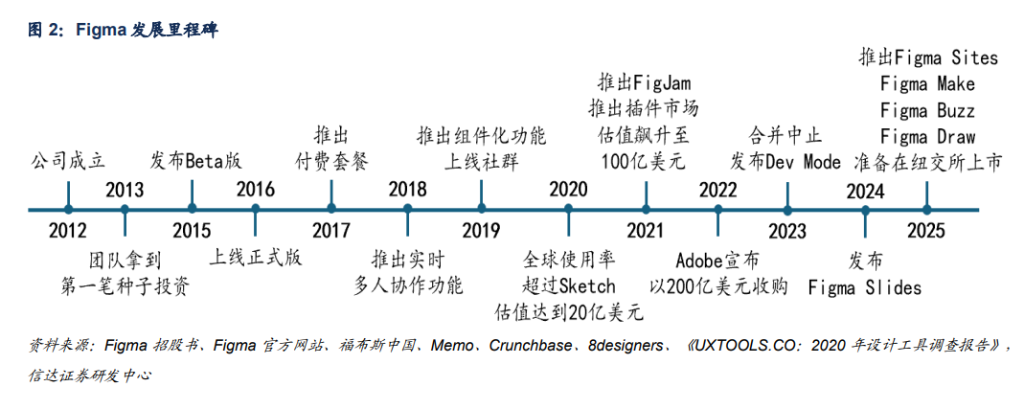
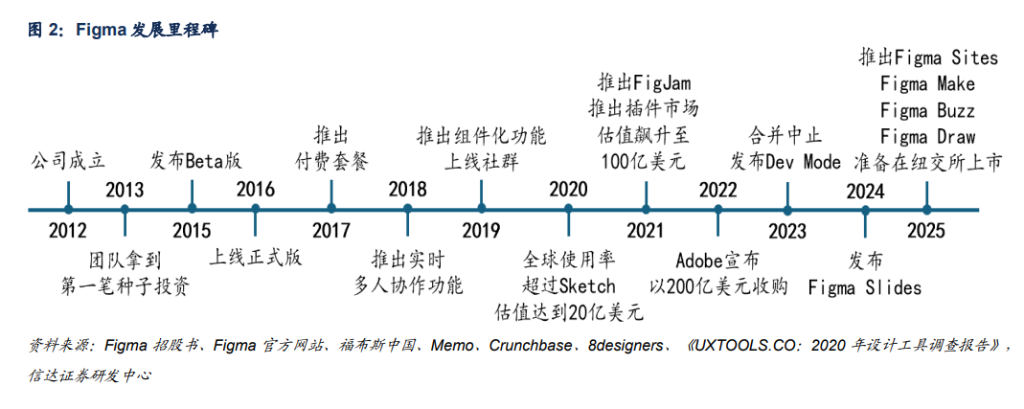
Core Insights - Figma's IPO on July 31, 2023, priced at $33 per share, achieved a valuation of $19.3 billion, marking it as the highest-valued enterprise software IPO since the 2021 market downturn [1][4] - The successful IPO is seen as a key indicator of a potential rebound in the IPO market and renewed interest from venture capitalists in the "AI + design" sector [1][19] - Figma's growth and profitability are highlighted, with a Q1 2023 revenue of $228 million, a 46% year-over-year increase, and a net profit of $45 million, showcasing a gross margin of 91% and an operating margin of 18% [4][20] Company Overview - Founded in 2012, Figma specializes in online UI design tools, known for real-time collaboration and a robust plugin ecosystem [1] - The company benefitted from a failed acquisition attempt by Adobe in 2022, which resulted in a $1 billion breakup fee that bolstered its product development and AI capabilities [1][4] Financial Performance - Figma's revenue is projected to reach $749 million by 2025, with an anticipated growth rate of 48% [4] - The company has achieved a compound annual growth rate (CAGR) of 53% in revenue from 2021 to 2025, with a non-GAAP operating profit margin steadily increasing [4][20] - The net dollar retention rate is expected to be 134% in 2024, indicating strong customer loyalty and repeat business [9] Product and Market Position - Figma's integration of AI into its design processes has significantly enhanced its product offerings, creating a unique end-to-end design collaboration ecosystem [5][20] - The platform currently has 13 million monthly active users and over 11,000 enterprise customers contributing more than $10,000 annually [8] - Despite its penetration into 78% of the Forbes Global 2000 companies, there remains substantial potential for customer expansion, as only 24% of customers pay over $100,000 annually [8] Industry Implications - Figma's IPO is viewed as a potential catalyst for a wave of upcoming software IPOs, particularly in the AI-driven sector, with analysts predicting more high-profile listings [17][19] - The success of Figma's IPO is seen as a confidence booster for venture capital-backed tech companies, signaling a possible recovery in the IPO market after a prolonged downturn [19][20]
3年来估值最高的美股软件公司IPO,一文读懂Figma
Hua Er Jie Jian Wen· 2025-07-31 12:09
Core Insights - Figma's IPO on July 31, priced at $33 per share, achieved a valuation of $19.3 billion, marking it as the highest-valued enterprise software company to go public since the 2021 IPO boom [1][5] - The successful IPO is seen as a key indicator of a potential rebound in the IPO market and renewed interest in the "AI + design" sector amidst a backdrop of declining venture capital [1][15] Company Overview - Founded in 2012, Figma specializes in online UI design tools, known for real-time collaboration and a robust plugin ecosystem [2] - Adobe attempted to acquire Figma for $20 billion in 2022, but the deal fell through in 2023 due to regulatory challenges, resulting in a $1 billion breakup fee that Figma utilized to enhance its product and AI capabilities [2][5] Financial Performance - Figma reported Q1 2023 revenue of $228 million, a 46% year-over-year increase, with a net profit of $45 million and a gross margin of 91% [5] - The company anticipates revenue of $749 million by 2025, reflecting a projected growth rate of 48% [5] - Figma achieved a compound annual growth rate (CAGR) of 53% in revenue from 2021 to 2025, with a non-GAAP operating profit margin steadily increasing [5][10] User Engagement and Market Position - Figma currently has 13 million monthly active users and over 11,000 enterprise customers contributing more than $10,000 annually [9] - The company has penetrated 78% of the Forbes Global 2000 companies, with only 24% of customers paying over $100,000 annually, indicating significant potential for customer expansion [9] Product Development and AI Integration - Figma's integration of AI into its design processes has enhanced its product offerings, creating a comprehensive toolchain from ideation to development [6][7] - The platform's unique end-to-end design collaboration process differentiates it from traditional tools, leading to increased user retention and platform stickiness [6] Market Implications - Figma's strong IPO performance is expected to pave the way for other high-profile software IPOs, potentially revitalizing the IPO market [15] - The success of Figma is seen as a signal for other AI-driven B2B tech companies to enter the public market, indicating a shift in investor sentiment towards technology IPOs [16]
Anywhere Announces Landmark Deal with Canva
Prnewswire· 2025-07-30 13:00
Core Insights - Anywhere Real Estate Inc. has partnered with Canva to provide Canva Enterprise to its network of affiliated agents, enhancing their marketing capabilities with AI-powered tools [1][2][3] Group 1: Partnership and Offerings - The partnership allows agents from various brands under Anywhere, including Better Homes and Gardens® Real Estate and CENTURY 21®, to access Canva Enterprise at no cost [1][4] - Canva Enterprise equips agents with templates and brand-compliant materials, facilitating the creation of marketing content such as listings and social media assets [2][4] Group 2: Benefits and Features - The integration of Canva Enterprise is aimed at simplifying the marketing process for agents, enabling them to produce high-quality, customized marketing assets efficiently [3][4] - The platform includes a library of prepopulated branded templates and custom integrations, allowing for collaborative content creation among team members [4] Group 3: Company Overview - Anywhere Real Estate Inc. is a leader in residential real estate services, operating a vast network of over 300,000 affiliated agents globally [5] - The company focuses on providing integrated services, including brokerage, relocation, and title services, to empower agents and enhance their productivity [5]


Jinqiu Select | 价格即品牌:AI产品定价如何重塑企业增长逻辑
锦秋集· 2025-07-28 14:38
Core Insights - The article emphasizes that sustainable growth for companies is driven by two engines: market share and wallet share, which must be balanced to avoid stagnation or financial difficulties [1][10] - The rise of AI technology has shifted pricing strategies from user count to actual usage and the value created, making pricing a strategic decision throughout product design and operations [2][3] Pricing Strategies - A growing number of AI companies are adopting hybrid pricing models that combine subscription fees with usage-based billing, though designing these models can be complex [4][5] - Clay's pricing strategy exemplifies hybrid pricing, offering a subscription package with usage credits, which encourages customer retention and avoids revenue erosion from large discounts [5] - The popularity of hybrid pricing is attributed to its ability to smoothly transition from traditional models, provide natural upsell paths, safeguard profits, and maintain predictable costs for customers [6][7] Common Pricing Models - Various pricing models are discussed, including pay-as-you-go, capped usage fees, and platform fees combined with usage fees, each with its own advantages and challenges [8][9] - Companies should adapt their pricing strategies based on their product's value delivery and customer preferences, potentially combining different models as they grow [9] Market Share and Wallet Share Strategy - Companies must focus on both acquiring new customers (market share) and maximizing revenue from existing customers (wallet share) to achieve sustainable growth [10][11] - Early-stage companies should prioritize product development and user growth, while later stages should enhance monetization capabilities, ensuring both engines are operational [11] Pricing Misconceptions - Entrepreneurs often fall into pricing traps by focusing too heavily on one growth engine, leading to missed opportunities or customer loss [13][14] - Common pitfalls include overemphasizing market share at the expense of retention, complicating pricing structures, and misjudging the relationship between price and perceived value [14] Value Attribution and Pricing Models - A 2x2 pricing model framework is proposed, categorizing pricing strategies based on value attribution and autonomy, guiding entrepreneurs in selecting appropriate pricing paths [15][17] - The ultimate goal is to reach a results-based pricing model, where companies charge based on measurable outcomes, significantly increasing their pricing power [18] Core Principles of Pricing Strategy - Key principles include focusing on the most valuable product features, overcoming price anxiety, and attracting the right customers to reduce churn [19] - Companies should ensure that core value is not given away for free and should be willing to adjust pricing based on the value provided [19] Organizational Changes and Challenges - Transitioning to usage-based pricing necessitates significant internal operational changes, requiring a redefinition of roles and processes across departments [20][21] - Establishing clear pricing responsibilities and collaborative processes is crucial to avoid decision-making paralysis as companies scale [21] Strategic Leadership in Pricing - CEOs must lead pricing strategy changes, setting clear timelines and accountability to ensure successful implementation across the organization [22][23] - Pricing should be integrated into product experience and brand strategy, reflecting the company's value proposition and differentiating it from competitors [23][24] AI Market Dynamics - The shift towards usage-based pricing is driven by structural factors, making it essential for companies to adapt their organizational frameworks to support this model [24][25] - Companies that effectively implement usage-based pricing can gain a competitive edge, as customer loyalty becomes harder to disrupt once established [25]