平安银行

Search documents
私人银行半年新增15万高净值客户
21世纪经济报道· 2025-09-04 05:24
Core Viewpoint - The private banking sector has shown remarkable growth in the first half of 2025, becoming a standout area within the wealth management segment of banks, despite a complex economic environment [1]. Group 1: Growth Metrics - As of June 2025, the total number of private banking clients across 15 banks exceeded 1.63 million, with an increase of nearly 150,000 clients, representing a growth rate of over 10% [1]. - Major banks like Agricultural Bank, Bank of China, and China Construction Bank reported AUM exceeding 3 trillion yuan, with Agricultural Bank's AUM reaching 3.5 trillion yuan, a growth of 11.11% year-on-year [3]. - The AUM of Industrial Bank surpassed 1 trillion yuan for the first time, joining the "trillion club" among joint-stock banks [1][3]. Group 2: Client Quality and Strategy - Despite high growth in scale, the average asset per client has generally declined, indicating a shift from rapid expansion to a focus on deeper client engagement and service quality [4]. - Banks are increasingly targeting ultra-high-net-worth clients and enhancing services such as family trusts and retirement financial planning to differentiate themselves in a competitive market [1][5]. Group 3: Service Innovations - Private banks are moving beyond traditional product sales to more refined customer operations, focusing on precise segmentation and embedding services into clients' daily lives [6]. - For instance, China CITIC Bank has launched a dedicated service brand for ultra-high-net-worth clients, achieving a 40.96% increase in this segment [6]. - Family trusts have become a key area of focus, with several banks reporting significant growth in this service, such as Everbright Bank's family trust business growing by 56.12% year-on-year [7]. Group 4: Revenue Generation - The private banking sector is increasingly contributing to banks' intermediary income, with Beijing Bank reporting a 16.89% increase in product sales, directly boosting its intermediary income by 17.77% [9]. - Construction Bank's net income from fees and commissions reached 65.218 billion yuan in the first half of the year, reflecting a year-on-year growth of 4.02% [10].





银行业正在形成“反内卷”共识
Jin Rong Shi Bao· 2025-09-04 03:03
以濮阳市银行业协会为例,该协会在近日发文时表示,"内卷"是一把"双刃剑",它在短期内或许能 带来表面繁荣,但其代价是扭曲了市场资源配置,削弱了金融体系的服务效能,挫伤了从业者的职业尊 严与热情,最终损害的是整个行业的形象与未来。 民银研究发布的报告提出,7月份,中央财经委员会第六次会议聚焦"纵深推进全国统一大市场建 设",要求"依法依规治理企业低价无序竞争,引导企业提升产品品质,推动落后产能有序退出",预示 着下半年综合整治"内卷式"竞争将会进一步落实。 在金融管理部门的指导下,银行业金融机构正在跳出 " 内卷式 " 恶性竞争、转变对产能过剩行业的融 资供给思路。 " 反内卷 " 带动的不仅仅是银行业金融机构经营思路与经营策略的调整,更是行业生态的优 化和发展质量的提升。 "今年以来,'反内卷'要求逐步推行,有利于规范银行业有序竞争,引导银行业把握好金融支持实 体经济和保持自身健康发展。"日前,在中信银行召开的2025年中期业绩发布会上,中信银行行长芦苇 表示。 今年以来,多地金融监管局、银行业协会先后发声,呼吁辖内银行业金融机构摒弃"内卷式"竞争, 规范发展、稳健运行。 今年7月,平安银行广州分行率先开始推 ...
中期分红队伍持续壮大
Jin Rong Shi Bao· 2025-09-04 03:03
Core Viewpoint - The recent announcements of interim dividend plans by A-share listed banks highlight a trend towards increased shareholder returns, with a total proposed dividend amount exceeding 200 billion yuan from major state-owned banks and several joint-stock banks [1][4]. Group 1: State-Owned Banks - Six major state-owned banks have announced their interim dividend plans for 2025, with a total proposed dividend amount exceeding 200 billion yuan [1]. - Industrial and Commercial Bank of China leads with a proposed dividend of 1.414 yuan per 10 shares, totaling 503.96 billion yuan [1]. - Other state-owned banks, including Agricultural Bank of China, Bank of China, China Construction Bank, Bank of Communications, and Postal Savings Bank, have proposed dividends of 418.23 billion yuan, 352.50 billion yuan, 486.05 billion yuan, 138.11 billion yuan, and 147.72 billion yuan respectively [1]. Group 2: Joint-Stock Banks - Several joint-stock banks, including China Merchants Bank, CITIC Bank, Minsheng Bank, Ping An Bank, and Huaxia Bank, have confirmed their interim dividend plans for 2025 [1][2]. - China Merchants Bank announced its first interim profit distribution plan since its listing, with a cash dividend amounting to 35% of its net profit attributable to ordinary shareholders for the first half of 2025 [1][2]. - CITIC Bank plans to increase its interim dividend payout ratio to 30.7%, enhancing investor return expectations [2]. Group 3: New Participants in Interim Dividends - New entrants to the interim dividend group include Ningbo Bank, Changsha Bank, Su Nong Bank, and Jiangyin Bank, indicating a growing trend among listed banks to adopt interim dividends [2][4]. - Su Nong Bank announced its first interim dividend plan, proposing a cash dividend of 0.9 yuan per 10 shares, totaling 1.82 billion yuan [2][3]. Group 4: Overall Market Trends - A total of 23 A-share listed banks implemented interim dividends in 2024, distributing over 250 billion yuan, with the number of banks participating expected to increase in 2025 [4]. - The push for interim dividends is seen as a response to regulatory guidance aimed at enhancing shareholder returns and stabilizing market expectations [5].


平安银行发布上金所代理业务调整合约保证金比例和涨跌幅度限制通知
Jin Tou Wang· 2025-09-04 03:01
Core Points - Ping An Bank announced adjustments to margin ratios and price fluctuation limits for gold and silver contracts based on the Shanghai Gold Exchange's notice [1] Summary by Category Margin Ratio Adjustments - For individual clients, the margin ratio for Au (T+D), mAu (T+D), Au (T+N1), and Au (T+N2) contracts increased from 40% to 41% [1] - For institutional clients, the margin ratio for Au (T+D), mAu (T+D), Au (T+N1), and Au (T+N2) contracts increased from 24% to 25% [1] - For individual clients, the margin ratio for Ag (T+D) contracts increased from 49% to 50% [1] - For institutional clients, the margin ratio for Ag (T+D) contracts increased from 30% to 31% [1] Price Fluctuation Limits - The price fluctuation limit for gold contracts increased from 12% to 13% starting from the next trading day [1] - The price fluctuation limit for silver contracts increased from 15% to 16% starting from the next trading day [1] Market Context - Recent significant fluctuations in gold and silver prices prompted Ping An Bank to remind clients to enhance risk awareness and manage positions carefully [1]

健康元药业集团股份有限公司关于为控股子公司提供担保进展情况的公告
Zhong Guo Zheng Quan Bao - Zhong Zheng Wang· 2025-09-03 22:59
Core Viewpoint - The company has entered into guarantee agreements with Ping An Bank to support its wholly-owned subsidiaries, ensuring their operational financing needs are met without any related guarantees or overdue situations [1][9][10]. Group 1: Guarantee Details - The total guarantee amounts for the subsidiaries are as follows: Shenzhen Haibin Pharmaceutical Co., Ltd. (RMB 200 million), Shenzhen Taotai Pharmaceutical Co., Ltd. (RMB 80 million), Jiaozuo Health Yuan Biological Products Co., Ltd. (RMB 200 million), and Health Yuan Haibin Pharmaceutical Co., Ltd. (RMB 100 million) [1]. - The company has approved a maximum credit financing of RMB 24.6 billion or equivalent foreign currency from banks, with a specific guarantee of up to RMB 20.201 billion for its subsidiaries [2][9]. - The guarantees provided are joint liability guarantees, with no counter-guarantees involved [5][6][7][8]. Group 2: Financial Health and Risk Management - As of August 31, 2025, the total guarantee balance of the company is RMB 2.834 billion, which represents 19.50% of the latest audited net assets attributable to shareholders [10]. - There are no overdue guarantees for the company or its subsidiaries, indicating a stable financial position and effective risk management [10].

信用卡业务“跑马圈地”退潮后,转型创新路在何方?
Bei Jing Shang Bao· 2025-09-03 15:01
Core Insights - The credit card business in China's banking sector is undergoing a significant adjustment, shifting from an era of aggressive expansion to a focus on optimizing existing customer bases and asset quality [1][2][3] Group 1: Credit Card Business Performance - In the first half of 2025, 11 out of 15 listed banks reported a decline in credit card loan balances, with China Bank showing the most significant reduction of 13.89% to 510.97 billion yuan [2] - The total credit card loan balance for the 15 banks showed a mixed trend, with only four banks, including Industrial and Agricultural Banks, experiencing growth [2] - Credit card transaction volumes also declined, with a notable drop of 8.54% for China Merchants Bank, despite leading the sector with a transaction amount of 2.02 trillion yuan [3] Group 2: Bad Debt and Risk Management - The total bad credit card loans across 11 banks reached 162.69 billion yuan, an increase of 5.88 billion yuan from the beginning of the year, with notable increases in bad loans for banks like China Communications Bank and Industrial Bank [4] - Only three banks managed to improve their bad loan ratios, while eight banks, including China Merchants Bank and Industrial Bank, saw increases in their bad loan ratios [4] - The overall credit card market is experiencing a contraction, with the total number of credit cards decreasing to 715 million by Q2 2025, down from 727 million in Q4 2024 [5] Group 3: Strategic Adjustments and Future Directions - Banks are actively working to optimize asset quality and manage bad debts, with nearly a thousand bad loan transfer announcements made in 2025 [6] - The focus is shifting towards product innovation and differentiated competition, emphasizing quality over quantity in credit card offerings [6][7] - Strategies include targeting high-end customers and meeting basic customer needs, with an emphasis on enhancing customer experience and integrating credit cards with other retail banking services [7]




金融中报观|信用卡业务“跑马圈地”退潮后,转型创新路在何方?
Bei Jing Shang Bao· 2025-09-03 14:58
Core Viewpoint - The credit card business in China's banking sector is undergoing a significant adjustment, shifting from an era of aggressive expansion to a focus on optimizing existing customer relationships and managing risks [1][3]. Group 1: Credit Card Business Performance - In the first half of 2025, 11 out of 15 listed banks reported a decline in credit card loan balances, with China Bank showing the most significant reduction of 13.89% to 5109.69 billion yuan [3][4]. - The total credit card loan balance for the 15 banks showed a mixed trend, with only four banks, including Industrial and Agricultural Banks, experiencing growth [3][4]. - Credit card transaction volumes also declined, with a notable drop of 8.54% for China Merchants Bank, despite leading in transaction amounts at 20.2 trillion yuan [4][6]. Group 2: Bad Debt and Risk Management - The total bad credit card loans across 11 banks reached 1626.9 billion yuan, an increase of 58.85 billion yuan since the beginning of the year, with several banks experiencing significant rises in bad loan ratios [5][6]. - Only three banks improved their bad loan ratios, while eight banks, including major players like China Merchants Bank and Industrial Bank, saw increases in their bad loan ratios [5][6]. - The overall credit card market is adjusting, with the total number of credit cards decreasing from 7.27 billion to 7.15 billion [6]. Group 3: Strategic Responses and Future Directions - Banks are actively working to optimize asset quality and manage bad debts, with nearly a thousand bad loan transfer announcements made in 2025 [6][7]. - The focus is shifting towards product innovation and differentiated competition, emphasizing quality over quantity in credit card offerings [7][8]. - Strategies include targeting high-end customers and meeting basic customer needs, with an emphasis on enhancing customer experience and integrating credit cards with other retail banking services [8].

金融中报观|银行零售业务梯队格局背后,谁在领跑,谁在补课
Bei Jing Shang Bao· 2025-09-03 14:17
Core Insights - The competitive landscape of retail banking in A-shares is becoming clearer as the 2025 mid-year reports are disclosed, revealing a distinct tiered structure in retail AUM (Assets Under Management) [1][2] - The first tier consists of major state-owned banks and China Merchants Bank, all exceeding 16 trillion yuan in retail AUM, while the second tier includes joint-stock banks and some leading city commercial banks [1][2] - The retail business performance is mixed, with many banks facing pressure on retail revenue and net profit, highlighting a structural issue of profit growth without revenue increase [1][6] Tiered Structure of Retail AUM - The first tier banks, including Industrial and Commercial Bank of China (ICBC) and Agricultural Bank of China (ABC), lead with AUM exceeding 16 trillion yuan, with ICBC at over 24 trillion yuan and ABC at 23.68 trillion yuan [2][3] - China Construction Bank (CCB) and Postal Savings Bank of China also show strong performance, with CCB managing over 22 trillion yuan and Postal Savings Bank at 17.67 trillion yuan [2] - China Merchants Bank, known as the "king of retail," has a retail AUM of 16.03 trillion yuan, reflecting a 7.39% increase from the previous year [2] Second Tier Performance - The second tier banks have retail AUM ranging from 1 trillion to 6 trillion yuan, with notable growth from banks like Bank of Communications at 5.79 trillion yuan and Industrial Bank at 5.52 trillion yuan [3] - Joint-stock banks are active in this tier, with CITIC Bank and Shanghai Pudong Development Bank also showing significant growth in retail AUM [3] Third Tier Characteristics - The third tier banks have retail AUM mostly below 1 trillion yuan, with Nanjing Bank and Shanghai Rural Commercial Bank showing notable growth rates of 14.25% and 3.99% respectively [4] - Regional banks are leveraging local advantages to deepen market penetration, but face challenges in competing with larger banks [5] Retail Profitability Challenges - The retail banking sector is undergoing significant adjustments, with a shift in customer demand towards diversified financial solutions, which raises the bar for product innovation and service customization [6] - Leading banks like ICBC and China Merchants Bank are showing resilience, with ICBC's net profit rising by 46.05% despite a slight revenue decline [6][7] - However, some banks, including ABC and Ping An Bank, are experiencing declines in both revenue and net profit, indicating a challenging environment [7] Asset Quality Concerns - The retail banking sector is facing challenges in asset quality, particularly in personal loans, with rising non-performing loan (NPL) ratios reported by several banks [9][10] - For instance, China Merchants Bank's retail loan NPL ratio increased to 1.04%, while Chongqing Rural Commercial Bank's rose to 2.04% [9] - Some banks, like Ping An Bank and Industrial Bank, have managed to improve their asset quality through refined risk management practices [10] Strategic Recommendations - Analysts suggest that banks, especially smaller ones, should focus on enhancing their support for small and micro enterprises and optimizing financial resource allocation to uncover new growth points [8] - There is a call for banks to improve their digital capabilities and customer experience to better compete with larger institutions [8]

健康元:关于为控股子公司提供担保进展情况的公告
Zheng Quan Ri Bao· 2025-09-03 14:09
Group 1 - The company Health元 announced the signing of a guarantee agreement with Ping An Bank Shenzhen Branch [2] - The guaranteed parties include four wholly-owned subsidiaries of the company: Shenzhen Haibin Pharmaceutical Co., Ltd., Shenzhen Taotai Pharmaceutical Co., Ltd., Jiaozuo Health元 Biological Products Co., Ltd., and Health元 Haibin Pharmaceutical Co., Ltd. [2] - The total guarantee amounts are RMB 200 million, RMB 80 million, RMB 200 million, and RMB 100 million for each respective subsidiary [2]
消费贷“国补”来了!如何申请、能补多少?
Sou Hu Cai Jing· 2025-09-03 12:22
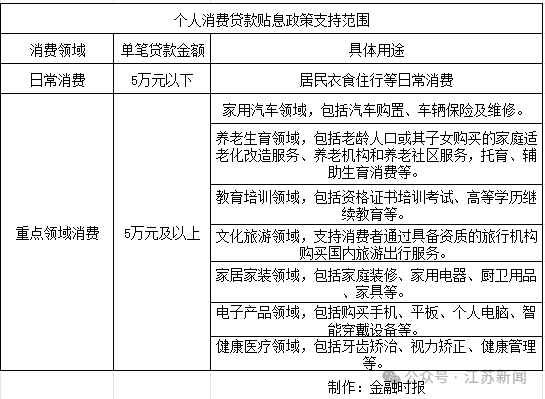
Group 1 - The core viewpoint of the article is the implementation of a personal consumption loan interest subsidy policy starting from September 1, which aims to stimulate consumer spending [1][2]. - The subsidy covers two categories of consumption: daily expenses under 50,000 yuan and significant expenditures such as home appliances, vehicles, and education over 50,000 yuan [3][4]. - Credit card transactions are excluded from this subsidy program [3]. Group 2 - The interest subsidy rate is set at 1% per annum, with a maximum subsidy cap of 3,000 yuan for eligible consumers, corresponding to a total consumption amount of 300,000 yuan [4][6]. - For daily expenses under 50,000 yuan, the subsidy is calculated based on the actual amount borrowed, with a maximum of 1,000 yuan for multiple loans from the same institution [6]. - For significant expenditures over 50,000 yuan, the subsidy is capped at 500 yuan per loan, with a total limit of 3,000 yuan for combined loans [4][6]. Group 3 - Consumers can apply for the subsidy through 18 major banks and 5 other lending institutions, provided they meet specific conditions [8][9]. - A supplementary agreement must be signed to authorize banks to verify the usage of the loan funds [9]. - If the loan is withdrawn as cash for consumption, the consumer will not be eligible for the subsidy, as banks cannot track the fund's usage [11][12].