广道数字

Search documents
为主动赔偿投资者点赞
Jing Ji Ri Bao· 2026-01-08 00:06
Core Viewpoint - The introduction of a "pre-compensation" mechanism allows investors to receive compensation for losses due to false statements or fraud before the completion of lengthy legal processes, enhancing investor protection and market confidence [1][2]. Group 1: Pre-Compensation Mechanism - Minmetals Securities has established a pre-compensation fund of 210 million yuan to compensate eligible investors for losses incurred due to the illegal disclosure practices of the listed company Guandao Digital [1]. - The essence of pre-compensation lies in the "pre" aspect, where responsible parties proactively provide compensation to investors before judicial rulings, allowing for quicker and more direct restitution [1][2]. Group 2: Market Impact and Efficiency - The pre-compensation approach demonstrates a proactive attitude from companies and intermediaries, helping to soothe market sentiment and mitigate reputational damage by addressing issues promptly [2]. - This mechanism can improve the efficiency of investor compensation, reduce reputational risks for responsible parties, and lower regulatory costs, presenting multiple benefits [2]. Group 3: Challenges and Considerations - Current regulations on pre-compensation are voluntary rather than mandatory, leading to a lack of sufficient motivation for companies and intermediaries to participate [3]. - A more precise and differentiated calculation model is needed to determine the extent of losses attributable to market risks versus those caused by illegal activities, ensuring fairness for both investors and responsible parties [3]. - The sustainability of the pre-compensation system relies on the ability of intermediaries to recover costs from other responsible parties after compensation is paid [3]. Group 4: Long-term Development - The improvement of any system is a gradual process, and as investor confidence in timely compensation grows, it will lead to a more active and resilient market, ultimately supporting high-quality economic development [4].
新年退市第一股:广道数字“一条龙”造假 监管“零容忍”顶格处罚
Xin Jing Bao· 2026-01-07 14:13
Core Viewpoint - The first delisted company of 2026, Guangdao Digital, faced termination of its listing on January 5 after a 15-day delisting adjustment period, following a systematic financial fraud case that inflated revenues by over 1.4 billion yuan [1] Group 1: Financial Fraud Details - Guangdao Digital's fraudulent activities included fabricating sales and procurement through fake contracts, invoices, and bank receipts, leading to a cumulative inflated revenue of approximately 1.466 billion yuan from 2018 to mid-2024, with a staggering 99.39% inflation rate in 2022 [3] - The fraud was exposed in December 2024, prompting regulatory inquiries and investigations, which revealed that the company's management, including the actual controller Jin Wenming, was complicit in the fraudulent activities [2][3] Group 2: Regulatory Actions and Penalties - The regulatory authorities imposed maximum penalties on Guangdao Digital, including a fine of 10 million yuan for the company and a total of 30.5 million yuan for 12 responsible individuals, with lifetime market bans for key figures [4] - Minmetals Securities, the underwriting institution, established a 210 million yuan compensation fund to address investor losses, reflecting the regulatory requirement for accountability among intermediaries [4] Group 3: Market Oversight and Future Implications - Since 2024, the China Securities Regulatory Commission (CSRC) has maintained a "zero tolerance" policy towards financial fraud, handling 159 cases and imposing fines totaling 8.1 billion yuan [5] - The CSRC emphasized the need for enhanced measures to improve the quality of listed companies and protect investor rights, indicating a commitment to high-quality market development [6]
以旧换新带动消费3.92万亿,英伟达发布新一代AI平台 | 财经日日评
吴晓波频道· 2026-01-07 00:30
Group 1 - The core viewpoint of the article emphasizes the impact of government subsidy policies on consumer spending, particularly in the automotive and home appliance sectors, projecting a total consumption boost of 3.92 trillion yuan [2] - The government aims to replace 18.3 million vehicles under the old-for-new policy, with nearly 60% being new energy vehicles, and 192 million home appliances, with 90% being of first-level energy efficiency [2] - The continuation of the "national subsidy" policy is expected to support the recovery of domestic consumption, having previously activated latent demand in the automotive and home appliance industries [2][3] Group 2 - The ISM manufacturing index in the U.S. fell from 48.2 to 47.9 in December, marking the largest contraction since 2024, with 15 industries experiencing shrinkage [4] - The report indicates that new orders have contracted for four consecutive months, and employment numbers have decreased for 11 months, although the rate of decline has slowed [4] - High inflation and trade tensions are putting increasing pressure on U.S. manufacturing, leading to a decline in production willingness [4] Group 3 - Shanghai is accelerating the establishment of a low-altitude economy advanced manufacturing cluster, targeting a core industry scale of approximately 80 billion yuan by 2028 [5] - The recent measures provide clear quantitative goals and financial support for enterprises, indicating a systematic approach to developing the low-altitude economy [5][6] - The low-altitude economy is expected to create more opportunities in related industries as regional and supply chain collaborations become tighter [6] Group 4 - NVIDIA launched the new Rubin AI platform at CES, which significantly reduces the cost of inference token generation and the number of GPUs needed for training mixed expert models [7] - The platform represents a major advancement in AI chip technology, maintaining NVIDIA's competitive edge with annual updates [7][8] - NVIDIA's strategy includes strengthening its software ecosystem and providing new open-source models for applications in autonomous driving and robotics [8] Group 5 - Intel introduced its first 18A process PC chip, the Core Ultra3, which is expected to enhance local AI inference, graphics processing, and energy efficiency [9] - The 18A process represents Intel's highest level of semiconductor manufacturing technology, aimed at improving chip performance and power efficiency [9][10] - The launch of this chip is critical for Intel to demonstrate its technological capabilities and regain market position amid competitive pressures [10] Group 6 - Tesla has introduced a five-year interest-free car purchase plan for its Model 3 and Model Y vehicles in China, amid declining global sales [11] - The company faced an 8.6% year-over-year drop in global deliveries, marking the first time it was surpassed by BYD in electric vehicle sales [11][12] - Tesla's strategy appears to be shifting towards autonomous driving technology and robotics to explore new revenue growth avenues beyond vehicle sales [12] Group 7 - The China Securities Regulatory Commission (CSRC) is leading a multi-department initiative to combat financial fraud in the capital market, focusing on enhancing legal frameworks and company governance [13] - The initiative aims to create a comprehensive system to deter financial fraud and improve the overall integrity of the capital market [13][14] - Recent actions have seen several companies delisted due to financial fraud, highlighting the increased penalties and enforcement efforts [14] Group 8 - The stock market showed strong performance with the Shanghai Composite Index reaching a ten-year high, driven by significant trading volume and active market participation [15] - The market's upward trend is supported by favorable fiscal and monetary policies, alongside increased efforts to combat financial fraud [16] - The influx of external capital is primarily motivated by a fear of missing out on potential gains, indicating a bullish sentiment towards the A-share market [16]



多家*ST公司花式保壳 监管紧密跟踪防违规
Zheng Quan Shi Bao· 2026-01-06 18:21
Core Viewpoint - Many *ST companies are engaged in a "shell protection" battle as they face strict regulatory scrutiny, utilizing various methods such as bankruptcy restructuring, asset mergers, and debt restructuring to survive, but the difficulty of compliance is increasing [1][4] Group 1: Self-Rescue Strategies - Companies are attempting to recover by divesting loss-making assets, with examples including *ST Nan Zhi selling assets for 1 yuan to eliminate negative net assets and *ST Lvkang selling subsidiaries for 0 yuan [2][3] - Mergers and acquisitions are also being used as a strategy to turn losses into profits, as seen with *ST Hui Ke acquiring a 51% stake in Yi Zheng Tong [2] - Bankruptcy restructuring is a key path for shell protection, with several companies like You Ke Shu and Wen Tou Holding undergoing restructuring processes [3] Group 2: Regulatory Environment - Regulatory bodies are closely monitoring shell protection actions, with increased scrutiny on companies suspected of data manipulation, as demonstrated by inquiries into *ST Guandian's financial reports [4] - Investigations into information disclosure violations have become a significant variable for companies attempting to protect their shells, with multiple companies facing regulatory actions [4] Group 3: Market Dynamics - A normalized delisting mechanism is gradually forming in the A-share market, with 32 companies having left the market in 2025, indicating a trend towards "survival of the fittest" [5][6] - Experts emphasize that companies must focus on their core business and enhance competitiveness to avoid temporary shell protection measures, advocating for a thorough transformation to address governance issues [6]

7年虚增收入超14亿!2026退市第一股来了
Jing Ji Guan Cha Wang· 2026-01-06 06:23
Core Viewpoint - The financial fraud at Guandao Digital began in 2018, three years before its listing on the Beijing Stock Exchange, and continued throughout its public offering and trading processes, indicating that the listing was not the starting point of the fraud but rather a means to cover it up [2][3] Group 1: Fraud Details - Guandao Digital was found to have systematically inflated its revenue by a total of 1.465 billion yuan from 2018 to mid-2024, with the highest annual inflation rate reaching 99.39% [2][4] - The company engaged in organized fraud, including intercepting audit confirmation letters and forging responses, indicating a high level of complicity among executives [4][5] - The fraud extended to the issuance of stock for specific targets in 2024, misleading investors during attempts to raise additional funds [5] Group 2: Regulatory Response - On January 5, 2026, Guandao Digital was officially delisted from the Beijing Stock Exchange, marking the first case of mandatory delisting due to significant violations since the exchange's establishment [2][3] - The China Securities Regulatory Commission imposed a fine of 10 million yuan on Guandao Digital and a total of 30.5 million yuan on 12 responsible individuals, including lifetime bans for key executives [4][5] - A compensation fund of 210 million yuan was established by the sponsor, Minmetals Securities, to cover losses for eligible investors who held shares during the fraudulent period [5][6] Group 3: Industry Implications - The case of Guandao Digital highlights systemic issues within the regulatory framework, where the focus on compliance at the issuance stage has led to a lack of thorough verification of historical financial authenticity [6][7] - The incident raises concerns about the effectiveness of existing monitoring mechanisms and the potential for similar frauds to occur if regulatory reforms do not address these vulnerabilities [6][7] - The delisting of Guandao Digital serves as a critical examination of the resilience of capital market systems, questioning the accountability of market participants when the costs of fraud are perceived to be lower than the benefits [7]

上市4年造假7年!新年首只退市股“花落”广道数字
Shen Zhen Shang Bao· 2026-01-06 04:03
Core Viewpoint - Shenzhen Guangdao Digital Technology Co., Ltd. has been delisted from the Beijing Stock Exchange due to severe financial fraud, marking it as the first company to be forcibly delisted for major violations since the exchange's establishment [1][3]. Company Overview - Guangdao Digital was established in October 2003, focusing on data application software development and sales, particularly in the digital government sector. The company was listed on the New Third Board in November 2016 and became one of the first companies to list on the Beijing Stock Exchange in November 2021, initially seen as a high-growth stock due to its revenue growth [3]. Fraud Discovery and Investigation - The fraud was exposed in late 2024, following media reports on irregularities in intercepting audit confirmation letters. The Beijing Stock Exchange issued an inquiry, leading to a formal investigation by the China Securities Regulatory Commission (CSRC) [3][4]. - On September 12, 2025, the CSRC concluded its investigation, confirming serious systemic financial fraud. The Beijing Stock Exchange decided to delist Guangdao Digital on November 12, 2025, due to major violations [3][4]. Scale of Fraud - From 2018 to mid-2024, Guangdao Digital inflated its revenue by 1.466 billion yuan, with each period showing an inflation rate exceeding 85%. In 2022, the inflated revenue reached 304 million yuan, accounting for 99.39% of the reported revenue, while in the first half of 2024, the inflated revenue was 71.646 million yuan, representing 88.11% [4]. - The company also inflated its operating costs by 754 million yuan during the same period, with inflation rates ranging from 83.30% to 99.13% [4]. Involvement of Executives - The fraud was a collective effort involving multiple executives, including the controlling shareholder and CEO, Jin Wenming, who was aware of and allowed the fraudulent activities. Key figures like Zhao Lu, the former director and CFO, were central to organizing the fraud, while other executives participated in various capacities [4][5]. Regulatory Actions and Penalties - The Shenzhen Securities Regulatory Bureau imposed penalties on Guangdao Digital, including a fine of 10 million yuan. Jin Wenming was fined 15 million yuan and banned from the securities market for life. Zhao Lu and another executive received fines of 5 million yuan and 2.5 million yuan, respectively [5]. - A compensation fund of 210 million yuan has been established by the underwriting institution to compensate eligible investors for losses incurred due to the company's violations [5]. Stock Market Activity - Prior to and after the delisting, Guangdao Digital experienced significant speculative trading, with a 251.49% increase over six trading days in July 2025 and a subsequent 118% increase during the delisting period, indicating notable retail investor activity [5].
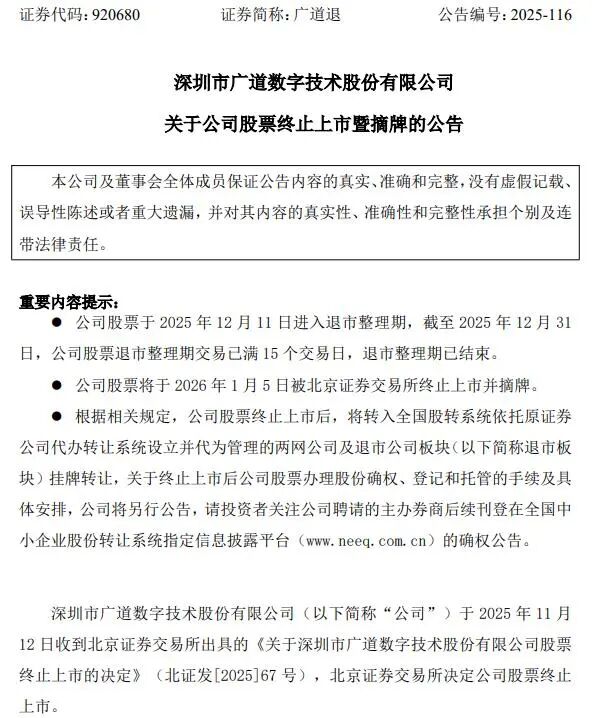
广道数字成2026年退市第一股
Xin Hua Cai Jing· 2026-01-06 03:59
Group 1 - Shenzhen Guangdao Digital Technology Co., Ltd. has been delisted from the Beijing Stock Exchange, becoming the first stock to be delisted in 2026 and the first delisted stock on the Beijing Stock Exchange [1] - Guangdao Digital was established on October 24, 2003, and was listed on the Beijing Stock Exchange on November 15, 2021, with an initial share price of 12.25 yuan and a market capitalization of 178.4 million yuan [4] - The company was found to have engaged in systematic financial fraud for several years, with false records in its annual reports from 2018 to 2023 and the first half of 2024 [4] Group 2 - The fraudulent activities included the creation of false sales and purchase contracts, invoices, bank receipts, delivery notices, and warehouse receipts, which inflated both revenue and costs [4] - The inflated revenue percentages for the years 2018 to 2023 and the first half of 2024 were 87.34%, 95.39%, 98.96%, 85.87%, 99.39%, 98.14%, and 88.11% respectively [4] - The inflated cost percentages for the same periods were 84.53%, 91.17%, 98.41%, 83.30%, 99.13%, 92.26%, and 83.81% respectively [4] Group 3 - The Shenzhen Securities Regulatory Bureau imposed a fine of 10 million yuan on Guangdao Digital and issued warnings to its executives, with fines totaling 15 million yuan for the chairman and 1.5 million yuan for other executives [5] - A special compensation fund of 210 million yuan has been established by Wuzhong Securities to compensate eligible investors for losses due to the company's illegal information disclosure [5]
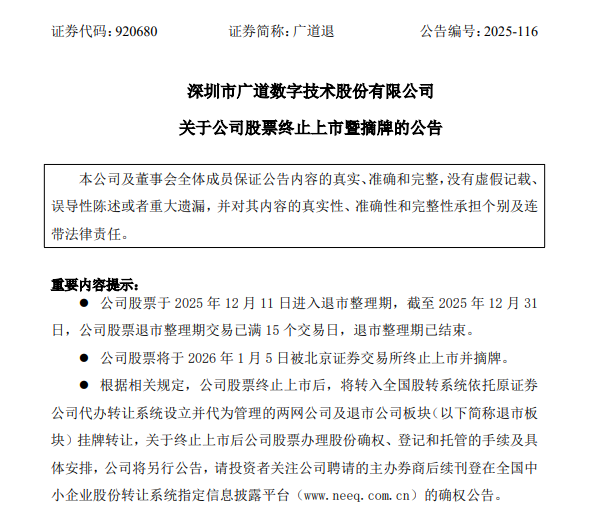
“四年上市路”终成空,“七年造假史”现原形 2026退市第一股广道数字摘牌
Jing Ji Guan Cha Wang· 2026-01-05 11:33
Core Viewpoint - Guangdao Digital has been officially delisted from the Beijing Stock Exchange due to severe financial fraud, marking the first case of forced delisting for major violations since the exchange's establishment [1][2]. Group 1: Company Overview - Guangdao Digital was founded in 2003 and listed on the New Third Board in November 2016, later becoming one of the first companies to list on the Beijing Stock Exchange in November 2021, focusing on data application software development and sales [1]. - The company reported continuous revenue growth since its listing, with a revenue of 306 million yuan in 2023, initially viewed as a high-growth stock on the exchange [1]. Group 2: Fraudulent Activities - The financial fraud began in 2018, three years before the company's listing, involving systematic inflation of revenue by 1.465 billion yuan through fictitious contracts and documents, with the highest annual inflation rate reaching 99.39% [1][2]. - The fraud was highly organized, with the actual controller and financial executives directly involved in creating false documentation and obstructing audits, indicating a collective conspiracy rather than isolated misconduct [2]. Group 3: Regulatory Actions and Consequences - In September 2025, the Shenzhen Securities Regulatory Bureau imposed a fine of 10 million yuan on Guangdao Digital and a total of 30.5 million yuan on 12 responsible individuals, including lifetime bans for key executives [3]. - The fraudulent activities extended to the issuance of stock fundraising documents, misleading investors during attempts to raise additional capital [3]. Group 4: Investor Compensation and Market Implications - In response to investor losses, the underwriting institution, Wukuang Securities, established a compensation fund of 210 million yuan to cover eligible investors who held shares during the fraudulent period [3]. - The case highlights the limitations of current investor protection mechanisms and the need for stronger regulatory oversight to prevent similar occurrences in the future [4][5].
2026年退市第一股,上市4年造假7年,北交所广道数字今起退市
Di Yi Cai Jing· 2026-01-05 09:04
Group 1 - The core point of the article is the forced delisting of Guandao Digital due to severe financial fraud, marking it as the first major violation delisting case on the Beijing Stock Exchange [1][4] - Guandao Digital inflated its revenue by 1.465 billion yuan over seven years, with a peak inflation rate exceeding 99% [4][3] - The company engaged in fraudulent activities including intercepting audit confirmation letters and using fake seals to mislead auditors [2][3] Group 2 - The company was established in 2003 and listed on the New Third Board in 2016, later becoming one of the first companies listed on the Beijing Stock Exchange in 2021 [2] - The financial misconduct involved creating false sales and purchase contracts, invoices, and bank receipts, leading to significant misrepresentation in financial reports [3][4] - The regulatory response included a fine of 10 million yuan for Guandao Digital and penalties totaling 30.5 million yuan for 12 executives, with lifetime bans for key individuals [4][3] Group 3 - Despite the delisting, Guandao Digital's stock experienced a dramatic increase of 466% in price prior to the delisting, attracting many investors [6] - The underwriter, Wukuang Securities, established a compensation fund of 210 million yuan to address investor losses due to the company's fraudulent disclosures [6][5] - The regulatory environment has been tightening, with 32 companies delisted in 2025 for various reasons, including financial misconduct [8][7]
2026年退市第一股!上市4年造假7年
第一财经· 2026-01-05 08:53
Core Viewpoint - Guangdao Digital (920680.BJ) has been officially delisted from the Beijing Stock Exchange due to severe financial fraud, marking it as the first major delisting case of 2026 and the first major fraud delisting in the history of the exchange [3][5]. Group 1: Company Background - Guangdao Digital was established in 2003 and listed on the New Third Board in November 2016, later becoming one of the first companies listed on the Beijing Stock Exchange in November 2021. The company focuses on the development and sales of software products aimed at data applications, with Wuzhong Securities as its sponsor [5]. Group 2: Financial Fraud Details - The company engaged in financial fraud for seven years, inflating its revenue by a total of 1.465 billion yuan, with the highest inflation rate exceeding 99% [8]. - From 2018 to the first half of 2024, Guangdao Digital inflated its revenue by 143 million yuan, 192 million yuan, 223 million yuan, 249 million yuan, 304 million yuan, 284 million yuan, and 71.646 million yuan, representing 87.34%, 95.39%, 98.96%, 85.87%, 99.39%, 98.14%, and 88.11% of the reported amounts for those periods, respectively [7]. - The company also inflated its operating costs significantly, with similar high percentages of inflation [7]. Group 3: Regulatory Actions - Following media reports of fraudulent activities, the Beijing Stock Exchange issued an inquiry letter to Guangdao Digital, demanding verification of the allegations regarding intercepting audit confirmations and falsifying documents [6]. - The China Securities Regulatory Commission (CSRC) initiated an investigation, leading to an administrative penalty notice in June 2025, which included a fine of 10 million yuan for the company and a total of 30.5 million yuan in fines for 12 executives, including the controlling shareholder Jin Wenming, who was banned from the securities market for life [8][9]. Group 4: Market Reactions and Investor Protection - Despite the impending delisting, Guangdao Digital's stock experienced a dramatic surge, with a maximum increase of 466% from June 25 to August 1, 2025 [10]. - Wuzhong Securities announced measures to protect investors, including the establishment of a 210 million yuan compensation fund for eligible investors who suffered losses due to the company's fraudulent disclosures [10][11]. Group 5: Regulatory Environment - The CSRC has been strengthening the delisting system as part of broader capital market reforms, with 32 companies completing delisting in 2025 due to various reasons, including financial fraud [12]. - Recent regulatory opinions emphasize the importance of investor protection in cases of major illegal delisting, encouraging proactive compensation measures from controlling shareholders and actual controllers of listed companies [13].