江阴银行

Search documents
2026年1月金融数据点评:存款搬家加速,M1、M2增速大幅回升
GF SECURITIES· 2026-02-14 05:23
Investment Rating - The industry rating is "Buy" [6] Core Insights - The overall social financing growth slightly declined to 8.2% in January, while M1 and M2 growth rates significantly rebounded, with M1 growing by 4.9% and M2 by 9.0% [6][16] - Government net financing increased significantly by 2,831 billion yuan year-on-year, contributing to the overall social financing growth [6][17] - The report indicates a shift in deposit structure due to accelerated deposit migration, impacting M1 negatively while having limited effect on M2 [6][16] Summary by Sections Overall Situation - Social financing growth decreased slightly to 8.2%, while M1 and M2 growth rates increased significantly [15][16] - M1 and M2 growth rates rose by 1.1 percentage points and 0.5 percentage points respectively compared to the previous month [6][16] Government Sector - Fiscal strength showed a year-on-year decline, impacting overall financing dynamics [39] Household Sector - Demand remained stable year-on-year, with short-term loan demand increasing [39] Corporate Sector - Short-term loan demand increased year-on-year, while bill financing saw a significant reduction [39] Non-Bank Sector - The acceleration of deposit migration was noted, with non-bank deposits increasing by 1.45 trillion yuan year-on-year [6][39]




丈量地方性银行(3):川渝132家区域性银行全梳理-20260212
GF SECURITIES· 2026-02-12 14:21
Investment Rating - The industry investment rating is "Buy" [2] Core Insights - The report analyzes 132 regional banks in the Sichuan-Chongqing area, highlighting the growth and structural changes in the banking sector [6][27] - The asset growth rates of major city commercial banks in the region are higher than those of listed city commercial banks, indicating a robust expansion [38] - Profitability metrics show that city commercial banks in the region have lower ROE compared to listed banks, while rural commercial banks outperform them [6][27] - Asset quality is slightly weaker in regional banks compared to listed banks, with higher non-performing loan ratios [6][27] Summary by Sections Economic Structure Analysis - Sichuan province is positioned as a key driver for western development, with a focus on enhancing the Chengdu-Chongqing economic circle [13][14] - In 2025, Chengdu's GDP is projected to account for 38.7% of the province's total, with significant growth in various sectors [15] Banking Sector Overview - The Sichuan-Chongqing region has 132 commercial banks, including 14 city commercial banks, 65 rural banks, and 51 rural commercial banks [27] - The asset growth rates for major city commercial banks in the region are 15.6% and 18.2%, surpassing the 14.2% growth of listed city commercial banks [38] Asset and Liability Structure - The proportion of loans to total assets has been increasing since 2016, with city commercial banks in Sichuan projected to have a loan ratio of 56.1% by 2024 [38][40] - The financial investment ratio for city commercial banks is on a downward trend, with a slight recovery noted in the first half of 2025 [40][46] Profitability and Asset Quality - The average ROE for city commercial banks in the region is 10.97%, lower than the 11.99% average for listed city commercial banks [6][27] - Non-performing loan ratios for city commercial banks in the region are higher than those of listed banks, indicating potential asset quality concerns [6][27] Capital Adequacy - Capital adequacy ratios for regional banks are comparable to those of listed banks, providing a safety margin for operations [6][27]
银行股集体下跌,重庆银行跌超2%
Ge Long Hui· 2026-02-12 02:37
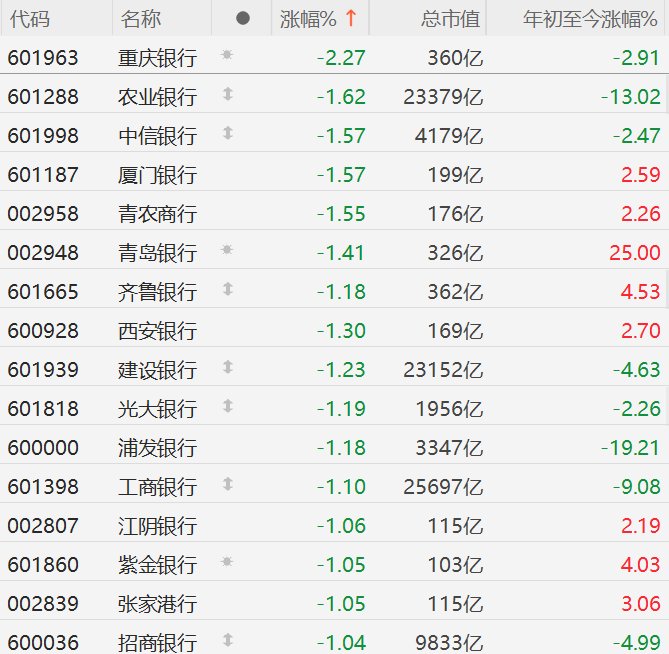
Core Viewpoint - The A-share market for banks experienced a collective decline, with several banks showing significant drops in their stock prices on February 12 [1] Group 1: Stock Performance - Chongqing Bank saw a decline of 2.27%, with a total market value of 36 billion [2] - Agricultural Bank dropped by 1.62%, with a market capitalization of 2,337.9 billion [2] - CITIC Bank decreased by 1.57%, with a market value of 417.9 billion [2] - Xiamen Bank fell by 1.57%, with a market capitalization of 19.9 billion [2] - Qingnong Commercial Bank declined by 1.55%, with a market value of 17.6 billion [2] - Qingdao Bank decreased by 1.41%, with a market capitalization of 32.6 billion [2] - Qilu Bank fell by 1.18%, with a market value of 36.2 billion [2] - Xi'an Bank dropped by 1.30%, with a market capitalization of 16.9 billion [2] - China Construction Bank decreased by 1.23%, with a market value of 23,152 billion [2] - Everbright Bank fell by 1.19%, with a market capitalization of 195.6 billion [2] - Pudong Development Bank decreased by 1.18%, with a market value of 334.7 billion [2] - Industrial and Commercial Bank dropped by 1.10%, with a market capitalization of 25,697 billion [2] - Jiangyin Bank fell by 1.06%, with a market value of 11.5 billion [2] - Zijin Bank decreased by 1.05%, with a market capitalization of 10.3 billion [2] - Zhangjiagang Bank fell by 1.05%, with a market value of 11.5 billion [2] - China Merchants Bank decreased by 1.04%, with a market capitalization of 983.3 billion [2] Group 2: Year-to-Date Performance - Chongqing Bank has a year-to-date decline of 2.91% [2] - Agricultural Bank has seen a year-to-date drop of 13.02% [2] - CITIC Bank's year-to-date decline is 2.47% [2] - Xiamen Bank has a year-to-date increase of 2.59% [2] - Qingnong Commercial Bank's year-to-date increase is 2.26% [2] - Qingdao Bank has a significant year-to-date increase of 25.00% [2] - Qilu Bank has a year-to-date increase of 4.53% [2] - Xi'an Bank's year-to-date increase is 2.70% [2] - China Construction Bank has a year-to-date decline of 4.63% [2] - Everbright Bank's year-to-date decline is 2.26% [2] - Pudong Development Bank has a significant year-to-date decline of 19.21% [2] - Industrial and Commercial Bank has a year-to-date decline of 9.08% [2] - Jiangyin Bank has a year-to-date increase of 2.19% [2] - Zijin Bank's year-to-date increase is 4.03% [2] - Zhangjiagang Bank has a year-to-date increase of 3.06% [2] - China Merchants Bank has a year-to-date decline of 4.99% [2]





A股银行股集体下跌,重庆银行跌超2%
Ge Long Hui A P P· 2026-02-12 02:25
Group 1 - The A-share market saw a collective decline in bank stocks, with Chongqing Bank dropping over 2% and several other banks, including Agricultural Bank, CITIC Bank, and Xiamen Bank, falling more than 1% [1] - Chongqing Bank's stock decreased by 2.27%, with a total market capitalization of 36 billion and a year-to-date decline of 2.91% [2] - Agricultural Bank's stock fell by 1.62%, with a market cap of 2,337.9 billion and a year-to-date decline of 13.02% [2] Group 2 - CITIC Bank's stock decreased by 1.57%, with a market capitalization of 417.9 billion and a year-to-date decline of 2.47% [2] - Xiamen Bank's stock also fell by 1.57%, with a market cap of 19.9 billion and a year-to-date increase of 2.59% [2] - Qingnong Commercial Bank's stock dropped by 1.55%, with a market cap of 17.6 billion and a year-to-date increase of 2.26% [2] Group 3 - Other banks such as Qilu Bank, Xi'an Bank, and China Construction Bank experienced declines of 1.18% to 1.30%, with respective market caps of 36.2 billion, 16.9 billion, and 23,152 billion [2] - The stock of Industrial and Commercial Bank fell by 1.10%, with a market cap of 25,697 billion and a year-to-date decline of 9.08% [2] - China Merchants Bank's stock decreased by 1.04%, with a market cap of 98.33 billion and a year-to-date decline of 4.99% [2]
跨境流动性跟踪20260208:贸易回流比率再度回正,服务逆差大幅收窄
GF SECURITIES· 2026-02-09 01:11
Investment Rating - The industry rating is "Buy" [4] Core Views - The trade return ratio has turned positive again, and the service trade deficit has significantly narrowed [16][18] - The cross-border capital flow is expected to gradually return, positively impacting domestic liquidity [5][19] - The service trade deficit for December 2025 was 966 billion CNY, a year-on-year decrease of 466 billion CNY, with a full-year deficit of 13,760 billion CNY, down 2,544 billion CNY, approximately 16% [18] Summary by Sections 1. Current Observation - The State Administration of Foreign Exchange (SAFE) released data on China's international balance of payments for December 2025, indicating a potential impact on the central bank's willingness to settle foreign exchange [16] - The trade return ratio is at a historical high, with a monthly unconverted trade net outflow of 447 billion CNY, a year-on-year increase of 1,392 billion CNY [17] 2. Arbitrage Trading Returns - The arbitrage trading return rate for 10Y US Treasury bonds in CNY has dropped significantly to -1.77%, indicating a shift in cross-border capital dynamics [17] 3. Service Trade Deficit - The service trade deficit has narrowed significantly, with major contributions from improved policies for foreign visitors, reduced international shipping costs, and enhanced competitiveness in high-tech services [18] 4. Cross-Border Liquidity Outlook - Despite the recent appointment of Kevin Warsh as the next Federal Reserve Chair, the trend of cross-border capital return is expected to continue, influenced by the Fed's monetary policy stance [19][21] - The short-term liquidity in the US remains tight, with limited space for balance sheet reduction, while long-term prospects depend on economic performance [20][21]
多重因素倒逼架构调整 银行财富管理业务地位进阶
Shang Hai Zheng Quan Bao· 2026-02-05 17:52
去年12月,交通银行宣布完成总行层面的财富管理业务整合,正式成立"财富管理部",在全行范围统筹 个人财富管理业务。邮储银行也于去年战略性组建财富管理部,在总行层面新设了"财富管理部"。今年 初,浦发银行也欲将财富管理业务独立出来。 这些动向都意味着,当下财富管理正在被推至银行整体经营体系中更加重要的位置。 张大伟 制图 ◎记者 黄坤 步入2026年,一场银行营收保卫战自财富管理业务悄然展开。 近期,多家银行在总行层面单设或整合财富管理部门,将原本分散在零售、个金等条线中的相关职能集 中统筹。此番"动刀"向外界传递出的信号是:财富管理独立性升级,从银行部门业务上升为能跨条线协 同、统筹资源的全行系统工程。 作为轻资本业务的财富管理,能为银行带来可观的中间收入,过去有不少银行已将其作为战略性业务, 但何以在2026年前后地位突然进阶、纷纷加码?分析其原因,多重因素交织,使得财富管理业务愈发重 要。而其进一步向"客户为中心"转型,成为银行间比拼业绩增长的关键。 地位进阶 架构变阵 这场调整大戏从国有大行开始。 这一趋势并不局限于大型银行,城农商行同样抬升了财富管理业务地位。青农商行在接受调研时表示, 2026年将聚 ...




农商行板块2月4日涨1.44%,常熟银行领涨,主力资金净流出5832.1万元
Zheng Xing Xing Ye Ri Bao· 2026-02-04 08:57
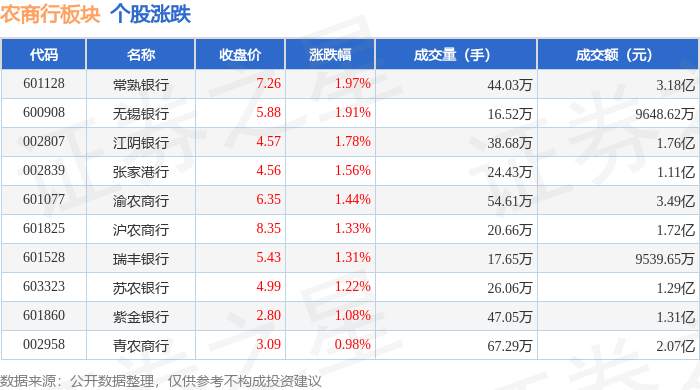
Core Viewpoint - The rural commercial bank sector experienced a rise of 1.44% on February 4, with Changshu Bank leading the gains, while the overall market indices also showed positive movement [1] Market Performance - The Shanghai Composite Index closed at 4102.2, up by 0.85% - The Shenzhen Component Index closed at 14156.27, up by 0.21% [1] Individual Stock Performance - Changshu Bank (601128) closed at 7.26, with a gain of 1.97% and a trading volume of 440,300 shares, amounting to a transaction value of 318 million yuan - Wuxi Bank (600908) closed at 5.88, up by 1.91% with a trading volume of 165,200 shares - Jiangyin Bank (002807) closed at 4.57, gaining 1.78% with a trading volume of 386,800 shares - Zhangjiagang Bank (002839) closed at 4.56, up by 1.56% with a trading volume of 244,300 shares - Yunnan Rural Commercial Bank (601077) closed at 6.35, gaining 1.44% with a trading volume of 546,100 shares - Shanghai Rural Commercial Bank (601825) closed at 8.35, up by 1.33% with a trading volume of 206,600 shares - Ruifeng Bank (601528) closed at 5.43, gaining 1.31% with a trading volume of 176,500 shares - Suzhou Rural Bank (603323) closed at 66.7, up by 1.22% with a trading volume of 260,600 shares - Zijin Bank (601860) closed at 2.80, gaining 1.08% with a trading volume of 470,500 shares - Qingnong Bank (002958) closed at 3.09, up by 0.98% with a trading volume of 672,900 shares [1] Fund Flow Analysis - The rural commercial bank sector saw a net outflow of 58.32 million yuan from institutional investors, while retail investors contributed a net inflow of 73.74 million yuan - The overall fund flow indicates a mixed sentiment, with institutional investors withdrawing funds while retail investors increased their positions [1] Detailed Fund Flow for Individual Stocks - Jiangyin Bank (002807) had a net inflow of 4.68 million yuan from retail investors, despite a net outflow from institutional and speculative investors - Ruifeng Bank (601528) also saw a net inflow from retail investors, while institutional and speculative investors withdrew funds - Other banks like Changshu Bank (601128) and Zijin Bank (601860) experienced significant net outflows from institutional investors, indicating a cautious approach from larger players [2]

丈量地方性银行(2):浙江163家区域性银行全梳理-20260203
GF SECURITIES· 2026-02-03 13:31
Investment Rating - The industry investment rating is "Buy" [2] Core Insights - The report provides a comprehensive analysis of 163 regional banks in Zhejiang Province, highlighting their asset and liability structures, profitability, and asset quality [6][20] - The asset growth rate for major city commercial banks in Zhejiang is 9.4%, which is lower than the 14.2% growth rate of listed city commercial banks, while major rural commercial banks show an asset growth rate of 8.0%, exceeding the 6.7% growth rate of listed rural commercial banks [6][25] - The report indicates that the loan-to-asset ratio for city commercial banks is projected to reach 55.5% in 2024, an increase of 95 basis points year-on-year, while rural commercial banks will see a decrease to 59.3%, down 19 basis points [31] - Profitability metrics show that the average Return on Assets (ROA) for city commercial banks in Zhejiang is 0.78%, slightly above the average of listed city commercial banks, while rural commercial banks have an average ROA of 0.82%, which is below the average of listed rural commercial banks [6][31] - The asset quality of regional banks in Zhejiang is reported to be better than that of listed banks, with non-performing loan ratios lower by 16 basis points for city commercial banks and 9 basis points for rural commercial banks compared to their listed counterparts [6][31] Summary by Sections Section 1: Economic Structure of Zhejiang Province - Zhejiang Province is focused on high-quality development and aims to become a model for common prosperity [13] - The province's GDP is heavily concentrated in cities like Hangzhou, Ningbo, and Wenzhou, with Hangzhou accounting for 24.3% of the total GDP in 2025 [15] Section 2: Overview of 163 Regional Banks - The report categorizes the banks into city commercial banks, rural banks, and others, with a total of 163 banks in the region [20] - The distribution of registered capital among these banks is relatively balanced, with 63 banks having over 500 million yuan in registered capital [22] Section 3: Asset and Liability Structure - The asset growth of major city and rural commercial banks has been declining since 2019, with city banks showing a growth rate of 9.4% in the first half of 2025 [25] - The liability structure indicates that customer deposits account for 77.5% of liabilities for city commercial banks, which is higher than the 66.2% for listed city banks [44] Section 4: Profitability and Asset Quality - The average ROE for city commercial banks in Zhejiang is 11.98%, slightly lower than the average of listed city banks [6][31] - The report highlights that the non-performing loan ratio for city commercial banks is lower than that of listed banks, indicating better asset quality [6][31]
江阴银行:截至2026年1月30日股东户数为47999户
Zheng Quan Ri Bao· 2026-02-03 11:11
证券日报网讯 2月3日,江阴银行在互动平台回答投资者提问时表示,截至2026年1月30日,江阴银行股 东户数为47999户。 (文章来源:证券日报) ...
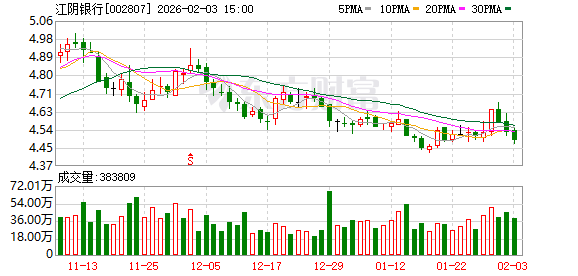
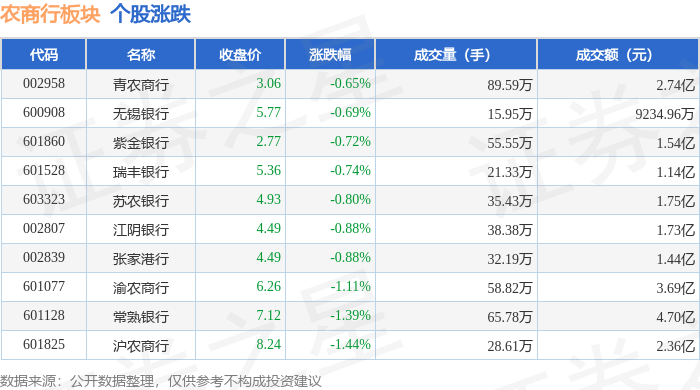
农商行板块2月3日跌1.13%,沪农商行领跌,主力资金净流入7782.14万元
Zheng Xing Xing Ye Ri Bao· 2026-02-03 09:03
Core Viewpoint - The agricultural commercial bank sector experienced a decline of 1.13% on February 3, with the Shanghai Agricultural Commercial Bank leading the drop, while the overall Shanghai Composite Index rose by 1.29% [1] Group 1: Market Performance - The Shanghai Composite Index closed at 4067.74, up 1.29%, and the Shenzhen Component Index closed at 14127.1, up 2.19% [1] - The agricultural commercial bank sector saw various individual stock performances, with notable declines in several banks, including Jiangyin Bank and Zhangjiagang Bank, both down by 0.88% [1] Group 2: Trading Volume and Capital Flow - The total trading volume for the agricultural commercial bank sector was significant, with the highest trading volume recorded for Qingnong Bank at 895,900 shares and a total transaction value of 274 million yuan [1] - The sector experienced a net inflow of 77.82 million yuan from institutional investors, while retail investors saw a net outflow of 106 million yuan [1] Group 3: Individual Stock Analysis - Yunnan Agricultural Commercial Bank had a net inflow of 32.1 million yuan from institutional investors, but a net outflow of 18.46 million yuan from retail investors [2] - Changshu Bank also saw a net inflow of 23.19 million yuan from institutional investors, with retail investors withdrawing 10.73 million yuan [2] - Su Nong Bank had a net inflow of 15.3 million yuan from institutional investors, but a significant net outflow of 20.84 million yuan from retail investors [2]