
BASF

Search documents
喹吖啶酮颜料行业报告 | 全球与中国市场现状及未来发展趋势
QYResearch· 2026-02-05 07:59
Core Viewpoint - Quinacridone pigments are high-performance organic pigments primarily in red and purple hues, first produced by DuPont in 1958, and are known for their vibrant colors, high color strength, and excellent resistance to heat, solvents, and light, making them widely used in various industries such as automotive coatings, high-end industrial coatings, plastic products, metal inks, and construction materials [2]. Industry Development Status - The quinacridone pigment industry is characterized by high demand concentration, with packaging printing inks being the largest consumer segment, driven by growth in food packaging, color printing films, and high-end gravure inks [5]. - The coatings sector focuses on automotive coatings, industrial protection, and building exteriors, where high weather resistance is crucial, making quinacridone one of the few organic red and purple pigments that maintain stable colors over time [5]. - The pricing structure of quinacridone pigments remains at a mid-to-high level among high-performance organic pigments, influenced by production process maturity, product form, and supplier brand strength [6]. - The supplier landscape is relatively concentrated, with international manufacturers dominating the high-end market while Chinese and Indian companies rapidly enhance their production capacity and cost advantages, leading to a multi-center competitive structure [7]. Development Trends - Quinacridone pigments are expanding from traditional inks and plastics to emerging applications requiring higher weather resistance, migration resistance, and high color strength [9]. - The global supply side is gradually concentrating on large-scale enterprises with environmental governance capabilities, with significant players including DIC Group and Sudarshan [10]. - The industry is experiencing a technological shift focused on improving pigment transparency, weather resistance, lightfastness, and dispersion, driven by downstream demands for more environmentally friendly and lower migration coloring systems [10]. Global Market Scale Analysis - The global quinacridone pigment market is projected to reach USD 519 million in sales by 2024, with an expected CAGR of 5.77% from 2025 to 2031, driven by increasing demand for high-performance coloring materials in various applications [11]. - The Chinese market is expected to grow rapidly, reaching USD 211 million by 2031, accounting for 28.26% of the global market share [11]. - The core manufacturers in the global market include DIC Corporation, Sudarshan, and Pigments Services, with the first-tier manufacturers holding approximately 53% of the market share [16]. Opportunities and Driving Factors - The primary driver for quinacridone pigments is the continuous demand for high-performance coloring materials in downstream industries such as packaging inks, industrial coatings, automotive repair paints, and engineering plastics [20]. - The transition of the global packaging printing system from solvent-based to water-based and low VOC systems is enhancing the penetration of quinacridone in high-end printing markets [20]. - Technological upgrades in surface treatment, crystal control, and environmental processes are essential for meeting high-end customer demands and increasing product value [20].

WENDEL: Agreement to sell Stahl, the global leader in specialty coatings for flexible materials, to Henkel
Globenewswire· 2026-02-04 07:29
Core Viewpoint - Wendel has agreed to sell its stake in Stahl, a leader in specialty coatings for flexible materials, to Henkel for an enterprise value of €2.1 billion, resulting in estimated net proceeds of €1.2 billion for Wendel, reflecting an annualized IRR of over 15% since 2006 [2][3]. Company Overview - Stahl is recognized as the global leader in specialty coatings for flexible materials, benefiting from favorable market trends, particularly in premium consumer segments, and strong exposure to high-growth regions like Asia [5]. - Under Wendel's ownership from 2006 to 2024, Stahl's global sales increased from €316 million to €930 million, nearly tripling, supported by both organic growth and strategic acquisitions [6]. - Stahl's adjusted operating income grew fourfold from €44 million to €181 million, with the adjusted operating margin expanding by 550 basis points to 19.5% in 2024 [7]. Transaction Details - The transaction values Stahl at a multiple of 6.6 times Wendel's total investment since 2006, including €427 million of past proceeds due to Stahl's strong cash generation [3]. - The sale involves Wendel (68.5% of the capital), BASF (16.1%), Clariant (14.6%), and other minority shareholders, and is subject to regulatory approvals and customary closing conditions [4]. Strategic Transformation - Stahl has completed a multi-year strategic transformation, evolving into a pure-play specialty coatings formulator by divesting its wet-end leather chemicals activities, which now operate under a standalone company named Muno [9]. - The company has established itself as an ESG frontrunner, achieving four consecutive Ecovadis Platinum ratings since 2021 and aligning its product portfolio with customer sustainability expectations [8]. Future Outlook - The transaction aligns with Wendel's capital allocation strategy and is expected to enhance long-term value creation through private asset investments, allowing for a share buyback program post-2025 earnings release [12]. - Stahl's leadership position in specialty coatings is anticipated to strengthen under Henkel, leveraging Henkel's innovation capabilities to enhance customer value [10].


聚酯数据周报-20260201
Guo Tai Jun An Qi Huo· 2026-02-01 07:42
Report Information - Report Title: Polyester Data Weekly Report [1] - Author: He Xiaoqin (Senior Analyst), Qian Jiayin (Contact) from Guotai Junan Futures Research Institute [2] - Date: February 1, 2026 [2] Industry Investment Rating - Not mentioned in the report Core Views - In the first half of 2026, PX is expected to be the strongest variety in the polyester industry chain [15] - Before the Spring Festival, the high - level volatility of PX increases, with limited downside space and a reverse spread of monthly differences. The PTA unilateral trend is strong before the holiday, with a 5 - 9 monthly difference reverse spread. MEG has a clear lower - level support, with limited upside rebound space [3][4][5] Summary by Directory PX Valuation and Profit - PX monthly spread weakens, with PX internal and external markets generally rising first and then falling, and PXN回调. The gasoline inventory continues to rise, the aromatics blending oil demand is weak, and the aromatics blending oil economy weakens [22][23][28] - The PX - MX spread reached a high of 170 US dollars/ton during the week, and the Asian MX blending oil economy decreased significantly. The toluene disproportionation unit profit improved significantly [41][50] Supply and Demand, and Inventory - Domestic production: The domestic production start - up rate is at a historical high. The 800,000 - ton PX unit of Sinochem Quanzhou restarted, and the domestic unit start - up rate rose to 89.2%. The December PX domestic production was 3.46 million tons [56][61] - Import: In December, the import volume was 930,000 tons. The Asian PX unit start - up rate this week was 81.2% (+0.2%). In November, PX imports from South Korea and Japan continued to increase, while those from Brunei decreased [63] - Inventory: In December, the Longzhong PX inventory was 4.45 million tons (+6) [89] PTA Valuation and Profit - The basis and monthly spread are weak. The PTA price has risen sharply, the basis has increased slightly, and the 5 - 9 monthly spread is weak due to increased supply pressure [96][97][101] - The PTA processing fee has been significantly repaired. The PTA spot processing fee has rebounded to 398 yuan/ton, and the polyester link profit is compressed by the upstream [105][106] Supply and Demand, and Inventory - Supply: The start - up rate remains at 76.6% without significant change. The 1 - million - ton unit of Sichuan Energy Investment recently restarted, the 2.5 - million - ton unit of Dushan Energy Phase II is expected to be overhauled at the end of January, and the 1.25 - million - ton unit of Zhuhai Ineos is shut down for maintenance [108] - Demand: The terminal orders of Jiangsu and Zhejiang weaving show differentiation. Export orders are good, but some re - flow orders have not increased significantly. Enterprises are cautious about pre - holiday stockpiling, and most enterprises have taken holidays [4] - Inventory: The total inventory is at a low level, and the inventory accumulation intensity will be relatively large in February [128] MEG Valuation and Profit - The unilateral price is in a volatile market. The relative valuation continues to decline, and Satellite Petrochemical will switch to produce plastics in February [148][154] - The profit of coal - based units is - 110 yuan/ton (+20). Oil - based units continue to be in a loss pattern, with the profit of naphtha - based ethylene glycol at - 1217 yuan/ton (-160), the profit of externally purchased ethylene - based ethylene glycol at - 187 yuan/ton (+30), the MTO profit at - 1601 (+20), and the profit of ethane cracking - based ethylene glycol at 366 (+15) [157] Supply and Demand, and Inventory - Supply: The start - up rate of units has risen to 74.4% (+1.3%). The 500,000 - ton unit of Sinochem Quanzhou and the 500,000 - ton unit of Ningbo Fude have restarted. From January to February, the ethylene glycol import volume will remain at a high level, with a monthly average of over 700,000 tons [166] - Inventory: Attention should be paid to the changes in units in Saudi Arabia and Taiwan. The port inventory data in East China is provided [170][176] Polyester Segment Start - up - The polyester start - up rate is 84.2% (-1.5%). Multiple sets of units have been overhauled, restarted, and some unit loads have been adjusted. The comprehensive polyester load has decreased. It is expected to be 88% in January, 80.5% in February, and 91% in March [182][185] Inventory - The inventory has increased slightly, but the pressure is not great [190][192] Export - From January to December, the total polyester export volume was 14.61 million tons, +13.5%. The total export volume of polyester filament was 4.29 million tons, +10.6%; the total export volume of polyester bottle chips was 6.46 million tons, +10.1%; the total export volume of polyester chips was 1.34 million tons, +21%; the total export volume of polyester staple fiber was 1.7 million tons, +28.2%; the total export volume of polyester film was 0.82 million tons, +15.5% [193] Profit - The losses of filament factories have expanded, while the profits of staple fiber and bottle chips are acceptable [195] Terminal: Weaving, Textile and Apparel Start - up - The start - up rate of Jiangsu and Zhejiang looms is 34% (-15%), and the start - up rate of texturing machines is 53% (-13%). Downstream texturing and weaving enterprises have entered the Spring Festival holiday season [217][219] Orders - Downstream orders are seasonally weak overall, but export orders are eye - catching, especially orders from the United States. Some enterprises reported that recent US clothing orders increased by 14% year - on - year, and Southeast Asian orders have also returned, but the overall order volume has not increased significantly [219] Inventory - The finished product inventory has decreased, and the grey fabric inventory has accumulated again. Weaving enterprises have stocked raw materials until the end of January [220][221] Retail and Export - China's textile and clothing retail: From January to December, it was 135.97 billion yuan, +3.5% [224] - China's textile and clothing export: From January to December, the cumulative export volume was 137.8 billion US dollars, with a cumulative year - on - year decrease of 4.4% [230] - Overseas textile and clothing retail: The US and European clothing retail data have risen strongly. In October, US retail was 19.3 billion US dollars, with a year - on - year increase of 9.8%. In 2025 from January to October, US clothing retail was 180 billion US dollars, with a year - on - year increase of 7.7%. In December, UK retail was 6.766 billion pounds, with a year - on - year increase of 5.8%. From January to December, UK retail was 50.6 billion pounds, with a year - on - year increase of 6.23% [234][238] - Overseas textile and clothing inventory: It has declined slightly month - on - month [240]
2026年欧洲并购展望——领导者的十大交易主题
奥纬咨询· 2026-01-27 05:55
Investment Rating - The report indicates a positive outlook for European M&A activity, expecting continued momentum into 2026, with a strong case for consolidation across various sectors [3][4][6]. Core Insights - European M&A deal value increased by 12% in 2025, reaching approximately $820 billion, driven by a shift in investor asset allocation towards Europe [3]. - Corporate profitability in Europe has risen by 50% from pre-2008 levels, yet many companies remain sub-scale, indicating a strong need for acquisitions to build capabilities [5]. - A robust pipeline of announced but uncompleted deals, along with favorable capital availability and regulatory conditions, suggests sustained M&A activity in 2026 [6]. Summary by Relevant Sections 1. Banking Sector - European banking M&A has seen a doubling in deal volumes since 2020, driven by restored profitability and regulatory support for consolidation [13]. - Banks are expected to generate over $500 billion in excess capital above regulatory minima over the next three years, which will be increasingly deployed in M&A [15]. 2. Asset Management - The asset and wealth management sector is facing consolidation due to profit margin pressures, with predictions of a 20% reduction in the number of asset managers by 2030 [17]. - M&A activity is expected to intensify, with 100 to 200 transactions anticipated annually in Europe [19]. 3. Telecommunications - The European telecom market is maturing, necessitating M&A for value-accretive deals amid high investment needs for 5G and fiber [20]. - The average EU operator has about 5 million subscribers, compared to 107 million in the US, highlighting the need for consolidation [20]. 4. Defense Sector - Military spending in Europe is projected to grow at approximately 9% annually through 2030, leading to increased demand for production capabilities [23]. - M&A is shifting towards acquiring production capabilities, with a focus on modernizing technical advantages [25]. 5. Logistics - The logistics sector is prioritizing transformative M&A strategies to address e-commerce growth and traditional mail network contraction [28]. - Acquirers are focusing on contract logistics and technology capabilities as core to deal value capture [31]. 6. Pharmaceuticals - Pharma dealmaking is becoming essential as companies face patent expirations and pipeline gaps, with a focus on high-value assets [33]. - Transaction activity is expected to be dominated by selective, de-risked acquisitions and structured deals to manage valuation risks [36]. 7. Chemicals - The chemical industry is leveraging M&A to refocus portfolios on specialty segments and secure cash flow amid economic challenges [37]. - Larger transactions are aimed at building global platforms and enhancing sustainability efforts [39]. 8. Insurance - M&A activity in the insurance sector is driven by private equity consolidation, accounting for about 90% of transactions by volume [42]. - The report anticipates continued acquisitions of specialty underwriting franchises by strategic buyers [45]. 9. Private Equity - European corporates hold approximately €2.6 trillion in cash, creating opportunities for trade buyers of private equity-backed assets [48]. - In 2026, over 1,500 European PE-backed assets, representing $760 billion in enterprise value, could potentially come to market [49]. 10. Portfolio Rebalancing - Portfolio rebalancing is becoming a core theme in European M&A as companies respond to economic headwinds and high capital costs [56]. - One-third of European corporates deliver returns below their cost of capital, indicating a need for divestitures of non-core assets [56].
行业聚焦:全球纺织业螯合剂行业头部生产商市场份额及排名调查(附龙头企业介绍)
QYResearch· 2026-01-27 02:43
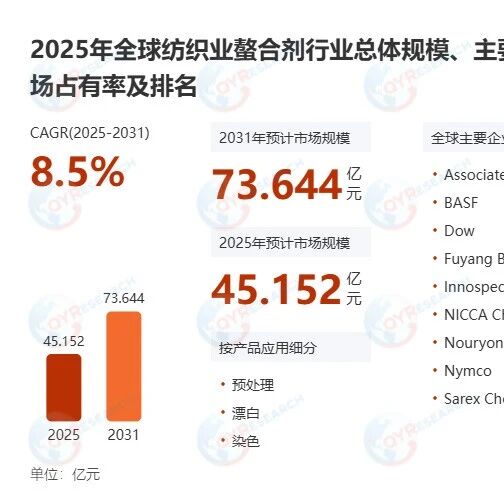
Core Viewpoint - The textile industry chelating agents are essential for improving product quality and sustainability by preventing metal ion reactions that can damage fibers and equipment, thus enhancing the efficiency and environmental compliance of textile production processes [2][3]. Product Range - The product range of textile chelating agents has evolved from traditional inorganic salts to a diverse family of fine chemicals, including: - Traditional inorganic chelating agents (e.g., polyphosphates) are widely used for general water treatment due to their low cost and high stability. - Organic carboxylic acid chelating agents (e.g., EDTA, NTA) dominate high-end dyeing processes but face environmental concerns. - Bio-based and green chelating agents (e.g., gluconates, chitosan derivatives) are rapidly emerging in response to sustainable textile policies. - Multifunctional composite chelating agents integrate dispersion, buffering, and anti-redeposition capabilities to meet integrated dyeing and finishing process needs [2]. Application Scope - Textile chelating agents serve as an "invisible engine" throughout the textile production process: - In the pre-treatment stage, they integrate calcium and magnesium ions to prevent hard water precipitation, enhancing desizing and refining efficiency. - During bleaching and dyeing, they stabilize oxidants and dye activity, ensuring color uniformity and reproducibility. - In post-treatment and water treatment, they inhibit metal ion catalysis that leads to fiber damage and reduce heavy metal loads in wastewater [3]. Market Overview - According to QYResearch, the global textile chelating agents market is projected to reach USD 1.16 billion by 2032, with a compound annual growth rate (CAGR) of 8.4% over the coming years [4]. Market Structure - Major manufacturers in the global textile chelating agents market include BASF, Dow, Nouryon, Innospec, and NICCA Chemical, with the top five companies holding approximately 59.0% market share by 2025 [6]. - The top three chemical giants (BASF, Dow, Nouryon) collectively account for over 40% of the market share, leveraging their global supply chains, R&D capabilities, and brand influence to dominate the high-end market [8]. Competitive Landscape - The competitive landscape shows that specialized manufacturers like Innospec and NICCA Chemical maintain stable shares in niche markets through application technology services and regional channels. - Asian companies (e.g., Fuyang Biotech, Taihe Chem, Yuanlian Chemical) leverage cost advantages and localized services to compete effectively in the mid-to-low-end market [8]. Industry Trends - The textile chelating agents market is transitioning from traditional functional additives to green, high-performance, and systematic solutions. The focus is shifting towards developing new molecular structures that are biodegradable, low-toxicity, and multifunctional to meet stringent environmental regulations [18]. - The application scenarios are deepening, with products extending beyond core processes to include textile recycling, wastewater treatment, and functional finishing, thus elevating their value from mere process aids to strategic materials that ensure supply chain compliance and resource efficiency [18]. Development Opportunities - The market faces structural constraints, primarily the challenge of balancing the technology and economics of green alternatives. The development and production costs of biodegradable or low-toxicity chelating agents are significantly higher than traditional products, which poses a challenge for cost-sensitive textile manufacturers [19]. - Additionally, the lack of unified industry standards and certification systems complicates product development and market entry, as different regions have varying definitions and compliance requirements for "environmentally friendly" and "biodegradable" [19]. Development Barriers - The market's growth is hindered by the cost-performance balance challenge in the green transition. The raw material costs and synthesis complexity of eco-friendly chelating agents are significantly higher than traditional products, leading to slow penetration of green products in cost-sensitive markets [20]. - Furthermore, traditional chelating agents (e.g., EDTA, phosphates) have established market inertia due to their stable performance and mature technology, making it difficult for new products to gain traction [20].

Futures Pointing To Initial Pullback On Wall Street
RTTNews· 2026-01-23 13:55
Market Overview - Major U.S. index futures indicate a modestly lower open on Friday, following a sharp rise in the previous two sessions, as traders may look to cash in on gains [1] - The Dow Jones Industrial Average rose by 306.78 points (0.6%) to 49,384.01, the Nasdaq increased by 211.20 points (0.9%) to 23,436.02, and the S&P 500 climbed by 37.73 points (0.6%) to 6,913.35 [5] Company-Specific News - Intel (INTC) shares are under pressure, plunging nearly 13% in pre-market trading after reporting better-than-expected fourth-quarter earnings but providing disappointing guidance for the current quarter [3][4] - The semiconductor giant's stock decline is expected to weigh on Wall Street [3] Economic Indicators - Initial jobless claims in the U.S. rose to 200,000, an increase of 1,000 from the previous week's revised level of 199,000, which was below economists' expectations of 205,000 [8] - Consumer prices in the U.S. increased in line with economist estimates for November [9] Commodity and Currency Markets - Crude oil futures surged by $1.17 to $60.53 per barrel after a previous drop [11] - Gold futures climbed by $19.50 to $4,932.90 per ounce, following a significant increase in the previous session [11] Asian Market Performance - Asian stocks ended mostly higher, with China's Shanghai Composite Index rising by 0.3% to 4,136.16, supported by Xiaomi's stock buyback announcement [12][13] - Japan's Nikkei 225 Index edged up by 0.3% to 53,846.87, while the broader Topix Index settled 0.4% higher at 3,629.70 [15] European Market Performance - European stocks traded slightly lower, with the pan-European Stoxx 600 Index down by 0.2% after a 1% surge on Thursday [19] - French lender BNP Paribas plans to eliminate about 1,200 jobs by the end of 2027, contributing to its stock decline [20]


BASF Shares Drop After Earnings Miss Guidance
WSJ· 2026-01-23 08:43
Core Viewpoint - The chemical group experienced a decline in shares following a prerelease of earnings that did not meet both its guidance and consensus expectations [1] Group 1 - The company's earnings fell short of its own guidance [1] - The earnings also failed to meet consensus expectations from analysts [1]


Northern Technologies International (NasdaqGM:NTIC) Conference Transcript
2026-01-21 18:17
Summary of Northern Technologies International (NTIC) Conference Call Company Overview - **Company**: Northern Technologies International (NTIC) - **Industry**: Industrial packaging and corrosion solutions - **Key Products**: Zerust Excor (volatile corrosion inhibitors), Zerust Oil & Gas, Natur-Tec Bioplastics (compostable plastics) [1][2] Core Business Segments - **Zerust Industrial**: Traditional industrial packaging products, primarily serving automotive, construction, agriculture, and mining sectors [8][10] - **Zerust Oil & Gas**: Focus on protecting oil and gas infrastructure, including pipelines and storage tanks, with a recent $13 million contract in Brazil [11][12] - **Natur-Tec Bioplastics**: Development of certified compostable resins, capitalizing on global trends towards reducing single-use plastics [14][15] Growth Strategies - **Revenue Growth Target**: Aim for 15% top-line revenue growth while limiting operating expense growth to under 10% [6] - **Investment Focus**: Significant investments in oil and gas and Natur-Tec businesses expected to yield dividends in the next 1-5 years [7][27] - **Geographic Expansion**: Operations in 65 countries, with notable growth in China and India [2][5] Financial Performance - **Gross Margins**: Higher margins in oil and gas (60%+) compared to traditional industrial products; Natur-Tec margins improving due to lower raw material costs [18][29] - **Joint Ventures**: 15 international joint ventures contribute significantly to profitability, with NTIC receiving 10-11% of joint venture revenues as after-tax profit [20][38] Market Dynamics - **Competitive Advantage**: Global presence allows NTIC to provide comprehensive corrosion solutions, enhancing customer service and product differentiation [4][22] - **Market Trends**: Increasing demand for compostable plastics and corrosion solutions in oil and gas due to regulatory pressures and infrastructure investments [15][27] Operational Insights - **KPI Tracking**: Focus on gross margins and operating expenses to drive profitability; investments in sales and technical teams to enhance execution [34] - **Revenue Volatility**: Oil and gas contracts are project-based, leading to potential revenue fluctuations; however, new contracts may stabilize monthly revenues [30][31] Future Outlook - **Long-term Growth**: NTIC expects continued growth in oil and gas and Natur-Tec sectors, driven by market mandates and infrastructure investments [27][28] - **Strategic Planning**: Management emphasizes a compelling growth strategy across all business segments, aiming to leverage existing capabilities for future success [24][25] Additional Considerations - **Dividend Policy**: Recent reductions in dividends due to capital investments in growth areas, maintaining a conservative balance sheet [23] - **Market Diversification**: Efforts to reduce reliance on automotive markets by expanding into general industry and other sectors [26]

Major European Markets Close Slightly Weak
RTTNews· 2026-01-16 18:40
Market Overview - Major European markets closed lower due to geopolitical tensions and uncertainty surrounding French budget negotiations, with investors taking profits from recent gains [1][2] - The pan-European Stoxx 600 edged down 0.03%, with the U.K.'s FTSE 100 down 0.04%, Germany's DAX down 0.22%, and France's CAC 40 down 0.65% [3] Company Performance - In the UK market, BAE Systems, Natwest Group, Smiths Group, Schroders, National Grid, Standard Chartered, British Land Company, and The Sage Group gained between 1.4% to 2.3% [4] - Conversely, Pearson, Metlen Energy & Metals, Entain, Antofagasta, Endeavour Mining, Glencore, Anglo American Plc., and Pershing Square Holdings lost between 2% to 4% [4] - Daimler Truck Holding reported a decline in 2025 sales, contributing to its stock decline [5] - Siemens Energy saw a significant increase of over 5%, while Zalando, RWE, and Fresenius Medical Care gained between 1.5% to 1.7% [6] Notable Transactions - Kloeckner & Co shares soared over 28% following Worthington Steel's announcement of a $2.4 billion acquisition of the German steel processor [6] French Market Insights - In the French market, Kering and Essilor closed down by 4.7% and 4%, respectively, while LVMH, Stellantis, TP, and Renault lost between 2.7% to 3.1% [6][7]
中国化工:碳纤维、MDI、电解液、硅专家电话会纪要-China Chemical Sector Carbon fibre_MDI_electrolyte_silicone expert call takeaways
2026-01-13 11:56
Summary of Key Points from the Conference Call on the China Chemical Sector Industry Overview - The conference call focused on the China Chemical Sector, specifically discussing carbon fibre, MDI (Methylene Diphenyl Diisocyanate), electrolytes, and silicone products for the year 2026. Carbon Fibre (CF) - **Capacity Projections**: China's new carbon fibre capacity planned for 2026 is estimated at 110,000 tons, bringing the total capacity to 280,000 tons. However, the actual capacity expected to come online is between 220,000 to 230,000 tons due to uncertainties with smaller enterprises and industrial parks [2][2]. - **Demand Drivers**: Wind turbine blades are projected to remain the primary application, accounting for 40% of CF demand in 2025, with potential growth in 2026-2028. The mass production of China's homegrown aircraft is expected to further increase demand for high-performance carbon fibre in the aerospace sector [2][2]. - **Price Trends**: Prices for high-performance carbon fibre products (>T800) are expected to remain stable, while lower-end products (T300) may face price pressures due to sufficient capacity [2][2]. MDI (Methylene Diphenyl Diisocyanate) - **Supply Outlook**: New MDI capacity in Asia for 2026-2027 is anticipated from expansions at Wanhua Fujian (700,000 tons per annum), BASF Shanghai (160,000 tons per annum), and Kumho in South Korea (100,000 tons per annum), with most expected to launch in the second half of 2026 [3][3]. - **Demand Growth**: MDI demand is expected to grow by 4-5% in 2026, with domestic demand remaining resilient despite weaker exports to the US in 2025. A mild recovery in exports is anticipated year-over-year [3][3]. - **Price Stability**: MDI prices are expected to stabilize with potential increases of RMB 500-1,000 per ton in the first half of 2026, with a focus on peak-season demand and new capacity launches in the second half [3][3]. Electrolytes - **Price Forecast**: Electrolyte prices are projected to rise to RMB 32,000 per ton in 2026 from RMB 22,000 per ton in 2025, with a midpoint forecast of RMB 33,000-36,000 per ton for 2027-2030 [4][4]. - **Demand Growth**: China's electrolyte demand is expected to grow by 24% in 2026 and 30% in 2027, driven by increasing shipments of power and energy storage batteries [4][4]. - **Capacity Utilization**: Overall electrolyte capacity utilization is expected to improve in 2026 compared to 2025, with attention needed on how new LiPF6 capacity launches will impact supply-demand dynamics in the second half of 2026 [4][4]. Silicone - **Profitability Outlook**: The average selling price (ASP) of Silicone DMC is expected to increase to RMB 12,570 per ton in 2026 from RMB 12,113 per ton in 2025, with profits likely to rise by approximately RMB 300 per ton to RMB 680 per ton [5][5]. - **Capacity Management**: No new DMC capacity is expected in 2026, and industry self-discipline efforts have led to coordinated production cuts among mainstream producers to balance supply and demand [5][5]. - **Utilization Rates**: Industry capacity utilization is projected to be 60.5% in 2026, down 1.5 percentage points from 2025, as producers aim to defend prices through production control [5][5]. Risks and Considerations - **Market Risks**: The chemical sector faces risks including large price fluctuations due to volatile international oil prices, potential demand risks from macroeconomic uncertainties, and the possibility of new capacity coming online faster than expected, which could weaken chemical fundamentals [7][7].