
FactSet

Search documents
Anthropic touts new AI tools weeks after legal plug-in spurred market rout
Yahoo Finance· 2026-02-24 14:35
SAN FRANCISCO, Feb 24 (Reuters) - Artificial intelligence lab Anthropic on Tuesday unveiled 10 new ways for business customers to plug in its technology to key areas of their work, weeks after other releases sparked an aggressive selloff of traditional software company shares. The San Francisco-based startup said its plug-ins could now help with investment banking tasks like reviewing deals, wealth-management tasks such as portfolio analysis and human resource-related tasks such as making new-hire mate ...
Anthropic将与Intapp面向专业公司推出AI agents。Anthropic与FactSet等合作伙伴开发出多种插件,Anthropic将AI agent与面向投行、HR的工具关联
Hua Er Jie Jian Wen· 2026-02-24 14:35
市场有风险,投资需谨慎。本文不构成个人投资建议,也未考虑到个别用户特殊的投资目标、财务状况或需要。用户应考虑本文中的任何 意见、观点或结论是否符合其特定状况。据此投资,责任自负。 Anthropic将与Intapp面向专业公司推出AI agents。Anthropic与FactSet等合作伙伴开发出多种插件, Anthropic将AI agent与面向投行、HR的工具关联。 风险提示及免责条款 ...
FactSet Research Systems: Value Over The AI Horizon
Seeking Alpha· 2026-02-19 18:34
Ted Waller is a private investor who bought his first stock at age 13 (GTE) and has over 55 years of investing experience. His focus is on value and favorable risk/reward ratio, and special situations. Acquiring wealth is an incremental process that requires setting goals, adherence to principles, and patience.Analyst’s Disclosure: I/we have a beneficial long position in the shares of FDS either through stock ownership, options, or other derivatives. I wrote this article myself, and it expresses my own opin ...



1万亿美元蒸发背后:垂直软件的护城河,正在被大模型重写
Hua Er Jie Jian Wen· 2026-02-18 06:41
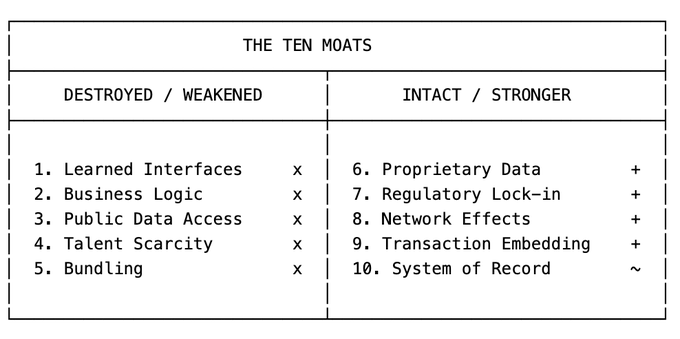
Core Insights - The article discusses how large language models (LLMs) are systematically dismantling the competitive advantages of vertical SaaS companies, leading to a significant market reevaluation of their value [1][11][40] - It highlights the drastic changes in the software landscape, where traditional barriers to entry are being lowered, resulting in increased competition and reduced pricing power for established players [41][44] Group 1: Disruption of Traditional Moats - "Usability" is no longer a competitive advantage as LLMs simplify complex software interfaces into conversational formats, eliminating the need for extensive training [1][14] - Business logic that once required years of coding can now be encapsulated in simple Markdown documents, drastically reducing the time for competitors to replicate workflows [2][20] - Companies relying on organizing public data for profit are at risk as LLMs can inherently understand and process these documents, commoditizing their business model [3][25] Group 2: Talent and Development Changes - The scarcity of talent that once posed a barrier to entry is diminished as domain experts can now directly translate their knowledge into software without needing programming skills [4][26] - The development process has shifted from requiring specialized engineers to being accessible to anyone with domain expertise, allowing for rapid iteration and deployment of software solutions [20][22] Group 3: Market Dynamics and Competition - The competitive landscape is shifting from a few dominant players to a fragmented market with hundreds of new entrants, leading to a collapse in pricing structures [7][41] - The threat of "pincer movement" from both AI-native startups and established horizontal platforms entering vertical markets is intensifying competition [45][49] Group 4: Value of Proprietary Data - Companies with exclusive, non-replicable data will see their value increase, as LLMs enhance the utility of such data rather than diminish it [5][32] - Proprietary data becomes a critical asset in the AI era, providing companies with significant pricing power and competitive advantage [5][32] Group 5: Regulatory and Compliance Barriers - Certain regulatory and compliance requirements create structural barriers that LLMs cannot easily penetrate, ensuring the stability of companies operating in heavily regulated industries [6][35] - Companies embedded in transaction processes are less vulnerable to disruption from LLMs, as their operational frameworks are essential for revenue generation [37][39] Group 6: Long-term Implications - The overall result of these changes is a significant reduction in barriers to entry, allowing new competitors to emerge rapidly and challenge established firms [40][41] - The market is beginning to differentiate between companies with genuine competitive advantages and those that are vulnerable to LLM-driven commoditization [56]

1万亿美元蒸发背后:垂直软件的护城河,正在被大模型重写
硬AI· 2026-02-18 06:41
作者 | Kozmon 硬·AI 编辑 | 硬 AI Fintool 创始人 Nicolas Bustamante 最近在 X 平台上发了一篇"杀人诛心"的深度长文,直接点破了最近软 件股万亿市值蒸发背后的残酷真相。 作为一位曾经打造过欧洲最大法律科技平台(Doctrine)、现在又投身 AI 金融(Fintool)的"双栖"创业 者, 他站在新旧时代的交界点上,详细拆解了垂直 SaaS 行业赖以生存的十大护城河是如何被大模型一 一瓦解的。 Nicolas认为,LLM(大语言模型)正在系统性地拆除垂直软件过去赖以生存的护城河,以前靠"软件难 用"和"流程复杂"赚取高昂溢价的日子结束了,市场正在经历一场残酷的价值重估。 我们给大家简单划了下这篇文章的重点: 1."难用"不再是护城河 LLM 正在系统性地拆除垂直软件过去赖以生存的护城河,以前靠 " 软件难用 " 和 " 流程复杂 " 赚取高昂溢价的日子结束了,市 场正在经历一场残酷的价值重估。 以前像彭博终端这种软件,最牛的护城河其实是「难用」,用户花了很长时间学会了那些复杂的快捷键和 代码,学会了就不想换。但现在,LLM把所有复杂的界面都坍缩成了一个聊天框,用 ...

FactSet: Buy The Drop On This Moat-Worthy Stock
Seeking Alpha· 2026-02-13 16:18
Group 1 - The recent decline in financial services and software stocks has created bargain opportunities, suggesting a potential for value investing in these sectors [2] - The focus is on income-producing asset classes that provide sustainable portfolio income, diversification, and inflation hedging [1][2] - The investment group iREIT®+HOYA Capital targets high-yield, dividend growth investment ideas, with portfolios aiming for dividend yields up to 10% [2] Group 2 - The investment research covers various asset classes including REITs, ETFs, closed-end funds, preferreds, and dividend champions [2] - The service emphasizes the importance of a medium- to long-term investment horizon, particularly in defensive stocks [2]

“AI+数字广告”霸主Applovin(APP.US)击碎“软件股末日论”! AI红利被烙印进业绩 Q4净利润猛增84%
智通财经网· 2026-02-12 00:13
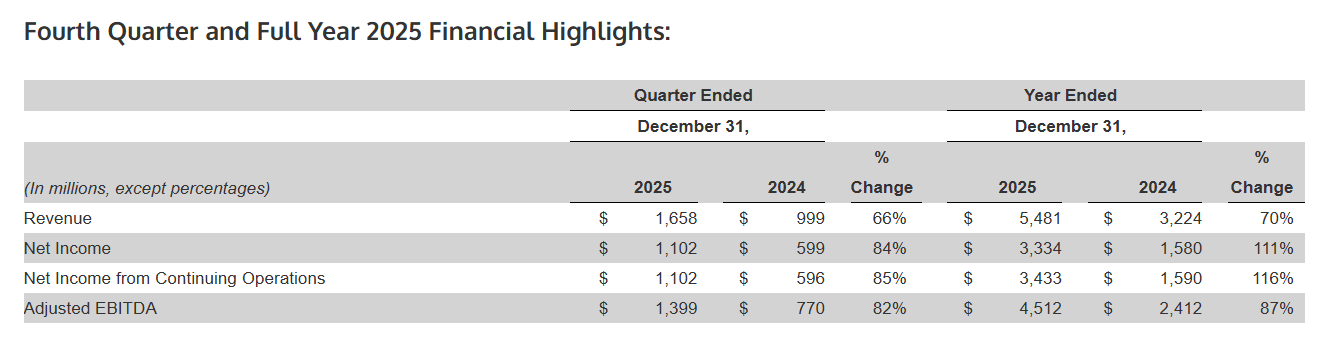
Core Viewpoint - Applovin has demonstrated strong performance and future revenue outlook, surpassing Wall Street analysts' expectations, amidst a market narrative that has exaggerated fears regarding AI's impact on software stocks [1][2][3] Financial Performance - For Q4 2025, Applovin reported total revenue of approximately $1.658 billion, a significant increase of 66% year-over-year, exceeding the analyst expectation of around $1.61 billion [3][4] - The net income for Q4 was approximately $1.102 billion, reflecting an 84% year-over-year growth, with GAAP earnings per share at $3.24, well above the expected $2.96 [3][4] - For the full fiscal year 2025, total revenue reached about $5.481 billion, a 70% increase from 2024, with net income of approximately $3.334 billion, up 111% [4] Future Outlook - Applovin's management anticipates Q1 2026 revenue in the range of $1.745 billion to $1.775 billion, indicating a potential sequential growth and exceeding the average analyst expectation of around $1.7 billion [5] - The adjusted EBITDA forecast for Q1 2026 is projected between $1.465 billion and $1.495 billion, also above analyst expectations [5] Market Context - The software sector has faced significant sell-offs, driven by fears of AI disrupting traditional SaaS models, yet Applovin's results counter this narrative, suggesting that platform software companies may benefit from AI rather than be replaced by it [2][6][8] - The introduction of AI tools by competitors like Anthropic has raised concerns about the viability of traditional software models, but Applovin's performance indicates a different trajectory for companies that integrate AI into their core operations [6][7][10] Strategic Positioning - Applovin has successfully embedded generative AI and deep machine learning into its advertising technology, creating a closed-loop system that enhances revenue and profit growth [5][9] - The company exemplifies how platform software can leverage AI to improve operational efficiency and economic metrics, reinforcing the long-term bullish outlook for such firms [9][10]

未知机构:广发计算机刘雪峰团队GenAI系列二十六大模型公司Coding和行-20260211
未知机构· 2026-02-11 02:25
Summary of Conference Call Notes Industry Overview - The software industry is experiencing a significant impact from AI-assisted programming, leading to increased development efficiency and lowered barriers to entry for software development [1][1] - The degree of influence from AI large models varies across software based on complexity, application scenarios, and industry sectors [1][1] Key Insights - Certain software companies with industry barriers and specific niches have long-term growth prospects [2][2] - Companies operating in specialized fields with strong data expertise that is non-public and non-generic may survive if they keep pace with AI advancements [2][2] - Data specific to client departments, such as operations and finance, often cannot be disclosed and require private, closed deployments and secondary development [2][2] - Data value service providers and consulting integrators remain essential in the industry chain, even in an AI-dominated software ecosystem [2][2] Competitive Landscape - Leading overseas AI large model companies are developing vertical AI solutions [2][2] - Anthropic launched a financial analysis solution in July 2025, enabling data integration, validation, and automation of financial analysis and modeling, which has begun to fulfill some functions of financial IT software [2][2] - This shift indicates a transition from "assisted collaboration" to "full agency" roles for AI in enterprise information systems, posing challenges for similar functional software companies [2][2] - Anthropic's financial analysis solution does not create data but operates on established financial data systems, positioning AI as a "super analytical layer" [2][2] Implementation and Partnerships - The financial analysis solution integrates data from multiple sources, including FactSet, Palantir, and S&P Global, to provide high-quality, cross-verified real-time data, significantly reducing analysis error risks from single information sources [3][3] - Key implementation partners such as Deloitte, KPMG, and PwC play a crucial role in addressing the practical application of the financial analysis solution within financial institutions [3][3] Focus Areas - Companies to watch include: - Basic general tool companies: Zhuoyi Information, Xinghuan Technology [3][3] - Companies with vertical know-how and specific data requirements: Jingtai Holdings, Hand Information, Tax Friend Co., Shiji Information, Kingdee International, Zhongkong Technology, Saiyi Information [3][3] - Companies with scene implementation and delivery capabilities: Changliang Technology, Yuxin Technology, Ruantong Power, China Software International [3][3]
FactSet Partners with Kepler Cheuvreux to Deliver GenAI-Activated AMR
Globenewswire· 2026-02-10 13:00
Core Insights - FactSet has announced a partnership with Kepler Cheuvreux to integrate its Aftermarket Research (AMR) into the FactSet platform, enhancing the delivery of premium sell-side research across EMEA [1][2] Group 1: Partnership Details - The collaboration aims to deepen European equity coverage through the largest independent research footprint in Europe, reinforcing FactSet's position as a leading research platform [2] - Kepler Cheuvreux's AMR will be enhanced by FactSet's AI capabilities, allowing users to interrogate, summarize, compare, and contextualize research in new ways tailored to actionable workflows [2][3] Group 2: Research Coverage - Kepler Cheuvreux covers over 1,000 stocks across 34 sectors, supported by a team of over 110 equity analysts operating from 12 major European financial centers and Dubai [2] - FactSet's existing AMR offering includes reports from more than 1,800 top brokers globally, such as J.P. Morgan, Barclays, and Deutsche Bank, complementing the new partnership [4] Group 3: Company Background - FactSet has over 47 years of expertise, operates in 19 countries, and serves more than 9,000 global clients with over 239,000 individual users [5] - Kepler Cheuvreux is recognized as the 1st independent European equity broker and has a strong presence in 14 major financial centers [6][7]

美股长牛关键催化震撼来袭!SpaceX与OpenAI等巨头蓄势待发,高盛押注2026年乃IPO大年
Jin Rong Jie· 2026-02-10 02:57
Group 1 - Goldman Sachs strategists predict a strong rebound in the U.S. IPO market, driven by a stable economy, increased board confidence, and expected continued accommodative monetary policy [1][8] - The projected IPO fundraising amount for 2026 is approximately $160 billion, significantly higher than last year's $48 billion, excluding SPACs and other fundraising types [1][8] - The number of IPOs is expected to rise to 120 in 2026, nearly doubling from the previous year, indicating a return to normal levels rather than speculative market exuberance [2][8] Group 2 - Recent IPO activity has been mixed, with notable companies experiencing both significant gains and losses upon their market debut [2] - Key risks for the IPO market include potential market volatility, which could hinder the expansion of actual IPO sizes, as seen in recent global market fluctuations [2] - Major private companies like SpaceX and OpenAI are preparing for IPOs, with SpaceX potentially raising up to $50 billion and OpenAI's valuation expected to approach $1 trillion [5][6] Group 3 - The resurgence of IPO activity is crucial for the bullish trend in the U.S. stock market, as it reflects increased risk appetite and favorable financing conditions [8] - Historical data suggests that significant increases in IPO activity, especially from major companies, are often associated with strong returns in the S&P 500 index [4][8] - Other companies to watch for potential IPOs include Canva, Strava, and Databricks, indicating a broader wave of IPO activity anticipated in the coming years [7]