
Mistral AI

Search documents
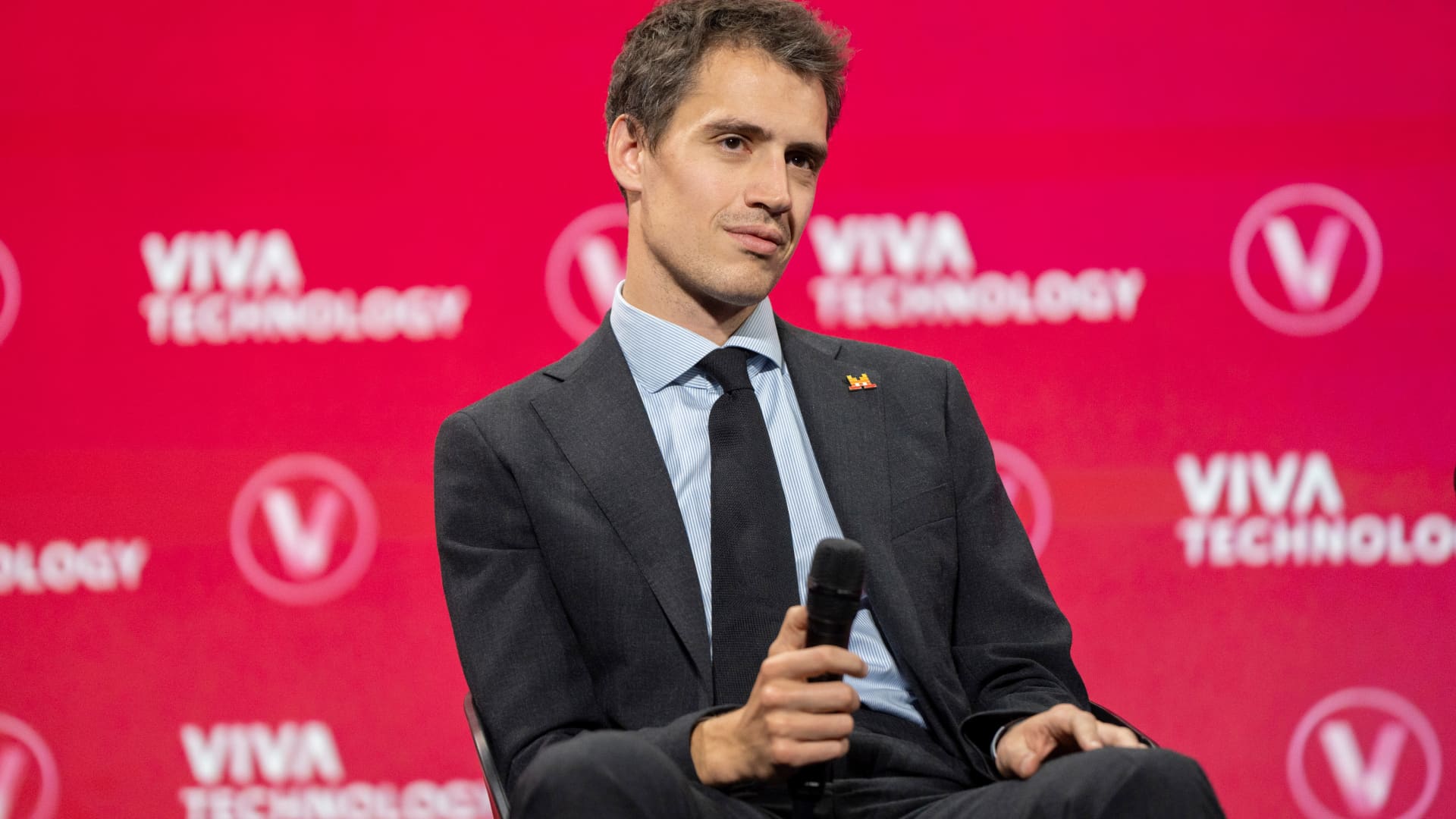
More than 50% of enterprise software could switch to AI, Mistral CEO says
CNBC· 2026-02-18 06:30
Core Insights - More than 50% of current enterprise software could potentially be replaced by AI, raising investor concerns over software stocks [1][2][4] - Major software stocks, including those in the SaaS sector, have experienced significant declines, with the iShares Expanded Tech-Software Sector ETF down over 20% this year [3] AI Impact on Software - The CEO of Mistral AI indicated that a shift from SaaS to AI is underway, with enterprises able to develop software rapidly using AI [4][6] - There is a "replatforming" trend where businesses are looking to replace outdated IT systems with AI solutions, which are seen as more efficient and cost-effective [7][8] Market Dynamics - Mistral AI is experiencing increased interest from over 100 enterprise customers looking to replatform their IT systems [7] - Workflow software is expected to face significant disruption from AI, while systems of record that support data management will remain essential [9] Expansion Plans - Mistral AI plans to open its first office in India, targeting both public and private sector customers [10] - The company aims to partner with existing firms in India to leverage local infrastructure, aligning with the Indian government's push for domestic data storage [11]

X @TechCrunch
TechCrunch· 2026-02-17 17:26
Mistral AI buys Koyeb in first acquisition to back its cloud ambitions https://t.co/orwcvZ6q4F ...
算力为王:AI数据中心万亿赛道的产业链争霸与投资风暴
QYResearch· 2026-02-13 09:30
Core Insights - The article emphasizes the accelerated global construction of AI-driven data centers, highlighting significant investments from major tech companies like Meta and Mistral AI, which reflect the strategic importance of AI computing power deployment [2][3] - Data centers are not only foundational for AI applications but also serve as critical support for profit growth and technological competition across the industry [4] Market Size and Policy Environment by Region - North America: Projected market size of approximately $95-100 billion by 2026 and $300-350 billion by 2030, with a CAGR of ~28%. The region benefits from supportive AI innovation policies and strict data privacy regulations [6] - Europe: Expected market size of around $40-45 billion by 2026 and $120-150 billion by 2030, with a CAGR of ~25%. The region faces strict GDPR compliance and has a strong demand for localized data centers [6] - China: Anticipated market size of about $50-55 billion by 2026 and $160-200 billion by 2030, with a CAGR of ~27%. The government encourages AI and computing infrastructure development [6] - South Korea: Estimated market size of $5-6 billion by 2026 and $20-25 billion by 2030, with a CAGR of ~30%. The government promotes AI strategies and local semiconductor advantages [6] - Japan: Projected market size of $6-7 billion by 2026 and $18-22 billion by 2030, with a CAGR of ~23%. The region's stable demand comes from high-end manufacturing and finance sectors [6] - India: Expected market size of $3-4 billion by 2026 and $12-15 billion by 2030, with a CAGR of ~28-30%. The region shows rapid growth in cloud computing and AI applications [6] Key Industry Chain and Leading Companies - AI Chips/Accelerators: Key players include NVIDIA, AMD, Intel, and Google, focusing on high-performance AI training and inference [8] - Data Center Infrastructure: Major operators like Equinix and Digital Realty, along with self-built centers from Meta, AWS, and Microsoft, dominate the market [8] - Cloud Services/AI Platforms: AWS, Microsoft Azure, and Google Cloud are leading providers of AI services and solutions [8] - Storage/Memory: Companies like Samsung and SK Hynix are crucial for high-speed storage demands [9] - Network Equipment: Cisco and Arista Networks are essential for data center connectivity [9] - Energy and Cooling: Schneider Electric and Vertiv lead in providing reliable power and cooling solutions [9] - Data Center Software: VMware and HashiCorp/Red Hat offer critical management tools for data centers [9] Investment Opportunities - Upstream Chips: Investment in GPU/TPU/accelerators offers high margins and long-term contracts [10] - Data Center Operations: Focus on self-built or managed centers in high-demand regions like North America, China, and South Korea for stable rental income [10] - Cloud Service Platforms: High-growth subscription revenue opportunities in AI SaaS/IaaS [10] - Storage/Memory: Long-term supply agreements with major operators for HBM/SSD [10] - Network Equipment: Targeting AI-optimized and low-latency products for mid to long-term replacement [10] - Energy/Cooling: Building green data centers to leverage policy benefits [10] - Software/Operations: Providing intelligent operation and monitoring services for high profit margins [10] Conclusion and Strategic Recommendations - AI data centers are positioned as the core hub of the global tech industry over the next decade, with understanding technology trends and market opportunities being crucial for competitive advantage and long-term returns [12][14] - Regional market differences indicate that North America and China have large, stable markets, while South Korea and Southeast Asia show rapid growth [14] - Investment strategies should focus on leveraging these regional insights for optimal positioning in the evolving landscape [14]






X @Bloomberg
Bloomberg· 2026-02-11 18:22
BNP Paribas is deepening its partnership with Mistral AI, extending it for a three year period https://t.co/qdzE0aSydt ...

Europe's OpenAI Rival Mistral Bets $1.4 Billion On Swedish AI Infrastructure Buildout - ASML Holding (NASDAQ:ASML), Alphabet (NASDAQ:GOOG)
Benzinga· 2026-02-11 12:49
Core Insights - Mistral AI has announced a €1.2 billion ($1.43 billion) investment in collaboration with EcoDataCenter to enhance Sweden's digital infrastructure [1] - This investment represents Mistral AI's first AI infrastructure project outside of France, aimed at establishing an AI-centric data center in Borlänge, Sweden [2][3] - The facility is expected to commence operations in 2027 and will facilitate the development and deployment of Mistral's next-generation AI models [3] Company and Industry Developments - The partnership will focus on creating AI-specialized data centers, advanced computing capacity, and localized AI capabilities [2] - Mistral's CEO emphasized that this investment is a significant step towards building independent AI capabilities in Europe [3] - The initiative aligns with Europe's broader strategy to enhance its technological infrastructure to compete with U.S. tech giants amid increasing geopolitical tensions [3]


X @Bloomberg
Bloomberg· 2026-02-11 11:52
French startup Mistral AI is investing $1.4 billion to build out AI infrastructure in Sweden https://t.co/enY5Syiulx ...
When the music stops: the unravelling of AI companies’ flawed valuations
Yahoo Finance· 2026-02-06 10:00
Group 1: Market Dynamics and Valuations - Public and private market investors are currently attributing significant premiums to AI companies, creating a scenario reminiscent of the dot com bubble, where over-valuations are part of the initial hype [1][2] - The AI industry is entering the Trough of Disillusionment, indicating that when the AI bubble bursts, flawed valuations will be revealed [2] - High valuations have been set for AI companies, such as Lovable's $330 million Series B at a $6.6 billion valuation and Mistral AI's €1.7 billion Series C at a €11.7 billion valuation, which creates unrealistic expectations for returns [6] Group 2: Investment Patterns and Risks - There is a concerning pattern of circular investing among major AI companies, where suppliers invest in their customers, leading to entangled partnerships that may pose risks to the ecosystem [3][4][5] - Major cloud providers have invested in AI companies like OpenAI and Anthropic, creating a cycle where these companies can invest in others that build applications on their platforms, further complicating the investment landscape [4] - The current reporting of Annual Recurring Revenue (ARR) for AI companies has become less predictable due to the inclusion of various contract types, which diverges from traditional subscription-based models [7]
AI进化速递 | 混元图像3.0图生图模型开源
Di Yi Cai Jing· 2026-01-28 13:07
④腾讯云支持Clawdbot云端极简部署; ⑤Kimi K2.5发布24小时登顶全球开源榜单; ⑥Figure发布新一代人形机器人Helix 02; AI进化速递 | 混元图像3.0图生图模型开源 ⑦蚂蚁集团旗下灵波科技宣布全面开源具身大模型LingBot-VLA; ①腾讯混元图像3.0图生图模型正式开源; ⑧智元:VLA端侧推理性能提速15倍,并于精灵G2机器人上完成真机验证; ②阿里云通义正式开源发布Z-Image基座模型; ⑨宸境科技发布具身智能新品牌及全栈技术矩阵; ③阿里云上线Clawdbot全套云服务; ⑪Mistral AI发布Vibe 2.0:终端编程助手进化,支持自定义子代理; ⑫韩国AI芯片设计公司FuriosaAI开始量产其第二代Renegade芯片; ⑬谷歌宣布将AI Plus订阅服务推广至包括美国在内的35个新市场; ⑭AI内容公司Thetawave AI完成数百万美金Pre-A轮融资。 ⑩SK海力士拟斥资100亿美元在美国设立人工智能解决方案公司; ...
格陵兰岛争端标志“欧美脱钩”?欧洲准备应对“美国技术封锁”
Hua Er Jie Jian Wen· 2026-01-25 02:19
Core Viewpoint - The article discusses the geopolitical tensions between the U.S. and Europe, highlighting a potential "decoupling" as Europe seeks to reduce its reliance on American technology infrastructure due to fears of U.S. government intervention [1][2][3]. Geopolitical Tensions - The relationship between the U.S. and Europe is deteriorating, with Trump's threats regarding Greenland symbolizing a deeper rift in shared values [2]. - European officials are increasingly concerned about the potential for U.S. administrative actions that could disrupt access to critical services, leading to a defensive economic strategy [2][3]. Legislative and Business Responses - The European Parliament has passed a "technological sovereignty" resolution, advocating for prioritizing European products in public procurement and supporting local cloud service providers [1][3]. - European officials are pushing for U.S. cloud service providers to ensure that critical industry clients can easily transition to local infrastructure in case of service disruptions [4]. Market Dynamics - Despite efforts for independence, European customers are projected to spend nearly $25 billion on services from the top five U.S. cloud companies in 2024, representing 83% of the European market [3]. - Major U.S. tech companies are responding by restructuring and launching services aimed at addressing European data sovereignty concerns [5]. Policy Shifts and Market Risks - The policy environment for U.S. tech companies in Europe is becoming increasingly challenging, with initiatives from France and Germany aimed at enhancing technological independence [6]. - The potential shift towards substantial market barriers for U.S. tech firms could lead to a reevaluation of their valuations, as a significant portion of their revenues comes from Europe [6].

联想首席财务官:公司拟与多家人工智能模型企业建立合作
Xin Lang Cai Jing· 2026-01-23 12:34
Core Viewpoint - Lenovo is seeking partnerships with major language model companies to enhance its devices and establish a presence in the global AI sector [1][3]. Group 1: Company Strategy - Lenovo plans to integrate AI technology across its entire product range, including personal computers, smartphones, and wearable devices [1][3]. - The company recently launched a cross-device intelligent system called "Kira," which can integrate with partners' large language models [1][3]. - Lenovo's CFO, Winston Cheng, stated that apart from Apple, Lenovo is the only company with significant market shares in both personal computers and mobile devices while operating in both open Android and Windows ecosystems [1][3]. Group 2: Potential Collaborations - Lenovo aims to sign cooperation agreements with several large language model developers, including Humain from Saudi Arabia, Mistral AI from Europe, Alibaba, and DeepSeek from China [1][3]. Group 3: Cost Management and Partnerships - Cheng mentioned that Lenovo adopts a "resource integrator" strategy, opting for partnerships rather than developing large language models in-house, mainly due to varying global regulatory policies [2][4]. - In response to rising memory chip prices affecting the consumer electronics sector, Lenovo plans to pass on the increased costs to consumers [2][4]. - Lenovo has partnered with NVIDIA to develop a liquid-cooled hybrid AI infrastructure to support AI cloud service providers in rapidly deploying data centers [2][4].
