PPG

Search documents
智能化赋能涂料柔性生产新业态
Zhong Guo Hua Gong Bao· 2025-12-10 02:42
Group 1: Industry Trends - The core driving force behind the profound transformation of coating manufacturing processes is the deep integration of intelligence, digitalization, greening, and automation [1] - Digital technology-driven intelligent upgrades are becoming a new solution for the increasing market demand for small-batch and personalized coating products, enabling flexible production and delivery [1] Group 2: Supply Chain Transparency - Traditional factories face challenges such as lack of order transparency, chaotic logistics, slow equipment response, and high communication costs [2] - Digital factories achieve smooth information and material flow, effectively reducing communication costs, waiting times, and error rates [2] - Companies like PPG and Nippon Paint are actively promoting intelligent manufacturing across the entire process, including supplier management, product development, production operations, and logistics [2][3] Group 3: Advanced Information Systems - Companies are planning to enhance supply chain services by optimizing customer relationship management (CRM) systems and introducing supplier relationship management (SRM) systems [3] - The use of big data analytics to build customer profiles aims to improve integrated supply chain services from production to after-sales [3] Group 4: Flexible Production Lines - Equipment is considered the backbone of industrial upgrades, with technological breakthroughs directly impacting high-quality industry development [4] - There is a need for equipment systems that can quickly respond to small-batch and diverse demands to achieve flexible customization [4] - Collaboration between coating production enterprises and equipment manufacturers is essential for achieving comprehensive digital transformation [4] Group 5: Automation Solutions - Automation upgrades are crucial for chemical companies to enhance competitiveness, with solutions like automated material extraction systems achieving high efficiency and product recovery rates [5] - The implementation of automation requires attention to demand research, solution design, installation, and operational maintenance [5] Group 6: Color Management - Small-batch and customized coating production necessitates high standards, precision, and stability in color formulation [7] - Traditional factories relying on manual input face challenges in precision and confidentiality, while foreign companies have achieved standardization and automation in small-batch color management through digitalization [7] - Automation and digital applications in quality control laboratories significantly reduce human errors and enhance data traceability [7]
PPG再获MSCI ESG最高评级
Zhong Guo Hua Gong Bao· 2025-11-26 02:18
中化新网讯 近日,PPG宣布,公司在摩根士丹利资本国际公司(MSCI)的环境、社会与治理(ESG)评级评 估中,再度荣获最高"AAA"评级,连续第二年获评"行业领导者"称号。 PPG全球可持续发展副总裁Peter Votruba Drzal表示:"可持续发展不仅是一个目标,更是我们业务战略 的核心组成部分。它是推动我们各个业务领域持续改进的核心驱动力,涵盖从客户解决方案到工厂运营 的方方面面。认可凸显了PPG如何精准定位以满足客户需求:在不断扩大具有可持续优势的产品组合的 同时,减少废弃物、用水量、排放和能源消耗。" 据介绍,MSCI ESG研究部门为全球数千家公司的ESG相关商业实践提供深入的研究、评级和分析。该 机构根据企业对行业特定ESG风险的暴露程度,以及相对于同行管理这些风险的能力,对全球上市公司 及部分精选私营公司进行评级,等级从AAA到CCC不等。此项研究旨在提供关键洞察,帮助机构投资 者识别传统投资研究中可能忽略的风险与机遇。 ...
Jim Cramer Discusses What “People Don’t Realize” About Axalta (AXTA)
Yahoo Finance· 2025-11-21 19:20
Core Viewpoint - Axalta Coating Systems Ltd. (NYSE:AXTA) is set to merge with Akzo Nobel, creating a combined entity valued at $25 billion, amidst a challenging global economic environment characterized by high interest rates and costs [2]. Group 1: Company Overview - Axalta Coating Systems Ltd. is being compared to Sherwin-Williams, but it is noted that Axalta's focus is on coatings rather than home products, making it more comparable to PPG Industries [3]. - The merger with Akzo Nobel positions Axalta as a significant player in the coatings industry, potentially enhancing its market power [3]. Group 2: Market Context - The merger occurs in a global economy facing high interest rates and rising costs, which may impact investor sentiment and market dynamics [2]. - Jim Cramer emphasizes that Axalta is undervalued compared to PPG, suggesting that there is potential for price appreciation following the merger [3].

聚焦高水平载体平台建设,蓄势高能级特色产业发展
Yang Zi Wan Bao Wang· 2025-10-09 14:01
Core Insights - The construction of industrial platform carriers has become a core engine for high-quality regional economic development amid increasing global competition [1] - Zhangjiagang Free Trade Zone is focusing on strengthening and optimizing its specialty new materials industry, continuously improving resource allocation and platform construction to promote high-level characteristic industry development [1] Group 1: Jiangsu Yangtze River International Chemical Industrial Park - Jiangsu Yangtze River International Chemical Industrial Park is currently the most advanced and concentrated new materials and fine chemicals park in China, hosting major global chemical companies including Dow Chemical, Wacker Chemie, and Honeywell [3] - The park has an average annual output value of approximately 100 billion yuan over the past three years [3] - It features significant policy advantages with nearly 10 km of chemical coastline and multiple specialized terminals and storage facilities for hazardous chemicals [3] Group 2: International Scientific and Technological Cooperation - The "Zhangjiagang Chemical New Materials International Scientific and Technological Cooperation Base" has been recognized by the Ministry of Science and Technology as a distinctive international cooperation base, contributing to national development and international technology transfer [5] - Jiangsu Province has a total of 25 national cooperation bases, with Zhangjiagang being the only one in the city [5] Group 3: National Key Laboratory of Material Chemistry Engineering - The National Key Laboratory of Material Chemistry Engineering Zhangjiagang Industrial Base is a collaborative project involving Nanjing University of Technology, Zhangjiagang Municipal Government, and the Free Trade Zone Management Committee [7] - The base focuses on low-carbon materials, new energy materials, and high-end chemical manufacturing technologies, aiming to create a comprehensive innovation system [7] - A project on high-performance ammonia-permeable membrane materials has been selected for the 2025 Jiangsu Province major science and technology project, showcasing the platform's effectiveness [7] Group 4: Zhangjiagang Chemical Pilot Base - The Zhangjiagang Chemical Pilot Base has a total investment of 800 million yuan and is one of the first pilot demonstration bases in the province [9] - It aims to address the "last mile" challenge in technology transfer through integrated research and testing platforms [9] - The Free Trade Zone plans to enhance platform functions and foster deep integration of technology, talent, and industry to cultivate globally competitive innovative enterprises and industrial clusters [9]


2025年中国涂层材料行业壁垒、市场政策、产业链图谱、市场规模、竞争格局及发展趋势研判:行业呈现“大行业、小企业”的格局[图]
Chan Ye Xin Xi Wang· 2025-10-08 00:42
Core Insights - The coating materials industry in China is experiencing steady growth, with a projected market size of 463.71 billion yuan in 2024, representing a year-on-year increase of 2.62% [1][15] - Industrial coating materials account for 58.90% of the market, driven by the demand from high-end industries such as new energy vehicles and display panels [1][15] - The industry is characterized by technological barriers, requiring a multidisciplinary approach for development and innovation [6][7] Industry Overview - Coating materials are essential in various sectors, including construction, automotive, aerospace, and electronics, serving functions such as protection, surface enhancement, and new functionalities [2][14] - The classification of coating materials includes solvent-based, water-based, and solvent-free types, as well as industrial, architectural, and auxiliary materials [4][5] Market Policies - Recent policies in China, such as the "14th Five-Year Plan" and various environmental regulations, provide a supportive framework for the development of the coating materials industry [9][10] Industry Chain - The upstream of the coating materials industry includes suppliers of resins, solvents, additives, and pigments, while the downstream encompasses applications in automotive, marine, machinery, new energy, electronics, and construction [11][12] Demand Structure - The automotive sector is the largest consumer of coating materials, accounting for 16.8% of the market, with significant growth in new energy vehicles, which saw a year-on-year increase of 37.3% in production and sales [13][14] Competitive Landscape - The global coating materials market is dominated by foreign companies, with the top three being Sherwin-Williams, PPG, and AkzoNobel, while the domestic market is characterized by numerous small players and a lack of large-scale leading companies [16][17] - Domestic companies like Songyi and Donglai Technology are focusing on high-end applications and customized solutions, with significant revenue contributions from automotive and consumer electronics sectors [16][18][19] Development Trends - Future trends indicate a shift towards high-performance coating materials with enhanced properties such as temperature resistance and environmental friendliness, driven by the dual carbon goals and stricter environmental regulations [20][21]


研判2025!中国航空涂料行业发展历程、产业链、发展现状、重点企业及前景展望:航空涂料规模达24.53亿元,国产化与技术升级驱动产业高速发展[图]
Chan Ye Xin Xi Wang· 2025-10-01 02:23
Core Insights - The aviation coatings market is experiencing significant growth driven by the recovery of air transport, increased orders for new-generation aircraft, and rising demand for advanced coatings in military aviation, particularly hypersonic vehicles [1][10][11] - China's aviation coatings market is expanding rapidly, with a projected growth from 4.52 billion yuan in 2016 to 24.53 billion yuan in 2024, reflecting a compound annual growth rate (CAGR) of 23.55% [1][10][11] Industry Overview - Aviation coatings are specialized coatings used on aircraft and components, providing protection against harsh environmental conditions and ensuring safety and performance under extreme operating conditions [1][10] - The global aviation coatings market was valued at $22.8 billion in 2021, rebounding by 28.81% year-on-year after a decline due to the COVID-19 pandemic [1][10] - By 2024, the global market size is expected to reach $28.7 billion, representing a year-on-year growth of 19.7% [1][10] Market Dynamics - The aviation coatings industry is primarily dominated by major aircraft manufacturers like Boeing and Airbus, with China emerging as a significant demand player due to the mass production of domestic aircraft like the C919 [1][10] - The demand for aviation coatings is also fueled by the increasing number of civil aviation aircraft, which is projected to reach 4,394 by the end of 2024, up from 4,270 in 2023 [8][10] Competitive Landscape - The aviation coatings market is characterized by high technical barriers, with foreign companies like PPG, Valspar, Akzo Nobel, and Sherwin-Williams dominating the first tier of the market [11] - Domestic companies such as Sanhe Tree, Haohua Technology, and Chongqing Three Gorges Paint are gradually capturing market share in the second tier [11] Industry Trends - The industry is shifting towards environmentally friendly and green transformation, with traditional solvent-based coatings being replaced by low-VOC water-based and high-solid coatings [13] - Innovations in materials, such as the use of nanomaterials and polyurethane, are enhancing the performance of aviation coatings, leading to breakthroughs in durability and functionality [14] - The integration of smart manufacturing and digital technologies is reshaping the development, production, and application of aviation coatings, improving quality and efficiency [16]


Universal Display (OLED) 2025 Conference Transcript
2025-09-04 18:32
Summary of Universal Display Corporation (UDC) Conference Call Industry Overview - The conference focused on the OLED market, particularly in the context of smartphones, TVs, and IT products [3][4][5] - UDC's guidance for the year is between $640 million and $700 million, with a midpoint of $675 million, indicating strong performance expectations [4][5] Key Market Segments - **Smartphones**: Approximately 60% penetration of OLED technology, with premium models reaching nearly 100% [11][12] - **IT Market**: Expected to see significant growth due to low current penetration rates and increasing OEM adoption of OLED products [5][6] - **TV Market**: Also growing, but at a slower rate compared to the IT market [5][6] - **Automotive Market**: Currently less than 1 million out of 85 million annual units globally incorporate OLEDs, but interest is increasing, especially in electric vehicles (EVs) [27] Technological Developments - **Gen 8.6 OLED Fabs**: Major customers like Samsung Display, BOE Technology Group, and Visionox are investing a collective $20 billion in new capacity to meet rising demand, particularly in the IT market [7][8] - **Phosphorescent Blue Development**: UDC is working on phosphorescent blue materials, which could increase energy efficiency by 25% when integrated into displays [13][14][15] - **Hybrid Tandem Structures**: LG Display has successfully produced a device using a hybrid structure, combining phosphorescent and fluorescent layers, marking a significant milestone [16][19] Financial Performance - UDC maintains a strong gross margin of approximately 76% to 77% [42] - The company is focused on maximizing value through customer contracts and improving manufacturing efficiencies [42][43] Strategic Initiatives - UDC is exploring M&A opportunities, particularly in acquiring OLED-related patent portfolios [45][46] - The company has a buyback authorization of $100 million and continues to prioritize dividends as a method of returning capital to shareholders [48] Supply Chain Management - UDC has been navigating geopolitical tensions and trade issues by balancing production between the U.S. and Ireland, ensuring efficient supply chain management [29][30] Emerging Applications - Beyond traditional markets, UDC sees potential in automotive displays, wearables, AR/VR, and even robotics, indicating a broadening scope for OLED applications [41] Conclusion - UDC is well-positioned in the OLED market with strong growth prospects across multiple segments, ongoing technological advancements, and a solid financial foundation. The company is actively pursuing new opportunities while managing supply chain challenges and exploring strategic partnerships.

中国巨石20250828
2025-08-28 15:15
Summary of the Conference Call for China Jushi (2025 H1) Industry Overview - The glass fiber yarn production in China increased by 4.9% year-on-year in H1 2025, despite approximately 510,000 tons of capacity being offline due to maintenance of magnetic kiln production lines [2][3] - The global glass fiber industry is undergoing consolidation, with major players like OCR and PPG exiting the market, and the closure of the largest glass fiber plant in the UK, enhancing the competitiveness of Chinese companies [2][3] Market Demand - Significant growth in various segments: - Wind power installed capacity increased by 18% globally, with China's wind power capacity surging by 98.9% [2][5] - Total automobile production rose by 10.8%, with new energy vehicle production up by 36.2% [2][5] - Retail sales of home appliances grew by 30.7% [2][5] - Infrastructure investment increased by 4.6%, while real estate investment declined by 11.2% [2][5] Company Performance - The company adopted a "volume + added value" strategy, achieving sales of 1.5822 million tons of yarn and products, a nearly 4% increase [2][6] - Revenue reached 9.109 billion yuan, a 17.7% increase; total profit was 2.119 billion yuan, up 83%; net profit was 1.758 billion yuan, up 78%; and net profit attributable to shareholders increased by 170% [2][7] - Operating cash flow was 1.4 billion yuan, with total assets of 53.7 billion yuan and a debt-to-asset ratio below 40% [2][7] Strategic Focus - The company plans to focus on "one increase, one decrease, four enhancements, and one optimization" in H2 2025, emphasizing sales priority, cost reduction, innovation, and strengthening competitive advantages [2][9] - The company anticipates stable to rising glass fiber prices, supported by policies regulating local government investments and a slowdown in new entrants [2][10][11] Competitive Landscape - The company noted that new entrants are slowing down their investments due to poor profitability, indicating a more rational supply environment [2][12] - The gross profit per ton of yarn has recovered to over 900 yuan, with overseas factories showing good profitability and expansion plans [2][13] Financial Management - The company has strengthened investor relations, with major shareholders increasing their stakes by 1.6 billion yuan, and plans to implement a mid-term dividend of 600 million yuan [2][8] - The company aims to enhance its market value management by improving operational performance and engaging with investors [2][22][23] Future Outlook - The company is optimistic about the future demand for glass fiber, particularly in wind power and automotive sectors, while maintaining a stable supply capacity [2][24] - Plans for expansion in both domestic and international markets are underway, with a focus on high-end electronic fabrics and special products [2][18][21] Conclusion - The overall sentiment is positive, with the company positioned to capitalize on market growth while managing risks associated with competition and pricing strategies. The focus on innovation and efficiency is expected to drive future performance.

Poux-Guillaume: Uncertainty leads to less investment and less purchasing
CNBC Television· 2025-07-22 12:24
All right. So, one of the reasons it seems like your stock's moving back is that you you lowered your fullear profit guidance. Can you give us a sense what was the real catalyst for that.Is it tariffs. Is it the stronger euro. What's the biggest factor.Uh, we actually didn't change our guidance. What we do is we guide at constant currency. And as you know, the euro's been particularly strong versus other currencies this year.And uh all we did was uh mark our guidance to market. So, um, we took the number do ...

全球与中国3C涂料市场现状及未来发展趋势
QYResearch· 2025-07-03 10:09
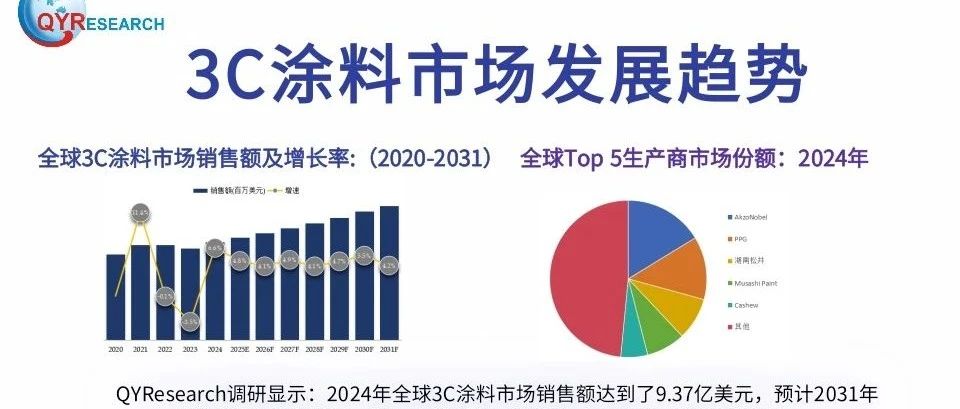
Core Viewpoint - The 3C coating industry is experiencing stable growth and structural transformation, driven by the recovery in demand from mobile phones, laptops, and wearable devices, particularly in emerging manufacturing bases like China, India, and Vietnam [3][10]. Industry Current Status - The overall demand for 3C coatings is expected to recover in 2024, reaching a market size of $937 million, with China holding a dominant market share of 62.86% [3][10]. - The global manufacturing focus is shifting, with Vietnam and India emerging as new locations for brand manufacturers to diversify risks, prompting international coating companies like AkzoNobel and PPG to increase capacity in Southeast Asia [3][10]. - There is a rapid acceptance of environmentally friendly coatings, such as water-based and low VOC systems, leading to the accelerated iteration of traditional solvent-based PU systems [3][10]. Development Trends - The future of the 3C coating industry will focus on environmental sustainability, functionality, and automation [5]. - Water-based UV and low-temperature curing systems are expected to replace traditional solvent-based coatings, becoming mainstream choices for high-end mobile phones and laptops [5]. - The functional sub-market is anticipated to grow quickly, with multi-functional coatings featuring fingerprint resistance, anti-glare, and anti-blue light properties being widely adopted in emerging electronic products like foldable screens and OLED panels [5]. Global Market Size Analysis - The global 3C coating market is projected to reach $937 million in sales in 2024 and grow to $1.284 billion by 2031, with a CAGR of 4.57% from 2025 to 2031 [7]. - The growth is primarily driven by the rising demand for appearance treatment due to the upgrade of smart terminal products and the gradual replacement trend of water-based eco-friendly systems [7]. Market Share and Competition - In 2024, the top five manufacturers, including AkzoNobel, PPG, and Hunan Songjing, will hold a combined market share of 51.54% [12]. - International brands focus on high-end mobile and laptop segments, while local brands dominate the mid-to-high-end Android model supply chain in China, showcasing a differentiated competitive landscape [12]. Policy Analysis - Recent policies encourage the development of low VOC content, environmentally friendly coatings for key industries, including electronics [16]. - The regulatory environment is tightening, promoting the use of low (or no) VOC content materials in coatings, which aligns with the industry's shift towards sustainability [16].