Red Hat

Search documents
Why IBM's $11 Billion Confluent Deal Could Supercharge Its Unique AI Strategy
The Motley Fool· 2025-12-08 20:10
Core Viewpoint - IBM is adopting a unique approach to artificial intelligence, focusing on enterprise solutions rather than investing heavily in AI data centers, which CEO Arvind Krishna believes may not yield acceptable returns [1][2]. Group 1: AI Strategy and Market Position - IBM has already secured $9.5 billion in AI-related business, primarily through consulting engagements, emphasizing its commitment to delivering AI solutions for enterprise clients [2]. - The company anticipates that AI will unlock trillions of dollars in productivity for enterprises, showcasing its optimistic outlook on the technology's potential impact [2]. Group 2: Acquisition of Confluent - IBM announced its intention to acquire Confluent for $11 billion, a company specializing in data streaming, which will enhance IBM's cloud and AI strategies [4][10]. - Confluent's platform, built on Apache Kafka, allows for efficient data and event streaming, making it particularly suitable for AI agents that require interaction with various tools and data sources [5][6]. - The acquisition is expected to create product synergies, enabling IBM to sell Confluent's offerings to its existing customer base and vice versa, which is projected to accelerate revenue growth over time [8]. Group 3: Financial Outlook - IBM is experiencing an acceleration in revenue growth, with expectations of over 5% growth in constant-currency revenue this year, compared to 3% growth in the previous two years [9]. - Confluent's revenue guidance for 2025 is approximately $1.11 billion, reflecting a 20% increase from 2024, indicating strong growth potential for the acquired company [9].



IBM (NYSE:IBM) M&A Announcement Transcript
2025-12-08 14:02
Summary of IBM's Acquisition of Confluent Industry and Company Involved - **Company**: IBM (NYSE: IBM) - **Acquisition Target**: Confluent - **Industry**: Software-led hybrid cloud and AI platform Core Points and Arguments 1. **Strategic Alignment**: The acquisition of Confluent is a deliberate step in IBM's strategy to become a software-led hybrid cloud and AI platform company, enhancing its leadership in enterprise-grade data and AI [3][4] 2. **Market Opportunity**: The acquisition targets the rapidly growing $100 billion-plus real-time data streaming and event processing market, driven by AI adoption [4] 3. **Confluent's Technology**: Confluent's platform, based on Apache Kafka, is essential for enterprises to access high-quality, trusted data in real time, which is crucial for maximizing AI value [5] 4. **Client Base**: Confluent's solutions are already utilized by major clients such as BMW, Citi, SAP, Bosch, Humana, and Walmart, showcasing the technology's capabilities [5] 5. **Transaction Details**: The acquisition is valued at $11 billion, funded by cash on hand, with approval from both companies' boards and a voting agreement from Confluent's largest shareholders [7] 6. **Financial Impact**: The transaction is expected to be accretive to Adjusted EBITDA within the first year and to Free Cash Flow in the second year post-close [7] 7. **Growth Potential**: Approximately 40% of the Fortune 500 are Confluent customers, with less than 5% generating over $1 million in annual recurring revenue, indicating significant growth opportunities [9] 8. **Synergy Expectations**: IBM anticipates about $500 million in run-rate synergies through operational efficiencies and leveraging its global market reach [9] 9. **Product Integration**: The acquisition will create a smart data platform that integrates IBM's existing products with Confluent's technology, enhancing application integration and AI capabilities [9] 10. **Financial Health**: IBM maintains a strong balance sheet and liquidity profile, with a commitment to its dividend policy, ensuring stability during the acquisition process [11] Other Important Content - **M&A Strategy**: IBM has a consistent approach to M&A, focusing on structurally growing markets aligned with its strategic priorities [3] - **Productivity Initiatives**: IBM has accelerated productivity initiatives, expecting to achieve over $4.5 billion in run-rate savings by the end of 2025, which supports its M&A strategy [10] - **Future Reporting**: Upon closing, Confluent's results will be reported as part of IBM's data within the software segment [11]
全球竞逐太空数据中心,张善从院长即将深度拆解算力如何“上天”
Xin Lang Cai Jing· 2025-12-03 13:37
Core Insights - The global consensus is forming around relocating data centers to space, with Beijing planning to build a centralized large-scale data center system in the 700-800 km dawn-dusk orbit, featuring over 1 GW of power capacity [1][4][12] - Major tech companies, including Google and SpaceX, are also pursuing space-based data centers to overcome terrestrial power and resource limitations [2][9][12] Group 1: Space Data Center Developments - Beijing's data center will consist of three subsystems: space computing, relay transmission, and ground control, with each space data center expected to host around 1 GW of power and accommodate millions of servers [1][4] - Google's "Project Suncatcher" aims to deploy solar-powered AI data centers in space, with plans to launch experimental satellites by 2027 [2][8] - SpaceX is expanding its next-generation Starlink satellites to support space data centers, while Axiom Space is developing a data center unit for the International Space Station [9][12] Group 2: Energy Consumption and Challenges - According to Gartner, global data center electricity consumption is projected to surge from 448 TWh in 2025 to 980 TWh by 2030, with AI-optimized servers' consumption increasing nearly fivefold [3][10] - The International Energy Agency (IEA) predicts that data center and AI energy consumption will double by 2026, raising concerns about local power supply and environmental impacts [11] - The unique characteristics of the dawn-dusk orbit allow satellites to receive nearly continuous sunlight, significantly enhancing solar energy generation compared to ground-based systems [4][11] Group 3: Implementation Timeline and Technical Challenges - The construction of Beijing's space data center is planned in three phases: from 2025 to 2027, focusing on energy and cooling technology breakthroughs; from 2028 to 2030, on in-orbit assembly and cost reduction; and from 2031 to 2035, on large-scale satellite production and deployment [5][12][13] - Significant engineering challenges include addressing heat dissipation in a vacuum environment and ensuring the longevity of sensitive components like GPUs through radiation protection [13]

Invent Hires Former Red Hat, Microsoft Executive As Chief AI Officer
Yahoo Finance· 2025-11-19 21:45
Core Insights - Companies across various industries are increasingly appointing chief artificial intelligence officers as AI becomes more integrated into existing technologies or replaces them [1] - The wealth management sector is also adopting this trend, exemplified by Invent's recent hiring of Jim Zimmerman as its chief AI officer [1] Company Overview - Jim Zimmerman previously worked at Red Hat and Microsoft, focusing on enterprise technology deployment and management, which will be a key aspect of his role at Invent [2] - Invent has over 130 team members and primarily serves large Registered Investment Advisors (RIAs) and Independent Broker-Dealers (IBDs) with assets ranging from $1 billion to $155 billion, as well as software companies in this market [4] Industry Trends - The wealth management sector is seen as conservative and slower to adopt innovations, but there is a growing recognition of the potential for AI to drive significant changes [5] - The recent introduction of AI tools like Claude for Financial Services indicates a shift towards more rapid innovation in the sector [5] Future Outlook - The current environment allows for faster development and proof of concept creation using AI, reducing the need for extensive human resources [6] - There is significant potential for automation in the industry, enabling advisors to focus more on client interactions rather than administrative tasks [7]
Atos launches Atos AMOS-AI with Red Hat OpenShift AI, a flexible hybrid and multi-cloud solution to support organizations retain data control and cloud sovereignty
Globenewswire· 2025-11-12 09:00
Core Insights - Atos has launched Atos Managed OpenShift AI (AMOS-AI), a hybrid and multi-cloud solution that integrates AI-driven automation and predictive analytics to enhance data control and cloud sovereignty for organizations [2][3][6]. Group 1: Product Features - AMOS-AI provides a fully auditable agnostic platform for training, deploying, and managing AI models securely across hybrid and multi-cloud environments, ensuring compliance with national and regional data protection requirements [3][6]. - The platform manages the entire lifecycle of AI, including data preparation, model training, deployment, and ongoing monitoring, within a unified hybrid cloud environment [3][4]. - The integration of AI into the Atos AMOS platform allows for process automation, enhanced security, and accelerated innovation, addressing challenges in operationalizing AI [4][5]. Group 2: Collaboration and Expertise - The collaboration between Atos and Red Hat has resulted in a platform that leverages Red Hat OpenShift AI, designed for the development and management of Generative AI and ML models, crucial for maintaining a competitive edge in sovereign cloud environments [6][7]. - Atos has over a decade of collaboration with Red Hat, focusing on enterprise open source technologies and cloud innovation, which enhances the capabilities of AMOS-AI [6][7]. Group 3: Market Position and Commitment - Atos Group operates with approximately 67,000 employees and generates annual revenue of around €10 billion, positioning itself as a leader in digital transformation and cybersecurity [8]. - The company is committed to providing tailored AI-powered solutions across various industries, emphasizing a secure and decarbonized future [8][9].

靠 AI,企业怎么才赚钱?IBM CEO:先别迷信技术
3 6 Ke· 2025-11-05 01:59
Core Insights - The core idea presented by IBM CEO Arvind Krishna is that AI should not be viewed merely as a tool but as a member of the team, necessitating a complete restructuring of organizational processes to realize its value [5][8][26] - IBM aims to achieve an annual productivity increase of $4.5 billion through AI and automation by the end of 2025 [2][26] Group 1: AI as an Employee - Krishna emphasizes that treating AI as a mere tool leads to superficial implementations that fail to deliver real value [4][6] - AI should be integrated into workflows with clearly defined roles and responsibilities, similar to onboarding a new employee [6][8] - Many companies invest heavily in AI without altering their organizational structures, resulting in ineffective outcomes [6][8] Group 2: Organizational Focus - Krishna advocates for a focused approach where the entire company aligns around a few core AI initiatives rather than spreading resources thinly across multiple projects [9][10] - The successful acquisition of Red Hat for $34 billion is cited as a strategic move that transformed IBM into a platform company, enabling better integration of AI solutions [11][15] - Watsonx, IBM's enterprise AI and data platform, is designed to help clients scale AI implementations based on IBM's internal experiences [12][15] Group 3: Value Creation through AI - The primary measure of AI success should be the ability to produce more rather than simply reducing headcount [16][18][20] - Krishna argues that AI should enhance productivity and allow teams to accomplish tasks that were previously unmanageable [17][20] - The focus should be on creating new value rather than merely saving costs, with an emphasis on deploying AI effectively to achieve tangible business results [20][22] Group 4: Decision-Making Framework - Krishna's decision-making process involves collaborative discussions with various stakeholders to assess the viability of AI investments [24][25] - He emphasizes the importance of building a network of diverse perspectives within and outside the organization to inform strategic decisions [25][26] - The success of AI initiatives is attributed to a comprehensive understanding of organizational readiness rather than just technological capabilities [26][27]
Omdia:2030年全球电信网络市场规模预计将达到248亿美元
智通财经网· 2025-11-04 06:19
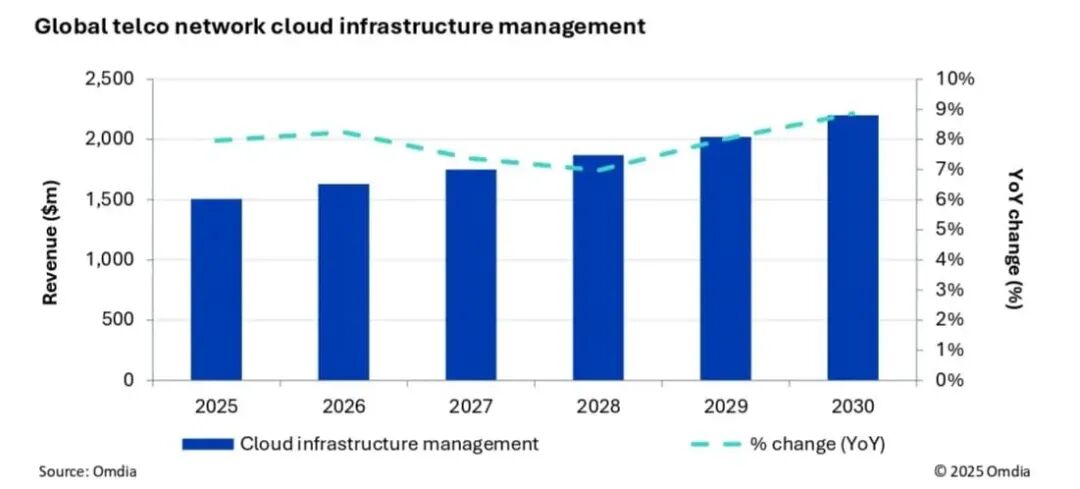
Core Insights - The global telecom cloud infrastructure and software spending is projected to grow from $17.4 billion in 2025 to $24.8 billion by 2030, with a compound annual growth rate (CAGR) of 7.3% [1] - Communication service providers (CSPs) are significantly accelerating their investments in cloud technology, with a projected growth rate of 12% in 2025, double that of 2024 [1] - The momentum is driven by the maturity of cloud-native tools, automation frameworks, and the deep integration of AI and generative AI in network operations [1] Industry Trends - AI Infrastructure: Over 62% of operators consider AI/ML support a critical factor in their cloud infrastructure decisions, with companies like NVIDIA, Red Hat, and VMware tailoring local AI capabilities for telecom environments [4] - Cloud-Native Growth: Spending on Kubernetes-based platforms is expected to grow at a CAGR of 25%, while spending in virtual machine (VM) environments is slowing down [4] - Public Cloud Adoption: The usage rate of public cloud for network workloads is expected to rise from 3% in 2024 to 13% by 2030, with major cloud service providers launching dedicated solutions for the telecom industry [4] - Vendor Landscape: Red Hat leads the telecom cloud platform market with a 25% market share [4] Recommendations for Technology Suppliers - To align with the cloud-native transformation and automation goals of telecom operators, technology suppliers are advised to adopt CI/CD pipelines and GitOps practices for the full lifecycle automation of clusters and network workloads [5]
长线看好量子计算,稀缺铲子股为何值得重视?
2025-10-27 00:31
Summary of Quantum Computing Industry Conference Call Industry Overview - The conference call focuses on the **quantum computing industry**, highlighting the transition from research to commercialization, particularly with **Guangdong Quantum** becoming controlled by **China Telecom** [1][3]. - The **15th Five-Year Plan** includes quantum technology as a key economic growth point, ensuring ample funding support for the industry's long-term development [1][3]. Key Points and Arguments - **Strong Growth Indicators**: Domestic quantum computing companies like **Liangxi** and **Guangdong Quantum** have shown significant increases in contract liabilities and revenue, indicating robust growth momentum [1][3]. - **Investment Recommendations**: The call recommends focusing on leading companies such as **Guangdong Quantum** (system integration) and **Core Instruments** (equipment), which are expected to drive sector growth and achieve substantial revenue increases [1][4][5]. - **Market Catalysts**: Key factors driving the market include: - **Policy Support**: Both domestic and U.S. government initiatives are backing quantum computing [2][6]. - **Investment from Major Players**: Companies like **NVIDIA** have invested heavily in quantum computing, indicating confidence in the sector's future [6]. - **Technological Breakthroughs**: Advances in chip technology and the ability to simulate complex problems position quantum computing favorably in sectors like finance, pharmaceuticals, and chemicals [2][7]. Financial Performance - **Contract Liabilities and Revenue Growth**: Companies in the sector are experiencing contract liabilities and revenue growth exceeding 100%, making them attractive investment targets [5][20]. - **Projected Market Growth**: By 2028, the global quantum computing market is expected to reach **$37 billion**, with China potentially capturing one-third of this market [19][21]. Investment Landscape - **Emerging Companies**: Companies like **Benyuan Quantum** and **Guangdong Quantum** are preparing for IPOs, which could significantly increase their market valuations [9]. - **Key Players**: The leading domestic quantum computing companies include **Guangdong Quantum**, **Benyuan**, and **Guoyi**, all of which are expected to expand their market share significantly [18][21]. Technical Insights - **Importance of Cooling Systems**: The cooling systems are critical for maintaining superconductivity in quantum computers, with companies like **Core Instruments** leading in this area [23][24]. - **Role of Measurement and Control Systems**: These systems are essential for the operation of quantum bits, with high precision required for effective functioning [25]. Market Dynamics - **Investment Trends**: The U.S. plans to invest **$5 billion** in quantum computing from 2025 to 2029, while China is expected to invest significantly more annually [19]. - **Supply Chain Insights**: The demand for components like cables and cooling systems is expected to grow exponentially as the number of qubits in quantum computers increases [26]. Conclusion - The quantum computing industry is poised for significant growth driven by technological advancements, strong policy support, and increasing investments from major players. Companies like **Guangdong Quantum** and **Core Instruments** are highlighted as key investment opportunities due to their strong performance and market positioning [27][28].

无惧Red Hat增长放缓,华尔街为IBM(IBM.US)撑腰:“本能性下跌”而已,AI业务前景仍向好
智通财经网· 2025-10-23 13:51
Core Insights - IBM's recent earnings and guidance exceeded market expectations, but concerns regarding its software business, particularly the mixed cloud segment driven by Red Hat, have caused investor unease [1][2] - Analysts believe the stock's decline due to Red Hat's slowdown is an "instinctive panic reaction" and does not alter IBM's positive growth trajectory in the artificial intelligence market [1] Group 1: Analyst Perspectives - Stifel analyst David Grossman remains optimistic about IBM's overall performance but warns that a "software reset" may negatively impact the stock in the short term, especially after an 18% increase in stock price over the past seven weeks [1] - Wedbush highlights IBM's $9.5 billion backlog in generative AI orders, indicating significant progress in AI-related projects, maintaining an "outperform" rating with a target price of $325 [1] - Wedbush analyst Dan Ives emphasizes IBM's strong market positioning amid the demand for hybrid cloud and AI applications, suggesting that any moderate panic sell-off would be a buying opportunity [2] Group 2: Financial Guidance and Adjustments - Bank of America analyst Wamsi Mohan slightly lowered the target price for IBM from $315 to $310 but reaffirmed a "buy" rating, citing the company's transition to higher-margin software and strong free cash flow [2] - IBM has raised its revenue growth guidance for fiscal year 2025 to over 5%, with an expected increase in pre-tax profit margins by over 1% and free cash flow projected at approximately $14 billion [2] - Management acknowledged a slowdown in Red Hat's quarterly growth due to execution challenges and lower-than-expected consumer services, adjusting the fiscal year 2025 growth expectation to about 14% year-over-year [2]
IBM Q3 earnings results beat on top, bottom lines
Youtube· 2025-10-22 21:03
IBM earnings are out. Let me get you those numbers. Uh the results are a beat on the top and bottom lines.You see the stock moving lower. I'll tell you why that might be in just a moment. Guidance raised for Q4 uh in effect because a full year is raised.So there's an asterisk on the beat. Get to that in a moment. But revenue beat at 16.33% billion versus 169 consensus.The upside though did not come from software overall. Software at 7.21%. 21 billion in line with consensus.Consulting though did beat at 5.32 ...