Syensqo

Search documents
Syensqo third quarter 2025 results
Globenewswire· 2025-11-06 06:00
Core Insights - Syensqo reported an underlying EBITDA of €326 million for Q3 2025, reflecting resilient margin performance despite a challenging macroeconomic environment [1][3][22] - The company generated strong free cash flow of €250 million in Q3, indicating robust cash generation capabilities [1][22] - An agreement to divest the Oil & Gas business unit for an enterprise value of €135 million was reached, advancing Syensqo's pure play specialty strategy [1][6][22] Financial Performance - Net sales for Q3 2025 were €1.52 billion, down 7.1% year-on-year, impacted by unfavorable foreign exchange movements (-5%) and lower volumes (-1%) [2][6][29] - Gross profit decreased by 15.3% year-on-year to €484 million, resulting in a gross profit margin of 31.9%, which remained unchanged sequentially [2][6][29] - Underlying EBITDA decreased by 12.8% year-on-year, with a margin of 21.5%, which expanded by 40 basis points sequentially [2][6][22] Cash Flow and Efficiency - Operating cash flow increased significantly to €331 million, up 57.9% year-on-year, while free cash flow surged to €250 million from €27 million in the previous year [2][6][22] - Cash conversion for the last twelve months (LTM) improved to 76%, up 690 basis points year-on-year [2][6][22] - Return on Capital Employed (ROCE) for LTM was 6.5%, down 160 basis points year-on-year [2][6][22] Strategic Outlook - The company anticipates a slower recovery in volumes for the remainder of the year, adjusting its full-year outlook accordingly [4][6][20] - Strong underlying demand in civil aerospace and space & defense applications is expected to support growth in Composite Materials in 2026 and beyond [7][20][34] - Syensqo aims to achieve over €200 million in run-rate savings by the end of 2026 through cost-saving initiatives [8][21][35]


Syensqo announces agreement to divest its Oil & Gas Business Unit to SNF Group
Globenewswire· 2025-10-31 06:00
Inside and Regulated information Syensqo announces agreement to divest its Oil & Gas Business Unit to SNF Group Agreement marks important milestone in Syensqo’s pure play specialty strategy Brussels, October 31, 2025 - 7:00am CET Syensqo today announced that it has entered into an agreement to divest its Oil & Gas Business Unit to SNF Group, a specialty chemical company headquartered in France and a global leader in polyacrylamide production, for an Enterprise Value of €135 million. On a last twelve month ...

合成生物学周报:深圳合成生物新规落地,高纯度OPO结构脂“精准复刻”母乳-20251022
Huaan Securities· 2025-10-22 06:31
Investment Rating - The report does not explicitly state an investment rating for the synthetic biology industry Core Insights - The synthetic biology sector is experiencing a global biotechnology revolution, providing innovative solutions to major challenges such as health, climate change, and food security, as highlighted by the National Development and Reform Commission's "14th Five-Year Plan for Bioeconomic Development" [4] - The Huazhong Securities Synthetic Biology Index, which includes 58 companies involved in synthetic biology, has seen a decline of 4.96% recently, indicating a performance lag compared to the Shanghai Composite Index [5][22] Summary by Sections 1. Synthetic Biology Market Dynamics - The synthetic biology sector's stocks fell by 4.96% in the week of October 13-17, 2025, ranking 24th among sectors [22] - The top five gainers in this sector included Yuanli Technology (+11%) and Fuxiang Pharmaceutical (+11%), while the top five losers included Shengquan Group (-18%) and Jinziham (-18%) [23][27] 2. Company Business Developments - Huada Zhizao has signed a licensing agreement to expand its sequencing technology into the European and American markets [28] - Haineng Energy has been approved to enter the bio-aviation fuel "white list," allowing it to produce 158,000 tons of bio-aviation fuel annually [29] - Jinggong Holdings is set to launch a 50,000-ton green recycled material production line, which will be the largest chemical recycling polyester enterprise globally [30] 3. Industry Financing Tracking - The synthetic biology sector has seen accelerated financing, with nearly 100 companies completing new funding rounds in 2025 [35] - Zhejiang Ruiwei New Materials Technology Co., Ltd. completed a multi-million yuan financing round, focusing on biodegradable materials for the beauty and textile industries [35]

Syensqo - Participation notification by Capital Group Companies Inc.
Globenewswire· 2025-10-14 06:30
Core Viewpoint - The Capital Group Companies, Inc. has crossed the 3% threshold of voting rights in Syensqo, now holding 3.02% as of October 6, 2025, according to Belgian transparency legislation [1][5][20]. Company Overview - Syensqo is a science company focused on developing innovative solutions that improve various aspects of life, work, travel, and leisure, with a global team of over 13,000 associates across 30 countries [3][11]. - The company aims to create safer, cleaner, and more sustainable products used in homes, food, consumer goods, transportation, and healthcare applications, contributing to a circular economy [4][12]. Recent Developments - The notification from The Capital Group Companies, Inc. indicates an acquisition of voting rights, with the total voting rights after the transaction being 3.02% and no equivalent financial instruments held [1][5][20]. - The denominator for the voting rights calculation is 103,921,273 shares [5][20].

市场规模1.3万亿!这些材料仍有缺口!
Xin Lang Cai Jing· 2025-10-08 04:55
Core Insights - The new materials market is valued at 1.3 trillion yuan and is growing at a rate exceeding 10% annually over the past decade [1] - There are significant material gaps in the market, with an overall self-sufficiency rate of less than 60% [1] - Major global players include Syensqo, BASF, Celanese, and Toray, while domestic companies like Kingfa Technology and Water Technology have a broader layout but still lag in product line and stability [1] - High-performance materials such as advanced polyolefins, engineering plastics, high-performance fibers, functional film materials, and electronic chemicals have self-sufficiency rates between 65% and 80%, indicating a heavy reliance on imports [1] - The profitability of general plastics has been marginal, while specialty engineering plastics maintain high profit margins, positioning them as "invisible champions" in the materials sector [1] - The rapid rise of nine strategic emerging industries and six future industries, including humanoid robots, quantum computing, 6G equipment, and brain-computer interfaces, will drive demand for high-performance materials, with an expected annual consumption growth rate of over 10% during the 14th Five-Year Plan period [1] Market Projections - The market size is projected to reach 1.8 trillion yuan by 2027 [2] - Challenges to seizing this opportunity include R&D innovation, core technology, talent shortages, process collaboration, international competition, and funding risks [2]
全球化工行业-温故知新:反内卷背景下全球基本面再探讨
2025-09-19 03:15
Summary of Global Chemical Industry Conference Call Industry Overview - The global chemical industry is expected to see an average compound annual growth rate (CAGR) in supply from 2024 to 2028 that will be lower than the period from 2020 to 2024 [1][22] - Anticipation of government measures to support a more significant recovery in the industry fundamentals starting from mid-2026 [1][25] Key Themes Discussed 1. **Global Supply and Demand Outlook** - The impact of potential "anti-involution" measures in China on global supply and demand dynamics is crucial [3][17] - The average CAGR for global benzene and C2-C6 capacity from 2024 to 2028 is projected to be between 1.0% to 6.4% if China does not close any capacity, and 0.8% to 4.0% if it does [20][22] 2. **Closure of Overseas Chemical Plants** - The closure of overseas chemical plants due to high production costs has reignited interest in the Chinese chemical sector [3][14] - The report emphasizes the need to assess the product exposure resulting from these closures [17] 3. **Profitability of Chinese Market Products** - The profitability levels of products in the Chinese market are under scrutiny, especially in light of the "anti-involution" measures [17][21] 4. **Import Substitution Process in China** - The ongoing process of import substitution in China is a significant factor influencing the market [17][21] Investment Recommendations - **China** - Wanhua Chemical's rating has been upgraded to Overweight (OW) with a target price of RMB 80, citing its higher potential for growth due to production increases and favorable policy impacts [26] - Rongsheng Petrochemical's target price has been raised to RMB 10.6, with expectations of improved earnings in Q3 2025 [26] - **Europe** - Akzo is favored, with a focus on companies like Syensqo, BASF, and AKE, all rated as Overweight [27][28] - **United States** - LyondellBasell is highlighted as a strong investment opportunity [26] - **India and Southeast Asia** - PTTGC and Petronas Chemicals are recommended due to their low-cost structures and focus on local markets [31] Market Dynamics - The A-share chemical sector has seen an average increase of approximately 10% since the announcement of the "anti-involution" policy on July 18, 2025, compared to a 9% rise in the Shanghai Composite Index [21] - The report notes that while liquidity is ample, a more significant recovery in fundamentals is contingent on the effective execution of "anti-involution" measures or substantial demand improvements [21][25] Risks and Considerations - Potential risks include ineffective supply-side reforms, worsening demand due to escalating trade tensions, and adverse inventory cycles [33] Conclusion - The global chemical industry is at a pivotal moment, with significant changes anticipated due to policy measures in China and shifts in global production dynamics. Investors are advised to closely monitor these developments for potential opportunities and risks in the sector [1][3][21]


化工行业_北美投资者关注什么-Chemicals Sector_ What are North American investors focused on_
2026-01-29 10:59
Summary of Conference Call on Chemicals Sector Industry Overview - The focus of North American investors is on the Chemicals sector, particularly regarding earnings risk for fiscal years 2025 and 2026 EBITDA [1] - There is skepticism about the sector's ability to achieve top-line inflection and double-digit earnings growth in FY26 [1] Key Points Discussed 1. **Volume Development**: - Feedback from the Global Material Conference indicated that volumes in end markets and regions have not improved since the end of Q2 [1] - Order book visibility is approximately two weeks [1] 2. **Earnings Growth Concerns**: - Investors are worried about the consensus EBITDA growth of 10% year-on-year for FY26, especially in the absence of volume recovery in H2 2025 [1] - Potential drivers for earnings growth include the impact of German fiscal stimulus, the EU Chemical Action Plan, and petrochemical capacity [1] 3. **Path to Normalized Earnings**: - A tightening of upstream supply/demand is expected, likely by late 2027/28, which could be exacerbated by capacity closures [1] - Companies are expected to focus on self-help and portfolio improvement in the interim [1] 4. **Consolidation Potential**: - Investors inquired about the potential for consolidation in the sector due to liquidity decline for many companies over the past three years [1] - Concerns were raised about the sustainability of volume growth for Ingredients & Gases [1] Stocks of Focus - **Diversified and Specialty Subsector**: - Key stocks include Solvay (benefiting from Chinese capacity closures and rare earths), Syensqo (margin recovery and non-core asset disposals), and BASF (FY26 earnings risk and coatings disposal) [2] - Defensive nature and margin improvement potential of Gases were acknowledged, but concerns about over-ownership of Air Liquide and Linde by long-only investors were noted [2] - **Consumer Chemicals**: - Focus on DSM-Firmenich (ANH disposal announcement), Symrise (pet food OSG recovery), Croda (turnaround strategy), and Novonesis (sustaining ~7% OSG and margin expansion) [2] - Lack of investor interest in Akzo Nobel, Covestro, Givaudan, fertilizers, and most mid-cap names in the sector was observed [2] Financial Performance Insights - The Chemicals sector is down 1.8% year-to-date and down 8.3% on a 12-month basis [51] - Top performers year-to-date include Bayer (+49.3%), JMAT (+41.4%), and Umicore (+32.8%) [51] - Worst performers include Symrise (-20.9%), Victrex (-32.2%), and Synthomer (-62.7%) [51] Price Trends and Spreads - **Downstream Prices**: - pMDI prices remained flat, but spreads increased by 1% as Benzene prices decreased by 1% [44] - TDI prices are flat, with spreads up by 1% as Toluene prices decreased by 2% [44] - Polycarbonate prices and spreads remained flat, while acrylic acid prices and spreads also remained flat [45] - **Upstream Prices**: - Naphtha prices decreased by 1% in Asia and 14% in the US over the last week [47] - Ethylene prices increased by 1% in Asia but decreased by 1% in the US [47] - Propylene prices remained flat, while butadiene prices were also flat [48] Conclusion - The Chemicals sector faces significant challenges regarding earnings growth and volume recovery, with investor sentiment reflecting caution. Key stocks are under scrutiny, and the potential for consolidation may shape future dynamics in the industry.
全球化工行业 - 不止于 “反内卷”,全球基本面再审视-Global Chemicals-More than Anti-Involution A Revisit of Global Fundamentals
2025-09-17 01:51
Summary of Global Chemicals Conference Call Industry Overview - The conference call focused on the **Global Chemicals** industry, particularly the impact of China's anti-involution measures and global supply-demand dynamics in the chemical sector [1][3][10]. Key Themes and Insights 1. **Global Supply Growth Projections**: - The compound annual growth rate (CAGR) for global supply from 2024 to 2028 is expected to be lower than from 2020 to 2024, with estimates of **3.1%** in a bear case (no Chinese closures) and **2.0%** in a bull case (all capacities over 20 years old closed) [1][21][52]. - The previous CAGR from 2020 to 2024 was **3.9%**, indicating a more disciplined supply growth moving forward [21][52]. 2. **Impact of China's Anti-Involution Measures**: - China's government is focusing on closing older capacities (over 20 years) to address oversupply issues in the refining and chemical markets [10][12]. - The anticipated recovery in the chemical sector is expected to be more meaningful from **mid-2026** onwards, contingent on the execution of these measures [13][23]. 3. **Investor Interest Reignited**: - The potential for anti-involution measures in China, combined with overseas chemical players closing plants due to high production costs, has rekindled investor interest in the chemical sector [3][10]. 4. **Product-Specific Capacity Growth**: - Capacity CAGRs for major products typically range from **1.0% to 6.4%** (without Chinese closures) and **0.8% to 4.0%** (with closures) [8][54]. - Specific products like ethylene and polyethylene are expected to see significant capacity additions in the upcoming years [65]. 5. **Profitability Trends**: - Major A-share chemical stocks have rallied approximately **10%** since the announcement of anti-involution measures on **July 18, 2025** [17]. - Despite a decline in profitability for major A-share companies in the first half of 2025, a seasonal recovery is expected in the second half [19][20]. Stock Recommendations - **China**: - Upgrade for **Wanhua** to Overweight (OW) with a price target of **Rmb80** due to expected benefits from volume growth and product spread expansion [25]. - Upgrade for **Rongsheng** to Equal-weight (EW) with a price target of **Rmb10.6**, anticipating quarterly earnings improvement [26]. - **Europe**: - Top pick is **Akzo**, with additional recommendations for **Syensqo**, **BASF**, and **AKE** [27][28]. - **India and Southeast Asia**: - Favorable outlook for **PTTGC** and **Petronas Chemicals** due to potential upside from China's anti-involution efforts [31]. Risks and Challenges - Potential risks include ineffective supply-side reforms, worsening demand due to trade tensions, and unfavorable inventory cycles [33]. Conclusion - The global chemicals industry is poised for a more disciplined growth phase, influenced by China's anti-involution measures and external market dynamics. The focus on closing older capacities and the potential for improved profitability in the coming years present both opportunities and risks for investors in this sector [1][10][20].
全球化工装置_更多供应关停之际,制造业或存下行风险_更多供应关停之际,制造业或存下行风险Global Chemicals Cracker_ Potential downside to manufacturing while more supply is being shut_ Potential downside to manufacturing while more supply is being shut
2025-08-31 16:21
Summary of Key Points from the Conference Call Industry Overview - The conference call primarily discusses the **Global Chemicals Cracker** industry, focusing on the dynamics of chemical demand and supply, particularly in relation to tariffs and manufacturing activity [1][2]. Core Insights and Arguments - **Chemical Demand Risks**: There is a potential downside to manufacturing as more supply is being shut down. The reversal of pre-emptive inventory builds due to tariffs could pose unexpected risks to chemical demand [1][2]. - **Supply Rationalization**: Despite announcements of supply rationalization, it appears insufficient to rebalance markets. The average spread in August remained flat, with a notable increase in EU TDI prices offset by declines in Asia [1][2]. - **Capacity Reductions**: Ten Korean companies are set to reduce naphtha cracking capacity by approximately 2.7-3.7 million tons, representing 18-25% of total capacity. Korea accounts for 6% of global ethylene/propylene capacity [2]. - **China's Supply Dynamics**: China's Ministry of Industry and Information Technology (MIIT) may phase out smaller refining and chemical facilities, but older crackers owned by Sinopec and PetroChina are expected to see upgrades, leading to net supply additions rather than closures [2]. - **Global Economic Indicators**: Citi's global economic surprise index increased in July but has since fallen in August, primarily due to China. Industrial production in China expanded by 6% YoY in July, but austerity measures are beginning to impact demand [2]. Margin and Performance Analysis - **Margin Trends**: The average spread was stable month-over-month in August, with lower spreads in Asia offset by TDI in Europe. BASF's average weighted spread decreased by approximately 1% month-over-month, indicating a potential EBITDA of around €7.3 billion, which is about 3% below consensus [3][10]. - **Sector Performance**: The chemical sector's weak performance in Q2 suggests that chemical demand has not significantly benefited from pre-buying. The outlook for September is critical to assess demand trends for the remainder of 2025 [2][3]. Company-Specific Developments - **BASF**: The company reported a marginal decline in its weighted average spread for chemicals and materials, translating to a negative net pricing impact of approximately €0.1 billion for the second half of the year [10]. - **Arkema**: European acrylic acid margins were flat month-over-month, but margins in China dropped by about 22% due to lower prices. Arkema is viewed positively for its long-term earnings resilience [10]. - **Clariant**: The company is favored for its defensive portfolio, which is less reliant on commodity pricing and more focused on higher quality end markets [10]. - **Dow Chemical**: Dow announced a 50% cut to its dividend due to a prolonged soft commodity cycle and missed Q2 earnings expectations [15]. - **LG Chem**: The company is focusing on high-value-added products amid industry oversupply, with a realistic outlook on cathode shipment guidance [14]. Additional Important Insights - **Market Sentiment**: The overall sentiment in the chemical industry remains cautious, with expectations of continued low margin conditions for the rest of the year [11][15]. - **Investment Recommendations**: Within diversified chemicals, companies such as AKE, CLN, EVK in Europe, and LG Chem, PChem, and Kumho in Asia are highlighted as favorable investment opportunities [4][10]. This summary encapsulates the key points discussed in the conference call, providing insights into the current state and future outlook of the global chemicals cracker industry.
全球与中国PVDF锂电池粘结剂市场现状及未来发展趋势
QYResearch· 2025-08-26 09:53
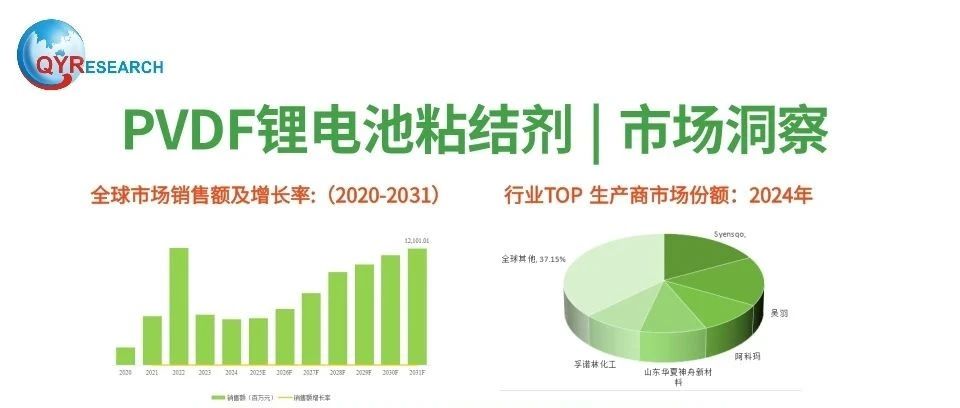
Core Viewpoint - The article discusses the growth and trends in the PVDF lithium battery binder market, highlighting its importance in the lithium-ion battery industry and the expected market dynamics through 2031 [11][14][18]. Group 1: Market Overview - PVDF is the most commonly used binder in lithium-ion batteries, crucial for enhancing the contact between active materials and conductive agents, directly affecting battery capacity, lifespan, and safety [2]. - The global PVDF lithium battery binder market is projected to reach 4.767 billion yuan in 2024 and 12.101 billion yuan by 2031, with a compound annual growth rate (CAGR) of 16.51% from 2025 to 2031 [14]. - China dominates the market, accounting for approximately 78.88% of the global market size in 2024, expected to reach 78.93% by 2031 [16]. Group 2: Production and Consumption - Major producers of PVDF lithium battery binders include Wu Yu, Syensqo, and Arkema, with the first tier of manufacturers holding about 33.24% of the market share in 2024 [17]. - The production method of PVDF binders primarily involves suspension polymerization, which allows for higher resin quality compared to emulsion polymerization [5]. - The market is currently experiencing overcapacity due to rapid expansion in production, leading to increased competition and price pressure [18]. Group 3: Application Segments - The primary applications of PVDF lithium battery binders are in digital batteries, energy storage batteries, and power batteries, with power batteries expected to hold a market share of approximately 74.09% in 2024 [6][10]. - The energy storage sector is gaining attention as a strategic support for the transition of energy structures and the transformation of electricity production and consumption [9]. Group 4: Policy and Industry Trends - The article outlines the Chinese government's policies aimed at promoting high-quality development in the fine chemical industry, which includes the PVDF sector [19]. - The "anti-involution" policy introduced in 2025 aims to curb low-price competition and encourage technological innovation within the lithium battery industry [21][23].