
万泰生物

Search documents
国产九价HPV疫苗北京“首针”落地,北大医院毕蕙:国内接种率低,不仅仅因为价格
Mei Ri Jing Ji Xin Wen· 2025-12-05 07:24
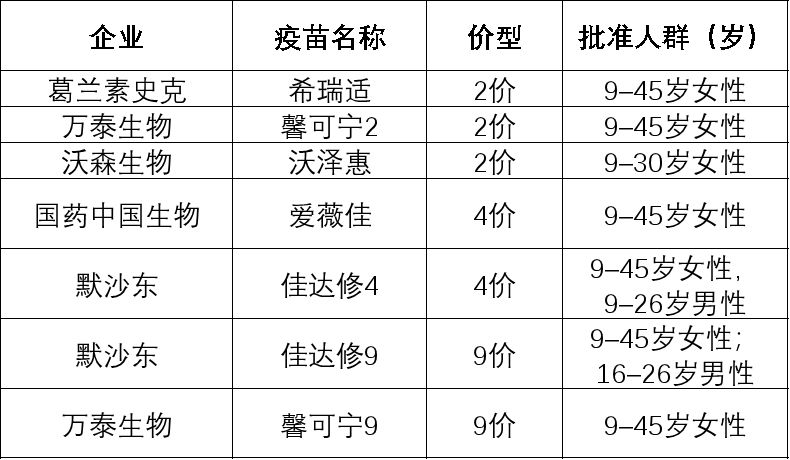
Core Insights - The first domestic nine-valent HPV vaccine was officially administered in Beijing on December 4, marking a significant step in cervical cancer prevention efforts in China [1] - Despite the approval of multiple HPV vaccines, the overall vaccination rate in China remains below the global average, indicating challenges in public awareness and accessibility [2][10] Industry Overview - China has the largest variety of HPV vaccines globally, with two domestic bivalent vaccines having received WHO pre-qualification, ensuring their safety and efficacy [2][3] - The vaccination coverage rates for HPV among women aged 9-45 in mainland China were reported at 10.15% for the first dose and 6.21% for the full series in 2022, with only 4.00% for girls aged 9-14 [3] Public Health Goals - The WHO's 2020 strategy aims for 90% of girls to complete HPV vaccination by age 15 by 2030, with a target incidence rate of cervical cancer below 4 cases per 100,000 women [4][7] - Countries with high vaccination coverage, such as Australia and Finland, have seen cervical cancer rates drop significantly, demonstrating the effectiveness of vaccination and screening programs [7] Challenges and Opportunities - Public awareness and willingness to vaccinate remain low, with factors such as pricing and lack of information contributing to the hesitance [10][11] - The inclusion of HPV vaccines in the national immunization program aims to provide free vaccinations for eligible girls, potentially increasing uptake [8] Recommendations for Improvement - Enhanced public education initiatives are necessary to inform parents about the importance of HPV vaccination, particularly targeting the appropriate age for administration [10][11] - A comprehensive management system integrating health consultation, vaccination, screening, and treatment is recommended to improve overall cervical cancer prevention efforts [11]

过去10年,顶级富豪们都怎么赚钱?
首席商业评论· 2025-12-05 04:14
Core Viewpoint - The article discusses the shifting landscape of wealth in China over the past decade, highlighting the rise of new wealthy individuals in the "emotional" economy, contrasting with the decline of traditional real estate tycoons [4][6]. Group 1: New Wealth Creation - The top new wealthy individuals in 2025 include Xu Gaoming and Xu Dongbo from Laopu Gold, with a wealth of 69.5 billion yuan, and Li Qibin and Qi Yan from Card Game, with 60 billion yuan [6]. - Companies like Pop Mart and Laopu Gold reported revenue and net profit growth exceeding 200% year-on-year in their latest financial reports [6][9]. - Card Game's revenue is projected to surpass 10 billion yuan in 2024, with a net profit margin exceeding 40%, outperforming Pop Mart [6]. Group 2: Emotional Economy - The rise of brands like milk tea chains has created a new class of wealthy individuals, emphasizing emotional connection and cultural identity over mere product functionality [9]. - The article notes a significant shift from high-tech internet and manufacturing wealth creation in 2015 to emotional-driven businesses in 2025 [9][10]. Group 3: Investment Challenges - Many of the new wealthy individuals faced initial skepticism from major investment firms, which underestimated their potential before they achieved significant financial success [10][11]. - For instance, Pop Mart's founder struggled to secure funding until a key investor provided crucial support, leading to the brand's eventual success [10]. Group 4: Female Entrepreneurs - The article highlights the increasing presence of female entrepreneurs on the wealth list, with 22.4% of the total being women, many of whom are first-generation wealth creators [12][15]. - Notable female figures include Zong Fuli, who became the first female billionaire in the beverage industry, and Zhong Huijuan, who emerged as a new female billionaire in the pharmaceutical sector [15][16]. Group 5: Decline of Real Estate Tycoons - The article notes a significant decline in the representation of real estate tycoons on the wealth list, dropping from 30% to just 10% over the past decade [25][28]. - High-profile figures like Wang Jianlin and Xu Jiayin have fallen from grace due to financial struggles and legal issues, reflecting the broader challenges facing the real estate sector [28][29]. Group 6: Market Dynamics - The article discusses the changing dynamics in the market, with traditional brands in the apparel sector facing difficulties adapting to new consumer preferences and competition from emerging brands [30][32]. - Companies like Meisibangwei and others have struggled with financial losses and are attempting to pivot their business models to survive in a competitive landscape [30].



北京启动首款国产九价HPV疫苗接种
Ke Ji Ri Bao· 2025-12-05 00:42
Group 1 - The first domestically produced nine-valent HPV vaccine has been officially launched in Beijing, providing a new and economical option for women aged 9 to 45 in cervical cancer prevention [1] - The vaccine can effectively prevent over 70% of cervical cancer cases and reduce the incidence of other diseases caused by HPV infection [1] - The National Health Commission has included the HPV vaccine in the national immunization program, offering free vaccinations for girls aged 13 who were born after November 10, 2011 [1] Group 2 - The nine-valent HPV vaccine was developed by Xiamen University and Beijing Wantai Biological Pharmacy Enterprise Co., Ltd., taking 18 years to complete [2] - Clinical trials involving over 11,000 healthy volunteers aged 9 to 45 have been conducted since 2019, demonstrating the vaccine's immunogenicity and safety comparable to imported products [2] - The vaccine is priced at 499 yuan per dose, with a total of 3 doses required for women aged 18 to 45, while those aged 9 to 17 only need 2 doses [2]
解密主力资金出逃股 连续5日净流出621股
Zheng Quan Shi Bao Wang· 2025-12-04 09:37
Group 1 - As of December 4, a total of 621 stocks in the Shanghai and Shenzhen markets have experienced a net outflow of main funds for five consecutive days or more [1][2] - WanTai Biologics has the longest streak of net outflow, with 27 consecutive days, followed by Zhongyou Capital with 26 days [1] - BlueFocus Media has the largest total net outflow amount, with 4.874 billion yuan over eight days, followed by Shanghai Electric with 3.172 billion yuan over 11 days [1] Group 2 - The stock with the highest percentage of net outflow relative to trading volume is Guanghui Energy, which has seen a 1.19% decline over the past seven days [1] - The table lists various companies with their respective net outflow days, amounts, percentages, and cumulative price changes, indicating a trend of declining stock prices among those with significant net outflows [1][2][3] - Notable companies with substantial net outflows include Longi Green Energy, Zhongyou Capital, and Guanghui Energy, all showing negative cumulative price changes [1][2]





2025年中国生物制剂行业政策、产业链、市场规模、研发支出、竞争格局及未来发展趋势研判:已成为医药行业增长最快的领域之一,市场规模将达到6752亿元[图]
Chan Ye Xin Xi Wang· 2025-12-03 01:24
Core Insights - The biopharmaceutical sector is one of the fastest-growing areas in the pharmaceutical industry, driven by an aging population and increased public health awareness [1][5] - China's biopharmaceutical market is projected to grow from CNY 312 billion in 2019 to CNY 587.1 billion in 2024, and is expected to reach CNY 675.2 billion by 2025, with a potential to hit CNY 1.149 trillion in the next five years [1][5][6] - Innovation remains the core driver of growth in the biopharmaceutical industry, which is capital-intensive and requires significant R&D investment [1][6] Industry Definition and Classification - Biopharmaceuticals are medical products manufactured using biological methods, aimed at replicating the activity of natural substances [2][4] - They can be categorized into vaccines, blood products, biopharmaceutical drugs, diagnostic reagents, and others, with further subdivisions based on source or mechanism of action [2] Current Industry Status - The global biopharmaceutical market is expected to grow from USD 286.4 billion in 2019 to USD 461.6 billion in 2024, with the original biopharmaceutical market projected to increase from USD 268.9 billion to USD 427.9 billion in the same period [5] - China plays a significant role in the global biopharmaceutical market, with rapid growth driven by favorable policies, increased R&D investment, and advancements in biotechnology [5][6] Industry Development Environment - Policies - The Chinese government has implemented various laws and policies to encourage biopharmaceutical R&D, including the Drug Registration Management Measures and regulations for clinical research and application of biomedical technologies [7] Competitive Landscape - The biopharmaceutical sector is recognized as a "new frontier" in the pharmaceutical industry, with major global players actively entering the market [9] - Key companies in China's biopharmaceutical industry include WuXi AppTec, Hengrui Medicine, ZhiFei Biological, BeiGene, and others, with a competitive landscape characterized by differentiated strategies [9] Future Development Trends - Market demand for biopharmaceuticals is expected to continue growing, supported by policy backing, technological advancements, and increased health awareness [10] - Domestic companies are transitioning from biosimilars to First-in-Class drugs, with examples like Hengrui Medicine's ADC drug showing superior efficacy [10][11] - Personalized medicine based on genetic testing is anticipated to become a trend, with increasing international recognition of Chinese innovative drugs [11]




解密主力资金出逃股 连续5日净流出459股
Zheng Quan Shi Bao Wang· 2025-12-02 09:03
Core Viewpoint - As of December 2, a total of 459 stocks in the Shanghai and Shenzhen markets have experienced net outflows of main funds for five consecutive days or more, indicating a significant trend of capital withdrawal from these stocks [1]. Group 1: Stocks with Longest Net Outflow Duration - Wantai Biological Pharmacy has the longest net outflow duration at 25 days, followed by Zhongyou Capital at 24 days [1]. - The stocks with the highest net outflow amounts include Dongfang Caifu with a total outflow of 6.068 billion yuan over 13 days and BlueFocus with 3.668 billion yuan over 6 days [1]. Group 2: Stocks with Significant Net Outflow Amounts - Dongfang Caifu (300059) has a net outflow of 6.068 billion yuan, with a net outflow ratio of 9.65% and a cumulative decline of 10.03% [1]. - BlueFocus (300058) has a net outflow of 3.668 billion yuan, with a net outflow ratio of 6.22% and a cumulative decline of 6.98% [1]. - Longi Green Energy (601012) has a net outflow of 2.710 billion yuan, with a net outflow ratio of 9.42% and a cumulative decline of 13.63% [1]. Group 3: Stocks with Notable Net Outflow Ratios - Guanghui Energy (600256) has the highest net outflow ratio at 23.41% over 5 days, with a cumulative decline of 0.99% [1]. - Zhongyou Capital (000617) has a net outflow ratio of 13.93% over 24 days, with a cumulative decline of 17.25% [1]. - Shanghai Electric Power (600021) has a net outflow ratio of 13.53% over 9 days, with a cumulative decline of 17.54% [1].

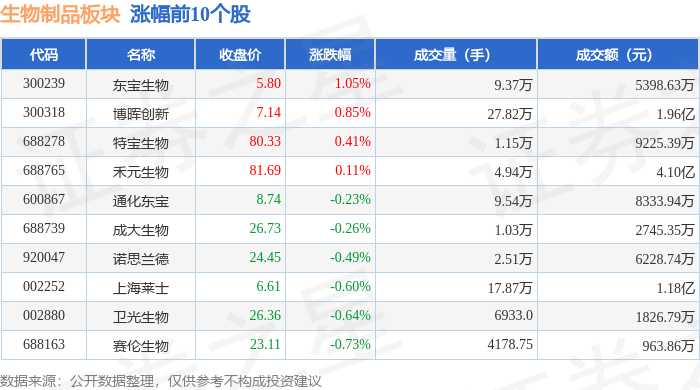
生物制品板块12月2日跌1.72%,奥浦迈领跌,主力资金净流出4.56亿元
Zheng Xing Xing Ye Ri Bao· 2025-12-02 09:03
Market Overview - The biopharmaceutical sector experienced a decline of 1.72% on December 2, with Aopumai leading the drop [1] - The Shanghai Composite Index closed at 3897.71, down 0.42%, while the Shenzhen Component Index closed at 13056.7, down 0.68% [1] Individual Stock Performance - Dongbao Bio (300239) closed at 5.80, up 1.05% with a trading volume of 93,700 shares and a transaction value of 53.99 million yuan [1] - Aopumai (688293) saw a significant drop of 8.01%, closing at 50.32 with a trading volume of 33,400 shares and a transaction value of 171 million yuan [2] - Other notable declines included Kanghong Pharmaceutical (002773) down 3.78% and Watson Bio (300142) down 3.17% [2] Capital Flow Analysis - The biopharmaceutical sector experienced a net outflow of 456 million yuan from institutional investors, while retail investors saw a net inflow of 270 million yuan [2] - Notable stocks with significant capital inflows included He Yuan Bio (688765) with a net inflow of 17.69 million yuan from institutional investors [3] - Conversely, stocks like Rongchang Bio (688331) and Shenzhou Cell (688520) also saw mixed capital flows, indicating varied investor sentiment [3]


万泰生物跌2.04%,成交额8056.05万元,主力资金净流出859.72万元
Xin Lang Zheng Quan· 2025-12-02 03:01
Core Viewpoint - Wante Bio's stock has experienced a significant decline in 2023, with a year-to-date drop of 31.81% and a recent 20-day decline of 13.58% [2] Company Overview - Wante Bio, established on April 24, 1991, and listed on April 29, 2020, is located in Changping District, Beijing. The company specializes in the research, production, and sales of in vitro diagnostic reagents, instruments, and vaccines [2] - The revenue composition of Wante Bio includes: diagnostic reagents (67.06%), vaccines (20.36%), diagnostic instruments (4.98%), agency products (4.97%), other (1.88%), and active raw materials (0.76%) [2] - As of September 30, 2025, Wante Bio had 42,000 shareholders, an increase of 9.41% from the previous period, with an average of 30,124 circulating shares per shareholder, a decrease of 8.60% [2] Financial Performance - For the period from January to September 2025, Wante Bio reported a revenue of 1.498 billion yuan, a year-on-year decrease of 23.09%, and a net profit attributable to shareholders of -173 million yuan, a year-on-year decrease of 165.04% [2] - Since its A-share listing, Wante Bio has distributed a total of 1.541 billion yuan in dividends, with 1.311 billion yuan distributed over the past three years [3] Shareholder Structure - As of September 30, 2025, the top ten circulating shareholders of Wante Bio include Hong Kong Central Clearing Limited, which holds 12.8991 million shares (a decrease of 9.8553 million shares), and Huatai-PB CSI 300 ETF, holding 6.4061 million shares (a decrease of 318,300 shares) [3] - The newly entered shareholder in the top ten is the China National Securities Biomedicine Index A, holding 4.9609 million shares [3]
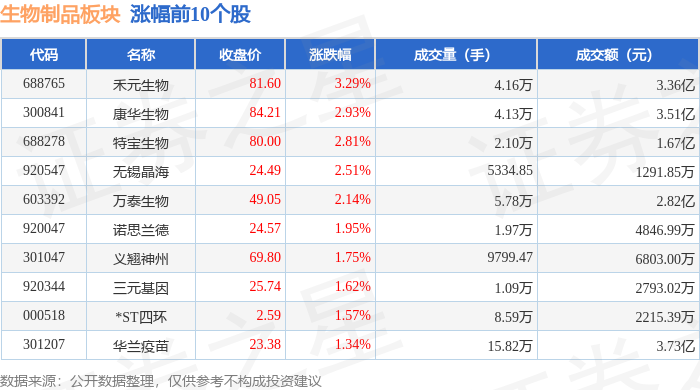
生物制品板块12月1日涨0.23%,禾元生物领涨,主力资金净流出2.73亿元
Zheng Xing Xing Ye Ri Bao· 2025-12-01 09:09
Core Viewpoint - The biopharmaceutical sector experienced a slight increase of 0.23% on December 1, with He Yuan Bio leading the gains. The Shanghai Composite Index rose by 0.65%, while the Shenzhen Component Index increased by 1.25% [1]. Group 1: Market Performance - The biopharmaceutical sector's performance on December 1 showed a mixed trend, with notable gainers including He Yuan Bio, which closed at 81.60 with a rise of 3.29%, and Kanghua Bio, which closed at 84.21 with a rise of 2.93% [1]. - The overall trading volume in the biopharmaceutical sector was significant, with He Yuan Bio achieving a transaction amount of 336 million yuan and Kanghua Bio reaching 351 million yuan [1]. Group 2: Individual Stock Performance - The table of individual stock performance indicates that several companies in the biopharmaceutical sector saw positive price movements, with Te Bao Bio and Wu Xi Jing Hai also recording increases of 2.81% and 2.51%, respectively [1]. - Conversely, some companies faced declines, such as Rong Chang Bio, which fell by 4.47%, and Bai Pu Sai Si, which decreased by 3.65% [2]. Group 3: Capital Flow - The biopharmaceutical sector experienced a net outflow of 273 million yuan from institutional investors, while retail investors contributed a net inflow of 178 million yuan [2]. - The capital flow data highlights that He Yuan Bio attracted a net inflow of 51.47 million yuan from institutional investors, despite a net outflow from retail investors [3].

万泰生物涨2.14%,成交额1.06亿元,主力资金净流出315.83万元
Xin Lang Cai Jing· 2025-12-01 02:55
Core Viewpoint - Wante Bio's stock has experienced a significant decline this year, with a 30.39% drop, and the company is facing challenges in revenue and profit margins [1][2]. Financial Performance - For the period from January to September 2025, Wante Bio reported a revenue of 1.498 billion yuan, a year-on-year decrease of 23.09% [2]. - The net profit attributable to the parent company was -173 million yuan, reflecting a year-on-year decrease of 165.04% [2]. Stock Market Activity - As of December 1, Wante Bio's stock price was 49.05 yuan per share, with a market capitalization of 62.054 billion yuan [1]. - The stock has seen a trading volume of 1.06 billion yuan, with a turnover rate of 0.17% [1]. - The stock has experienced a decline of 4.76% over the last five trading days and 11.21% over the last 20 days [1]. Shareholder Information - As of September 30, 2025, the number of shareholders increased to 42,000, a rise of 9.41% [2]. - The average number of circulating shares per shareholder decreased by 8.60% to 30,124 shares [2]. Dividend Distribution - Wante Bio has distributed a total of 1.541 billion yuan in dividends since its A-share listing, with 1.311 billion yuan distributed over the past three years [3]. Institutional Holdings - As of September 30, 2025, Hong Kong Central Clearing Limited was the fifth-largest circulating shareholder, holding 12.8991 million shares, a decrease of 9.8553 million shares from the previous period [3]. - The top ten circulating shareholders included new entrants and exits, indicating changes in institutional interest [3].