
南山智尚

Search documents
南山智尚股价涨5.12%,东方阿尔法基金旗下1只基金重仓,持有212.65万股浮盈赚取250.93万元
Xin Lang Cai Jing· 2025-09-10 05:17
Group 1 - Nanshan Zhishang's stock price increased by 5.12% on September 10, reaching 24.22 CNY per share, with a trading volume of 406 million CNY and a turnover rate of 4.02%, resulting in a total market capitalization of 12.259 billion CNY [1] - The stock has risen for three consecutive days, with a cumulative increase of 12.67% during this period [1] - Nanshan Zhishang, established on April 29, 2007, and listed on December 22, 2020, is primarily engaged in the production and sale of fabrics and clothing, with revenue composition as follows: 46.70% from fine woolen fabrics, 29.83% from clothing, 12.04% from ultra-fine fibers, 9.94% from nylon fibers, and 1.50% from other sources [1] Group 2 - The Oriental Alpha Fund holds a significant position in Nanshan Zhishang, with the Oriental Alpha Selected Mixed A Fund (007518) owning 2.1265 million shares, accounting for 4.52% of the fund's net value, making it the second-largest holding [2] - The fund has realized a floating profit of approximately 2.5093 million CNY today and a total of 5.5077 million CNY during the three-day increase [2] - The Oriental Alpha Selected Mixed A Fund was established on September 12, 2019, with a current size of 101 million CNY, achieving a year-to-date return of 55.89% and a one-year return of 101.12% [2] Group 3 - The fund manager of the Oriental Alpha Selected Mixed A Fund is Zhou Mi, who has been in the position for 7 years and 192 days, managing total assets of 1.563 billion CNY [3] - During his tenure, the best fund return achieved was 112.22%, while the worst return was 6.73% [3]
灵巧手:赛道蓝海可期,各类新技术百花齐放
2025-09-09 14:53
Summary of Key Points from the Conference Call Industry Overview - The conference call discusses the humanoid robot industry, focusing on the development and technology of dexterous hands, which are crucial for precise operations in humanoid robots [1][2][3]. Core Technologies and Trends - **Drive Modules**: The main drive technologies include hydraulic, motor, pneumatic, and shape memory alloy drives. Motor drives are favored due to their cost-effectiveness and technical advantages, with hollow cup motors being seen as the ideal choice for the future due to their efficiency and low noise [1][3][4]. - **Reduction Modules**: These modules increase motor torque and include harmonic reducers, planetary reducers, and RV reducers. Harmonic reducers are considered the mainstream choice due to their compact size and high load capacity, while Japanese manufacturers currently dominate the market [5]. - **Sensor Modules**: These are critical for assessing the usability of humanoid robots, affecting operational flexibility, load efficiency, and interaction safety. The international market is led by Japanese and European manufacturers, but domestic companies are gradually improving their capabilities [6][7]. Market Dynamics - The market for various components is projected to grow significantly over the next three years, with expected market sizes of 13.1 billion, 2.5 billion, 2.5 billion, and 16.3 billion for drive modules, reduction modules, transmission modules, and sensor modules, respectively. The overall compound annual growth rate (CAGR) is anticipated to reach 110% [3][13]. - **Hollow Cup Motors**: European suppliers currently lead in this segment, but domestic companies like Mingzhi Electric and Dingzhi Technology are emerging with competitive advantages in cost and efficiency [8]. - **Tactile Sensors**: The dominant technology is resistive sensors due to their maturity, low cost, and high sensitivity. The six-dimensional torque sensor market is primarily led by overseas companies, but domestic firms are beginning to emerge [9][10]. Competitive Landscape - The dexterous hand industry is still in its early stages, with three main player categories: self-research entities, new entrants, and component extension players. Each category has opportunities for growth and differentiation [14]. - Tesla's humanoid robot is expected to lead the market with large-scale production planned for 2025, which could significantly impact the industry and create opportunities for domestic suppliers [15]. Investment Opportunities - Companies such as Longsheng Technology, Qiangjing Technology, Wuzhou Xinchun, Nanshan Zhishang, Hengshuai Co., and Guangyang Co. are highlighted as potential investment targets due to their strengths in specific segments of the humanoid robot supply chain [15]. Additional Insights - The industry is witnessing trends such as increased dexterity in dexterous hands, expansion of micro-screw applications, the emergence of electronic skin technologies, and the promising application of PEEK materials in lightweight humanoid robots [11][12].

南山智尚股价涨5.35%,长城基金旗下1只基金重仓,持有24.62万股浮盈赚取29.54万元
Xin Lang Cai Jing· 2025-09-09 04:18
Group 1 - Nanshan Zhishang's stock price increased by 5.35% to 23.63 CNY per share, with a trading volume of 364 million CNY and a turnover rate of 3.68%, resulting in a total market capitalization of 11.96 billion CNY [1] - Nanshan Zhishang Technology Co., Ltd. is located in Yantai, Shandong Province, established on April 29, 2007, and listed on December 22, 2020, primarily engaged in the production and sales of fabrics and clothing, with 100% of its revenue coming from the textile industry [1] Group 2 - Changcheng Fund holds a significant position in Nanshan Zhishang through its fund Changcheng New Emerging Industries Mixed A (000976), which held 246,200 shares in the second quarter, accounting for 5.17% of the fund's net value, ranking as the seventh-largest holding [2] - The fund has achieved a year-to-date return of 26.23%, ranking 2827 out of 8179 in its category, and a one-year return of 51.4%, ranking 2570 out of 7984 [2] - The fund manager, Liu Jiang, has been in position for 6 years and 155 days, with a total fund asset size of 125 million CNY, achieving a best return of 134.79% and a worst return of 20.09% during his tenure [2]
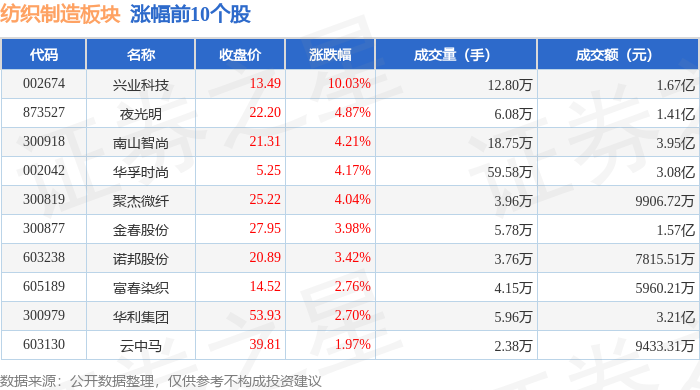
纺织制造板块9月5日涨1.86%,兴业科技领涨,主力资金净流入3775.87万元
Zheng Xing Xing Ye Ri Bao· 2025-09-05 08:56
Market Performance - The textile manufacturing sector increased by 1.86% on September 5, with Xingye Technology leading the gains [1] - The Shanghai Composite Index closed at 3812.51, up 1.24%, while the Shenzhen Component Index closed at 12590.56, up 3.89% [1] Key Stocks in Textile Manufacturing - Xingye Technology (002674) closed at 13.49, up 10.03% with a trading volume of 128,000 shares and a turnover of 167 million yuan [1] - Yeguangming (873527) closed at 22.20, up 4.87% with a trading volume of 60,800 shares and a turnover of 141 million yuan [1] - Nanshan Zhishang (300918) closed at 21.31, up 4.21% with a trading volume of 187,500 shares and a turnover of 39.5 million yuan [1] - Huazhong Fashion (002042) closed at 5.25, up 4.17% with a trading volume of 595,800 shares and a turnover of 308 million yuan [1] Capital Flow Analysis - The textile manufacturing sector saw a net inflow of 37.76 million yuan from institutional investors, while retail investors experienced a net outflow of 13.20 million yuan [2] - The main stocks with significant net inflows included Huazhong Fashion (2885.24 million yuan) and Xingye Technology (2417.08 million yuan) [3] Individual Stock Performance - Huazhong Fashion had a net inflow of 2885.24 million yuan, accounting for 9.37% of the total [3] - Xingye Technology experienced a net inflow of 2417.08 million yuan, representing 14.46% of the total [3] - Jin Chun Co. (300877) had a net inflow of 1786.58 million yuan, making up 11.36% of the total [3]


特斯拉强化机器人战略地位,26年有望放量 | 投研报告
Zhong Guo Neng Yuan Wang· 2025-09-05 01:24
Core Viewpoint - Tesla's CEO Elon Musk emphasized that the scaling of FSD (Full Self-Driving) and Optimus robots is crucial for the company's future, with approximately 80% of Tesla's value expected to come from Optimus robots [1][3]. Group 1: Strategic Importance of Humanoid Robots - The strategic position of humanoid robots within Tesla's business model has been significantly enhanced, indicating their potential as a new growth engine for the company [3]. - The technology for humanoid robots is rapidly evolving, moving from diverse solutions to more concentrated approaches, with significant breakthroughs anticipated in the capabilities of the third-generation robots [3]. Group 2: Market Outlook and Projections - By 2026, humanoid robots are expected to see substantial market penetration, with design upgrades and data accumulation ongoing until the end of 2025, leading to a rise in sales as the industry matures [3]. - As the supply chain for humanoid robots matures, prices are expected to decrease, enhancing the certainty of the market structure [3]. Group 3: Investment Opportunities - Investment opportunities in the robotics supply chain are highlighted, including companies involved in the core robot body, actuators, sensors, reducers, universal joints, and tendons [4].

2025年1-7月纺织业企业有21281个,同比增长1.75%
Chan Ye Xin Xi Wang· 2025-09-05 01:23
Core Viewpoint - The textile industry in China is experiencing growth, with an increase in the number of enterprises and a positive outlook for the future [1] Industry Summary - As of January to July 2025, the number of textile enterprises reached 21,281, marking an increase of 366 enterprises compared to the same period last year, representing a year-on-year growth of 1.75% [1] - The textile industry accounts for 4.09% of the total industrial enterprises in China [1] - The data indicates a steady expansion in the textile sector, reflecting its resilience and potential for investment [1] Company Summary - The report mentions several listed companies in the textile sector, including Lutai A (000726), Huamao Co., Ltd. (000850), Xinlong Holdings (000955), Weixing Co., Ltd. (002003), Huafu Fashion (002042), Nanshan Zhishang (300918), Huali Group (300979), Wanshili (301066), Huasheng Co., Ltd. (600156), Yingfeng Co., Ltd. (605055), Huasheng Technology (605180), and Fuchun Dyeing and Weaving (605189) [1]

特斯拉强化机器人战略地位,26年有望放量
Xinda Securities· 2025-09-04 13:30
Investment Rating - The industry investment rating is "Positive" [2] Core Insights - Tesla has elevated the strategic position of humanoid robots, with CEO Elon Musk stating that approximately 80% of the company's future value will come from the Optimus robot, highlighting its potential as a new growth engine for Tesla [2][3] - The technology for humanoid robots is rapidly evolving, moving from diverse solutions to more concentrated approaches, with significant breakthroughs expected in the capabilities of the third-generation robots [3] - By 2026, humanoid robots are anticipated to enter a phase of significant volume production, with the industry expected to see an increase in sales as supply chains mature and prices decrease [3] Summary by Sections Industry Overview - The report discusses Tesla's "Master Plan Part 4," emphasizing the importance of scaling FSD and Optimus robots as key future initiatives [2] Technology Development - The third-generation humanoid robots are expected to excel in coordination and complex task execution, with capabilities such as folding clothes and childcare [3] Market Outlook - The humanoid robot market is projected to begin a sales increase by the end of 2025, with a focus on design upgrades and data accumulation leading to a more concentrated supply chain [3] Investment Opportunities - Investment opportunities in the robot industry chain include companies such as UBTECH and Xinjian for the robots themselves, and various suppliers for actuators, sensors, reducers, universal joints, and tendons [4]
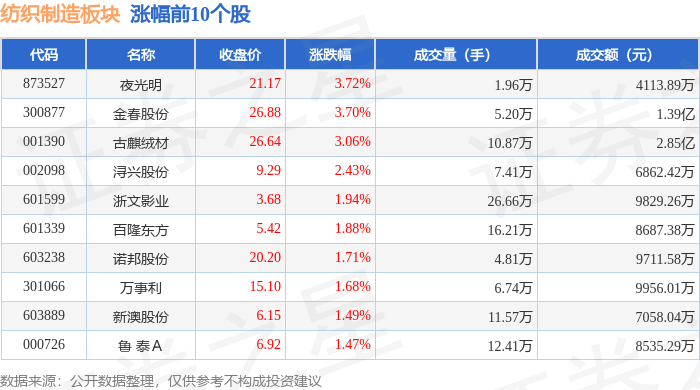
纺织制造板块9月4日涨0.19%,夜光明领涨,主力资金净流出1.79亿元
Zheng Xing Xing Ye Ri Bao· 2025-09-04 08:50
Market Overview - The textile manufacturing sector rose by 0.19% on September 4, while the Shanghai Composite Index fell by 1.25% to close at 3765.88 [1] - The Shenzhen Component Index decreased by 2.83% to close at 12118.7 [1] Top Performers - Night Light (夜光明) led the gains with a closing price of 21.17, up by 3.72% with a trading volume of 19,600 lots and a transaction value of 41.14 million [1] - Jin Chun Co., Ltd. (金春股份) followed closely with a closing price of 26.88, up by 3.70% and a trading volume of 52,000 lots, totaling a transaction value of 139 million [1] - Gu Mo Rong Material (古膜绒材) also performed well, closing at 26.64, up by 3.06% with a trading volume of 108,700 lots and a transaction value of 285 million [1] Underperformers - Yingfeng Co., Ltd. (迎丰股份) saw the largest decline, closing at 7.54, down by 9.59% with a trading volume of 331,100 lots and a transaction value of 252 million [2] - Nanshan Zhishang (南山智尚) decreased by 5.93%, closing at 20.45 with a trading volume of 199,800 lots and a transaction value of 425 million [2] - Ju Jie Microfiber (聚杰微纤) fell by 3.81%, closing at 24.24 with a trading volume of 40,700 lots and a transaction value of 102 million [2] Capital Flow - The textile manufacturing sector experienced a net outflow of 179 million from institutional investors, while retail investors saw a net inflow of 105 million [2] - Speculative funds had a net inflow of 73.85 million into the sector [2] Individual Stock Capital Flow - Gu Mo Rong Material (古膜绒材) had a net inflow of 8.63 million from institutional investors, while it faced a net outflow of 852.23 million from retail investors [3] - Jin Chun Co., Ltd. (金春股份) saw a net inflow of 6.17 million from institutional investors but a net outflow of 626.66 million from retail investors [3] - Notably, Nobon Co., Ltd. (诺邦股份) had a net inflow of 15.52 million from institutional investors, but retail investors experienced a net outflow of 1.50 million [3]


印尼发生暴乱对橡胶影响几何
Bao Cheng Qi Huo· 2025-09-03 10:35
Report Industry Investment Rating No relevant content provided. Core Viewpoints - Affected by the conflict in Indonesia, the supply expectation of rubber has been disturbed. The market is worried that the rubber production and export of the world's second-largest rubber-producing country may decline due to the riots. Supported by bullish factors, China's rubber futures showed a volatile and stable trend this week. It is expected that China's rubber futures may maintain a volatile and stable trend in the future [5][11]. - Although the main rubber-producing areas in Indonesia are not directly damaged at present, the riots have posed potential threats to its industrial chain through multiple channels such as labor, logistics, and policy confidence. In the short term, production may fluctuate, and export delivery faces a risk of delay; in the long term, it depends on whether the government can effectively resolve social conflicts and rebuild governance credibility. If the situation continues to be turbulent, Indonesia's position in the global natural rubber market may be challenged [6][29]. Summary by Directory 1. Market Review - The spot price oscillated and rebounded, and the basis widened [1]. - The futures price rose, and the monthly spread turned to premium [1]. 2. Rubber Market Supply and Demand - The rubber production of producing countries has steadily recovered, increasing the supply pressure [5]. - The tire operating rate has slightly recovered [5]. - The sales volume of the automobile market has significantly improved [5]. - The inventory of the Shanghai Futures Exchange has recovered, and the inventory in the Qingdao Free Trade Zone has increased [5]. 3. Preface - In late August 2025, large-scale demonstrations broke out in multiple cities in Indonesia, causing casualties. The trigger was the high housing subsidies for members of parliament approved by the Indonesian Congress and a series of controversial remarks made by the members. The turmoil in Indonesia may have a profound impact on the rubber supply and export pattern [10]. 4. Supply Expectation Disturbance and Rubber Volatility Stabilization - Since September, affected by the conflict in Indonesia, the supply expectation of rubber has been disturbed. The market is worried that the rubber production and export may decline. Supported by bullish factors, China's rubber futures showed a volatile and stable trend. The Shanghai rubber futures 2601 contract traded in the range of 15,720 - 16,135 yuan/ton, and the standard rubber futures 2511 contract traded in the range of 12,605 - 12,935 yuan/ton. It is expected that China's rubber futures may maintain a volatile and stable trend in the future [11]. 5. Root Causes of the Riots in Indonesia - The root causes of the large-scale protests in Indonesia are economic inequality, policy conflicts, and the failure of democratic reform. The riots have caused serious consequences, including traffic paralysis, arrests, arson, and a decline in the stock market [20][21]. 6. Indonesia as an Important Rubber-Producing Country - Indonesia is the world's second-largest natural rubber producer. Its rubber plantations are mainly concentrated in Sumatra and Kalimantan. Sumatra features large-scale and intensive production, while Kalimantan is in the stage of scattered small farmers with great potential for future production increase [22]. 7. Impact of the Riots on Rubber Production and Export in Indonesia - The El Niño phenomenon in 2024 had a negative impact on Indonesia's rubber production. In 2024, the total rubber production was 2.3443 million tons, a year-on-year decrease of 758,000 tons, a decline of 24.43%. From January to June 2025, the total rubber production was 1.1761 million tons, a year-on-year decrease of 73,800 tons, a decline of 5.90%. From January to June 2025, the total export volume of natural rubber was 892,000 tons, a year-on-year increase of 108,500 tons, an increase of 13.85%. If the riots continue, rubber production and export may further decline, and international rubber prices may rise [25]. - The riots may affect rubber production through labor shortages and logistics disruptions, impact exports through port operations and supply chain stability, and shake policy confidence and foreign investment [26][27]. 8. Conclusion - Although the main rubber-producing areas in Indonesia are not directly damaged at present, the riots have posed potential threats to its industrial chain. In the short term, production may fluctuate, and export delivery faces a risk of delay; in the long term, it depends on whether the government can effectively resolve social conflicts and rebuild governance credibility. If the situation continues to be turbulent, Indonesia's position in the global natural rubber market may be challenged [6][29].
纺织服饰行业今日跌1.17% 主力资金净流入2.22亿元
Zheng Quan Shi Bao Wang· 2025-09-03 09:14
Market Overview - The Shanghai Composite Index fell by 1.16% on September 3, with only three sectors rising: comprehensive, communication, and electric equipment, which increased by 1.64%, 1.61%, and 1.44% respectively [1] - The sectors with the largest declines were defense and military industry, and non-bank financials, which dropped by 5.83% and 3.05% respectively [1] Capital Flow Analysis - The main capital outflow from the two markets totaled 71.426 billion yuan, with only three sectors experiencing net inflows: electric equipment (2.958 billion yuan), textile and apparel (222 million yuan), and comprehensive (3.1066 million yuan) [1] - The non-bank financial sector had the largest net outflow, totaling 12.210 billion yuan, followed by the defense and military industry with a net outflow of 10.131 billion yuan [1] Textile and Apparel Sector Performance - The textile and apparel sector declined by 1.17%, with a net inflow of 222 million yuan. Out of 105 stocks in this sector, 24 rose, including three that hit the daily limit, while 79 fell [2] - The top three stocks with the highest net inflow were Meibang Fashion (205 million yuan), Wanlima (129 million yuan), and Tanshan (46.315 million yuan) [2] - The stocks with the largest net outflow included Jihua Group (78.477 million yuan), Nanshan Zhishang (46.579 million yuan), and China Gold (31.176 million yuan) [3]


