
平安人寿

Search documents
又一大型机构入场!险资系私募证券基金,增至6家!
券商中国· 2025-08-10 07:52
Core Viewpoint - The article discusses the recent approval of Taiping Asset's establishment of a private equity securities investment fund management company, marking a significant step in the long-term investment pilot program for insurance funds in China [2][4]. Group 1: Approval and Establishment - Taiping Asset, a subsidiary of China Taiping, has received approval from the National Financial Regulatory Administration to establish Taiping (Shenzhen) Private Securities Investment Fund Management Co., Ltd. [2][3] - This approval adds to the growing number of insurance-related private equity securities fund companies, with a total of six now approved [2][7]. Group 2: Long-term Investment Pilot Program - The long-term investment pilot program for insurance funds allows insurance companies to establish private equity securities funds primarily targeting the secondary market for stocks, with a focus on long-term holding [4]. - The pilot program has seen three batches of approvals, with the first batch in October 2023 involving China Life and Xinhua Insurance, each contributing 25 billion yuan to a total fund size of 50 billion yuan [4]. - The second batch included eight insurance companies with a total scale of 112 billion yuan, while the third batch amounted to 60 billion yuan [4]. Group 3: Impact on Capital Markets - The establishment of Taiping's private equity securities fund is expected to enhance the investment capacity of long-term funds in the capital market, with Taiping Asset managing over 1.5 trillion yuan in assets by the end of 2024 [5]. - The initiative aims to align with national strategies and support the real economy, reinforcing the role of insurance funds as stabilizers in the market [5]. Group 4: Current Fund Operations - Currently, six insurance-related private equity securities investment funds are operational, including various funds managed by Guofeng Xinghua, Taikang, and Taibao [8][9]. - The first pilot fund, managed by Guofeng Xinghua, began investing in March 2024, with a total scale of 50 billion yuan fully deployed by March of the same year [8]. - The ongoing pilot program is designed to optimize the asset-liability matching of insurance funds under new accounting standards, thereby improving capital efficiency [9].





险资年内完成22次举牌,银行、公用事业成重点布局方向
Sou Hu Cai Jing· 2025-08-09 18:09
Group 1 - The core viewpoint is that insurance capital has been increasingly active in the secondary market, with 22 instances of shareholding increases reported by the China Insurance Industry Association as of August 8, surpassing the total for the previous year [1] - The targeted sectors for increased holdings are concentrated in banking, public utilities, energy, transportation, and environmental protection, characterized by reasonable valuations, stable dividend returns, and high operational certainty [1][3] - Hongkang Life's recent purchase of Honghua Smart Energy H-shares, exceeding a 5% stake, exemplifies this trend [1] Group 2 - Public utilities have become a focal point for insurance companies, with Honghua Smart Energy being a recent example, projecting over HKD 21.3 billion in revenue for 2024, alongside improvements in net profit and earnings per share [3] - The banking sector is also a key area for insurance capital, with institutions like Ping An Life and Xinhua Insurance increasing their stakes in banks such as China Merchants Bank and Agricultural Bank of China, attracted by the high dividend yield and low valuation in the H-share market [3] - The frequency of shareholding increases and the number of participating insurance institutions have significantly risen this year, with multiple companies, including China Life and Ruizhong Life, disclosing shareholding announcements [3] Group 3 - In terms of fund utilization, some of the targeted shares are classified as FVOCI assets to smooth profit fluctuations, while others are included as long-term equity investments measured by the equity method [4] - The core logic behind these strategies is to secure high-dividend, low-volatility, and sustainably operating quality assets, enhancing the stability of insurance companies' investment portfolios [4] - This asset allocation approach is particularly beneficial in addressing the pressures on the asset side in a low-interest-rate environment [4]

今年险资举牌已达22次,重点盯上这些领域
2 1 Shi Ji Jing Ji Bao Dao· 2025-08-09 12:23
Core Insights - Insurance capital is increasingly active in equity markets, with 22 instances of shareholding increases reported this year [1][6] - The preference of insurance capital is for undervalued, low-volatility, high-dividend, and high-certainty performance assets [1][6] Group 1: Recent Shareholding Activities - Hongkang Life has acquired a 5% stake in Honghua Smart Energy, marking its first shareholding increase of the year [4][5] - Other insurance companies, such as Taikang Life, have also participated in shareholding increases, with Taikang investing $25 million in Fengcai Technology's IPO, representing 8.69% of the total shares issued [5][6] - A total of 11 insurance companies have disclosed 22 shareholding increase announcements, surpassing the total for the previous year [6][10] Group 2: Sector Preferences - The majority of insurance companies are focusing on energy, public utilities, and banking sectors, with 9 instances of shareholding increases in bank stocks this year [8][9] - The characteristics of bank stocks, such as low volatility, high dividends, and low valuations, continue to attract insurance capital [9][10] - The average dividend yield of stocks targeted for shareholding increases in 2024 is 4.6%, the highest in recent years, indicating a shift towards high-dividend investments [10] Group 3: Market Conditions and Strategies - The current market environment, characterized by declining risk-free interest rates, makes high-dividend stocks particularly appealing to insurance companies seeking stable returns [10] - Insurance companies are increasingly looking for long-term equity investments to secure stable investment returns, reflecting a strategic shift in their investment approach [10]
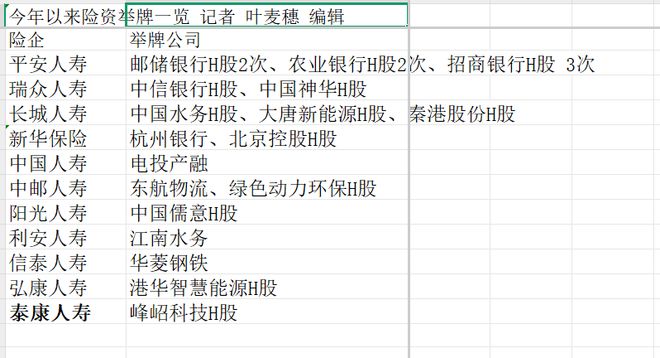
今年险资举牌已达22次,重点盯上这些领域
21世纪经济报道· 2025-08-09 12:14
编辑丨杨希 险资举牌越战越勇。 近日,弘康人寿通过港股通二级市场,买入港股上市公司港华智慧能源股票,持股比例达到5%,触发举 牌。 中国保险行业协会披露信息显示,今年以来,险资举牌已经达到22次。梳理举牌标的可以发现,险 资偏好较低估值、较低波动、较高分红、较高业绩确定性等资产。 | 今年以来险资举牌一览 记者 叶麦穗 编辑 | | | --- | --- | | 险企 | 举牌公司 | | 平安人寿 | 邮储银行H股2次、农业银行H股2次、招商银行H股 3次 | | 瑞众人寿 | 中信银行H股、中国神华H股 | | 长城人寿 | 中国水务H股、大唐新能源H股、秦港股份H股 | | 新华保险 | 杭州银行、北京控股H股 | | 中国人寿 | 电投产融 | | 中邮人寿 | 东航物流、绿色动力环保H股 | | 阳光人寿 | 中国儒意H股 | | 利安人寿 | 江南水务 | | 信泰人寿 | 华菱钢铁 | | 弘康人寿 | 港华智慧能源H股 | | 泰康人寿 | 峰昭科技H股 | 记者丨叶麦穗 弘康人寿今年首次举牌 8月7日,弘康人寿公告称,公司参与举牌港华智慧能源。弘康人寿表示,本次举牌前,公司直接持有港 华智 ...
华夏幸福(600340.SH):平安人寿与平安资管拟减持不超3%股份
智通财经网· 2025-08-08 11:34
Group 1 - The company, Huaxia Happiness (600340.SH), announced that it received a notice from Ping An Asset Management regarding a share reduction plan [1] - Ping An Life and Ping An Asset Management plan to reduce their holdings by no more than 117 million shares, which accounts for up to 3% of the company's total share capital [1]

华夏幸福:平安人寿与平安资管拟减持不超3%股份
Zhi Tong Cai Jing· 2025-08-08 11:25
华夏幸福(600340)(600340.SH)发布公告,近日,公司收到平安资管致送的《持股5%以上股东股份减 持计划告知函》,平安人寿与平安资管计划自公告披露之日起15个交易日后的3个月内,拟减持所持股 份不超过1.17亿股,占公司总股本比例不超过3%。 ...
华夏幸福(600340.SH):平安人寿与平安资管拟合计减持不超3%股份
Ge Long Hui A P P· 2025-08-08 11:12
格隆汇8月8日丨华夏幸福(600340.SH)公布,近日,公司收到平安资管致送的《持股5%以上股东股份减 持计划告知函》,平安人寿与平安资管计划自本公告披露之日起15个交易日后的3个月内,拟减持所持 股份不超过1.17亿股,占公司总股本比例不超过3%。其中,拟通过大宗交易方式进行减持的,在任意 连续90日内减持股份数量不超过公司总股本的2%;拟通过集中竞价交易方式进行减持的,在任意连续 90日内减持股份数量不超过公司总股本的1%。若减持计划期间公司有送股、资本公积金转增股本、配 股、回购注销等股份变动事项的,上述减持股份数量将相应调整。拟减持股份的价格区间视市场价格确 定。 ...
华夏幸福:平安人寿、平安资管拟合计减持公司不超3%股份
Zheng Quan Shi Bao Wang· 2025-08-08 11:05
人民财讯8月8日电,华夏幸福(600340)8月8日晚间公告,合计持股25.1865%的股东平安人寿及其一 致行动人平安资管计划15个交易日后的3个月内,减持所持公司股份不超过1.17亿股,占公司总股本比 例不超过3%。 ...
华夏幸福:平安人寿拟减持3%
Xin Lang Cai Jing· 2025-08-08 10:55
华夏幸福公告,平安人寿及一致行动人平安资管合计持股9.86亿股,占25.1865%,拟于2025年9月1日至 2025年11月30日期间减持不超过1.17亿股,即不超过3%;其中大宗交易不超过7827.44万股,集中竞价 不超过3913.72万股。 ...
政策双周报:买断式逆回购靠前操作,系列育儿补贴措施出台-20250808
Huachuang Securities· 2025-08-08 10:12
Report Industry Investment Rating No information provided in the content. Core Viewpoints of the Report - A series of policies have been introduced across various sectors, including macro - economic, fiscal, monetary, financial regulatory, real estate, and tariff policies, aiming to promote economic stability, adjust industry structures, and manage international trade relationships [1][2][3] - The focus is on implementing existing policies, with an emphasis on policy continuity and stability, while also promoting new initiatives to support emerging industries and address social issues such as population growth [11][12][13] Summary According to Relevant Catalogs 1. Macro - Tone - A package of parenting subsidies and fertility support measures have been introduced. From 2025, a parenting subsidy of 3,600 yuan per child per year will be provided until the child is 3 years old. Free preschool education for the last year in public kindergartens will start in the fall of 2025, benefiting about 12 million people this fall and increasing government expenditure by about 20 billion yuan [11][16] - The Politburo meeting emphasized policy continuity and stability, mainly focusing on implementing existing fiscal and monetary policies. The "moderately loose" monetary policy tone continues [12] - The list of "two - major" construction projects has been fully released. The third batch of 69 billion yuan for consumer goods trade - in has been issued, and the fourth batch of 69 billion yuan will be issued in October. New policy - based financial instruments are to be established and launched soon [13] 2. Fiscal Policy - Use a more proactive fiscal policy, establish a debt - service reserve fund system to prevent risks, and accelerate the issuance and use of government bonds [17] - Starting from August 8, 2025, VAT will be restored on the interest income of newly issued national, local, and financial bonds. Natural persons with a monthly quota of no more than 1 million yuan will enjoy a VAT exemption until the end of 2027 [18] - The Ministry of Finance reported six typical cases of local government implicit debt accountability, and some provinces have exited the high - risk area list [18][19] 3. Monetary Policy - Continue to implement a moderately loose monetary policy, coordinate treasury management and national debt issuance and redemption with the fiscal department [21] - Seven departments including the central bank jointly issued a document to support the improvement of science and technology finance efficiency, and support the cultivation of emerging industries and forward - looking layout of future industries [22] - In August, the 3 - month term buy - back repurchase was operated earlier, and a second 6 - month operation may occur in the middle of the month, reflecting the coordination between monetary and fiscal policies [23] 4. Financial Supervision - The maximum预定 interest rate of insurance products has been lowered. Ordinary insurance products decreased by 50BP to 2.0%, dividend - type insurance products decreased by 25BP to 1.75%, and universal insurance products decreased by 50BP to 1.0% [25] - The second batch of 12 new floating - rate funds have been approved, with the fee level linked to product returns [26] - Guotai Junan Asset Management initiated the absorption and merger of Haitong Asset Management [26] 5. Real Estate Policy - Coordinate to resolve real - estate enterprise bond default risks, improve real - estate financial macro - prudential management, and support the construction of a new real - estate development model [29] - Harbin increased the housing provident fund loan limit for "trade - in" home - buying families; Beijing strengthened support for multi - child families' housing; Kunming optimized the provident fund withdrawal policy [30] - Shanghai accelerated the "two - old and one - village" renovation, planning to start 25 village renovation projects this year. Some cities promoted the conversion of non - residential properties to rental housing [31][32] 6. Tariff Policy - The third round of Sino - US negotiations ended, and the 24% part of the US reciprocal tariffs and China's counter - measures will be extended for 90 days, reducing export uncertainties [34] - Trump signed an executive order to set "reciprocal tariffs" for multiple countries, with rates ranging from 10% to 41%, effective August 7 [35] - The US will impose a 50% tariff on imported semi - finished copper products and a 100% tariff on chips and semiconductors starting from August 1 and August 6 respectively [35]