沪农商行

Search documents
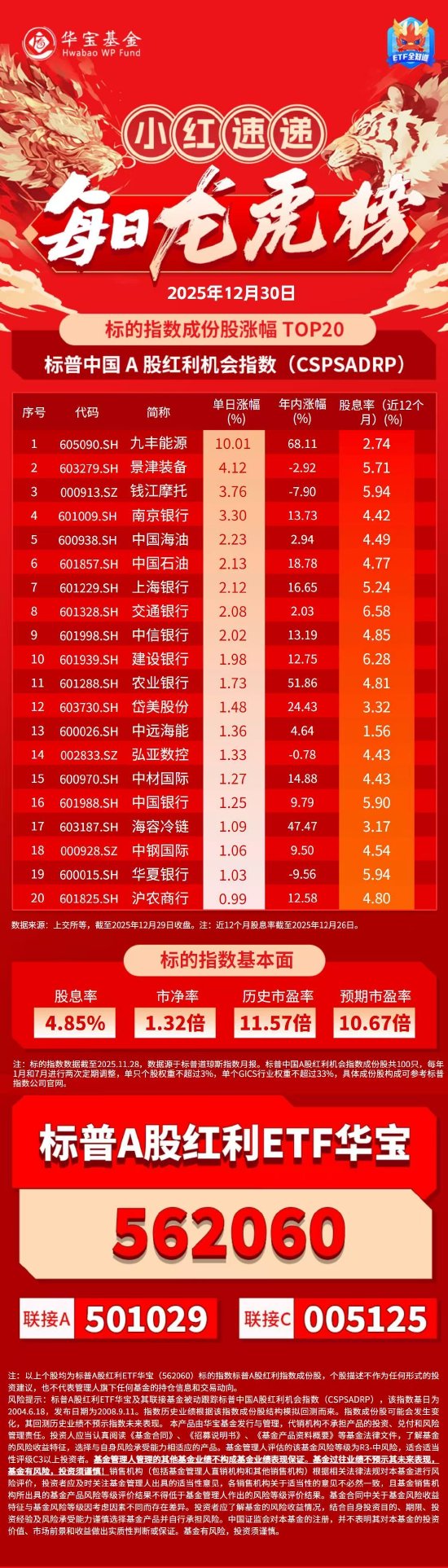
小红日报|银行石油板块携手抗震,标普A股红利ETF华宝(562060)标的指数收跌0.3%
Xin Lang Cai Jing· 2025-12-30 01:34
Group 1 - The article highlights the top 20 stocks in the S&P China A-Share Dividend Opportunity Index (CSPSADRP) based on their daily and year-to-date performance as of December 30, 2025 [1][5] - The top performer is Jiufeng Energy (605090.SH) with a daily increase of 10.01% and a year-to-date increase of 68.11%, along with a dividend yield of 2.74% [1][5] - Other notable stocks include Jiangsu Jingjin Environmental Protection (603279.SH) with a daily increase of 4.12% and a year-to-date decrease of 2.92%, and Qianjiang Motorcycle (000913.SZ) with a daily increase of 3.76% and a year-to-date decrease of 7.90% [1][5] Group 2 - The list includes several banks, with Agricultural Bank of China (601288.SH) showing a significant year-to-date increase of 51.86% and a daily increase of 1.73% [1][5] - China Petroleum (601857.SH) and Shanghai Bank (601229.SH) also performed well, with year-to-date increases of 18.78% and 16.65% respectively [1][5] - The data is sourced from the Shanghai Stock Exchange and reflects the closing prices as of December 29, 2025, with dividend yields calculated up to December 26, 2025 [1][5]






9家A股ESG强信披银行碳排同比上升|ESG热搜榜
2 1 Shi Ji Jing Ji Bao Dao· 2025-12-29 08:22
Group 1: Climate Disclosure Standards - The Ministry of Finance, along with nine other departments, issued the "Corporate Sustainable Disclosure Standard No. 1 - Climate (Trial)" on December 25, marking a significant step towards a unified sustainable disclosure standard system in China [1] - The "Climate Standard" is currently positioned as a trial document, with voluntary implementation by companies until specific requirements are established [1] - The Ministry of Finance plans to adopt a gradual approach to implementation, expanding from listed companies to non-listed companies, and from large enterprises to small and medium-sized enterprises [1] Group 2: ESG Disclosure in A-Share Banks - The list of A-share banks with strong ESG disclosure has expanded to 27, including 6 state-owned banks, 9 joint-stock banks, 10 city commercial banks, and 2 rural commercial banks [2] - Among the 27 banks, 16 reported a year-on-year decrease in carbon emissions, while 9 banks, including 1 state-owned bank and 6 city commercial banks, reported an increase in carbon emissions [2] Group 3: Carbon Emission Changes - The top five banks with the highest year-on-year increase in carbon emissions are Beijing Bank (13.88%), Nanjing Bank (13.23%), Qingdao Bank (11.92%), Chongqing Bank (10.96%), and Hangzhou Bank (10.02%) [3] - The top five banks with the most significant reductions in carbon emissions are Shanghai Rural Commercial Bank (34.52%), Bank of China (23.64%), China Construction Bank (20.65%), Chongqing Rural Commercial Bank (17.89%), and Jiangsu Bank (8.58%) [3] Group 4: Regulatory Actions on Companies - First Capital announced that its wholly-owned subsidiary was fined 12.7358 million yuan for failing to diligently supervise a convertible bond project [4] - Jinghua Pharmaceutical's subsidiary was fined 500,000 yuan for environmental pollution, but the impact on the company's net profit for 2025 is expected to be minimal [5] - Tianyi Medical received a notice of administrative penalty for not producing medical devices according to technical requirements, with a proposed fine of 8.7852 million yuan [6] Group 5: Energy ESG Index - The "National Energy Sustainable Development Index" was officially launched, achieving a cumulative return rate of 40% [7] - The index was developed by the China Energy Research Society and Shenzhen Securities Information Co., focusing on securities with high trading volumes and market capitalization [7] Group 6: Challenges in the Power Sector - Five thermal power companies have been included in the ESG mandatory disclosure category, facing their first ESG assessment in 2026 [8] - A report indicated that while the overall power structure shows a significant reliance on thermal power, the transition to non-fossil energy sources is lagging behind the national average [8]
9家A股ESG强信披银行碳排同比上升
2 1 Shi Ji Jing Ji Bao Dao· 2025-12-29 08:20
Group 1: Climate Disclosure Standards - The Ministry of Finance, along with nine other departments, issued the "Corporate Sustainable Disclosure Standard No. 1 - Climate (Trial)" on December 25, marking a significant step towards a unified sustainable disclosure standard system in China [1] - The "Climate Standard" is currently positioned as a trial document, with voluntary implementation by companies until specific requirements are established [1] - The Ministry of Finance plans to adopt a gradual approach to implementation, expanding from listed companies to non-listed companies, and from large enterprises to small and medium-sized enterprises [1] Group 2: ESG Disclosure in A-Share Banks - The A-share ESG strong disclosure list has expanded to 27 banks, including 6 state-owned banks, 9 joint-stock banks, 10 city commercial banks, and 2 rural commercial banks [2] - Among the 27 banks, 16 reported a year-on-year decrease in carbon emissions, while 9 banks, including 1 state-owned bank and 6 city commercial banks, reported an increase in carbon emissions [2] - The top five banks with the highest year-on-year increase in carbon emissions are Beijing Bank (13.88%), Nanjing Bank (13.23%), Qingdao Bank (11.92%), Chongqing Bank (10.96%), and Hangzhou Bank (10.02%) [3] Group 3: Regulatory Actions and Penalties - First Capital's subsidiary was fined 12.7358 million yuan for failing to diligently supervise a convertible bond project [4] - Jinghua Pharmaceutical's subsidiary was fined 500,000 yuan for environmental pollution, which is not expected to significantly impact the company's net profit for 2025 [5] - Tianyi Medical is facing a potential fine of 8.7852 million yuan for not producing medical devices according to registered technical requirements [6][7] Group 4: Energy Sector ESG Developments - The "National Energy Sustainable Development Index" was officially launched, achieving a cumulative return rate of 40% [8] - Five thermal power companies have been included in the ESG strong disclosure category, which will require them to improve ESG governance and reporting by 2026 [9] - A report evaluated the low-carbon transition performance of 33 thermal power companies, indicating significant disparities in transition progress and a slower development of non-fossil energy compared to national averages [9]



超半数上市银行完成中期分红,还有“红包”在路上
Huan Qiu Wang· 2025-12-28 01:34
Core Viewpoint - The mid-term dividend distribution among listed banks is progressing steadily, with half of the banks having completed their 2025 mid-year dividend payouts, characterized by an earlier distribution schedule and an increase in dividend rates [1] Group 1: State-owned Banks - The five major state-owned banks, including Industrial and Commercial Bank of China, Agricultural Bank of China, Bank of China, China Construction Bank, and Bank of Communications, successfully completed their mid-term dividend payouts in December, distributing a total of 189.885 billion yuan to shareholders [3] - Bank of Communications announced a cash dividend of 0.1563 yuan per share (including tax) on December 25, totaling 13.811 billion yuan [3] - Industrial and Commercial Bank of China and Agricultural Bank of China initiated their mid-term dividends on December 15, with Industrial Bank distributing 0.1414 yuan per share (approximately 50.396 billion yuan) and Agricultural Bank distributing 0.1195 yuan per share (approximately 41.823 billion yuan) [3] - China Construction Bank and Bank of China completed their payouts on December 11, with China Construction Bank distributing 0.1858 yuan per share (approximately 48.605 billion yuan) and Bank of China distributing 0.1094 yuan per share (approximately 35.250 billion yuan) [3] Group 2: Joint-stock and City Commercial Banks - Among the A-share joint-stock banks that have implemented mid-term dividends, CITIC Bank, Minsheng Bank, and Ping An Bank completed their payouts in August 2025, with total cash dividends of 10.461 billion yuan, 5.954 billion yuan, and 4.580 billion yuan respectively [4] - Additionally, 13 A-share listed city commercial banks and rural commercial banks completed their mid-term dividends for 2025, including Shanghai Bank and Nanjing Bank, with a total distribution exceeding 18.5 billion yuan [4] - According to Guotai Junan Securities, the dividend rates for most banks that have disclosed their plans for 2025 mid-term dividends are consistent with those of 2024, while six banks, including Suzhou, Minsheng, Shanghai, Hangzhou, Huaxia, and CITIC, have increased their rates by 0.9 to 4.5 percentage points compared to 2024 [4] Group 3: Upcoming Dividend Plans - Postal Savings Bank plans to distribute 1.230 yuan (including tax) for every 10 ordinary shares, totaling approximately 14.8 billion yuan [4] - Industrial Bank intends to distribute 5.65 yuan (including tax) for every 10 shares, amounting to 11.957 billion yuan [4] - China Merchants Bank has confirmed that its mid-term cash dividend distribution will occur between January and February 2026, with a distribution ratio of 35% [4]




太豪爽!中期分红近2300亿元,A股半数上市银行发“红包”
券商中国· 2025-12-27 07:17
Core Viewpoint - The article discusses the recent trend of mid-term dividends among listed banks in China, highlighting the significant cash distributions made by state-owned banks and the increasing participation of smaller banks in dividend payouts [1][2][3]. Group 1: Mid-term Dividends Overview - As of December 26, 21 A-share listed banks have implemented mid-term dividends, totaling nearly 230 billion yuan, with an observed trend of earlier dividend announcements and increased payout ratios [2]. - State-owned banks are the primary contributors to mid-term dividends, with five major banks distributing a total of approximately 189.89 billion yuan in cash dividends [3]. - The Agricultural Bank of China and Industrial and Commercial Bank of China led the mid-term dividend payouts, with 41.82 billion yuan and 50.40 billion yuan respectively [3]. Group 2: Participation of Smaller Banks - More small and medium-sized banks are joining the mid-term dividend trend, with 13 local listed banks announcing their plans, collectively distributing over 18.5 billion yuan [6]. - Qilu Bank and Zijin Bank have recently disclosed their mid-term dividend plans, with Qilu Bank proposing a payout of 0.121 yuan per share, totaling 745 million yuan [6]. - The trend indicates that many banks are maintaining or increasing their dividend payout ratios compared to the previous year, with some banks showing increases of 0.9% to 4.5% [6]. Group 3: Future Dividend Plans - Postal Savings Bank has outlined a clear plan for mid-term dividends, proposing a payout of 1.23 yuan per 10 shares, amounting to approximately 14.8 billion yuan, which represents 30% of its net profit [4]. - China Merchants Bank has indicated that its mid-term cash dividend distribution will occur between January and February 2026, with a proposed payout ratio of 35% [6]. - Several other banks, including Industrial Bank and Everbright Bank, have also announced their mid-term dividend plans, with payout ratios exceeding 25% [5].


信用卡App逐步关停!银行线上渠道加速整合
Guo Ji Jin Rong Bao· 2025-12-27 01:25
Core Viewpoint - The trend of integrating credit card apps into main banking apps is gaining momentum among Chinese banks, with Postal Savings Bank being the second state-owned bank to announce the closure of its independent credit card app, following Bank of China [1][3][4]. Group 1: Bank Actions - Postal Savings Bank announced the integration of its "Postal Credit Card App" services into the "Postal Bank App," ceasing the use of the independent app [3]. - Bank of China previously announced a similar move, planning to migrate services from its "Bountiful Life" app to the main "Bank of China" app [3]. - Over the past two years, more than ten banks, including Beijing Rural Commercial Bank and Shanghai Rural Commercial Bank, have also closed or merged their credit card app services [3]. Group 2: Market Trends - Experts indicate that the closure of independent credit card apps reflects a broader trend in the banking industry aimed at reducing costs and improving efficiency [4][8]. - The integration of apps is seen as a response to the declining profitability and operational costs associated with maintaining separate credit card apps [4][8]. - The digital transformation in banking is shifting focus from standalone functionalities to a more integrated and user-friendly experience through main banking apps [6]. Group 3: Strategic Considerations - Different types of banks have varying motivations for app integration; state-owned banks focus on creating a unified ecosystem, while joint-stock banks aim for differentiated competitive advantages [7]. - Smaller banks prioritize efficiency and survival, using app integration primarily to reduce costs and enhance local service offerings [7]. - The operational burden of maintaining multiple apps, including development and maintenance costs, is a significant factor driving this trend [8]. Group 4: Future Outlook - The future of credit card services may not be limited to main banking apps, as new service formats like mini-programs and embedded lifestyle platforms could emerge [8]. - Banks are encouraged to strengthen their "one bank" digital strategy, enhancing online integration based on business characteristics and user preferences to improve user experience [8].

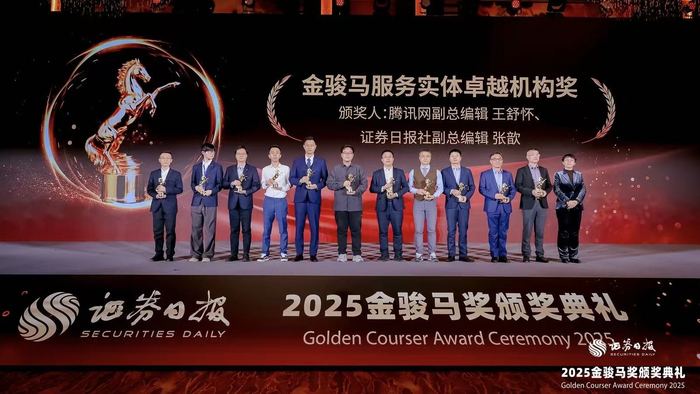
2025年度金骏马服务实体卓越机构奖
Zheng Quan Ri Bao Zhi Sheng· 2025-12-26 14:46
国泰海通 五矿证券 光大银行 华夏银行 建设银行 厦门银行 华龙证券 财达证券 国联民生 中金公司 人保资产 五矿信托 昆仑信托 中泰证券 山西证券 陕国投A 沪农商行 浦发银行 陆金所控股 宁波银行 重庆银行 ...
中国银行业协会发布《中国银行业中间业务发展报告暨创新案例选编》
Xin Lang Cai Jing· 2025-12-26 12:21
Core Viewpoint - The report highlights the trends, characteristics, significant changes, and achievements in the development of intermediary business in China's banking sector, while also analyzing the challenges faced and forecasting future directions [1][5] Group 1: Service National Strategy and Improve Service Quality - Due to factors such as slowing economic growth and policy interest rate cuts, commercial banks are experiencing a continuous narrowing of net interest margins, necessitating a shift towards intermediary business with lighter capital and assets [2][6] - Commercial banks are actively serving key sectors like advanced manufacturing, strategic emerging industries, and the elderly care industry, while enhancing product innovation and accelerating business transformation [2][6] - The implementation of fee reduction policies aims to improve financial service quality and optimize customer financial experiences, thereby supporting high-quality economic development [2][6] Group 2: Strengthen Management Capabilities and Solidify Operational Foundation - Intermediary business is crucial for commercial banks to serve the real economy and promote their own high-quality development [7] - In the context of narrowing net interest margins and tightening capital constraints, banks are enhancing refined management and professional capabilities to achieve cost reduction and efficiency improvement [7] - The report emphasizes the need for product and service innovation, building a versatile talent pool, deepening technological empowerment, and strengthening compliance management to enhance value creation capabilities [7] Group 3: Learn from International Experience to Promote Transformation and Upgrading - The report reviews the overall development and structural characteristics of intermediary business in European and American banks over the past three years, comparing income structure, product service innovation, and management models [3][7] - By integrating China's national conditions and policy guidance, the report suggests adopting mature practices from international banks in terms of management philosophy, operational models, and technological innovation to facilitate the transformation and upgrading of intermediary business in China [3][7] Group 4: Select Excellent Cases to Showcase Good Practices - The report selects exemplary cases of intermediary business product innovation from various banks, including the China Development Bank, Agricultural Development Bank of China, and others, showcasing innovation models, service effectiveness, significance, and specific application scenarios [4][7] - This selection aims to demonstrate the innovative development of intermediary business in commercial banks and the effective practices in addressing key issues [4][7]
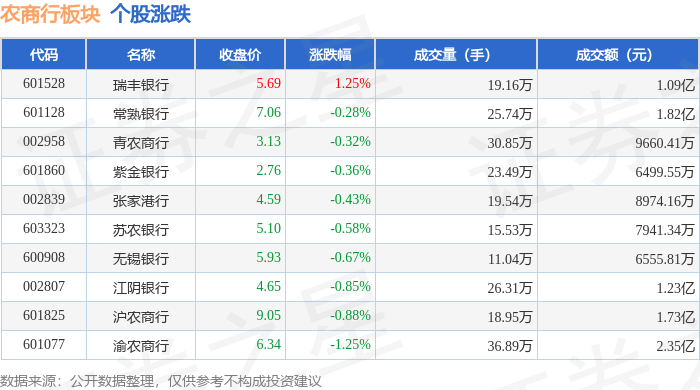
农商行板块12月26日跌0.72%,渝农商行领跌,主力资金净流出6353.1万元
Zheng Xing Xing Ye Ri Bao· 2025-12-26 09:07
Core Viewpoint - The rural commercial bank sector experienced a decline of 0.72% on December 26, with Yunnan Rural Commercial Bank leading the drop [1] Market Performance - The Shanghai Composite Index closed at 3963.68, up 0.1% - The Shenzhen Component Index closed at 13603.89, up 0.54% [1] Individual Stock Performance - 瑞丰银行 (Rui Feng Bank) closed at 5.69, up 1.25% with a trading volume of 191,600 shares and a transaction value of 1.09 billion - 常熟银行 (Changshu Bank) closed at 7.06, down 0.28% with a trading volume of 257,400 shares and a transaction value of 182 million - 青农商行 (Qingnong Bank) closed at 3.13, down 0.32% with a trading volume of 308,500 shares and a transaction value of 96.6 million - 紫金银行 (Zijin Bank) closed at 2.76, down 0.36% with a trading volume of 234,900 shares and a transaction value of 64.99 million - 张家港行 (Zhangjiagang Bank) closed at 4.59, down 0.43% with a trading volume of 195,400 shares and a transaction value of 89.74 million - 苏农银行 (Sunong Bank) closed at 5.10, down 0.58% with a trading volume of 155,300 shares and a transaction value of 79.41 million - 元锡银行 (Yuanxi Bank) closed at 5.93, down 0.67% with a trading volume of 110,400 shares and a transaction value of 65.56 million - 江阴银行 (Jiangyin Bank) closed at 4.65, down 0.85% with a trading volume of 263,100 shares and a transaction value of 123 million - 沪农商行 (Hu Nong Bank) closed at 9.05, down 0.88% with a trading volume of 189,500 shares and a transaction value of 173 million - 渝农商行 (Yun Nong Bank) closed at 6.34, down 1.25% with a trading volume of 368,900 shares and a transaction value of 235 million [1] Capital Flow - The rural commercial bank sector saw a net outflow of 63.53 million from main funds, while retail funds had a net inflow of 15.54 million [1] - The detailed capital flow for individual stocks shows varying trends, with some banks experiencing significant net outflows from main funds [2]



A股银行ESG强制披露扩容至27家,超六成上市银行入列
Sou Hu Cai Jing· 2025-12-26 07:28
在信息披露的深度层面,范围3温室气体排放的核算与披露仍是难点。据梳理,2024年报告期内有10家银行尝试披露范围3排放,较去年增加6家,但各机构 披露的具体口径与覆盖范围存在较大差异。北京绿色金融协会方面曾表示,对于披露尚不完善的银行,应将碳排放披露提升至战略层面进行系统规划。 基于上证180、深证100等主要市场指数的最新调整结果,A股银行ESG强制信息披露名单实现扩容,新增成都银行与上海农村商业银行(沪农商行)两家机 构。至此,适用《上市公司自律监管指引——可持续发展报告》强制披露要求的上市银行数量达到27家。 根据统计,目前这27家银行的整体构成包括6家国有大型商业银行、9家股份制银行、10家城市商业银行以及2家农村商业银行。这代表着超过六成的A股上 市银行(共计42家)正式进入ESG强制披露序列。公开资料显示,上述银行均已完成了2024年度ESG报告的编制与发布。 强制性信息披露框架将银行业ESG实践的重心聚焦于运营碳排放与绿色金融业务。在已披露碳排放数据的26家银行中,有16家银行的年度碳排放总量实现同 比下降。然而,数据显示不同机构的减碳进展参差不齐,部分银行碳排放量仍同比上升,其中北京银行与南京 ...