大秦铁路

Search documents
大秦铁路(601006.SH):累计回购2763.95万股公司股份
Ge Long Hui A P P· 2025-11-21 12:08
Core Viewpoint - Daqin Railway (601006.SH) has announced a share buyback program, indicating a strategic move to enhance shareholder value and confidence in the company's future prospects [1] Summary by Relevant Sections Share Buyback Details - As of November 21, 2025, the company has repurchased a total of 27.6395 million shares through the Shanghai Stock Exchange, which represents 0.1372% of the company's total share capital of 2.0147 billion shares [1] - The highest price paid for the repurchased shares was RMB 5.78 per share, while the lowest price was RMB 5.58 per share [1] - The total amount spent on the buyback, excluding transaction fees, is RMB 157 million [1]

大秦铁路:累计回购约2764万股
Mei Ri Jing Ji Xin Wen· 2025-11-21 11:05
Group 1 - Daqin Railway announced a share repurchase of approximately 27.64 million shares, accounting for 0.1372% of its total share capital of approximately 20.147 billion shares, with a total expenditure of about 157 million RMB [1] - The highest and lowest prices for the repurchased shares were 5.78 RMB and 5.58 RMB per share, respectively [1] - As of the report, Daqin Railway's market capitalization stands at 112.2 billion RMB [1] Group 2 - For the first half of 2025, Daqin Railway's revenue composition shows that railway transportation accounts for 98.66%, while other businesses contribute 1.34% [1]
大秦铁路(601006) - 大秦铁路关于以集中竞价方式回购公司股份的进展公告
2025-11-21 10:32
证券代码:601006 证券简称:大秦铁路 公告编号:2025-084 大秦铁路股份有限公司 本公司董事会及全体董事保证本公告内容不存在任何虚假记载、误导性陈述 或者重大遗漏,并对其内容的真实性、准确性和完整性承担法律责任。 关于以集中竞价方式回购公司股份的进展公告 二、回购股份的进展情况 重要内容提示: 截至2025年11月21日,公司通过上海证券交易所交易系统以集中竞价交易方 式已累计回购公司股份27,639,500股,占公司总股本20,147,177,716 股的比例为 0.1372%,回购成交的最高价为人民币5.78元/股,最低价为人民币5.58元/股,支付 的资金总额为人民币157,242,890.00元(不含交易费用)。上述回购符合相关法律 法规的规定及公司的回购股份方案。 | 回购方案首次披露日 | 2025/8/29 | | | | | | | --- | --- | --- | --- | --- | --- | --- | | 回购方案实施期限 | 年 日~2026 2025 23 9 | 9 | 月 | 年 | 月 | 日 22 | | 预计回购金额 | 10亿元~15亿元 | | | ...
铁路公路板块11月21日跌1.21%,江西长运领跌,主力资金净流出4.04亿元
Zheng Xing Xing Ye Ri Bao· 2025-11-21 09:33
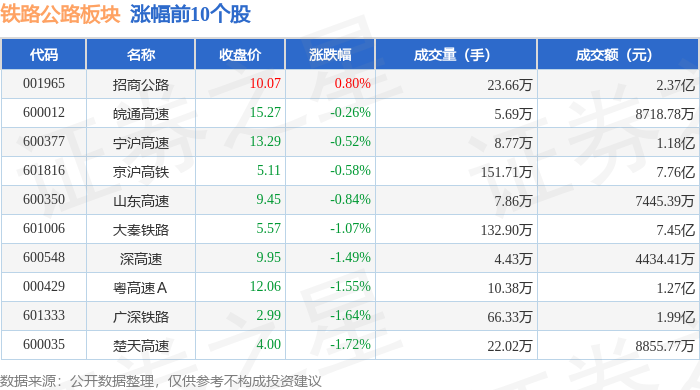
Market Overview - The railway and highway sector experienced a decline of 1.21% on November 21, with Jiangxi Changyun leading the drop [1] - The Shanghai Composite Index closed at 3834.89, down 2.45%, while the Shenzhen Component Index closed at 12538.07, down 3.41% [1] Individual Stock Performance - Jiangxi Changyun saw a significant drop of 7.33%, closing at 6.70, with a trading volume of 89,100 shares and a transaction value of 61.79 million [2] - Other notable declines included Wuzhou Transportation down 7.01% to 3.98, and Fulian Yuanshan down 5.68% to 9.46 [2] - The highest trading volume was recorded for Jinghu High-speed Railway, with 1.5171 million shares traded, closing at 5.11, down 0.58% [1] Capital Flow Analysis - The railway and highway sector saw a net outflow of 404 million from institutional investors, while retail investors contributed a net inflow of 371 million [2][3] - The main stocks with significant capital inflows included Jinghu High-speed Railway with a net inflow of 21.17 million from institutional investors [3] - Conversely, stocks like Ningshu High-speed experienced a net outflow of 834,400 from institutional investors [3]






交通运输ETF(159666)近6个月超越基准年化收益达5.43%
Sou Hu Cai Jing· 2025-11-20 07:26
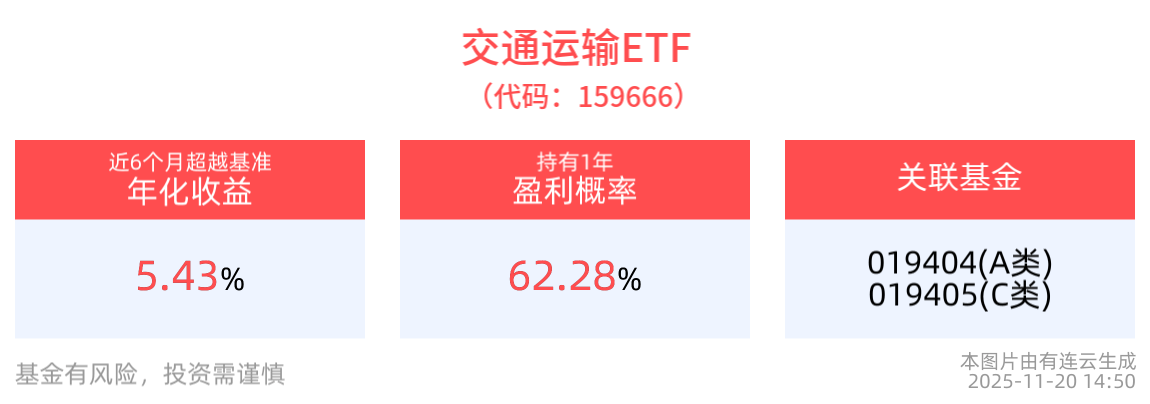
Core Viewpoint - The Transportation ETF (159666) has shown a slight decline of 0.29% as of November 20, 2025, with a recent price of 1.02 yuan, while it has increased by 1.68% over the past month [2]. Performance Summary - The Transportation ETF has achieved a net value increase of 17.73% over the past two years [2]. - The highest single-month return since inception was 15.82%, with the longest consecutive monthly gain being 4 months and a maximum gain of 11.93% [2]. - The average monthly return during rising months is 3.16%, with a total annual profit percentage of 100.00% and a historical one-year profit probability of 62.28% [2]. - Over the last six months, the ETF has outperformed its benchmark with an annualized return of 5.43% [2]. - The Sharpe ratio for the past month is reported at 1.78 [2]. Liquidity and Trading Activity - The ETF had a turnover rate of 7.64% during the trading session, with a total transaction volume of 6.1092 million yuan [2]. - The average daily trading volume over the past month was 9.4084 million yuan [2]. Risk and Drawdown Analysis - The maximum drawdown over the past six months was 4.93%, with a relative benchmark drawdown of 0.04% [2]. - The recovery time after drawdown was 68 days [2]. Fee Structure - The management fee for the Transportation ETF is 0.50%, and the custody fee is 0.10% [3]. Tracking Accuracy - The tracking error for the Transportation ETF over the past two years is 0.051% [3]. Index Composition - The ETF closely tracks the CSI All Share Transportation Index, which categorizes companies into various industry levels, providing a comprehensive performance analysis tool [3]. - As of October 31, 2025, the top ten weighted stocks in the index include China Railway High-speed (601816), SF Express (002352), and COSCO Shipping Holdings (601919), collectively accounting for 48.47% of the index [3]. Top Holdings - The top ten stocks and their respective weightings are as follows: - China Railway High-speed (601816): 8.89% - SF Express (002352): 8.46% - COSCO Shipping Holdings (601919): 7.87% - Daqin Railway (601006): 6.20% - Shanghai Airport (600009): 3.46% - China Eastern Airlines (600115): 3.09% - Southern Airlines (600029): 2.84% - YTO Express (600233): 2.75% - Air China (601111): 2.58% - China Merchants Energy Shipping (601872): 2.50% [5].
中国银行股价创新高!红利低波ETF(512890)近60个交易日资金狂揽47亿元,机构持续看好红利资产配置价值
Xin Lang Ji Jin· 2025-11-20 03:13
Core Viewpoint - The article highlights the performance and investment appeal of the Dividend Low Volatility ETF (512890), which has shown significant capital inflows and strong market recognition. Group 1: ETF Performance - The Dividend Low Volatility ETF (512890) rose by 1.15% to 1.233 CNY, with a trading volume of 4.18 billion CNY, leading its category in terms of transaction scale [1][3] - Over the past five trading days, the ETF has seen a net inflow of 180 million CNY, and over the last 20 trading days, the net inflow reached 1.15 billion CNY, indicating strong investor interest [2][3] - As of November 19, 2025, the ETF's total circulation scale was 21.431 billion CNY, ranking first among similar products, reflecting market confidence in the dividend low volatility strategy [2][3] Group 2: Investment Strategy and Holdings - The ETF's top holdings include major banks and transportation sectors, such as China Grain Reserves Corporation, Nanjing Bank, and Agricultural Bank of China, showcasing a focus on stable dividend-paying stocks [2][6] - The ETF has achieved a cumulative return of 143.68% since its inception in December 2018, outperforming its benchmark, making it a viable option for investors seeking stable returns amid market volatility [6] Group 3: Market Outlook - Analysts from Zheshang Securities express optimism about the value of dividend assets, predicting a balanced market style in 2026, with cyclical and technology growth sectors performing well [5] - The banking sector is highlighted as having significant investment potential due to its low historical valuations and strong dividend policies, making it an attractive choice for long-term investors [5]





对话交运:26年煤炭运输量价展望
2025-11-20 02:16
Summary of Conference Call on Coal Transportation Outlook Industry Overview - The conference call focuses on the coal transportation industry, specifically the dynamics of coal transportation from Xinjiang, China, and the associated pricing mechanisms [1][2]. Key Points and Arguments - **Coal Price and Transportation Costs**: Initial declines in coal prices led railway companies to reduce transportation fees, redistributing profits with coal mining enterprises. This flexibility in railway freight rates serves as a profit adjustment tool [1]. - **Market Response**: As coal prices rebounded in July and August, railway freight rates were adjusted upwards, with some regions returning to normal levels, confirming the model where transportation costs fluctuate with market prices. It is anticipated that in 2026, freight rates will continue to adjust in line with market fluctuations [2]. - **Current Transportation Costs**: The current cost of transporting coal from Xinjiang is approximately 500 RMB per ton, with a low of 400 RMB per ton. The pithead cost in Xinjiang is around 100-200 RMB per ton, indicating a maintained profit margin for coal transportation [2]. - **Capacity Expansion Plans**: The potential for expanding the Lanzhou-Xinjiang Railway is limited. Future focus will be on upgrading the North Wing Linhe Line, which is expected to increase capacity to between 100 million and 200 million tons. The completion of the Naoliu Highway expansion will enhance capacity by 1.5 times, adding 20 million tons of transportation capability [1][4]. - **Economic Viability of Coal Transportation**: Despite the cancellation of some transportation subsidies, the economic viability of transporting Xinjiang coal to ports remains strong. The strategy of reducing railway freight rates during off-peak seasons is expected to continue, although the lowest rates may be higher than this year [1][5]. - **Impact of Maintenance on Transportation**: Regular maintenance of railways, such as the Daqin Railway's seasonal repairs, significantly reduces daily transportation volumes, impacting downstream port operations. During maintenance, daily transport can drop from approximately 1.3 million tons to around 1 million tons [7]. - **Future Economic Outlook**: The economic outlook for Xinjiang coal exports remains positive, with expected increases in transportation capacity and maintained economic efficiency. The target cost for Xinjiang coal to remain competitive is between 300-350 RMB per ton [5][8]. Additional Important Insights - **Seasonal Adjustments**: The railway freight rates have historically been adjusted during off-peak seasons, and similar adjustments are anticipated for the upcoming year if coal prices remain stable [6]. - **Infrastructure Development**: The ongoing upgrades to key transportation routes are crucial for enhancing the overall capacity and efficiency of coal transportation from Xinjiang, which is vital for meeting regional demand [4][5]. This summary encapsulates the critical insights from the conference call regarding the coal transportation industry, focusing on pricing dynamics, capacity expansion, and economic viability.
华创证券:2026年交运行业弹性可期 红利续航与周期修复双重机遇
智通财经网· 2025-11-20 02:16
Core Viewpoint - The report from Huachuang Securities indicates that the highway sector is expected to maintain resilience in 2026, with high dividend configurations being a preferred investment direction. The port industry is anticipated to shift from a single container-driven growth model to a dual-wheel structure of stable container growth (5%-8%) and a recovery in bulk cargo (2%-5%) by 2026, with stable pricing expected. There are strategic layout opportunities for leading companies in the bulk supply chain that focus on dividends and returning to growth expectations in the coming year [1]. Highway Sector - The highway sector is viewed as a preferred option for stable asset allocation due to low valuations and high dividends, with expected dividend yields around 5% for leading highway companies in 2026. Notable companies include Sichuan Chengyu (5.6%), Shandong Highway (5.0%), and Anhui Wantong Highway (5.0%), with higher yields for H-shares [2]. - The outlook for 2026 suggests strong performance driven by stable volume and pricing, alongside significant cost reduction opportunities. Key factors include potential optimization of toll policies and a favorable interest rate environment that could alleviate operational pressures for highway companies [2]. - High dividend characteristics are expected to remain stable in 2026, with clear three-year return plans from leading companies like Sichuan Chengyu and Wantong Highway [2]. Port Sector - The port sector is entering a strategic value era, transitioning from a perception of cyclical capacity assets to being recognized as global supply chain security hubs. This shift is driven by geopolitical factors and the need for strategic asset control [3]. - The industry is expected to see stable throughput and pricing in 2026, with a dual growth model of container stability and bulk cargo recovery. The average dividend payout ratio is projected to be 37.46%, indicating significant potential for increases [3]. Railway Sector - Passenger transport is expected to see steady growth, with flexible pricing mechanisms in place. Freight transport is also showing signs of improvement, particularly in coal and other cargo types [4][5]. Bulk Supply Chain - The bulk supply chain is poised for a new growth phase in 2026, with companies like Xiamen Xiangyu leading the way in transformation logic focused on profit margin enhancement and investor returns. The operational environment is recovering, with strong performance trends evident since 2025 [6][7]. - Strategic layout opportunities exist for leading companies in the bulk supply chain that emphasize dividends and growth expectations [7]. Investment Recommendations - The company continues to favor A/H share transportation assets, highlighting the importance of industry logic and valuation elasticity. Key recommendations include Sichuan Chengyu and Wantong Highway for their stable growth and high dividends, as well as other notable companies in the highway and port sectors [8].


国家电投获国际金奖!
Zhong Guo Dian Li Bao· 2025-11-19 10:49
Industry News - The National Development and Reform Commission has approved five flexible power interconnection projects, which will enhance inter-provincial power support and accident response capabilities, providing reliable power for economic and social development [3] - The Ministry of Industry and Information Technology has announced the establishment of a Green Low-Carbon Standardization Technical Committee, aiming to gather opinions from various sectors [3] - The Ministry of Industry and Information Technology has published a list of typical cases for power demand-side management in the industrial sector for 2025, including 34 enterprises and 30 products [3] - The Daqin Railway has maintained high coal transportation levels, with daily shipments exceeding 1.2 million tons, and a total coal transport volume of 21.166 million tons in November [3] Company News - China Petroleum Group Electric Power Co., Ltd. was officially established, focusing on integrating power generation and consumption resources to build a comprehensive energy supply system [5] - Two achievements from State Power Investment Corporation were awarded gold medals at the 50th International Quality Control Circle Conference, highlighting the company's commitment to quality management [5] - The first "Hualong One" nuclear power unit with a cooling tower has begun construction, marking a significant step in the project [5] - Inner Mongolia Power Group signed a cooperation agreement with China Southern Power Grid to deepen strategic collaboration on flexible DC technology [5] Local News - The Gansu Electric Power Zhangye Power Plant's expansion project has successfully put its third unit into operation, significantly enhancing the power supply capacity in the Hexi Corridor [6][7] - A 900,000-kilowatt renewable energy project in Xinjiang is nearing completion, combining solar thermal and photovoltaic technologies to optimize energy structure and improve system stability [9] International News - Two nuclear power plants in Ukraine are operating at reduced capacity due to military attacks on substations, which are critical for maintaining external power and safety systems [11]
13分钟发一列保供电煤列车 “中国能源通道”大秦铁路持续高位运行
Zhong Guo Xin Wen Wang· 2025-11-19 06:24
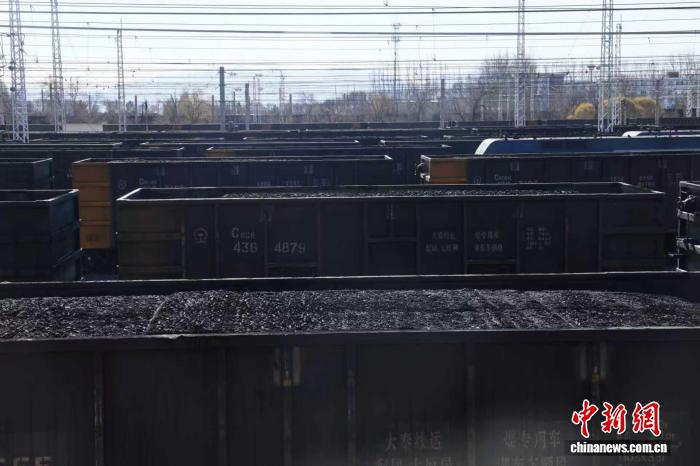
Core Viewpoint - The Daqin Railway is operating at a high capacity to ensure coal supply for winter heating and production needs in China, with daily coal transport exceeding 1.2 million tons [1][3]. Group 1: Operational Efficiency - The Daqin Railway, a key channel for coal transportation from the west to the east of China, is responsible for transporting coal for over 300 major power plants and 6,000 industrial enterprises, accounting for 20% of the national railway coal transport volume [3]. - The railway has optimized its operations by implementing targeted supply guarantee plans based on real-time communication with coal producers and power plants, ensuring a coal train departs every 13 minutes [3][5]. - The average turnaround time for coal transport has been reduced to 2.51 days, a decrease of 0.18 days year-on-year, enhancing the efficiency of train operations [3][5]. Group 2: Coal Transport Volume - As of November, the Daqin Railway has transported a total of 21.166 million tons of coal, with an average daily dispatch of 1.245 million tons, reflecting an increase of 239,000 tons compared to the previous period [5].