
Spotify Technology S.A.

Search documents
“AI垃圾”泛滥,最后的防线在人类自身
Ke Ji Ri Bao· 2025-12-16 02:20
Core Viewpoint - The rise of "AI Slop" content, characterized by low-quality, repetitive, and meaningless information generated by AI tools, is increasingly prevalent on the internet, particularly on social media platforms [1][2][4]. Group 1: Definition and Characteristics of AI Slop - "AI Slop" refers to low-quality content produced by AI tools, including text, images, and videos, often found on social media and automated content farms [2][3]. - The term "Slop" originally described cheap and low-nutrition items, and its modern usage highlights the poor quality of AI-generated content that clutters online spaces [2][3]. - AI Slop differs from "deepfakes" and "AI hallucinations" in that it is not necessarily intended to deceive but results from careless content production without verification [3]. Group 2: Causes of AI Slop Proliferation - The proliferation of AI Slop is driven by the increasing power and low cost of AI technology, enabling rapid content generation that prioritizes clicks and ad revenue over quality [4][5]. - Tools like ChatGPT, Gemini, and Sora allow for quick production of readable content, leading to the rise of content farms that prioritize quantity over quality [4]. - Algorithms on social media platforms often favor engagement metrics over content quality, further exacerbating the issue of AI Slop [4][5]. Group 3: Consequences of AI Slop - The overwhelming presence of AI Slop can lead to a decline in the visibility of credible sources, blurring the lines between truth and fiction [5][6]. - This trust crisis can have tangible effects, as misinformation spreads more rapidly when users cannot discern credible information from AI-generated content [5][6]. Group 4: Potential Solutions and Industry Responses - Some companies, like Spotify, are beginning to label AI-generated content and adjust algorithms to reduce the recommendation of low-quality material [6]. - The C2PA (Coalition for Content Provenance and Authenticity) standard aims to embed metadata in digital files to trace their origins, helping to distinguish between human-created and AI-generated content [6]. - The most effective defense against AI Slop lies in individual user behavior, encouraging users to verify sources and support genuine creators [6][7].
“AI垃圾”泛滥 最后的防线在人类自身
Ke Ji Ri Bao· 2025-12-16 00:23
Core Viewpoint - The rise of "AI Slop" content, characterized by low-quality, repetitive, and meaningless information generated by AI tools, is increasingly prevalent on the internet, particularly on social media platforms [1][2][4]. Group 1: Definition and Characteristics of "AI Slop" - "AI Slop" refers to low-quality content produced by AI tools, including text, images, and videos, often found on social media and automated content farms [2][3]. - The term "Slop" originally described cheap and low-nutrition items, and its modern usage highlights the poor quality of AI-generated content that clutters information channels [2][3]. - Unlike "deepfakes" or "AI hallucinations," which have specific deceptive intents or technical errors, "AI Slop" is produced without regard for accuracy or logic, leading to a proliferation of meaningless content [3]. Group 2: Causes of Proliferation - The widespread creation of "AI Slop" is driven by the increasing power and low cost of AI technology, allowing users to generate content quickly for clicks and ad revenue [4]. - Tools like ChatGPT, Gemini, and Sora enable rapid content generation, leading to the emergence of content farms that prioritize quantity over quality [4]. - Algorithms on social media platforms often favor engagement metrics over content quality, further incentivizing the production of "AI Slop" [4]. Group 3: Consequences of "AI Slop" - The overwhelming presence of "AI Slop" can obscure the line between credible and false information, leading to a trust crisis where misinformation spreads rapidly [5][6]. - As "AI Slop" proliferates, it diminishes the visibility of trustworthy sources in search results, complicating users' ability to discern fact from fiction [5][6]. Group 4: Potential Solutions - Some companies, like Spotify, are beginning to label AI-generated content and adjust algorithms to reduce the recommendation of low-quality material [8]. - The C2PA (Content Authenticity Initiative) aims to embed metadata in digital files to trace their origins, helping users identify whether content is human-created or AI-generated [8]. - The most effective defense against "AI Slop" lies in individual user behavior, encouraging people to verify sources and support genuine creators [8].
These Experts Have 6 Top Internet Stock Picks Lined Up for Next Year
Investopedia· 2025-12-15 20:30
Core Insights - Jefferies identifies potential investment opportunities in the tech sector despite recent challenges, particularly focusing on companies with strong fundamentals and peer-leading growth [2][10] Company Highlights - AppLovin (APP) is a top pick for Jefferies, having more than doubled in value in 2025, reaching a high near $725, with expectations for further growth due to a planned expansion of its advertising platform in 2026 [5][6] - Reddit (RDDT), Spotify (SPOT), and Roku (ROKU) have all increased over a third in value in 2025, with Jefferies projecting significant upside potential: $325 target for Reddit (45% gain), $135 for Roku (33% gain), and $800 for Spotify (26% gain) [7] - Uber (UBER) has risen approximately 40% year-to-date, with Jefferies forecasting a further 40% increase to $120, driven by partnerships and new customer acquisitions [8] - Zillow (Z) has faced a 17% decline from September highs but is expected to recover, with a target of $100 as it introduces new tools for agents [9]


Paramount highly motivated to get WBD deal done to address scale deficit, says Wolfe's Peter Supino
Youtube· 2025-12-15 19:06
Core Viewpoint - Paramount is facing significant challenges in the competitive media landscape, particularly in streaming, where it has fewer subscribers and lower revenue per subscriber compared to competitors [1][2] Group 1: Paramount's Position and Challenges - Paramount has a rich historical library but is competing from a subscale position, which affects its market competitiveness [1] - The productivity of Paramount's film and TV studio has been lower than that of other Hollywood studios over the past 10 to 20 years, impacting its recent performance [2] - There is a strong motivation for Paramount to complete a merger with Warner to address its scale deficits and improve its market position [2][3] Group 2: Merger Implications - Winning the merger would provide Paramount with more optionality and upside potential, but it also introduces significant risks, including increased debt and execution challenges [4] - The merger scenario presents a greater degree of risk and opportunity, as it would require management to navigate uncharted territory [4] Group 3: Streaming Market Outlook - The streaming business is expected to remain fragmented, contrary to the belief that it will become a winner-takes-all market dominated by Netflix [6] - The renegotiation of NFL broadcasting rights in 2026 is anticipated to be a significant event that could impact the distribution landscape [6] Group 4: Investment Opportunities in Live Entertainment and Music - Live entertainment and music are viewed as promising sectors, with companies like Live Nation identified as top investment ideas due to their ability to capitalize on the increasing value of live events [7][10] - The value of music and concert tickets is expected to rise, driven by the enhanced reach and engagement provided by streaming and social media [9][10] - Spotify is also highlighted as a favorable investment, benefiting from the improved experience and shareability of music in the current market [10][11]

暴涨3倍,18-34岁占比反降15%:这届中年人开始占领AI
3 6 Ke· 2025-12-15 02:09
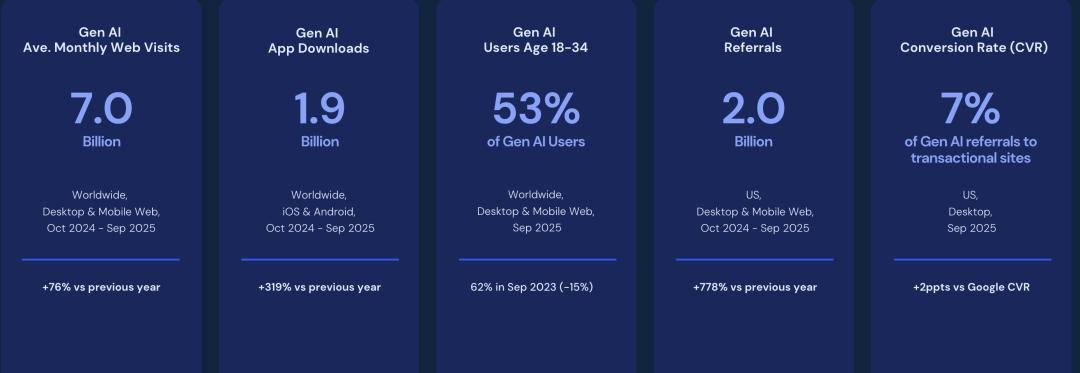
Core Insights - The report highlights the transformation of Generative AI (GenAI) from a niche technology to a new digital infrastructure, indicating its widespread adoption across various demographics and use cases [2][5][22]. Group 1: User Engagement and Demographics - Global monthly visits to GenAI platforms have surpassed 7 billion, marking a 76% year-over-year increase [5]. - Mobile app downloads have reached 1.9 billion, more than tripling in one year [5]. - The demographic of GenAI users is expanding, with a notable 15% decrease in the proportion of users aged 18-34, indicating an influx of older users [5][22]. Group 2: Changing Internet Dynamics - ChatGPT has entered the top five global websites, complementing traditional search engines like Google, with 95% of users utilizing both platforms [6][31]. - The nature of online behavior is shifting from passive information consumption to active engagement with AI for problem-solving and content creation [10][36]. - The average prompt length for ChatGPT is around 60 words, compared to Google's average query length of 3-4 words, reflecting deeper user interactions [44]. Group 3: Market Competition and Landscape - ChatGPT dominates the GenAI market with nearly 80% of global traffic, while competitors like Gemini and Claude are carving out niche segments [14][18]. - The GenAI ecosystem is evolving towards a dual-track differentiation, with mainstream tools like ChatGPT and specialized products targeting specific user needs [18][21]. Group 4: AI Integration and Future Trends - AI is becoming an embedded layer in digital experiences, with applications like ChatGPT integrating functionalities such as online payments and music playlist generation [30][26]. - The introduction of Google's AI Mode is blurring the lines between traditional search and conversational AI, potentially reshaping user interaction with information retrieval [43][61]. - The future of internet access may see users bypassing traditional search methods in favor of AI-driven interactions, indicating a significant shift in how digital content is consumed [62].

X @Avi Chawla
Avi Chawla· 2025-12-12 19:26
RT Avi Chawla (@_avichawla)- Google Maps uses graph ML to predict ETA- Netflix uses graph ML in recommendation- Spotify uses graph ML in recommendation- Pinterest uses graph ML in recommendationHere are 6 must-know ways for graph feature engineering (with code): ...


X @Avi Chawla
Avi Chawla· 2025-12-12 06:46
- Google Maps uses graph ML to predict ETA- Netflix uses graph ML in recommendation- Spotify uses graph ML in recommendation- Pinterest uses graph ML in recommendationHere are 6 must-know ways for graph feature engineering (with code): ...

iPad12或搭载iPhone17同款芯片/GPT-5.2屠榜,迪士尼10亿美元投资OpenAI/马斯克点赞腾讯游戏:品味非常好
Sou Hu Cai Jing· 2025-12-12 01:16
Group 1: OpenAI and GPT-5.2 Release - OpenAI officially released the GPT-5.2 series model, targeting paid ChatGPT users and API developers, with three versions: Instant, Thinking, and Pro [3][4][5] - The Instant version focuses on low latency and high responsiveness for tasks like information retrieval and document translation, while the Thinking version is designed for programming and complex project planning [3] - The Pro version emphasizes extreme accuracy and reliability for high-difficulty tasks in fields like research and finance, marking a significant enhancement in programming capabilities and factual accuracy [3][4] Group 2: Competition with Google - OpenAI CEO Sam Altman acknowledged the competitive pressure from Google’s Gemini 3, which has narrowed the performance gap between the two companies [4] - OpenAI is temporarily slowing down its AGI goals to focus on improving the quality of ChatGPT in response to this competition [4] - Altman expects OpenAI to exit its "red alert" status by January, indicating a stabilization in its competitive position [4] Group 3: Xiaomi's Smart Home Factory - Xiaomi announced the completion and production launch of its first major home appliance factory in Wuhan, capable of producing an air conditioner every 6.5 seconds [8][9] - The factory utilizes AI visual inspection for quality control, achieving 100% detection of key components and maintaining manufacturing tolerances of ±0.05 mm [9] - This facility represents a significant step in Xiaomi's strategy to create a closed-loop capability in the home appliance sector, integrating design, research, production, sales, and service [9] Group 4: Market Trends and AI Integration - ChatGPT topped the 2025 U.S. iPhone free app downloads, indicating a significant increase in the penetration of generative AI in daily life [16][18] - OPPO established a new smart product R&D department to unify its AI assistant services under the "Super Xiaobu" brand, reflecting a trend of deeper integration of AI across product lines [20][21] - Adobe integrated its applications into ChatGPT, allowing users to perform tasks like image editing and PDF processing through natural language commands, enhancing cross-platform creative productivity [57][59] Group 5: Industry Insights and Future Developments - Bill Gates commented on the AI industry, suggesting that not all high-valuation companies will succeed, and some investments may lead to "dead ends" [44][46] - MIT introduced a new chip manufacturing method that significantly improves energy efficiency, addressing the growing power consumption issues associated with AI and deep learning applications [41][42] - Spotify is testing a new feature that allows users to generate personalized playlists through natural language prompts, showcasing the increasing integration of AI in consumer applications [24]




Sabra Health Care, Apollo, Spotify And More On CNBC’s ‘Final Trades’ - Apollo Asset Management (NYSE:APO), iShares Russell 1000 Value ETF (ARCA:IWD)
Benzinga· 2025-12-11 12:58
分组1 - Sabra Health Care REIT, Inc. has a dividend yield of 6.3% and is supported by favorable demographics, with no threat from AI [1] - Wells Fargo analyst John Kilichowski maintained an Overweight rating on Sabra Health Care and raised the price target from $20 to $21 [1] - Apollo Global Management, Inc. was upgraded from Equal-Weight to Overweight by Morgan Stanley analyst Michael Cyprys, with a price target increase from $151 to $180 [2] 分组2 - Spotify Technology S.A. reported third-quarter 2025 earnings of $3.83 per share, exceeding the analyst consensus estimate of $1.87 [3] - Spotify's revenue reached $4.99 billion, a 7% year-over-year increase, surpassing projections of $4.92 billion [3] 分组3 - Sabra Health Care shares fell 1.6% to close at $19.00 [5] - Apollo Global Management gained 3.6% to settle at $149.08 [5] - iShares Russell 1000 Value ETF gained 1.4% [5] - Spotify jumped 3.4% to settle at $609.41 [5]


X @TechCrunch
TechCrunch· 2025-12-11 11:04
Port raises $100M at $800M valuation to take on Spotify’s Backstage https://t.co/Z8XYQ1kUqD ...