龙大美食

Search documents
龙大美食回应上半年业绩下滑,围绕市场需求,持续加大研发和创新
Xi Niu Cai Jing· 2025-09-19 11:18
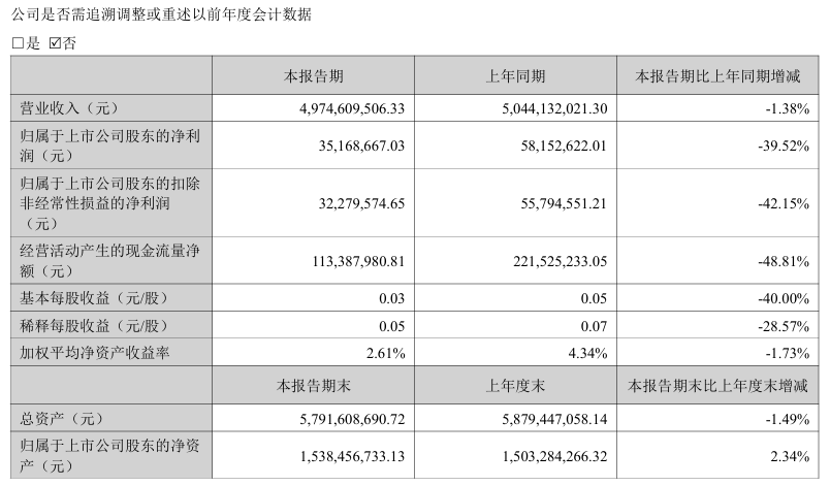
Core Viewpoint - Longda Food (002726.SZ) reported a decline in revenue and net profit for the first half of 2025, indicating challenges in the pre-prepared food segment and overall market conditions [1][2]. Financial Performance - The company achieved a revenue of 4.975 billion yuan, a decrease of 1.38% year-on-year [2]. - Net profit attributable to shareholders was 35.169 million yuan, down 39.52% compared to the previous year [2]. - The net profit after deducting non-recurring gains and losses was 32.280 million yuan, reflecting a 42.15% decline [2]. - The net cash flow from operating activities was 113.388 million yuan, a significant drop of 48.81% [2]. - Basic earnings per share were 0.03 yuan, down 40% year-on-year, while diluted earnings per share were 0.05 yuan, a decrease of 28.57% [2]. - The weighted average return on equity was 2.61%, down from 4.34% in the previous year [2]. - Total assets at the end of the reporting period were 5.792 billion yuan, a decrease of 1.49% from the previous year [2]. - Net assets attributable to shareholders increased by 2.34% to 1.538 billion yuan [2]. Business Segment Analysis - Revenue from pre-prepared foods was 783 million yuan, a decline of 19.5% year-on-year [3]. - The overall food industry revenue was 866 million yuan, down 19.91% [3]. - The company stated that the decline in revenue was due to a strategic focus on optimizing product structure and reducing low-margin businesses [3][4]. - The overall gross margin for the pre-prepared food segment improved by 1.24% compared to the previous year [4]. - The company is focusing on high-margin products and has developed new products for both B-end and C-end customers, including customized offerings and seasonal products [4].


龙大美食遭遇增长困境2025年上半年业绩双降 预制菜战略承压
Xin Lang Zheng Quan· 2025-09-18 10:07
Core Insights - Longda Food, once favored by the capital market as a "pre-made food concept stock," is currently facing dual challenges of sluggish main business growth and obstacles in strategic transformation [1] - The company's H1 2025 report reveals a decline in both revenue and net profit, with total revenue at 4.975 billion yuan, down 1.38% year-on-year, and net profit attributable to shareholders at 35.1687 million yuan, down 39.52% year-on-year [1] Business Structure Challenges - Longda Food's core challenge lies in its imbalanced business structure, heavily reliant on the low-margin slaughtering business, which, despite its large revenue scale, contributes minimally to profits [2] - The pre-made food segment, positioned as a future growth engine, has faced significant revenue declines during the reporting period, indicating that the strategic transformation is more difficult than anticipated [2] - The pre-made food industry is characterized by intense competition, with a market landscape that shows insufficient consumer recognition despite policy support and capital empowerment [2] Financial Pressure and Debt Risks - The significant increase in financial expenses has further compressed the already limited profit margins, with interest burdens becoming a key factor dragging down overall performance [3] - The company faces notable short-term debt pressure, with a declining current ratio indicating weakened short-term solvency, thus increasing financial risk [3] - Longda Food exhibits a "high debt and high cash" phenomenon, raising questions about its financial management efficiency due to substantial short-term borrowings alongside considerable cash reserves [3] - The growing ratio of accounts receivable to revenue suggests a weakening ability to collect payments, increasing cash flow pressure [3] Strategic Responses - In response to current challenges, Longda Food is attempting various strategies, including controlling breeding scale, adjusting product structure, deepening processing business, and expanding new retail channels [3] - However, these measures have yet to reverse the declining performance, and the company must find more effective ways to enhance product competitiveness and market recognition in an increasingly competitive pre-made food industry [3]
日本为何爱吃预制菜?
3 6 Ke· 2025-09-18 09:29
Core Viewpoint - The dispute between Luo Yonghao and Jia Guolong regarding pre-prepared dishes has concluded, with West Be acknowledging the need for transparency in the use of pre-prepared ingredients in restaurants [1][2] Industry Overview - The pre-prepared dish sector has seen a rise in stock prices despite consumer backlash, with companies like Delisi and established brands such as Weizhi Xiang and Sanquan Foods experiencing significant gains [1][2] - The National Health Commission's draft for national food safety standards for pre-prepared dishes is expected to provide clarity on the definition and usage of these products in the restaurant industry [1][2] Definitions and Concepts - The distinction between central kitchens and pre-prepared dishes is crucial, with pre-prepared dishes being fully cooked and frozen for direct consumption, while central kitchens provide semi-finished products that require further cooking [3][4] - The official definition of pre-prepared dishes by the State Administration for Market Regulation excludes dishes made in central kitchens, highlighting the need for clarity in industry standards [2][3] Market Dynamics - The development of central kitchens is seen as a trend in the restaurant industry, driven by the need for efficiency and quality control in food preparation [4][6] - The pre-prepared dish market in China is still in its early stages, with significant differences compared to Japan, where a well-established market exists with strict food production standards [7][9][10] Future Outlook - The pre-prepared dish industry in China is projected to grow rapidly, with estimates suggesting a market size of 674.9 billion yuan by 2030 and a compound annual growth rate (CAGR) exceeding 10% [12] - Companies are recognizing the challenges in gaining consumer trust and are implementing quality management measures to address food safety and regulatory issues [11][12]
猪肉股午后持续调整,邦基科技跌超8%
Jing Ji Guan Cha Wang· 2025-09-17 13:38
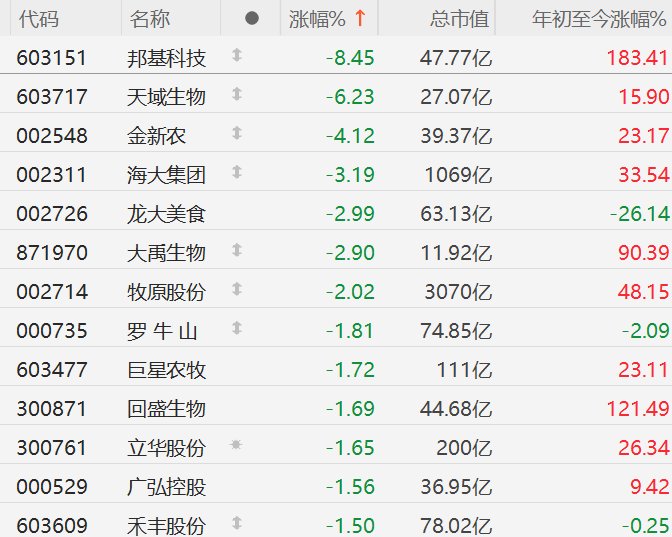
经济观察网 猪肉股午后持续调整,邦基科技一度跌近9%,天域生物、牧原股份、龙大美食等跟跌。 ...


A股猪肉股走弱,邦基科技跌超8%
Ge Long Hui A P P· 2025-09-17 06:40
Group 1 - The A-share market for pork stocks has weakened, with several companies experiencing significant declines in their stock prices [1] - Bangji Technology saw a drop of over 8%, while Tianyu Biological fell over 6%, and Jinxinnong decreased by over 4% [1] - Other notable declines include Haida Group down over 3%, Longda Meishi and Dayu Biological both down over 2%, and Muyuan Foods down over 2% as well [1] Group 2 - Bangji Technology's market capitalization is 4.777 billion, with a year-to-date increase of 183.41% despite the recent decline of 8.45% [2] - Tianyu Biological has a market cap of 2.707 billion, with a year-to-date increase of 15.90%, experiencing a decline of 6.23% [2] - Jinxinnong's market capitalization stands at 3.937 billion, with a year-to-date increase of 23.17%, and a recent drop of 4.12% [2] - Haida Group has a market cap of 106.9 billion, with a year-to-date increase of 33.54%, and a decline of 3.19% [2] - Longda Meishi's market cap is 6.313 billion, with a year-to-date decrease of 26.14%, and a recent decline of 2.99% [2] - Dayu Biological has a market cap of 1.192 billion, with a year-to-date increase of 90.39%, and a decline of 2.90% [2] - Muyuan Foods has a market cap of 307 billion, with a year-to-date increase of 48.15%, and a decline of 2.02% [2]


猪肉股午后持续调整,邦基科技一度跌9%
Xin Lang Cai Jing· 2025-09-17 06:36
猪肉股午后持续调整,邦基科技一度跌9%,天域生物跌超6%,牧原股份、龙大美食等股跌超2%。 ...
预制菜应该感谢罗永浩
3 6 Ke· 2025-09-16 03:35
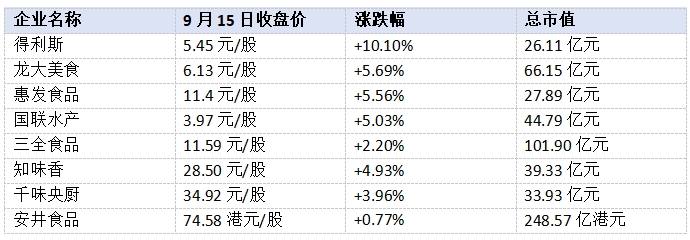
Core Viewpoint - The dispute between Luo Yonghao and Jia Guolong regarding pre-prepared dishes has concluded, with West Be acknowledging the need for transparency in their use of pre-prepared ingredients, while the market for pre-prepared dishes remains resilient despite consumer concerns [1][8]. Industry Summary - The pre-prepared dish sector has seen a rise in stock prices since September 15, with companies like Delisi reaching a limit up, indicating strong market interest [2][3]. - The National Health Commission's draft for national food safety standards for pre-prepared dishes is expected to clarify the definition and usage of these products in the restaurant industry, which may enhance consumer confidence [3][12]. - The controversy highlights a disconnect between industry definitions of pre-prepared dishes and consumer perceptions, with concerns over food safety and ingredient quality being prominent [4][12]. Company Summary - Companies such as Delisi, Longda Meishi, and others have experienced significant stock price increases, reflecting positive market sentiment towards the pre-prepared food sector [2]. - Qianwei Central Kitchen has acknowledged the trust challenges in the pre-prepared dish market and is implementing quality management measures to address these issues [13]. - The market for pre-prepared dishes in China is projected to grow rapidly, with estimates suggesting a market size of 674.9 billion yuan by 2030, driven by various factors including evolving consumer preferences and regulatory developments [13].
预制菜亟需统一标准
Zheng Quan Shi Bao Wang· 2025-09-16 02:57
Group 1 - The core debate between Luo Yonghao and Xibei highlights the lack of standardized definitions and regulations in the prepared food industry, which is crucial for its healthy development [1][3] - The prepared food industry in China is projected to reach a market size of 485 billion yuan in 2024, with a year-on-year growth of 33.8%, and is expected to exceed 749 billion yuan by 2026 [1][2] - The industry serves as an important vehicle for the integration of agriculture and the catering sector, promoting agricultural efficiency and farmers' income [1] Group 2 - The prepared food industry faces challenges such as inconsistent standards, food safety concerns, and an incomplete regulatory framework, which demand higher quality and innovation from companies [2][3] - A draft national standard for food safety in prepared foods, led by the National Health Commission, is set to be publicly reviewed, which will clarify the identity of prepared foods and enforce mandatory disclosure for their use in restaurants [2] - The recent market response to the news of the upcoming standards has been positive, with significant stock price increases for related companies [2]
预制菜国标或将出台,多只概念股走强!一股票涨停
Nan Fang Du Shi Bao· 2025-09-16 00:48
Group 1 - The recent controversy surrounding the use of pre-prepared dishes in restaurants, particularly highlighted by Luo Yonghao's comments about Xibei, has led to increased public attention on the pre-prepared food sector [1][2] - The National Health Commission has successfully passed the draft of the "National Standards for Food Safety of Pre-prepared Dishes," which will soon be open for public consultation, establishing a unified definition and mandatory disclosure for the use of pre-prepared dishes in restaurants [2][3] - Following the announcement, several A-share pre-prepared dish concept stocks experienced significant gains, with Delisi (002330) hitting the daily limit and closing at 5.45 yuan, up 10.10%, and its pre-prepared dish revenue projected to account for 21.67% of total revenue in 2024 [2][3] Group 2 - The stock of Longda Meishi (002726), a supplier to Xibei, also rose by 5.69% to 6.13 yuan, following a strategic cooperation agreement with Xibei to enhance product supply and brand influence [3] - Industry experts are optimistic about the positive impact of regulatory standards on the pre-prepared dish sector, with expectations that the introduction of these standards will promote industry self-discipline and benefit leading brands [3] - The recent discussions around pre-prepared dishes have emphasized the need for restaurants to disclose their use of such products, which is expected to strengthen industry self-regulation and enhance consumer trust in quality brands [3]



西贝致歉:尽可能在门店现做
Nan Fang Du Shi Bao· 2025-09-15 23:10
Core Viewpoint - The ongoing dispute between Luo Yonghao and Xibei Youmian Village regarding the "pre-made dishes" issue has drawn significant public attention, leading to Xibei's commitment to rectify its production processes and Luo's decision to monitor the situation without pursuing further legal action [3][4]. Company Response - Xibei issued an apology acknowledging the gap between its production processes and customer expectations, promising to adjust its central kitchen processing to on-site preparation by October 1 [3][4]. - Xibei is also in discussions with suppliers to shorten the shelf life of its products while ensuring food safety [3]. Market Reaction - Following the developments, several pre-made dish-related stocks surged, with companies like Delisi and Huifa Foods hitting their daily price limits, and Guolian Aquatic experiencing a 12.43% intraday increase before closing up 5.03% [4]. - The incident has reignited consumer interest in the pre-made dish industry, highlighting the potential for growth despite existing challenges [4]. Industry Standards - Recent regulatory efforts have aimed to standardize the pre-made dish industry, with various local standards being introduced to enhance food safety and quality [6]. - The market is expected to benefit from clearer regulations, which may strengthen industry self-discipline and favor leading brands [5]. Market Size and Growth - The pre-made dish market in China is projected to reach 485 billion yuan in 2024, with a year-on-year growth of 33.8%, and is expected to grow to 749 billion yuan by 2026 [7]. Competitive Landscape - Despite the market's rapid growth, many listed companies in the pre-made dish sector reported declining profits in the first half of 2025, with some facing significant losses [8][9]. - Companies like Guolian Aquatic reported a loss of 550 million yuan, attributed to decreased revenue and increased asset impairment losses [9]. Consumer Sentiment - Consumers express a desire for transparency and choice regarding pre-made dishes, indicating a need for better communication from companies about their products [10].